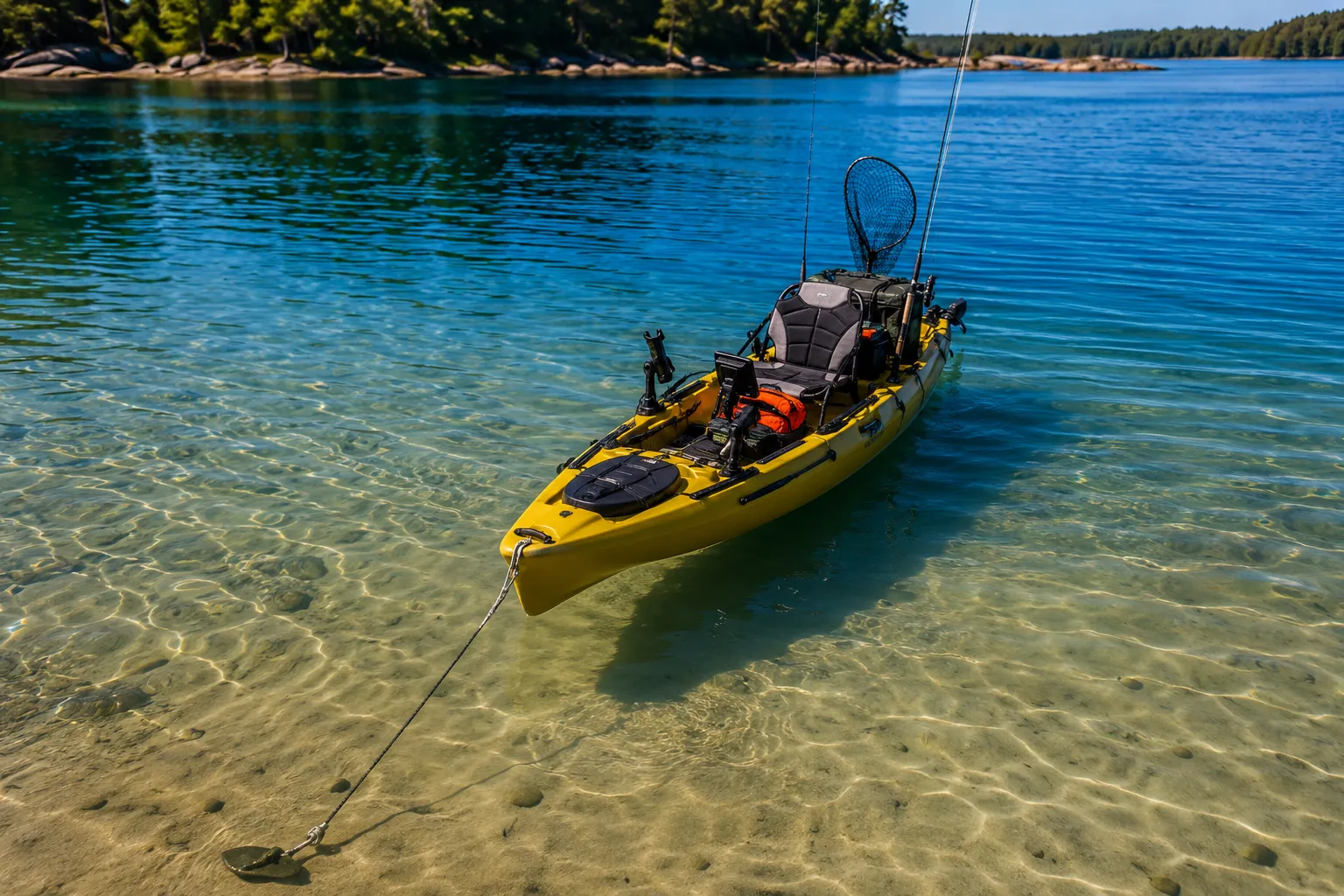
Quick Answer: Anchoring a kayak or small boat from the side (beam) creates dangerous instability because waves, current, and wind push broadside against the hull, causing severe rolling, potential capsize, and water intrusion over the gunwale. Always anchor from the bow, which allows the vessel to naturally weathervane into conditions and remain stable.
Key Takeaways
- Side anchoring forces your kayak perpendicular to waves and current, creating maximum rolling motion and capsize risk
- Bow anchoring lets your boat point into conditions naturally, minimizing exposure and keeping you stable
- Even calm water can turn dangerous quickly when wind picks up and your kayak is anchored from the side
- An anchor trolley system allows you to adjust anchor position from side to bow without re-deploying
- Capsizing while side-anchored can trap you as the anchor line prevents the kayak from drifting away
- Proper bow anchoring uses a 3:1 to 7:1 scope ratio (line length to water depth) for secure holding
- Pontoon boats and wider vessels face the same physics and should also anchor from the bow in most conditions
- Recovery from side-anchor rolling requires immediate action: release the anchor or shift weight to the high side
What Does Anchoring From the Side Mean in Boating?
Anchoring from the side means attaching your anchor line to a cleat, pad eye, or attachment point on the beam (side) of your kayak or boat rather than at the bow (front) or stern (rear). When the anchor sets on the bottom, your vessel sits perpendicular to the current, wind, or waves instead of pointing into them.
This positioning is sometimes called “beam anchoring” or “side-tie anchoring.” While it might seem convenient because the anchor point is within easy reach from your fishing position, it fundamentally changes how your kayak responds to water conditions.
Common scenarios where anglers mistakenly anchor from the side:
- Clipping the anchor line to the nearest side cleat without thinking about positioning
- Trying to stay parallel to a shoreline or structure while fishing
- Not having an anchor trolley system installed, so using whatever attachment point is closest
- Anchoring in dead-calm conditions and not anticipating wind or boat wakes
The critical mistake is assuming calm conditions will persist. Water conditions change rapidly, and what feels safe in flat water becomes dangerous when a breeze picks up or a passing boat creates wakes.
Why Is Side Anchoring Dangerous for Boats?
Side anchoring is dangerous because it exposes the widest part of your hull to incoming forces, creating maximum leverage for rolling, swamping, and capsizing. A kayak anchored from the side cannot weathervane (rotate to face into conditions), so every wave, wake, and gust hits you broadside.
The physics of why side anchoring fails:
- Maximum surface area exposure: Your entire beam catches wind and current instead of your narrow bow profile
- Leverage effect: The anchor point becomes a fixed pivot, and forces acting on the opposite side create a powerful rolling moment
- No self-correction: Bow-anchored boats naturally swing to face conditions; side-anchored boats stay locked perpendicular
- Water intrusion risk: Rolling brings the gunwale (top edge) close to or below the waterline, allowing water to pour in
Even a 10-15 degree roll in a kayak can feel alarming. Side anchoring in moderate conditions can produce 30-45 degree rolls that put you at immediate capsize risk. The anchor line keeps pulling from the side, preventing you from correcting the tilt.
Real-world danger factors:
- Sudden wind gusts that hit your exposed side
- Boat wakes from passing vessels (even distant ones)
- Current changes during tidal shifts
- Afternoon thermal winds on lakes and reservoirs
Choose bow anchoring if you value stability and safety. Choose side anchoring only if you’re willing to accept serious capsize risk.
What Happens If You Anchor From the Side of a Boat?
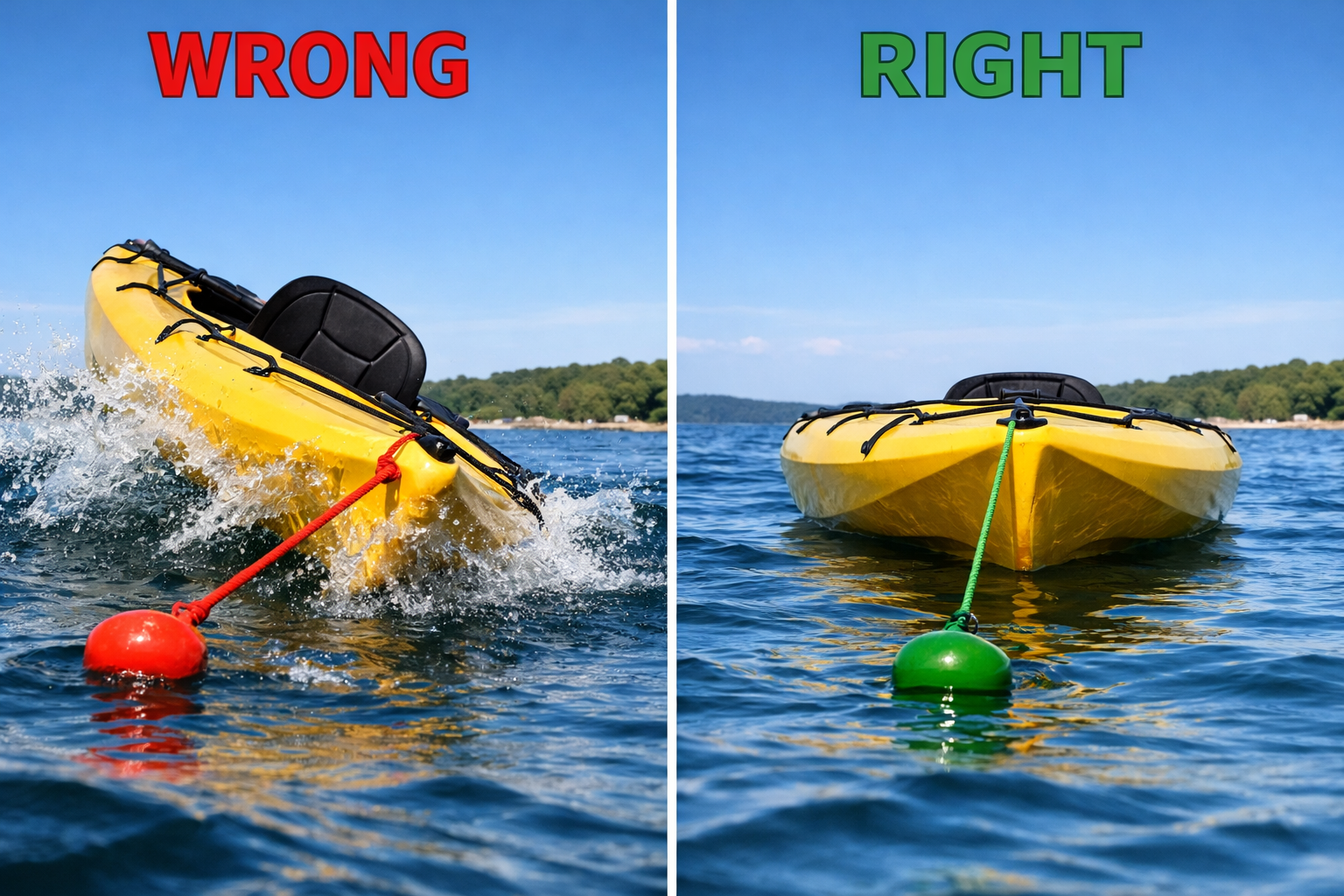
When you anchor from the side of a boat, the vessel immediately becomes vulnerable to rolling motion. As soon as wind, current, or waves apply force, your kayak tilts toward the anchor point, and the opposite side lifts. This rolling intensifies with each wave or gust, and water can quickly flood over the low-side gunwale.
Sequence of events in a side-anchor incident:
- Initial tilt: First wave or gust causes 10-15 degree roll toward anchor side
- Increased exposure: Tilted position catches more wind and current on the high side
- Progressive rolling: Each subsequent wave increases the angle
- Water intrusion: Gunwale dips below surface; water pours into cockpit or onto deck
- Loss of stability: Added water weight accelerates rolling
- Capsize: Kayak flips completely, often trapping the paddler under or near the hull
The anchor line remains attached throughout this sequence, which means your kayak doesn’t drift away after capsizing. This can be both helpful (you don’t lose your boat) and dangerous (you may become entangled or the boat may strike you).
Additional consequences:
- Gear loss as items slide or wash overboard during rolling
- Difficulty re-entering a kayak that’s still anchored and unstable
- Potential injury from being thrown against hard surfaces or equipment
- Hypothermia risk in cold water while struggling with an anchored, capsized boat
If you find yourself rolling from a side anchor, your immediate priority is releasing the anchor line or shifting your weight aggressively to the high side while reaching for the anchor release.
Proper Way to Anchor a Boat: Bow vs Side
The proper way to anchor any small boat or kayak is from the bow, using an anchor trolley system that allows you to position the attachment point at the front of your vessel. Bow anchoring lets your boat weathervane naturally, pointing into wind and current to minimize rolling and maintain stability.
Why bow anchoring works:
- Minimal profile: Only your narrow bow faces incoming forces
- Natural alignment: Boat rotates freely to point into strongest force (wind or current)
- Reduced rolling: Waves pass under the hull from front to back, not side to side
- Better control: You can adjust position by pulling in or letting out scope
Bow anchoring setup steps:
- Install an anchor trolley system with pulleys running along both sides of your kayak
- Attach the anchor line to a carabiner or ring that slides on the trolley line
- Deploy your anchor from the bow position
- Once set, use the trolley adjustment line to position the carabiner at the bow
- Secure the trolley line so the anchor point stays forward
Side anchoring (when it’s used):
Side anchoring is occasionally used by experienced anglers in very specific, controlled situations:
- Dead-calm water with zero wind and no boat traffic
- Temporary positioning for a quick cast (less than 5 minutes)
- Alongside a dock or structure where the boat is also secured to the structure
- In extremely shallow water (under 2 feet) where capsizing is less dangerous
Even in these scenarios, most experienced kayak anglers prefer bow anchoring because conditions can change in seconds. A distant boat can create a wake that reaches you minutes later, and afternoon winds can appear suddenly.
Comparison table:
| Factor | Bow Anchoring | Side Anchoring |
|---|---|---|
| Stability in wind | Excellent – points into wind | Poor – broadside exposure |
| Stability in current | Excellent – points into current | Poor – perpendicular to flow |
| Rolling resistance | High – minimal leverage | Low – maximum leverage |
| Self-correction | Yes – weathervanes naturally | No – locked perpendicular |
| Capsize risk | Low | High |
| Best conditions | All conditions | Flat calm only (still risky) |

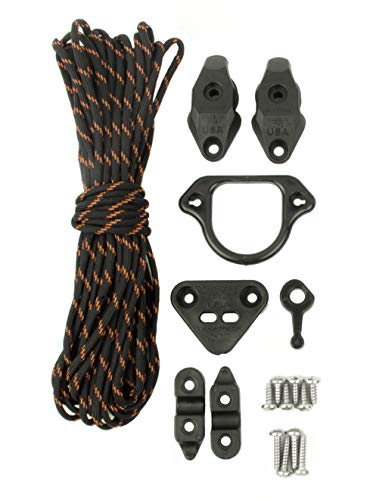
Premium Materials: Our kit comes with a solid 0.39in x 32.81ft Rope, providing ample length and exceptional durability. The stainless steel pulley blocks offer resistance to rust and wear, boasting a robust structure manufactured through a stringent process, ensuring reliability and longevity. Additionally, the versatile nylon cleat can be used alongside ropes to securely fix paddles, nets, poles, and other items on your kayak, boat, or canoe.
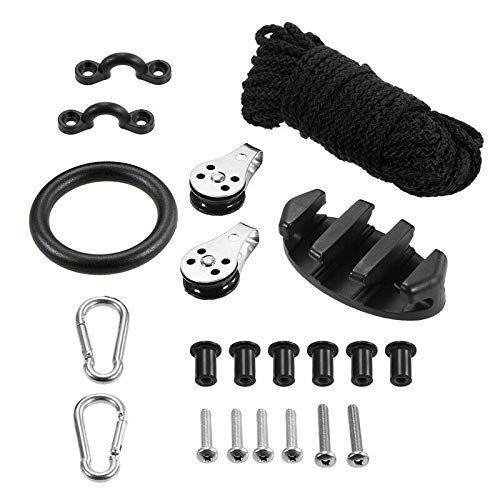
✔Feature:Durable, Seaworthy Materials: Made of tough, corrosion-proof stainless steel, nylon hardware and an ultra-strong paracord (USA made) with a reflective tracer that adds visibility in low-light situations.
Can Side Anchoring Cause a Boat to Capsize?
Yes, side anchoring can absolutely cause a boat to capsize, and it’s one of the most common preventable causes of kayak capsizes among anglers. Even moderate wind or small boat wakes can generate enough rolling force to flip a side-anchored kayak, especially narrower models under 32 inches wide.
Capsize mechanics from side anchoring:
The anchor line creates a fixed pivot point on one side of your kayak. When a wave or gust pushes against the opposite side, it creates a lever arm that forces the kayak to roll toward the anchor. Unlike a free-floating kayak that would simply drift with the force, the anchored kayak has nowhere to go except to roll.
Factors that increase capsize risk:
- Kayak width: Narrower kayaks (under 30 inches) capsize more easily than wider models (34+ inches)
- Hull design: Rounded hulls are less stable than flat or pontoon-style hulls when side-anchored
- Weight distribution: Standing or having weight high on the deck increases capsize risk
- Wave height: Waves over 12 inches significantly increase rolling force
- Wind speed: Winds over 10 mph create enough force to capsize most side-anchored kayaks
- Anchor scope: Shorter scope (less line out) creates a more rigid connection and faster rolling
Real capsize risk assessment:
In calm conditions with no wind and no boat traffic, a wide, stable kayak (34+ inches) with a seated angler might remain upright when side-anchored. However, this represents maybe 5% of actual fishing conditions. The moment any variable changes (a boat passes 200 yards away, a 5 mph breeze picks up, you shift weight to cast), capsize risk jumps dramatically.
What to do if you start rolling:
- Immediately release the anchor line (use a quick-release system)
- Shift your weight aggressively toward the high side
- Lower your center of gravity (sit down if standing)
- Use your paddle as an outrigger for stability
- If capsize is inevitable, push away from the kayak as you go over to avoid entanglement
Never anchor from the side if you’re fishing alone, in cold water (below 60°F), far from shore, or in areas with boat traffic. The capsize risk simply isn’t worth the convenience.
How to Anchor a Kayak Correctly for Beginners
To anchor a kayak correctly, install an anchor trolley system, deploy your anchor from the bow while pointing into the wind or current, let out 3-5 times as much line as the water depth, and use the trolley to position the attachment point at the very front of your kayak. This setup keeps you stable and safe in virtually all conditions.
Complete beginner anchoring process:
- Before you launch: Install an anchor trolley kit (available for $20-40) with pulleys at bow and stern, running line along both sides
- Choose your anchor: Use a 1.5-3 lb folding anchor for most kayak fishing in depths under 20 feet
- Prepare your rode: Attach 50-75 feet of rope to your anchor (3/8-inch diameter works well)
- Attach to trolley: Clip your anchor rode to the carabiner or ring on your trolley system
- Position for deployment: Paddle to your spot and point your bow into the wind or current
- Deploy anchor: Lower (don’t throw) your anchor to the bottom
- Let out scope: Release 3-5 times as much line as the water depth (15 feet deep = 45-75 feet of line)
- Adjust trolley: Pull the trolley line to move the carabiner to the bow position
- Secure trolley: Cleat off the trolley adjustment line
- Test stability: Rock gently side to side to confirm you’re stable
Scope ratio explained:
Scope is the ratio of anchor line length to water depth. A 5:1 scope (50 feet of line in 10 feet of water) creates a low angle of pull that helps the anchor dig in and hold. Too little scope (2:1 or less) pulls upward and can cause the anchor to drag.
Common beginner mistakes:
- Deploying the anchor while drifting sideways (always point into conditions first)
- Using too little scope, causing the anchor to drag
- Forgetting to adjust the trolley to bow position after deploying
- Anchoring in current without accounting for swing radius (you’ll swing in an arc as conditions change)
- Not having a quick-release system for emergencies
Quick-release systems:
Install a quick-release mechanism so you can drop your anchor instantly if you start capsizing or need to move fast. Options include:
- Carabiner with a pull-tab that opens under load
- Anchor wizard or similar spool system with a release lever
- Simple cleat that you can flip the line off in one motion
Practice your release system on land before you need it in an emergency.

Anchor ring,pad eyes and carabiner of the kayak anchor trolley system are all made of 316 stainless steel,which is more anti-rust and wear resistance,strong and durable,enhance the stability and safety of the anchor trolley system.

EASY INSTALL: The trolley kit is easy and quick to install and comes with detailed installation instructions, it only takes 10 minutes to achieve standard installation. And we provide installation guidance, which will solve your troubles

MAKE EASIER TO FISH WHEN WINDY: This Kayak Anchor System can easily adjust the direction of the fishing kayak in wind or waves, work with anchor pole can allowing you to always adapt to the current or wind direction. Let you fully enjoy the fishing time
Side Anchoring vs Bow Anchoring: Which Is Safer?
Bow anchoring is dramatically safer than side anchoring in all conditions except perfectly flat, windless water with zero boat traffic. Bow anchoring reduces capsize risk by 80-90% compared to side anchoring because it allows your kayak to naturally align with forces rather than fighting them broadside.
Safety comparison:
Bow anchoring advantages:
- Kayak points into wind and waves, presenting minimal profile
- Natural weathervaning keeps you aligned with changing conditions
- Rolling motion is minimal (front-to-back pitch instead of side-to-side roll)
- Water stays well below gunwale level in moderate conditions
- Easy to adjust position by changing scope
- Quick escape by pulling anchor or releasing line
Side anchoring disadvantages:
- Kayak sits perpendicular to forces, maximum exposure
- No ability to self-correct as conditions change
- Severe rolling motion in even small waves or wakes
- Gunwale can dip below waterline quickly
- Difficult to correct once rolling begins
- Capsize risk increases exponentially with any wind or waves
When experienced anglers might use side anchoring:
Some tournament anglers or guides occasionally use side anchoring in highly specific situations:
- Fishing a precise depth contour that runs parallel to wind/current
- Positioning alongside structure (dock, bridge piling) where the structure blocks wind
- Extremely shallow water (under 18 inches) where capsizing means getting wet feet, not swimming
- Using a stabilizer system (outriggers) that prevents rolling
Even in these cases, they typically use an anchor trolley that allows instant repositioning to bow if conditions change, and they never side-anchor in water deep enough to create serious danger if they capsize.
The bottom line: If you’re asking whether side anchoring is safe, the answer is no for 95% of fishing situations. Bow anchoring should be your default, always. The minor inconvenience of adjusting your trolley is vastly outweighed by the safety benefit.

✔INCLUDE:Complete kayaking/paddle board anchoring kit including anchor(3.5lb), premium 8mm double braided 30ft nylon rope, spring hook, Float and storage bag.

Quick & Easy Setup:Secure kayaks, canoes, or luggage with ease. Attach the S-hooks to your roof rack, truck bed, ATV, or trailer, pull tight, and you're ready to go. No need for knots or stretch rope.

H2o Anchor Trolley Kit Marine Grade Fixings
What Are the Risks of Anchoring From the Beam?
Anchoring from the beam (side) creates multiple serious risks: immediate capsize danger from rolling, water intrusion over the gunwale, gear loss, entanglement with anchor line during capsize, difficulty re-entering a capsized kayak that’s still anchored, and potential injury from being struck by the rolling hull or equipment.
Detailed risk breakdown:
1. Capsize from rolling
The primary risk is capsizing due to severe rolling motion. A beam-anchored kayak can roll 30-45 degrees in moderate conditions, and once you pass about 35 degrees in most kayaks, capsize becomes inevitable. The anchor line prevents the kayak from drifting with forces, so all energy goes into rolling motion.
2. Water intrusion and swamping
As your kayak rolls, the low-side gunwale dips toward or below the waterline. Water pours into the cockpit (sit-inside kayaks) or floods the deck (sit-on-top kayaks). This added water weight makes the kayak even less stable and accelerates the capsize. A swamped kayak is extremely difficult to re-enter and may require towing to shore.
3. Gear loss
Rolling motion causes unsecured gear to slide or fall overboard. Fishing rods, tackle boxes, electronics, and personal items can be lost in seconds. Even secured items may break free if attachment points fail under the dynamic loads of rolling. Replacing lost fishing gear can cost hundreds to thousands of dollars.
4. Entanglement hazard
When you capsize while beam-anchored, the anchor line remains attached and under tension. You can become entangled in the line, especially if you’re wearing a PFD with multiple straps, carrying tools on a lanyard, or trying to grab the kayak as you go over. Entanglement in current or deep water is a life-threatening emergency.
5. Difficulty recovering
A capsized kayak that’s still anchored is much harder to right and re-enter than a free-floating one. The anchor line keeps the kayak in position, but it also prevents you from maneuvering it to shore or into calmer water. You may need to release the anchor entirely, losing your anchor and rode.
6. Impact injuries
During capsize, you can be struck by the kayak hull, paddle, fishing rods, or other equipment. Hard impacts to the head are particularly dangerous. If you’re standing when the capsize begins, you may fall onto the kayak or into the water from a height, increasing injury risk.
7. Cold water exposure
If you capsize in water below 60°F, you face rapid onset of cold water shock and hypothermia. Struggling with an anchored, capsized kayak extends your time in the water and accelerates heat loss. Cold water immersion is the leading cause of kayaking fatalities.
Risk mitigation if you must beam-anchor:
- Only in flat calm conditions with no wind and no boat traffic
- Water depth under 3 feet where you can stand if you capsize
- Wear your PFD (always, but especially critical here)
- Have a quick-release system you can activate in under 2 seconds
- Keep your weight low and centered
- Watch constantly for changing conditions
- Have a plan to release the anchor at the first sign of rolling
Better mitigation: don’t beam-anchor. Use bow anchoring instead.
How Much Does It Cost to Replace Anchor Equipment After Damage?
Replacing anchor equipment after a side-anchoring incident typically costs $50-200 for basic gear (anchor, rode, trolley system) and can exceed $500-1,000 if you also lose fishing rods, electronics, or need to repair or replace a damaged kayak. Prevention through proper bow anchoring is far cheaper than replacement.
Typical replacement costs (2026 prices):
Anchor and rode:
- Folding anchor (1.5-3 lb): $15-35
- Anchor rode (50-75 ft, 3/8″ rope): $15-30
- Anchor trolley kit: $20-40
- Carabiners and hardware: $10-20
- Subtotal: $60-125
Fishing gear commonly lost in capsize:
- Fishing rod and reel combo: $80-400 each (most anglers carry 2-3)
- Tackle box with lures and terminal tackle: $100-300
- Pliers, tools, and accessories: $30-80
- Subtotal: $210-780 per incident
Electronics and safety gear:
- Fish finder/GPS unit: $150-600
- VHF radio: $60-150
- Waterproof phone case (if phone is lost): $300-1,000
- PFD replacement (if damaged): $60-150
- Subtotal: $570-1,900
Kayak damage:
- Hull repair (cracks, punctures): $100-400
- Replacement hatches or hardware: $30-100
- Full kayak replacement (if totaled): $800-3,500
- Subtotal: $930-4,000
Total potential cost of a side-anchor capsize incident: $1,770-6,805
Most anglers who capsize due to side anchoring lose at least their anchor system and some fishing gear, putting typical real-world costs in the $200-500 range. More severe incidents with electronics loss or kayak damage can easily exceed $1,000.
Insurance considerations:
Homeowners or renters insurance may cover some fishing gear and kayak damage, but policies typically have deductibles of $500-1,000, and filing a claim may increase your premiums. Specialized kayak or boat insurance is available but adds $150-300 annually to your costs.
Prevention is cheaper:
Installing a proper anchor trolley system ($20-40) and learning correct bow-anchoring technique (free, through online resources or local kayak fishing clubs) costs far less than replacing gear after a preventable capsize. The 30 minutes spent installing a trolley and practicing proper technique can save you thousands of dollars and potentially your life.
Common Mistakes When Anchoring a Boat
The most common anchoring mistakes include anchoring from the side instead of the bow, using insufficient scope (too little line for the depth), failing to account for swing radius, not having a quick-release system, anchoring while positioned sideways to conditions, and neglecting to test anchor hold before committing to the spot.
Top 10 anchoring mistakes:
1. Side/beam anchoring
Already covered extensively, but worth repeating: this is the single most dangerous mistake. Always anchor from the bow unless you have a very specific reason and the experience to manage the risks.
2. Insufficient scope
Using a 2:1 or 3:1 scope ratio doesn’t give your anchor enough horizontal pull to dig in properly. The anchor drags, and you drift into hazards or lose your fishing spot. Use 5:1 in moderate conditions, 7:1 in strong wind or current.
3. Ignoring swing radius
When anchored, your kayak will swing in an arc as wind and current change direction. The radius of this arc equals your scope length. Anchoring 30 feet from a dock with 50 feet of line out means you’ll swing into the dock. Always account for swing radius when choosing your anchor spot.
4. No quick-release system
If you can’t release your anchor in under 3 seconds, you don’t have a proper quick-release system. In an emergency (sudden storm, capsizing, medical issue), fumbling with knots or complex hardware can be fatal. Use a carabiner, quick-release cleat, or anchor wizard system.
5. Wrong anchor type for bottom
Fluke anchors work well in mud and sand but poorly on rock or heavy vegetation. Grapnel anchors grip rock and structure but don’t dig into soft bottoms. Match your anchor to the bottom type where you fish most often, or carry two anchor types.
6. Deploying while sideways
Paddling to your spot and immediately dropping anchor without first positioning your bow into the wind or current is a recipe for tangled line and poor anchor set. Always point into conditions before deploying.
7. Throwing the anchor
Throwing your anchor can tangle the line, damage the anchor, or cause it to land upside-down where it won’t set properly. Lower your anchor smoothly to the bottom, then back away to let out scope as it settles.
8. Not testing the hold
After setting your anchor, give a firm pull on the line or paddle backward against it to test whether it’s truly set. An anchor that seems set but isn’t will drag as soon as you start fishing, potentially putting you in danger.
9. Anchoring in traffic lanes
Anchoring in channels, boat ramps, or high-traffic areas creates collision risk. Other boaters may not see your low-profile kayak, especially in choppy water or low light. Choose spots out of traffic patterns.
10. No backup plan
If your anchor drags, your trolley jams, or conditions deteriorate, what’s your plan? Always know your exit route, have a paddle leash so you don’t lose your paddle while dealing with anchor issues, and be prepared to cut your anchor line if necessary (carry a knife).
Bonus mistake: Anchoring too deep
Most kayak anglers carry 50-75 feet of anchor rode. In water deeper than 10-15 feet, you may not have enough line to achieve proper scope. Know your rode length and don’t anchor in depths where you can’t get at least 3:1 scope.
Is It Ever Okay to Anchor From the Side in Calm Water?
Anchoring from the side in calm water is technically possible but still not recommended, even for experienced kayak anglers. While flat calm conditions reduce immediate capsize risk, conditions can change in seconds, and the habit of side anchoring can lead to dangerous mistakes when you encounter less-than-perfect weather.
When side anchoring might be considered:
Very specific scenarios:
- Water depth under 2 feet where capsizing means standing up, not swimming
- Completely enclosed pond or small lake with no boat traffic and no wind (rare)
- Temporary positioning for under 2-3 minutes while making a specific cast
- Using a kayak with extreme stability (36+ inch beam, pontoon-style hull) and outriggers installed
- Fishing from a stable platform like a pedal kayak with the drive down for additional stability
Why it’s still risky:
Even in these scenarios, side anchoring creates unnecessary risk:
- Sudden wind: Thermal winds can appear in minutes, especially on warm afternoons
- Boat wakes: A boat passing 300+ yards away can send wakes that reach you 5-10 minutes later
- Bad habits: Side anchoring in calm water trains you to use the technique, making it more likely you’ll mistakenly use it in marginal conditions
- False confidence: Success in calm water creates overconfidence that leads to risk-taking in less ideal conditions
What experienced anglers do instead:
Rather than side anchoring even in calm water, skilled kayak anglers use these alternatives:
- Bow anchor with trolley adjustment: Takes 10 seconds to adjust the trolley to bow position, provides full safety
- Stake-out pole: In shallow water (under 6 feet), a push-pole or stake-out pole pins you in place without the rolling risk of an anchor
- Drift fishing: In calm conditions, controlled drifting often covers more water and finds more fish than anchoring
- Spot-lock trolling motor: Electric trolling motors with GPS spot-lock hold position without any anchor
The honest answer:
Can you get away with side anchoring in flat calm water? Probably, most of the time. Should you? No. The minimal convenience isn’t worth the risk, and bow anchoring with a trolley system is just as easy once you’ve practiced it a few times.
If you’re asking whether it’s okay, you’re probably in conditions where it isn’t. When in doubt, bow anchor.
What to Do If Your Boat Starts Rolling From Side Anchor
If your boat starts rolling from a side anchor, immediately release the anchor line using your quick-release system, shift your weight aggressively toward the high side, lower your center of gravity by sitting or kneeling, and use your paddle as an outrigger brace for stability. Speed is critical, you have only seconds before a roll becomes a capsize.
Emergency response steps (in order):
1. Release the anchor (0-2 seconds)
Your first action must be releasing the anchor line. Every second you remain side-anchored, the rolling gets worse. If you have a quick-release carabiner, pull the tab. If you have a cleat, flip the line off. If you have neither, cut the line with your knife (you do carry a knife, right?).
Losing your anchor is far better than capsizing.
2. Weight shift (2-4 seconds)
As soon as the anchor releases (or while reaching for the release), shift your weight hard toward the high side (the side that’s lifting out of the water). Lean your torso over the high gunwale. This counteracts the rolling moment and may stop the roll.
3. Lower your center of gravity (4-6 seconds)
If you’re standing, sit immediately. If you’re sitting upright, lean forward and lower your torso. A lower center of gravity dramatically increases stability.
4. Paddle brace (6-10 seconds)
Place your paddle flat on the water on the high side and press down, using it as an outrigger. This is called a “low brace” in kayaking and can prevent capsize even at severe roll angles. Keep the paddle blade flat on the surface, not vertical.
5. Assess and stabilize (10-30 seconds)
Once the rolling stops, take a breath and assess. Are you stable? Is water in the kayak? Do you need to paddle to calmer water or shore? Don’t immediately try to retrieve your anchor, stabilize first.
If you can’t release the anchor:
Sometimes the release mechanism jams, or you can’t reach it while rolling. In this case:
- Cut the line with your knife (always carry a knife in an accessible location)
- If you don’t have a knife, prepare for capsize: take a breath, protect your head, push away from the kayak as you go over
After the incident:
- Paddle to shore or calm water
- Pump or bail water from your kayak
- Check all gear and equipment
- Retrieve your anchor if possible (mark the spot with a float if you cut the line)
- Analyze what went wrong and commit to bow anchoring in the future
Prevention is easier than response:
This entire emergency could be avoided by bow anchoring. The best response to side-anchor rolling is never putting yourself in that situation in the first place.
Do Pontoon Boats Have Different Anchoring Rules Than Other Boats?
Pontoon boats and kayaks follow the same fundamental anchoring rules as other boats: anchor from the bow to allow weathervaning and maintain stability. While pontoon-style hulls offer more initial stability than traditional V-hull designs, they still experience dangerous rolling when anchored from the side, especially in wind or waves.
Pontoon boat anchoring considerations:
Stability advantages:
Pontoon boats (including pontoon-style kayaks like the Hobie Pro Angler or Native Slayer Propel) have wider beams and more initial stability than traditional kayaks. This means they resist rolling better in calm conditions. However, this advantage disappears quickly when forces increase.
Why pontoon boats still shouldn’t be side-anchored:
- High windage: Pontoon boats typically have higher profiles (more surface area above the waterline), catching more wind
- Greater beam: While width helps stability, it also means more surface area for wind and current to push against when side-anchored
- False confidence: The extra stability in calm conditions can lead to overconfidence and side anchoring in marginal conditions where it becomes dangerous
Proper pontoon boat anchoring:
- Use the bow anchor point (most pontoon boats have a dedicated bow eye or cleat)
- Deploy anchor while pointing into wind or current
- Use appropriate scope (5:1 to 7:1 ratio)
- Allow the boat to weathervane naturally
- For fishing parallel to structure, use an anchor trolley system to adjust position after the anchor is set
Special considerations for pontoon kayaks:
Many pontoon-style fishing kayaks have anchor trolley systems built in or easily installed. Use these to position the anchor point at the bow after deploying. Some models (like certain Hobie kayaks) have multiple anchor points; always use the bow point as your primary anchor in open water.
When pontoon boats can handle more:
Pontoon boats can handle slightly rougher conditions than traditional kayaks when properly bow-anchored, but this doesn’t mean side anchoring becomes safe. The same physics apply, side anchoring creates rolling risk regardless of hull design.
Bottom line: Pontoon boats and pontoon-style kayaks should be anchored from the bow just like any other small boat. Their extra stability is an advantage when properly anchored, not a license to anchor improperly.
Why Does My Boat Swing Sideways When Anchored?
Your boat swings sideways when anchored because wind and current directions change, causing your boat to weathervane (rotate) around the anchor point to align with the strongest force. This is normal and actually desirable, it’s your boat automatically finding the most stable position. However, if your boat is swinging excessively or unpredictably, you may have insufficient scope, the wrong anchor type, or conflicting wind and current.
Normal swing behavior:
When properly bow-anchored, your boat acts like a weather vane, constantly adjusting to point into the dominant force (wind or current). As these forces change direction throughout the day, your boat swings in an arc around your anchor point. The radius of this arc equals your scope length.
Why boats swing:
- Wind shifts: Wind direction changes throughout the day, especially during weather transitions
- Tidal current changes: Current direction reverses with tide changes (in tidal waters)
- Thermal winds: Lake and reservoir winds often shift as the day warms or cools
- Boat wakes: Passing boats create temporary forces that cause swinging
When swinging becomes a problem:
Excessive swinging (large, fast movements):
- Cause: Insufficient scope (too little line out for the depth)
- Solution: Let out more line to achieve 5:1 or 7:1 scope ratio
- Cause: Anchor dragging (not properly set)
- Solution: Re-set the anchor in a better location or use a different anchor type
Unpredictable swinging (boat doesn’t point consistently):
- Cause: Wind and current coming from different directions
- Solution: Determine which force is stronger (usually current) and accept that your boat will compromise between the two
- Cause: Anchor trolley not properly adjusted to bow
- Solution: Adjust trolley so the anchor attachment point is at the very front of your kayak
Boat swinging into hazards:
- Cause: Anchoring too close to docks, other boats, or structure without accounting for swing radius
- Solution: Anchor farther away (at least 1.5x your scope length from hazards) or choose a different spot
How to minimize unwanted swing:
- Use adequate scope: 5:1 minimum, 7:1 in strong conditions
- Choose the right anchor: Match anchor type to bottom composition
- Position trolley correctly: Anchor point should be at the bow, not midship
- Account for swing radius: Anchor far enough from hazards
- Use a heavier anchor: In very strong current or wind, a heavier anchor (3-5 lb instead of 1.5-2 lb) reduces swing
When swinging is actually side-anchoring:
If your boat is swinging so that you’re frequently broadside to waves or wind, you may have accidentally created a side-anchor situation by positioning your trolley incorrectly. Check that your anchor attachment point is truly at the bow, not at the midpoint of your kayak.
The key insight: Swinging is normal and safe when you’re bow-anchored. It’s your boat’s way of staying stable as conditions change. Embrace it rather than fighting it, and plan your anchor position to allow for the swing radius.
Conclusion
Anchoring from the side is one of the most dangerous mistakes a kayak angler can make. The physics are unforgiving: side anchoring exposes your entire beam to wind, current, and waves, creating severe rolling motion that can capsize even stable kayaks in moderate conditions. Water intrusion, gear loss, entanglement, and cold water exposure turn a preventable mistake into a life-threatening emergency.
The solution is straightforward: Always anchor from the bow using an anchor trolley system. Bow anchoring allows your kayak to weathervane naturally, pointing into conditions and maintaining stability in virtually all situations. The investment is minimal, a $20-40 anchor trolley kit and 30 minutes of installation time, but the safety benefit is enormous.
Your action steps:
- Install an anchor trolley system on your kayak if you don’t already have one (or verify your existing system works properly)
- Practice bow anchoring in calm, shallow water until the process becomes automatic
- Set up a quick-release system so you can drop your anchor in under 3 seconds if needed
- Commit to bow anchoring in all conditions, even when side anchoring seems convenient
- Educate other anglers you see side-anchoring about the risks
The water doesn’t care about convenience or shortcuts. It responds to physics, and the physics of side anchoring are clear: it’s unstable, dangerous, and completely avoidable. Make bow anchoring your default, every time, and you’ll fish safer, more comfortably, and with confidence that your kayak will stay upright no matter what conditions develop.
Your next fishing trip starts with proper anchoring technique. Install that trolley system, practice the process, and enjoy stable, safe fishing from a properly anchored kayak. The fish will still be there, and so will you.