Quick Answer
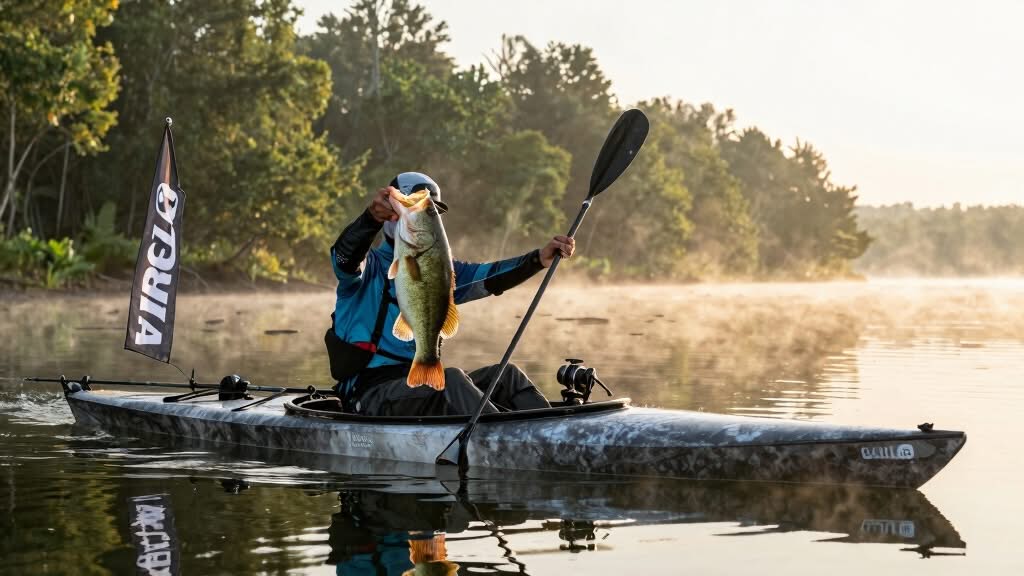
Kayak bass fishing tournament format is a competitive angling structure where participants fish from kayaks and submit their catches through a catch-photo-release (CPR) system rather than traditional live weigh-ins. Anglers measure and photograph their bass on standardized measuring boards, then upload images to tournament apps for scoring. Most tournaments run 6-8 hours, score the top 3-5 fish per angler, and award prizes based on total length rather than weight.
Key Takeaways
- Catch-photo-release (CPR) is the standard format—anglers photograph bass on measuring boards and release them immediately, eliminating the need for live wells or weigh-in facilities
- Tournament duration typically runs 6-8 hours during daylight hours, with specific launch and check-in times enforced through GPS-enabled tournament apps
- Scoring is based on total length of an angler’s best 3-5 bass (depending on tournament rules), measured to the nearest quarter-inch on approved boards
- Entry fees range from $25-75 for local club events to $150-300+ for major trail tournaments, with additional costs for memberships and permits
- Minimal gear requirements make kayak tournaments more accessible than boat tournaments—any stable fishing kayak, basic safety equipment, measuring board, and smartphone suffice
- Beginner-friendly structure allows new anglers to compete without expensive boats, though understanding CPR protocols and measurement rules is essential
- Multiple tournament trails exist including Kayak Bass Fishing (KBF), B.A.S.S. Kayak Series, and regional clubs, each with slightly different rules and formats
How Do Kayak Bass Fishing Tournaments Work?
Kayak bass fishing tournaments operate on a self-reporting system where anglers launch from designated areas, fish independently throughout the tournament hours, and submit their catches digitally via smartphone apps. Unlike traditional boat tournaments with centralized weigh-ins, kayak tournaments rely on the honor system backed by photo verification and strict measurement protocols.
The typical tournament day follows this structure:
Pre-tournament (1-7 days before):
- Anglers register online and pay entry fees
- Tournament directors announce boundaries, launch locations, and specific rules
- Participants download required tournament apps (TourneyX, KBF, or trail-specific platforms)
Tournament morning:
- Anglers arrive at designated launch sites 30-60 minutes before start time
- Check-in occurs through the tournament app using GPS verification
- All participants must launch from approved locations only
- Tournament begins at a specific time (commonly 6:00-7:00 AM)
During competition:
- Anglers fish anywhere within tournament boundaries
- When a keeper bass is caught, the angler places it on an approved measuring board
- A photo is taken showing the fish, measurement, and a tournament identifier (often a personalized card or number)
- The image is uploaded to the tournament app immediately or stored for later submission
- The bass is released alive as quickly as possible
- Anglers continue fishing to improve their best 3-5 fish (depending on rules)
Tournament end:
- Fishing stops at the designated time (commonly 2:00-3:00 PM)
- Anglers have 15-30 minutes to submit all photos through the app
- Late submissions result in disqualification or penalties
- Tournament directors review submissions for rule compliance
- Results are posted online, typically within hours
Common mistake: New tournament anglers often struggle with photo quality and proper fish positioning on measuring boards, leading to disqualified catches. Practice photographing bass on your measuring board before your first tournament, ensuring the entire fish, measurement markings, and identifier are clearly visible in good lighting.
For those new to competitive fishing, understanding beginner kayak fishing fundamentals helps build confidence before entering tournaments.
What Are the Rules and Scoring in Kayak Bass Fishing Tournaments?
Kayak bass fishing tournament scoring is based on cumulative length rather than weight, with most events counting an angler’s longest 3-5 largemouth, smallmouth, or spotted bass (species allowed vary by tournament and region). Each fish must meet a minimum length requirement—typically 12 inches—and be measured on an approved board following strict photo documentation protocols.
Standard scoring rules:
- Fish limits: Most tournaments score your best 3 fish (common in KBF) or best 5 fish (common in B.A.S.S. Kayak Series)
- Measurement precision: Fish are measured to the nearest 0.25 inch (quarter-inch)
- Minimum length: Usually 12 inches, though some tournaments set higher minimums (13-15 inches)
- Species restrictions: Typically largemouth, smallmouth, and spotted bass; other species don’t count
- Tiebreakers: First tiebreaker is usually longest single fish; second tiebreaker may be submission time or a predetermined method
Photo documentation requirements:
- Fish must lie flat on an approved measuring board with mouth closed against the zero-end stop
- Tail must be pinched to maximum length without damage
- Entire fish and measurement markings must be clearly visible
- Tournament identifier (card, number, or code) must appear in photo
- Photo must be taken during tournament hours within boundaries
- Each fish can only be submitted once (no re-measuring the same fish)
Common penalties and disqualifications:
- Late submission: Automatic disqualification or severe length penalties (often 3-5 inches per minute late)
- Out of bounds: Fishing or photographing fish outside tournament boundaries results in disqualification
- Dead fish: Some tournaments impose length penalties (2-4 inches) for dead fish; others disqualify them entirely
- Improper measurement: Fish not properly positioned, unclear photos, or missing identifiers result in that fish being disqualified
- Minimum length violations: Submitting fish under the minimum disqualifies that fish and may result in additional penalties
Edge case: If you catch a fish that appears to be exactly at the minimum length (say, 12.00 inches), photograph it carefully. Tournament directors typically disqualify borderline fish if there’s any doubt, so a fish that measures 12.00-12.10 inches is risky. Many experienced anglers won’t submit fish unless they clearly exceed the minimum by at least 0.25 inches.
The honor system works because tournament trails maintain databases of angler histories, and patterns of suspicious catches or rule violations lead to investigations and potential lifetime bans from competitive circuits.
Catch-Photo-Release vs Traditional Weigh-In Formats
Catch-photo-release (CPR) has become the dominant format in kayak bass fishing tournaments because it eliminates the need for live wells, reduces fish mortality, and allows tournaments to run across vast geographic areas simultaneously. Traditional weigh-in formats, still common in boat tournaments, require anglers to keep fish alive in aerated tanks and transport them to a central location for official weighing.
CPR format advantages:
- Conservation: Fish are released immediately after photographing, minimizing stress and mortality
- Accessibility: No need for expensive live well systems or aeration equipment
- Geographic flexibility: Tournaments can span entire states or regions with anglers fishing their local waters
- Lower costs: No venue rental for weigh-in facilities or logistics for transporting fish
- Faster results: Digital submissions allow real-time leaderboards and quick result posting
CPR format challenges:
- Honor system reliance: Depends on angler integrity, though technology and community oversight provide checks
- Photo quality issues: Poor lighting, unclear measurements, or improper fish positioning can disqualify legitimate catches
- Technology requirements: Anglers must have smartphones with cameras and reliable cellular or WiFi connectivity
- Learning curve: New participants must master measurement board techniques and photo protocols
Traditional weigh-in advantages:
- Verification certainty: Officials physically handle and weigh each fish, eliminating measurement disputes
- Spectator appeal: Live weigh-ins create excitement and community gathering opportunities
- Sponsorship value: Physical events provide better branding and media opportunities for sponsors
Traditional weigh-in disadvantages:
- Fish mortality: Keeping bass in live wells for hours, especially in warm weather, increases death rates
- Equipment requirements: Live wells, aerators, and fish care systems add significant cost
- Geographic limitations: All anglers must fish near the weigh-in location and return by a specific time
- Logistics complexity: Requires venue, scales, officials, and infrastructure
Choose CPR tournaments if: You’re fishing from a kayak (most kayak tournaments use CPR exclusively), want to minimize environmental impact, prefer fishing your local waters, or are new to tournament fishing and want lower barriers to entry.
Choose traditional weigh-in tournaments if: You fish from a boat with live well capacity, enjoy the community atmosphere of physical events, or prefer the certainty of official verification (though note that most kayak-specific tournaments don’t offer this option).
The shift toward CPR in kayak fishing reflects both practical constraints—kayaks lack space for live wells—and a broader conservation ethic within the kayak angling community. Major trails like Kayak Bass Fishing (KBF) have proven CPR can work at scale, with thousands of anglers competing fairly across North America using standardized protocols.
How Much Does It Cost to Enter a Kayak Bass Fishing Tournament?
Entry fees for kayak bass fishing tournaments range from $25-75 for local club events to $150-300+ for major national trail tournaments, with additional costs including trail memberships ($50-100 annually), fishing licenses, and optional side pots or big bass jackpots. Total first-year costs typically run $500-1,500 depending on how many events you enter and which circuits you join.
Typical cost breakdown:
Local club tournaments:
- Entry fee: $25-50 per event
- Club membership: $25-50 annually
- Frequency: Monthly or bi-monthly events
- Annual cost (10 events): $300-550
Regional trail tournaments:
- Entry fee: $75-150 per event
- Trail membership: $50-100 annually
- Frequency: 6-10 events per season
- Annual cost (6 events): $550-1,000
National trail tournaments (KBF, B.A.S.S.):
- Entry fee: $150-300 per event
- Trail membership: $75-125 annually
- Championship qualification fees: $200-500 if you qualify
- Annual cost (4-6 events): $750-2,000+
Additional costs:
- Fishing licenses: $30-100 annually depending on state; some tournaments require licenses for multiple states
- Tournament identifier: $5-15 for personalized tournament cards or boards
- Measuring board: $20-40 for approved boards (Hawg Trough, Ketch Board)
- Tournament app subscriptions: Usually free, but some premium features cost $5-10/month
- Side pots and big bass: Optional $5-20 per tournament for additional prize pools
- Travel: Gas, lodging, and meals if fishing tournaments away from home
What you get for entry fees:
Most tournament entry fees fund the prize pool, with typical payout structures returning 70-90% of entry fees to top finishers. A $100 entry tournament with 50 anglers might pay:
- 1st place: $1,500-2,000
- 2nd place: $800-1,200
- 3rd place: $500-700
- 4th-10th place: $100-400 each
The remaining 10-30% covers tournament director costs, insurance, app fees, and trail operations.
Cost-saving strategies:
- Start with local club tournaments to learn the format before investing in expensive trail memberships
- Fish tournaments close to home to minimize travel expenses
- Join a single trail system initially rather than spreading across multiple circuits
- Skip optional side pots until you’re consistently finishing in the money
- Share travel costs by carpooling with other anglers to distant events
Common mistake: New tournament anglers sometimes sign up for multiple trail memberships and numerous events in their first season, spending $2,000+ before determining if competitive fishing suits them. Start with 3-4 local events to test the waters before committing to expensive trail circuits.
For those evaluating whether tournament fishing fits their budget, remember that equipment costs are separate—you’ll need a suitable fishing kayak and basic gear before entering any competition.
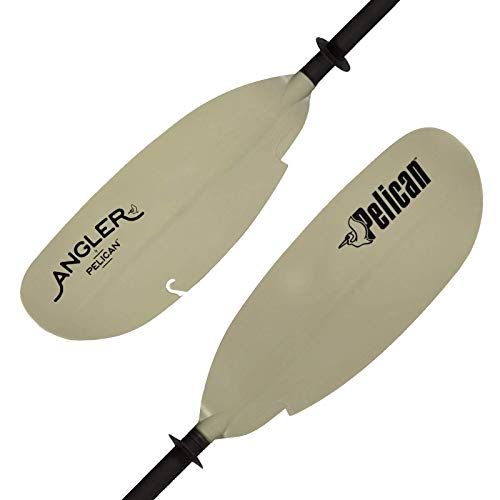
The Poseidon Angler Kayak Paddle is ideal for angler paddlers taller than 5'5". Measuring 98.5” (250cm) long, this paddle is the perfect match for wider fishing kayaks

HANDS-FREE PEDAL POWER: Cover more water with a responsive propeller drive system that delivers instant forward and reverse control for precise maneuvering. This pedal kayak gives you the agility needed for kayak fishing in tight spots, open water, and changing conditions.

SUPER-TOUGH – 3-ply laminate construction combined with SuperStrong enhanced molecular formulation PVC provides superior structural strength and unmatched resistance to damage from abrasion, impact and sunlight, while allowing more pressure for rigidity
Kayak Bass Fishing Tournament vs Boat Tournament Differences
Kayak bass fishing tournaments differ from traditional boat tournaments in access, cost, competition structure, and fishing tactics, with kayak events emphasizing stealth and intimate water access while boat tournaments prioritize speed and covering vast areas. The fundamental distinction is that kayak anglers fish at human-powered speeds (2-4 mph) from low-profile platforms, while boat anglers use motors to cover 10-20+ miles and fish from elevated positions.
Key differences:
| Aspect | Kayak Tournaments | Boat Tournaments |
|---|---|---|
| Entry barrier | $500-2,000 initial investment (kayak + basic gear) | $20,000-70,000+ (boat, motor, trailer, electronics) |
| Tournament format | Catch-photo-release (CPR) | Live weigh-in (most events) |
| Competition area | Fish locally; tournaments span regions | Centralized around weigh-in location |
| Fishing range | 2-10 miles typical per day | 20-50+ miles typical per day |
| Water access | Shallow creeks, ponds, tight cover | Primarily main lakes and rivers |
| Tactics | Stealth, precision, intimate presentations | Speed, electronics, power fishing |
| Physical demand | High (paddling/pedaling all day) | Moderate (standing, casting, boat control) |
| Community size | Growing (thousands of participants) | Established (tens of thousands) |
Tactical advantages of kayak tournaments:
- Stealth approach: Low profile and quiet movement allow closer approaches to spooky fish in clear or pressured waters
- Shallow water access: Kayaks reach backwaters, flooded timber, and skinny flats inaccessible to boats
- Spot-lock precision: Pedal kayaks and anchors enable pinpoint positioning in current or wind
- Intimate water knowledge: Slower speeds encourage thorough coverage of smaller areas, rewarding local knowledge
Tactical advantages of boat tournaments:
- Coverage area: Outboard motors allow sampling multiple locations miles apart in a single day
- Electronics: Larger boats accommodate advanced sonar, mapping, and fish-finding technology
- Weather resilience: Bigger platforms handle wind, waves, and rough conditions better
- Efficiency: Less physical fatigue allows more fishing time and less recovery between casts
Competition dynamics:
Boat tournaments typically feature 100-300 anglers fishing the same lake or river system, creating intense pressure on popular spots and rewarding those who find overlooked areas or dial in precise patterns. Kayak tournaments often span entire states or regions, with anglers fishing their local waters, which reduces direct competition for specific spots but increases variability in fishing conditions and fairness questions.
Choose kayak tournaments if: You prefer affordable entry points, enjoy self-powered outdoor experiences, fish smaller waters or tight cover, or value conservation-focused formats. Kayak tournaments suit anglers who fish 2-4 times monthly and want competitive outlets without boat ownership costs.
Choose boat tournaments if: You already own a bass boat, prioritize covering maximum water, compete in established circuits with larger prize pools, or prefer the tradition and spectacle of live weigh-ins. Boat tournaments suit serious anglers treating fishing as a primary hobby or semi-professional pursuit.
Many anglers participate in both formats, using kayaks for local club events and smaller waters while reserving boat tournaments for major lakes and higher-stakes competitions. The skills transfer well—reading water, understanding bass behavior, and presentation techniques apply equally across platforms.

Fishing rod reel combos with carrier bag and nessary accessories for fishing,include: Two telescopic fishing rods+ Two fishing reels +One carrier bag + fishing lures + some nessary accessories.

MODERATE ACTION: The Zebco Dock Demon spinning combo features a compact 30-inch 1-piece fishing rod that provides medium power and moderate action making it easier to catch light and medium species from panfish to trout, walleye, bass and more

【Easy Install Or Remove From Kayak Track】The unique track mount design makes installing or removing a breeze without using tools, and matches well the track that already had on the kayak or new track you installed.
What Gear Do You Need for Kayak Bass Fishing Tournaments?
Essential gear for kayak bass fishing tournaments includes a stable fishing kayak (sit-on-top or pedal-driven), Coast Guard-approved personal flotation device (PFD), approved measuring board, smartphone with tournament app, tournament identifier card, basic fishing tackle, and safety equipment including whistle and light. Total equipment investment ranges from $800-5,000 depending on kayak choice and electronics.
Mandatory tournament gear:
Kayak and propulsion:
- Sit-on-top fishing kayak: Minimum 10-12 feet long with adequate stability for standing (if desired)
- Paddle or pedal drive: Pedal kayaks (Hobie, Old Town, Bonafide) offer hands-free propulsion but cost $2,000-4,000; paddle kayaks run $500-1,500
- Anchor system: Stake-out pole for shallow water or anchor trolley for deeper areas
Choosing the right fishing kayak length and kayak stability is critical for tournament success and safety.
Safety equipment (required by most tournaments):
- PFD: Coast Guard-approved Type III or V, worn at all times
- Whistle: Attached to PFD
- Light: 360-degree white light for low-light conditions
- First aid kit: Basic supplies
- Communication device: Smartphone or VHF radio
Tournament documentation:
- Measuring board: Hawg Trough, Ketch Board, or other approved brand ($20-40)
- Tournament identifier: Personalized card or number provided by tournament director
- Smartphone: With camera, GPS, and tournament app installed
- Waterproof phone case or mount: RAM mounts or dry bags to protect phone
Fishing tackle (minimum):
- Rods: 2-3 rods covering different techniques (7′ medium-heavy for general use, 7’6″ heavy for flipping, 6’6″-7′ medium for finesse)
- Reels: Baitcasting and/or spinning reels matched to rods
- Terminal tackle: Hooks, weights, soft plastics, hard baits appropriate for local bass
- Tackle storage: Waterproof tackle boxes or bags secured to kayak
- Pliers and tools: For hook removal and tackle management
- Landing net: Optional but helpful for controlling fish during measurement
Recommended but optional gear:
Electronics:
- Fish finder: Garmin, Lowrance, or Humminbird units ($200-1,000+) help locate structure and fish
- GPS mapping: Detailed lake maps for navigation and spot marking
- Battery and power: Lithium batteries to run electronics all day
Comfort and efficiency:
- Upgraded seat: Aftermarket seats improve comfort during 8-hour days
- Rod holders: Multiple holders allow quick tackle changes
- Milk crate or gear storage: Organized storage for tackle, tools, and supplies
- Dry bag: For extra clothes, food, and valuables
- Sun protection: Hat, sunglasses, sunscreen, and UV-protective clothing
What you don’t need initially:
- Expensive pedal drive: Paddle kayaks work fine for beginners; upgrade later if you compete regularly
- High-end electronics: Many successful kayak anglers fish tournaments without fish finders, relying on water reading skills
- Specialized tournament kayak: Any stable fishing kayak suffices; you don’t need the latest $4,000 model
Budget-conscious tournament setup:
- Used paddle fishing kayak: $400-800
- Basic paddle: $50-100
- PFD and safety gear: $75-150
- Measuring board and identifier: $25-50
- Smartphone (you likely own): $0 additional
- Existing fishing tackle: $0-300 if you already fish
- Total: $550-1,400
Premium tournament setup:
- New pedal-drive kayak: $2,500-4,000
- Upgraded seat and accessories: $200-400
- Fish finder with GPS: $400-1,000
- Multiple rods and reels: $500-1,200
- Comprehensive tackle selection: $300-600
- Total: $3,900-7,200
Common mistake: New tournament anglers often over-invest in gear before developing skills. A $500 used kayak with basic tackle can win tournaments if the angler understands bass behavior and fishes efficiently. Focus on learning the format and building skills before upgrading to premium equipment.
For those just starting out, reviewing a comprehensive fishing kayak buying guide helps avoid costly mistakes when selecting your first tournament-ready kayak.

【Partner For Paddles】 Designed to prevent losing your paddle on water, paddle leash is an essential kayak accessory for every paddler. A leash at a nice price but could keep your paddle always secure. Find the perfect partner for your paddles!

Satisfy Your Daily Use: the package contains 6 pieces of fishing lanyards, coming in 2 sizes, 3 pieces for each size, sufficient quantity and different sizes to meet your daily needs and replacements, as well as sharing demands

Crafted with a premium ripstop polyester shell and replaceable EPE foam inside for superior buoyancy. Inside zipper opening for convenient to take out the floating foam to be a super thin and breathable vest.
Are Kayak Bass Fishing Tournaments Good for Beginners?
Kayak bass fishing tournaments are beginner-friendly compared to boat tournaments because of lower costs, accessible entry points through local clubs, and supportive communities that help new anglers learn CPR protocols and tournament procedures. However, beginners should fish 10-20 days from a kayak before entering their first tournament to develop paddling stamina, fish-handling skills, and basic kayak bass fishing techniques.
Why kayak tournaments suit beginners:
- Low financial barrier: Entry fees of $25-75 and minimal required gear make trying tournament fishing affordable
- Local competition: Many tournaments allow fishing your home waters, eliminating travel and unfamiliar venue challenges
- Skill-based competition: Success depends more on fishing knowledge than expensive equipment or boat-handling skills
- Welcoming community: Kayak anglers generally embrace newcomers, sharing tips and encouragement
- Flexible participation: Fish a single event to test the format without committing to full-season memberships
Challenges for beginners:
- Physical demands: Paddling or pedaling 4-8 hours while fishing requires cardiovascular fitness and upper body strength
- Multitasking complexity: Managing kayak positioning, casting, fish fighting, and documentation simultaneously takes practice
- CPR learning curve: Proper fish measurement and photography techniques require practice to avoid disqualifications
- Tournament pressure: Time limits and competition stress can affect decision-making and enjoyment
- Safety considerations: Beginners must understand kayak safety and self-rescue techniques before competing
Preparation steps before your first tournament:
- Build kayak time: Spend 10-20 days fishing from your kayak to develop comfort, stability, and efficient paddling
- Practice CPR: Photograph 10-20 bass on your measuring board at home or during practice sessions to master technique
- Study rules: Read tournament rules thoroughly and watch tutorial videos from your chosen trail
- Scout locations: Pre-fish tournament waters 2-3 times to identify productive areas and develop a game plan
- Test gear: Ensure all equipment works reliably, especially phone mounts, measuring boards, and tournament apps
- Join local clubs: Attend club meetings or online forums to ask questions and learn from experienced anglers
Realistic first-tournament expectations:
Most beginners don’t finish in the money during their first 2-3 tournaments. Common first-event outcomes include:
- Catching 1-2 keeper bass instead of a full limit
- Disqualifying one fish due to photo errors
- Struggling with time management and fishing efficiency
- Finishing in the middle or bottom third of the field
- Learning valuable lessons about tournament strategy and preparation
Success indicators for beginners:
- Submitting a legal catch (even if only 1-2 fish)
- Avoiding disqualifications or rule violations
- Completing the full tournament day without exhaustion or safety issues
- Identifying specific improvements for the next event
- Enjoying the experience enough to want to compete again
Choose your first tournament wisely:
- Start with: Small local club events (20-40 anglers) on familiar waters during comfortable weather
- Avoid initially: Major trail championships, unfamiliar venues, or extreme weather conditions (very hot or cold)
Common mistake: Beginners sometimes enter their first tournament on unfamiliar water during peak summer heat, leading to exhaustion, frustration, and poor performance. Stack the odds in your favor by choosing a comfortable, familiar first event.
For those new to the sport entirely, building foundational skills through beginner kayak fishing resources before competing helps ensure a positive first tournament experience.
Common Mistakes in Your First Kayak Bass Fishing Tournament
First-time kayak tournament anglers commonly make mistakes including improper fish measurement photos, poor time management, inadequate hydration and nutrition, fishing too far from launch sites, and failing to practice CPR protocols before competition day. These errors often result in disqualified fish, incomplete limits, or exhaustion that ruins the tournament experience.
Photo and measurement errors:
- Fish not flush against zero-end: Leaving gaps between the fish’s mouth and the measuring board’s zero-end stop adds length illegally
- Tail not pinched properly: Failing to pinch the tail to maximum length (without damage) costs measurement
- Unclear photos: Poor lighting, blurry images, or obstructed measurement markings lead to disqualification
- Missing identifier: Forgetting to include your tournament card or number in the photo disqualifies the catch
- Photographing outside boundaries: Taking photos after paddling outside tournament boundaries results in disqualification
Solution: Practice photographing 10-20 bass before tournament day. Set up your phone mount or camera position in advance. Take multiple photos of each keeper fish from slightly different angles to ensure at least one meets all requirements.
Time management failures:
- Fishing too long in unproductive areas: Spending 2-3 hours in a spot without bites wastes valuable tournament time
- Running out of time for submission: Catching fish in the final minutes but failing to photograph and upload before the deadline
- Underestimating paddle/pedal time: Fishing too far from the check-in point and running late
- Neglecting to upgrade: Keeping your first three fish instead of continuing to fish for larger replacements
Solution: Set phone alarms for key time checkpoints (2 hours in, halfway, 1 hour remaining, 30 minutes remaining). Plan to stop fishing 15-30 minutes before the deadline to ensure photo submission time. If you haven’t caught fish in 45-60 minutes, move to a new location.
Physical preparation mistakes:
- Inadequate hydration: Failing to drink enough water leads to fatigue, poor decision-making, and potential heat illness
- Insufficient food: Not eating enough calories during 8-hour tournaments causes energy crashes
- Wrong clothing: Overdressing in heat or underdressing in cold creates discomfort and distraction
- No sun protection: Sunburn and sun exposure ruin concentration and cause long-term skin damage
Solution: Pack 2-3 liters of water, high-protein snacks, and electrolyte drinks. Wear moisture-wicking layers appropriate for conditions. Apply sunscreen before launch and reapply every 2 hours.
Strategic errors:
- Fishing too far from launch: Paddling 5+ miles from the launch site leaves you exhausted and limits fishing time
- Ignoring weather changes: Failing to adjust tactics when wind, clouds, or temperature shift
- Sticking with unproductive techniques: Throwing the same lure for hours without bites instead of experimenting
- Fishing only “famous” spots: Competing with multiple anglers on obvious locations instead of finding overlooked areas
Solution: Plan a 2-4 mile fishing circuit from your launch point. Bring versatile tackle covering multiple techniques (topwater, crankbaits, soft plastics, jigs). Be willing to change approaches every 30-45 minutes if you’re not getting bites.
Safety and equipment mistakes:
- Not wearing PFD: Some beginners remove PFDs for comfort, violating rules and risking disqualification or worse
- Dead phone battery: Failing to charge your phone fully or bring backup power
- Forgotten measuring board: Leaving essential equipment at home or in the vehicle
- Inadequate anchor system: Drifting away from productive spots due to poor anchoring
Solution: Create a pre-tournament checklist covering all required gear. Charge all devices the night before. Test your anchor system during pre-fishing.
Edge case – what if you catch a potential winning fish in the final minutes? Prioritize photo quality over submission speed. A slightly late submission with a perfect photo might receive a minor penalty but still place high, while a rushed, unclear photo will be disqualified entirely. However, know your tournament’s late-submission penalties—some trails disqualify any late entries, while others deduct length per minute.
How to Measure and Photograph Bass in Kayak Tournaments
Measuring and photographing bass for kayak tournaments requires placing the fish flat on an approved measuring board with its mouth closed against the zero-end stop, pinching the tail to maximum length without damage, and capturing a clear photo showing the entire fish, measurement markings, and tournament identifier in good lighting. The process must be completed quickly—ideally within 30-60 seconds—to minimize fish stress and ensure healthy release.
Step-by-step measurement process:
Prepare before catching fish:
- Mount your phone or camera in a stable position with a clear view of your measuring board
- Place your measuring board in an accessible location (many anglers use their lap or a flat area between their legs)
- Have your tournament identifier card ready and visible
- Set your phone camera to photo mode (not video) with sufficient storage space
Land the fish safely:
- Use a landing net if needed to control the fish
- Wet your hands before handling to protect the fish’s slime coat
- Keep the fish in water as much as possible until ready to photograph
Position the fish on the board:
- Lay the fish flat on its side on the measuring board
- Press the fish’s mouth firmly but gently against the zero-end stop (the closed end of the board)
- Ensure the mouth is completely closed—no gaps between lips and stop
- Keep the fish’s body straight along the centerline of the board
Pinch the tail properly:
- Gently squeeze the tail fin to its maximum natural length
- Do not stretch or damage the tail—pinch only to remove natural curl
- The tail should form a straight line from body to tip
- Some boards have a pinch point or guide to help with proper tail positioning
Capture the photo:
- Ensure your tournament identifier is visible in the frame
- Check that measurement markings are clearly readable
- Verify the entire fish from mouth to tail is in frame
- Confirm good lighting without shadows obscuring measurements
- Take 2-3 photos from slightly different angles as backup
Release the fish immediately:
- Gently place the fish back in the water
- Support it upright until it swims away strongly
- If the fish appears stressed, hold it facing into current or move it gently forward and backward to push water through its gills
Common photo mistakes and fixes:
| Mistake | Why It’s Disqualified | Fix |
|---|---|---|
| Gap between mouth and stop | Adds illegal length | Press mouth firmly against stop; check before shooting |
| Tail not pinched | Loses legitimate length | Gently squeeze tail to remove curl |
| Blurry image | Measurements unreadable | Use burst mode or take multiple shots; ensure adequate light |
| Identifier missing | Can’t verify tournament entry | Always include your card in frame; check before releasing fish |
| Shadows on measurements | Can’t confirm length | Adjust angle or wait for better light; use phone flash if needed |
| Fish curved or bent | Measurement inaccurate | Straighten fish along board centerline |
Lighting considerations:
- Best: Overcast days or shaded areas provide even lighting without harsh shadows
- Good: Early morning or late afternoon with sun behind you
- Challenging: Midday sun creates harsh shadows; angle your board to minimize shadows on measurement markings
- Solution for poor light: Use your phone’s flash or LED light to illuminate the board, but avoid washing out the measurement markings
Board positioning tips:
Many successful tournament anglers develop a consistent setup:
- Lap method: Place the board across your lap with the zero-end toward your dominant hand for easy fish positioning
- Between-legs method: Position the board on the kayak deck between your legs for stability
- Crate method: Use a milk crate or tackle box as a stable platform for the board
Practice drill: Before your first tournament, practice the complete process 10-20 times at home using a fish-shaped object (even a banana or zucchini works). Time yourself to build speed and develop muscle memory for the photo sequence.
Edge case – what if the fish won’t stay still? Some bass thrash during measurement, making clean photos difficult. Gently cup your hand over the fish’s eyes to calm it, or wait 5-10 seconds for it to settle before attempting the photo. Never force a fish into position—if it’s too active, take a moment to let it calm down. A few extra seconds of handling is better than a disqualified photo.
Understanding proper fishing techniques helps you land fish more efficiently, reducing handling time and stress during the measurement process.
What Happens If You Capsize During a Kayak Fishing Tournament?
If you capsize during a kayak fishing tournament, your immediate priority is self-rescue and safety—tournament rules universally allow you to exit the water, recover your kayak, and either continue fishing or withdraw without penalty. Most tournaments require you to report capsizes to tournament directors, and any fish caught before the capsize remain valid for scoring if they were properly photographed and submitted before the incident.
Immediate capsize response:
- Stay calm and assess: Determine if you’re injured and whether you can self-rescue or need assistance
- Secure yourself: Ensure your PFD is functioning and you’re floating safely
- Locate your kayak: Most fishing kayaks float even when swamped; swim to your kayak if it drifts
- Recover essential gear: Prioritize retrieving your paddle, phone (if waterproof), and PFD if it came off
- Re-enter or swim to shore: Perform a self-rescue re-entry if you’ve practiced the technique, or swim your kayak to shore
Tournament-specific considerations:
- Previously caught fish: Any bass you photographed and submitted before capsizing count toward your score—you don’t lose them
- Continuing competition: You may continue fishing after recovering if you’re physically able and have time remaining
- Reporting requirements: Most tournaments require reporting capsizes to directors via phone or app, both for safety tracking and rule compliance
- Equipment loss: Lost gear (rods, tackle, electronics) is your responsibility; tournaments don’t provide replacements or compensation
- Disqualification factors: Capsizing itself doesn’t disqualify you unless you violate other rules (fishing outside boundaries while recovering, receiving motorized assistance within tournament boundaries, etc.)
Safety protocols:
- Call for help if needed: Don’t hesitate to use your phone or whistle to signal for assistance if you’re injured, exhausted, or in dangerous conditions
- Motorized assistance: Accepting a tow from a motorboat to shore typically doesn’t disqualify you, but check your specific tournament rules—some require you to paddle/pedal under your own power at all times
- Medical attention: If you need medical care, withdraw from the tournament; your health is more important than competition
Preventing capsizes:
- Know your limits: Don’t stand in unstable kayaks or rough conditions
- Anchor carefully: Improper anchoring in current or wind is a common capsize cause; always anchor from the bow and deploy slowly
- Manage weight shifts: Move deliberately when reaching for gear or landing fish; avoid sudden movements
- Respect weather: High winds, waves, or storms dramatically increase capsize risk; consider withdrawing if conditions exceed your skill level
What to do with your phone:
- Waterproof case: If your phone is in a quality waterproof case, it should survive a capsize
- Dry bag: Phones stored in dry bags typically stay dry if the bag is properly sealed
- No protection: An unprotected phone will likely be damaged or lost; consider this a lesson for future tournaments
- Backup plan: Some anglers carry a backup phone or waterproof camera for emergencies
Post-capsize decision:
After recovering from a capsize, assess whether to continue:
Continue fishing if:
- You’re physically uninjured and not exhausted
- You have sufficient time remaining (at least 2-3 hours)
- Your essential gear (paddle, measuring board, phone) is recovered
- Weather conditions are safe
Withdraw if:
- You’re injured, exhausted, or shaken
- You’ve lost critical equipment (paddle, phone, measuring board)
- Weather conditions remain dangerous
- You have less than 1-2 hours remaining and no fish caught yet
Common mistake: Some anglers continue fishing after capsizing despite exhaustion or lost gear, leading to poor performance, additional safety risks, or disqualification due to missing equipment. It’s better to withdraw safely and compete another day than to push through dangerous conditions.
Edge case – what if you capsize while holding a fish you haven’t photographed yet? The fish is lost and doesn’t count toward your score. This is one reason experienced anglers photograph fish immediately after landing them rather than keeping them in a live well or on a stringer—capsizes, though rare, can happen at any moment.
For more information on staying safe on the water, review kayak capsize recovery techniques and practice them before competing.
KBF Tournament Trail vs Other Kayak Bass Fishing Formats
Kayak Bass Fishing (KBF) is the largest and most established kayak tournament trail in North America, featuring a catch-photo-release format where anglers fish their local waters and submit their best three bass via smartphone app, competing against thousands of participants across multiple states simultaneously. Alternative formats include regional trails with traditional weigh-ins, team tournaments, and specialty events, each offering different competition structures, prize pools, and community experiences.
KBF format characteristics:
- Geographic scope: National and international events with anglers fishing their home waters
- Scoring: Best three bass measured to the nearest 0.25 inch
- Entry fees: $50-100 for regular events; $150-200 for championship qualifiers
- Membership: $75-100 annual membership required
- Season structure: Monthly online tournaments plus regional and national championships
- Prize pools: $5,000-50,000+ depending on event size
- Technology: TourneyX app for submissions and real-time leaderboards
B.A.S.S. Kayak Series format:
- Geographic scope: Regional events at specific venues (similar to traditional bass tournaments)
- Scoring: Best five bass measured to the nearest 0.25 inch
- Entry fees: $150-250 per event
- Membership: B.A.S.S. membership required ($50-75 annually)
- Season structure: 6-8 regional events leading to championship
- Prize pools: $10,000-30,000 per event
- Format: CPR with in-person check-in at designated venues
Regional and local club formats:
- Geographic scope: Single lake, river, or local area
- Scoring: Varies—some use best three, others best five; some still use traditional weigh-ins
- Entry fees: $25-75 per event
- Membership: Club membership typically $25-50 annually
- Season structure: Monthly or bi-monthly events, often March-November
- Prize pools: $500-3,000 depending on participation
- Community: Strong local connections and mentorship opportunities
Team tournament formats:
- Structure: Two-person teams combine their catches for total score
- Scoring: Typically best three fish per angler (six fish total per team)
- Entry fees: $50-150 per team
- Strategy: Partners can share water, tactics, and support each other
- Social aspect: Appeals to anglers who prefer collaborative competition
Specialty formats:
- Big bass tournaments: Score based on single largest fish only
- Species-specific: Smallmouth-only or spotted bass-only events
- Multi-species: Include other species (pike, walleye) for variety
- Charity events: Fundraising tournaments with relaxed rules and community focus
Choosing the right format:
Choose KBF if:
- You want to fish your local waters without traveling
- You prefer competing against a large national field
- You value flexible scheduling (fish anytime during tournament hours)
- You’re comfortable with technology and smartphone apps
Choose B.A.S.S. Kayak Series if:
- You want to fish premier venues across your region
- You prefer in-person events with community atmosphere
- You’re willing to travel for tournaments
- You value the B.A.S.S. brand and potential pathways to higher-level competition
Choose local clubs if:
- You’re new to tournament fishing and want mentorship
- You prefer smaller, more personal competition
- You want to build local fishing community connections
- You’re on a tight budget
Choose team formats if:
- You enjoy collaborative competition
- You want to learn from a more experienced partner
- You prefer the social aspects of tournament fishing
- You want to share costs and logistics
Can you fish multiple trails? Yes, many anglers participate in KBF, local clubs, and regional trails simultaneously. However, this requires significant time and financial investment—expect to spend $1,000-2,500 annually on entry fees and memberships alone if fishing multiple circuits.
Common mistake: New tournament anglers sometimes join multiple trails immediately, spreading themselves too thin financially and logistically. Start with one trail or local club for your first season, then expand once you understand your preferences and commitment level.
Do You Need a Fishing License for Kayak Bass Tournaments?
Yes, you need a valid fishing license for the state(s) where you’re competing in kayak bass tournaments, and some multi-state events require licenses for multiple jurisdictions. Tournament participation doesn’t exempt you from standard fishing regulations, and fishing without proper licensing can result in disqualification, fines, and potential bans from future events.
License requirements:
- State fishing license: Required for the state where you’re fishing, regardless of your residency
- Resident vs. non-resident: You’ll pay higher fees for non-resident licenses if fishing outside your home state
- Freshwater endorsement: Some states require specific freshwater or bass fishing stamps in addition to base licenses
- Tournament exemptions: Very few states offer tournament-specific exemptions; assume you need a standard license
Multi-state tournament considerations:
For trails like KBF where you fish your local waters, you only need a license for your home state. For regional trails where you travel to specific venues, you may need licenses for multiple states:
- Example: A Texas angler fishing a B.A.S.S. Kayak Series event in Oklahoma needs both Texas and Oklahoma licenses if they practice in Texas waters and compete in Oklahoma
Cost considerations:
- Resident annual license: $20-50 in most states
- Non-resident annual license: $50-150 in most states
- Short-term licenses: Some states offer 1-day, 3-day, or 7-day licenses for $10-30, useful for single-event travel
Where to purchase:
- State wildlife agency websites: Most states offer online license purchases with instant digital delivery
- Retail locations: Sporting goods stores, bait shops, and some big-box retailers sell licenses
- Mobile apps: Many states have official apps for license purchase and storage
Verification and enforcement:
- Tournament check: Some tournament directors verify licenses during check-in or randomly audit participants
- Law enforcement: Game wardens may check licenses during tournaments; violations result in citations and tournament disqualification
- Self-reporting: Most tournaments operate on the honor system but require you to certify you hold valid licenses when registering
Special situations:
- Military exemptions: Some states offer free or discounted licenses for active-duty military and veterans
- Senior discounts: Many states provide reduced-cost licenses for anglers over 60-65
- Disability exemptions: Some states offer free licenses for anglers with disabilities
- Youth licenses: Reduced-cost or free licenses for anglers under 16-18 (age varies by state)
What happens if you fish without a license?
- Tournament consequences: Immediate disqualification and forfeiture of entry fees
- Legal consequences: Fines ranging from $100-500+ depending on state
- Trail consequences: Potential suspension or ban from future events
- Reputation damage: Tournament communities are tight-knit; license violations damage your standing
Common mistake: Anglers sometimes let licenses expire mid-season or forget to purchase non-resident licenses when traveling to events. Set calendar reminders for license renewals and verify requirements for each tournament location well in advance.
Edge case – what if you’re fishing on a multi-state border water? Some lakes and rivers form state boundaries (Lake Texoma, Kentucky Lake, etc.). In these situations, you typically need licenses for both states unless a reciprocal agreement exists. Check specific regulations for the water body—some border waters have special rules allowing fishing with either state’s license.
For more information on licensing and registration requirements, review kayak laws and watercraft registration resources for your state.
How Long Do Kayak Bass Fishing Tournaments Last?
Kayak bass fishing tournaments typically last 6-8 hours of fishing time during daylight hours, with most events running from early morning (6:00-7:00 AM start) to early afternoon (2:00-3:00 PM finish). Total time commitment including travel, launch preparation, and post-tournament activities ranges from 10-14 hours for a single event day.
Standard tournament timeline:
5:00-6:00 AM – Arrival and preparation:
- Arrive at launch site 30-60 minutes before start time
- Unload kayak and gear
- Complete final equipment checks
- Check in via tournament app using GPS verification
- Attend any pre-tournament briefings (if required)
6:00-7:00 AM – Tournament start:
- Launch at designated start time (varies by tournament and season)
- All anglers must be on the water and fishing within the start window
- Late launches may result in penalties or disqualification
6:00 AM-2:00 PM – Competition hours (typical 8-hour event):
- Fish anywhere within tournament boundaries
- Photograph and submit catches throughout the day
- Manage time, location changes, and strategy
- Monitor weather and adjust tactics
2:00-2:30 PM – Tournament end and submission deadline:
- Stop fishing at designated end time
- Submit all photos within 15-30 minutes (varies by tournament)
- Late submissions result in penalties or disqualification
- Return to launch area (some tournaments require GPS check-out)
2:30-4:00 PM – Post-tournament:
- Load kayak and gear
- Review results as they’re posted
- Attend awards ceremony if held on-site (many trails post results online only)
- Socialize with other anglers
Variations by tournament type:
Short-format tournaments (4-6 hours):
- Common for local club events or extreme weather conditions
- Typically 7:00 AM-12:00 PM or 8:00 AM-2:00 PM
- Faster-paced with less time for location changes
Standard tournaments (6-8 hours):
- Most common format for regional and national trails
- Allows time for strategic location changes and pattern development
- Balances competition with physical demands
Extended tournaments (10-12 hours):
- Rare in kayak fishing due to physical demands
- Sometimes used for championship events
- May include dawn-to-dusk fishing windows
Multi-day tournaments:
- Championship events sometimes span 2-3 days
- Each day is a separate 6-8 hour competition
- Cumulative scoring across all days determines winners
- Requires significant time commitment and physical endurance
Seasonal timing variations:
- Summer tournaments: Often start earlier (5:30-6:00 AM) to maximize cooler morning fishing and avoid afternoon heat
- Spring/fall tournaments: May start later (7:00-8:00 AM) with later finish times
- Winter tournaments: Rare in northern states; southern events may run shorter hours due to cold
Time management strategies:
First 2 hours (6:00-8:00 AM):
- Focus on high-percentage areas you pre-fished
- Establish a pattern and catch your first 1-2 fish
- Don’t waste time in unproductive spots
Middle 4 hours (8:00 AM-12:00 PM):
- Upgrade your catch by targeting larger fish
- Explore secondary locations if your primary spots aren’t producing
- Adjust tactics based on weather and fish behavior
Final 2 hours (12:00-2:00 PM):
- Make strategic decisions about location changes vs. staying put
- Ensure you have time to photograph and submit catches
- Stop fishing 15-30 minutes before deadline to guarantee submission time
Physical preparation:
An 8-hour tournament requires significant physical endurance:
- Paddling/pedaling: 4-8 miles of propulsion depending on your fishing style
- Casting: 200-400+ casts throughout the day
- Sun exposure: Full day outdoors, often with limited shade
- Sitting: Extended periods in kayak seat with limited position changes
Common mistake: New tournament anglers often underestimate the physical demands and fade in the final 2-3 hours, missing opportunities to upgrade their catch or failing to submit photos on time due to exhaustion. Build your fitness through regular kayak fishing sessions before competing.
Edge case – what if weather forces early termination? Tournament directors may shorten or cancel events due to dangerous weather (lightning, high winds, extreme temperatures). If a tournament is shortened after starting, your catches up to the new end time count. If canceled before starting, entry fees are typically refunded or applied to future events.
Frequently Asked Questions
Can you fish kayak bass tournaments from an inflatable kayak?
Yes, you can fish kayak bass tournaments from an inflatable kayak as long as it meets basic safety requirements (stable platform, proper flotation) and you can effectively fish from it. Many successful tournament anglers use high-quality inflatable fishing kayaks like those from Sea Eagle or Advanced Elements. However, inflatables may be less efficient for covering water compared to hard-shell kayaks, and you’ll need to ensure your model accommodates a measuring board and provides stable photo-taking positions.
What’s the minimum bass size for most kayak tournaments?
Most kayak bass fishing tournaments set a 12-inch minimum length for bass to count toward your score, though some events use 13-inch or 15-inch minimums depending on the fishery and local regulations. Always check your specific tournament rules before competing, as minimum lengths vary by trail and location. Fish under the minimum are disqualified and may result in penalties if submitted.
Do you have to release every bass you catch in CPR tournaments?
Yes, catch-photo-release (CPR) tournaments require you to release every bass immediately after photographing it on your measuring board. Keeping bass in live wells, on stringers, or in any containment violates CPR rules and results in disqualification. The only exception is if a bass dies during the catch-and-release process; some tournaments allow submitting dead fish with length penalties (typically 2-4 inches deducted), while others disqualify dead fish entirely.
Can you pre-fish tournament waters before the event?
Yes, pre-fishing is allowed and encouraged in most kayak bass fishing tournaments. Anglers commonly scout tournament waters days or weeks before competition to identify productive areas, test techniques, and develop game plans. However, you cannot pre-fish on tournament day before the official start time, and some championship events restrict pre-fishing to specific time windows. Always check your tournament’s pre-fishing rules.
What happens if two anglers tie for first place?
Tournament tiebreakers typically follow this order: (1) longest single fish, (2) second-longest fish, (3) third-longest fish, and so on. If anglers remain tied after comparing all fish, some tournaments use submission time (earlier submission wins), while others may award co-champion status and split prize money. Specific tiebreaker rules vary by trail and should be clearly stated in tournament rules.
Can you use a trolling motor on a kayak in tournaments?
Most kayak bass fishing tournaments prohibit electric trolling motors and require human-powered propulsion only (paddle or pedal drive). This rule maintains the “kayak” nature of the competition and ensures fair competition. However, some specialty events or local clubs may allow motors—always verify your specific tournament’s propulsion rules before competing.
Are there age restrictions for kayak bass fishing tournaments?
Most kayak bass fishing tournaments require participants to be at least 18 years old due to liability and safety concerns. However, many trails offer youth divisions (typically ages 13-17) with parental consent and supervision requirements. Some family-friendly events allow younger children to compete with adult partners. Check your specific tournament’s age requirements and youth division availability.
How do tournament directors verify catches are legitimate?
Tournament directors verify catches through photo review (checking measurement accuracy, proper fish positioning, and identifier presence), GPS data from tournament apps (confirming photos were taken within boundaries and time limits), and community oversight (anglers reporting suspicious submissions). Patterns of unusually large catches, inconsistent photo metadata, or reports from other anglers trigger investigations. Proven cheating results in disqualification, prize forfeiture, and bans from future events.
Can you fish with a partner or from a tandem kayak?
Standard kayak bass fishing tournaments require solo competition from single-person kayaks. However, some trails offer team divisions where partners fish from separate kayaks and combine their catches for scoring. Tandem fishing kayaks are generally not allowed in standard divisions but may be permitted in specialty or adaptive divisions. Check your tournament’s rules regarding partnerships and kayak types.
What’s the best time of year to start tournament fishing?
Spring (March-May) and fall (September-November) offer the best conditions for beginning tournament anglers because of comfortable temperatures, active bass feeding patterns, and less extreme weather. Summer tournaments can be physically demanding due to heat, while winter events are limited in northern regions. Start your tournament career during moderate weather seasons to build skills and confidence before tackling more challenging conditions.
Do you need a fish finder to be competitive?
No, you don’t need a fish finder to be competitive in kayak bass fishing tournaments, especially on smaller waters or if you have strong water-reading skills and local knowledge. Many successful tournament anglers fish without electronics, relying on visual cues, structure identification, and bass behavior understanding. However, fish finders provide advantages on larger, unfamiliar waters by helping locate structure, depth changes, and fish. Consider electronics an enhancement rather than a requirement, especially when starting out.
How much money do top kayak tournament anglers make?
Top kayak bass fishing tournament anglers can earn $20,000-100,000+ annually through prize winnings, though most competitors don’t profit after accounting for entry fees, travel, and equipment costs. Elite anglers supplement tournament winnings with sponsorships, guide services, content creation, and product sales. The vast majority of kayak tournament anglers compete for enjoyment and modest prizes rather than as a primary income source. Treat tournament fishing as an expensive hobby unless you reach the top 1-2% of competitors.
Conclusion
Kayak bass fishing tournament format centers on catch-photo-release competition where anglers fish from human-powered kayaks, measure their bass on standardized boards, and submit photos digitally for scoring based on total length. This accessible format has democratized competitive bass fishing by eliminating the need for expensive boats while promoting conservation through immediate fish release.
Whether you’re considering your first tournament or looking to understand what is kayak bass fishing tournament format more deeply, the key is starting with local club events on familiar waters. Invest time practicing CPR protocols, building your physical endurance through regular kayak fishing sessions, and studying the specific rules of your chosen trail before competing.
Your next steps:
- Research local tournaments: Search for kayak bass fishing clubs and trails in your region; most have Facebook groups or websites with event calendars
- Attend as a spectator: Visit a tournament launch or check-in to observe the process and talk with experienced anglers
- Practice CPR: Spend 2-3 fishing sessions photographing bass on a measuring board to master the technique
- Verify your gear: Ensure you have all required equipment including PFD, measuring board, tournament identifier, and a reliable smartphone
- Pre-fish your first venue: Scout the water 2-3 times before your first tournament to build confidence and identify productive areas
- Register for a beginner-friendly event: Choose a small local tournament on familiar water during comfortable weather for your first competition
The kayak bass fishing tournament community welcomes newcomers and values sportsmanship, conservation, and shared passion for the sport. With proper preparation and realistic expectations, your first tournament can be the start of a rewarding competitive fishing journey that combines outdoor adventure, skill development, and camaraderie with fellow anglers.