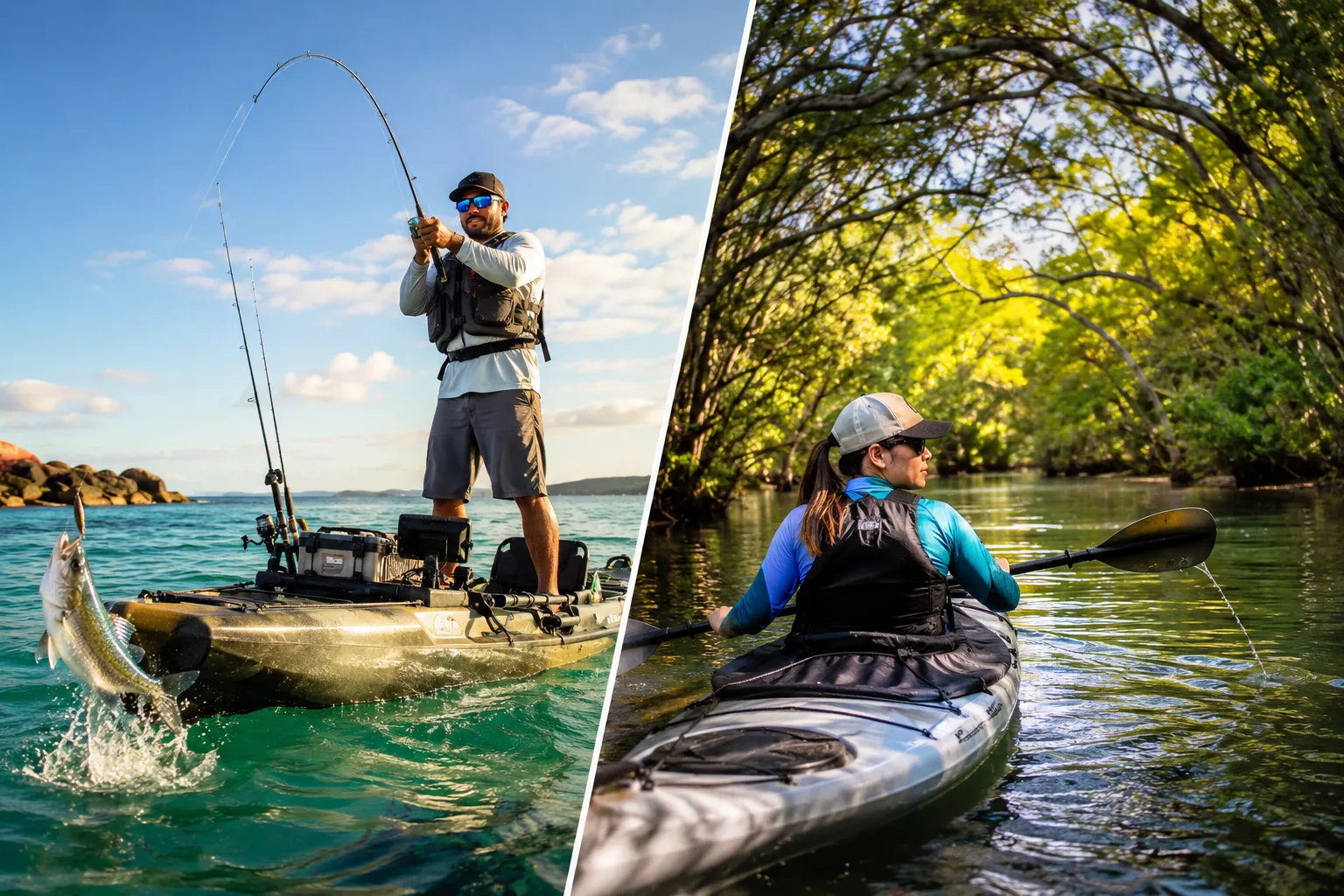
Quick Answer: Sit-on-top kayaks are generally better for fishing because they offer easier entry and exit, better stability for standing, simpler self-rescue after capsizing, and more accessible gear storage. Sit-inside kayaks excel in cold weather, rough water, and situations requiring speed and efficiency, but their enclosed cockpit limits fishing mobility and complicates gear access.
Key Takeaways
- Sit-on-top kayaks provide superior stability, easier re-entry after capsizing, and better gear accessibility, making them ideal for warm-weather fishing
- Sit-inside kayaks keep you drier and warmer, making them the better choice for cold-water fishing and challenging conditions
- Standing while fishing is practical only in sit-on-top models with widths of 32 inches or more
- Sit-inside kayaks tip over less frequently but are much harder to re-enter and drain when they do capsize
- Most professional tournament anglers use sit-on-top kayaks for their versatility and fishing-specific features
- Sit-on-top models cost $400-$3,000+ while comparable sit-inside fishing kayaks range $300-$2,500
- Saltwater anglers overwhelmingly prefer sit-on-top kayaks due to self-draining scupper holes and corrosion-resistant designs
- Your local climate and target water conditions matter more than any single feature when choosing between styles
What Is the Difference Between Sit-On-Top and Sit-Inside Kayaks?
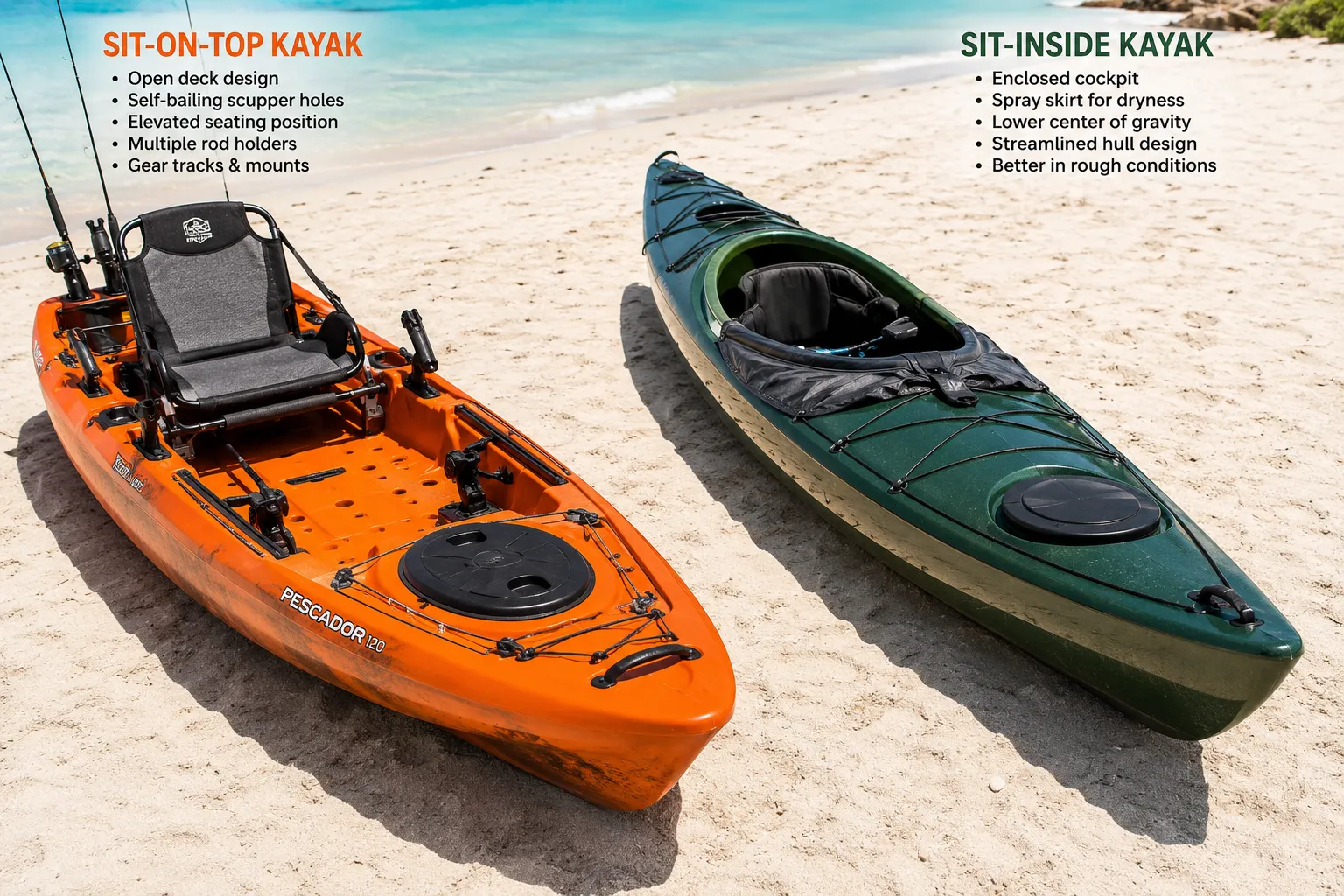
Sit-on-top kayaks have an open deck where you sit on top of the hull with your legs exposed, while sit-inside kayaks feature an enclosed cockpit where you sit inside the hull with your legs covered. This fundamental design difference affects everything from stability to storage to safety.
Sit-on-top kayaks feature:
- Molded seat on top of a sealed hull
- Scupper holes that drain water automatically
- Open deck with gear tracks and mounting points
- Wider beam (typically 30-36 inches)
- Self-bailing design
- Easier entry and exit
Sit-inside kayaks feature:
- Cockpit opening with a seat inside the hull
- Enclosed leg area that stays dry
- Spray skirt compatibility
- Narrower profile (typically 24-30 inches)
- Dry storage hatches
- Lower center of gravity
The choice between these designs determines how you’ll interact with your kayak every time you fish. Sit-on-top models feel more like a floating platform, while sit-inside kayaks feel more like wearing the boat.
Common mistake: Assuming sit-inside kayaks are always faster. While they’re generally more efficient for long-distance paddling, modern fishing-specific sit-on-tops with pedal drives can match or exceed the speed of recreational sit-inside kayaks.
Which Kayak Is More Stable for Fishing: Sit-On-Top or Sit-Inside?
Sit-on-top kayaks are more stable for fishing because their wider beam and higher center of gravity create greater initial stability, which is what you feel when the kayak is flat on the water. This design allows anglers to shift weight, reach for gear, and fight fish without constantly worrying about tipping.
Stability comparison:
Initial stability (resistance to tipping when flat):
- Sit-on-top: Excellent, wide, flat hull design
- Sit-inside: Good to moderate, narrower beam
Secondary stability (resistance to capsizing when tilted):
- Sit-on-top: Good, recovers well from lean
- Sit-inside: Excellent, lower center of gravity helps
For fishing, initial stability matters most because you’re constantly moving, casting, reeling, and handling fish. A sit-on-top kayak’s width (often 32-36 inches) provides a stable platform that forgives movement.
Sit-inside kayaks have better secondary stability, meaning they’re less likely to capsize once they start leaning. This makes them excellent for rough water and ocean paddling, but the narrower design means you need to be more careful with weight shifts while fishing.
Choose sit-on-top if: You plan to stand, fish in calm to moderate conditions, or want to move around frequently.
Choose sit-inside if: You’re paddling in rough water, prioritize speed over stability, or fish exclusively while seated.
Are Sit-On-Top Kayaks Better for Beginners Who Want to Fish?
Yes, sit-on-top kayaks are significantly better for beginners who want to fish because they’re easier to enter and exit, more forgiving of balance mistakes, simpler to re-board after falling off, and less intimidating overall. The open design eliminates the claustrophobic feeling some new paddlers experience in sit-inside cockpits.
Why beginners prefer sit-on-tops:
- No fear of entrapment, you can’t get stuck inside
- Simpler re-entry, climb back on from the side in seconds
- Intuitive balance, feels like sitting on a floating chair
- Easier launching, step on and sit down
- Visible gear, everything stays in sight and reach
- Confidence-building, stable platform reduces anxiety
New anglers already have enough to learn about casting, fish behavior, and water safety. A sit-on-top kayak removes the additional learning curve of managing a spray skirt, executing wet exits, or mastering the balance required in narrower sit-inside models.
The self-draining scupper holes mean beginners don’t need to worry about bailing water or dealing with a swamped cockpit. Water that splashes in simply drains out through the bottom.
Edge case: If you’re a beginner planning to fish exclusively in cold water (below 60°F), the learning curve of a sit-inside kayak might be worth it for the warmth and dryness it provides. Consider taking a basic kayaking course first.
Can You Stand Up in a Sit-On-Top Kayak While Fishing?
Yes, you can stand up in most fishing-specific sit-on-top kayaks that are 32 inches wide or wider, and many are specifically designed with standing platforms, non-slip deck pads, and enhanced stability for sight-fishing and casting. However, standing requires practice and isn’t safe in all water conditions.
Requirements for standing:
- Kayak width of at least 32 inches (34+ is better)
- Flat, stable hull design
- Non-slip deck padding
- Calm to light chop conditions
- Good core strength and balance
- Proper foot positioning (shoulder-width stance)
Modern fishing sit-on-tops like the Hobie Pro Angler, Old Town Sportsman, and Bonafide SS127 are engineered for standing. They feature:
- Wide, flat standing platforms
- Textured deck surfaces
- Lower seat positions for better center of gravity
- Pontoon-style hulls for maximum stability
Standing advantages:
- Better sight-fishing visibility
- Improved casting distance and accuracy
- Ability to work topwater lures effectively
- Easier hook-setting on long casts
- More comfortable for long fishing sessions
When not to stand:
- Wind over 10-15 mph
- Waves or boat wakes
- When fighting large fish
- In current or moving water (until experienced)
- During the learning phase
Start by practicing standing in shallow water near shore. Use a paddle as an outrigger for balance, and always wear your PFD. Most anglers find they can stand confidently after 3-5 practice sessions.
You cannot safely stand in sit-inside kayaks due to the enclosed cockpit and narrower beam. The cockpit rim creates a tripping hazard, and the design isn’t meant for standing.
Do Sit-Inside Kayaks Tip Over Easier When Fishing?
Sit-inside kayaks don’t necessarily tip over easier when fishing, but they feel less stable during the movements fishing requires, and when they do capsize, the consequences are far more serious. The narrower beam and enclosed cockpit make weight shifts more noticeable and recovery more complicated.
Tipping comparison:
Likelihood of capsizing:
- Sit-inside: Lower in skilled hands, higher for beginners
- Sit-on-top: Moderate, but less consequential
Recovery difficulty:
- Sit-inside: Very difficult, requires advanced skills
- Sit-on-top: Easy, climb back on in 30 seconds
The real issue isn’t whether sit-inside kayaks tip easier, but what happens when they do. A capsized sit-inside kayak fills completely with water and requires either a paddle float rescue, T-rescue with a partner, or towing to shore. Your gear often ends up at the bottom of the lake.
A capsized sit-on-top kayak floats right-side-up, drains through scupper holes, and can be re-boarded immediately by climbing on from the side. Gear secured with bungees or leashes stays with the boat.
Fishing movements that challenge stability:
- Reaching for gear behind you
- Fighting a fish that runs to one side
- Netting or landing a fish
- Turning to cast in different directions
- Leaning to unhook a snag
Sit-inside kayaks require more disciplined body mechanics during these movements. Experienced paddlers compensate with hip movements and core engagement, but beginners often overcorrect and increase instability.
Choose sit-inside if: You’re an experienced paddler, fish in rough conditions where the enclosed cockpit provides protection, or prioritize speed over fishing-specific stability.
What Happens If a Sit-Inside Kayak Flips While Fishing?
If a sit-inside kayak flips while fishing, the cockpit fills completely with water (often 50-100+ gallons), making the kayak extremely heavy and nearly impossible to re-enter without assistance or advanced rescue skills. Most fishing gear not secured in dry hatches will sink or float away, and you’ll likely need to swim the swamped kayak to shore or wait for rescue.
Immediate consequences:
- Full cockpit flooding, the enclosed space becomes a water tank
- Gear loss, tackle boxes, rods, and electronics can sink
- Heavy kayak, water-filled hull weighs hundreds of extra pounds
- Difficult re-entry, standard climbing techniques don’t work
- Potential hypothermia, especially in cold water
- Exhaustion risk, swimming a swamped kayak is physically demanding
Recovery options:
Paddle float rescue (requires practice):
- Attach paddle float to paddle blade
- Create outrigger for stability
- Pump or bail water from cockpit
- Carefully re-enter while balanced
- Success rate for beginners: Low
T-rescue (requires partner):
- Partner positions kayak perpendicular
- Lifts bow to drain water
- Stabilizes for re-entry
- Success rate: High with trained partner
Swim to shore (most common):
- Secure paddle and any floating gear
- Swim kayak to nearest shore
- Drain and restart
- Time required: 15-60+ minutes depending on distance
Prevention strategies:
- Always wear a properly fitted PFD
- Secure all gear with leashes or in dry hatches
- Practice wet exits in controlled conditions
- Paddle with a partner when possible
- Know your limits and water conditions
- Consider a sit-on-top for fishing if you’re not confident in rescue skills
The enclosed cockpit that keeps you dry in normal conditions becomes a liability during capsize. This is the single biggest reason experienced kayak anglers choose sit-on-top designs for fishing.
Best Kayak Type for Saltwater Fishing
Sit-on-top kayaks are overwhelmingly the best choice for saltwater fishing because their self-draining scupper holes handle waves and spray automatically, the open deck resists corrosion better than enclosed spaces, and the wider platform provides stability in ocean swells and tidal currents. Nearly all saltwater-specific fishing kayaks use sit-on-top designs.
Why sit-on-tops dominate saltwater:
Self-bailing design:
- Scupper holes drain waves and spray instantly
- No need to bail or pump water
- Cockpit can’t flood during rough conditions
- Handles following seas without swamping
Corrosion resistance:
- Open design allows thorough rinsing
- No hidden spaces where saltwater pools
- Better air circulation prevents mold
- Easier to inspect for damage
Fishing functionality:
- Room for large coolers and fish bags
- Multiple rod holders for trolling
- Standing capability for sight-fishing
- Easy access to gear while fighting fish
Saltwater-specific features to look for:
- Marine-grade hardware (stainless steel or aluminum)
- UV-resistant polyethylene hull
- Sealed hatches for dry storage
- Anchor trolley system
- Rod holders positioned for trolling
- Tank well for cooler or live well
- Paddle or pedal drive options
Popular saltwater sit-on-top models:
- Hobie Pro Angler series (pedal drive)
- Old Town Sportsman PDL
- Jackson Coosa HD
- Bonafide SS127/SS107
- Native Watercraft Slayer Propel
Sit-inside kayaks in saltwater:
While some experienced paddlers use sit-inside kayaks for saltwater fishing in protected bays or calm conditions, they’re poorly suited for ocean fishing. A wave breaking over the bow can fill the cockpit, and the enclosed spaces trap salt that accelerates corrosion.
Exception: Sea kayaks (a specialized sit-inside design) work for saltwater fishing in rough conditions, but they’re designed for expedition paddling, not fishing. They lack the stability, gear capacity, and fishing features that dedicated fishing kayaks provide.
For inshore fishing, flats fishing, nearshore ocean fishing, or any saltwater application, a sit-on-top kayak is the clear winner.
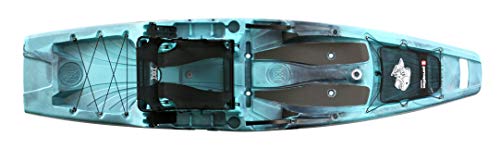
Ultimate Fishing & Storage Space: Perception Outlaw 11.5 is a fishing-optimized sit on top kayak with superior stability and an impressive weight capacity of 425 lbs. It boasts a large rear tankwell and front storage area for all your fishing and personal gear.

UV-Protected HDPE Construction for Durability: Built with high-density polyethylene (HDPE) plastic, this kayak is both lightweight and highly durable, offering long-lasting protection against UV rays for years of use in various conditions. Paddle included.

Ergolounge seating system : Extra-thick cushioning and an extra high and wide padded backrest.
Which Kayak Has More Storage Space for Fishing Gear?
Sit-on-top kayaks typically offer more accessible storage space for fishing gear with large open tank wells, deck rigging, and gear tracks, while sit-inside kayaks provide more protected dry storage in sealed hatches but with less capacity and harder access. For fishing, accessible storage beats protected storage in most situations.
Sit-on-top storage:
Tank wells (rear and sometimes front):
- Large open areas for coolers, crates, or bags
- Secured with bungee rigging
- Capacity: 20-40+ liters
- Access: Immediate, no opening required
Deck rigging:
- Bungee cords across deck
- Gear tracks for accessories
- Rod holders (2-4+ positions)
- Paddle clips and tool holders
Dry hatches:
- Sealed compartments in hull
- Capacity: 10-30 liters per hatch
- Access: Requires opening screw or twist hatches
- Protection: Waterproof for electronics and valuables
Total gear capacity: 60-100+ liters of usable space
Sit-inside storage:
Dry hatches:
- Bow and stern sealed compartments
- Capacity: 40-80 liters total
- Access: Must reach behind seat or in front
- Protection: Excellent waterproofing
Cockpit space:
- Limited area around seat
- Gear bags between legs
- Small items only
- Gets wet from drips and spray
Deck rigging:
- Minimal bungees on deck
- Limited mounting points
- Smaller surface area
Total gear capacity: 40-60 liters, mostly inaccessible while fishing
What this means for fishing:
Sit-on-top kayaks let you carry:
- Large tackle boxes or crates
- Full-size coolers for fish and drinks
- Multiple rod and reel combos
- Landing nets, gaffs, and tools
- Anchor and rope
- Safety gear and extra clothing
Everything stays within arm’s reach while you’re fishing. You can grab a different lure, switch rods, or access your fish finder without stopping.
Sit-inside kayaks force you to:
- Pack light and prioritize essentials
- Store most gear in inaccessible hatches
- Keep only immediate-use items in cockpit
- Stop fishing to access stored gear
Choose sit-on-top if: You fish all day, target multiple species requiring different tackle, or want to bring lunch, drinks, and comfort items.
Choose sit-inside if: You’re a minimalist angler, fish short sessions, or prioritize keeping a few valuable items completely dry.
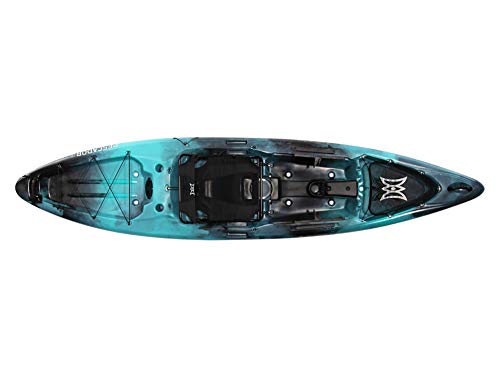
Premium Fishing Experience: The Perception Pescador Pro 12 is a sit-on-top kayak designed for the recreational angler. Equipped with a large front and rear storage area, it provides ample space for all your fishing gear and personal items.

Gear rails: Equipped with 4-inch rigging tracks to set up your favorite accessories.

How Much Do Fishing Kayaks Cost: Sit-On-Top vs Sit-Inside?
Fishing-specific sit-on-top kayaks cost $400-$3,500+ with most quality models in the $800-$1,800 range, while sit-inside kayaks suitable for fishing cost $300-$2,500 with fewer fishing-specific features at any price point. Pedal-drive sit-on-tops represent the premium category at $2,500-$5,000+.
Sit-on-top fishing kayak prices:
Budget ($400-$800):
- Basic rotomolded designs
- Limited features
- Heavier weight (70-90 lbs)
- Examples: Lifetime Tamarack, Sun Dolphin Journey
Mid-range ($800-$1,800):
- Fishing-specific features
- Rod holders and gear tracks
- Better stability and comfort
- Weight: 60-80 lbs
- Examples: Perception Pescador, Vibe Sea Ghost, Crescent Lite Tackle
Premium ($1,800-$3,500):
- Advanced hull designs
- Standing stability
- Extensive rigging options
- Premium seats and accessories
- Weight: 70-100 lbs
- Examples: Bonafide SS127, Jackson Coosa HD, Old Town Sportsman
Pedal drive ($2,500-$5,000+):
- Hands-free propulsion
- Tournament-level features
- Maximum fishing functionality
- Weight: 90-130 lbs
- Examples: Hobie Pro Angler, Old Town PDL, Native Slayer Propel
Sit-inside kayak prices:
Budget ($300-$600):
- Recreational designs
- Minimal fishing features
- Examples: Pelican Argo, Sun Dolphin Aruba
Mid-range ($600-$1,200):
- Better tracking and speed
- Some fishing adaptations
- Examples: Wilderness Systems Pungo, Perception Carolina
Premium ($1,200-$2,500):
- Touring designs
- High-quality materials
- Limited fishing focus
- Examples: Current Designs Kestrel, Delta Kayaks 12S
Cost factors:
- Material: Rotomolded polyethylene (cheaper) vs thermoformed ABS (lighter, more expensive)
- Features: Rod holders, fish finders, anchor systems add $200-$800
- Propulsion: Pedal drives add $1,500-$2,000 to base price
- Brand: Premium brands charge 20-40% more for reputation and warranty
Hidden costs to budget:
- Paddle: $50-$300
- PFD: $40-$150
- Anchor system: $30-$100
- Rod holders (additional): $20-$60 each
- Fish finder: $150-$800
- Cart for transport: $60-$200
Best value: Mid-range sit-on-top kayaks ($800-$1,200) offer the best balance of fishing features, durability, and cost for most anglers. You get fishing-specific design without paying for premium brand markup or pedal drive complexity.

Powerful & Responsive Propeller Drive System: Take control with our smooth kayak propeller drive system, offering hands-free power, quiet acceleration, and easy reverse maneuvering. Perfect for tight spaces, docks, or mangrove fishing

Quality Construction: Constructed of uv-protected high-density polyethylene. Multiple footrest positions for different size riders. Stable flat bottom

A multi chine flat bottom hull ensures the stability needed when casting lines and reeling in fish.
Are Sit-On-Top Kayaks Too Wet for Cold Weather Fishing?
Yes, sit-on-top kayaks are significantly wetter and colder for cold-weather fishing because water constantly drains through scupper holes and across the deck, soaking your lower body and exposing you to wind chill. For water temperatures below 60°F or air temperatures below 50°F, sit-inside kayaks with spray skirts provide much better protection.
Why sit-on-tops are cold:
Constant water exposure:
- Scupper holes allow water up through the bottom
- Waves and spray wash across deck
- Your seat and clothing get wet
- No protection from wind
- Evaporative cooling increases heat loss
Lower body immersion:
- Legs and feet sit in water that drains through
- Wet clothing loses insulating value
- Difficult to stay dry even with rain gear
Wind chill:
- Exposed position catches full wind
- Wet clothing amplifies cooling
- No windbreak or shelter
Sit-inside advantages in cold weather:
Dry cockpit:
- Spray skirt seals out water
- Legs stay completely dry
- Enclosed space traps body heat
- Protection from wind
Layering effectiveness:
- Dry insulation maintains warmth
- Can wear lighter, more mobile clothing
- Less bulk needed for same warmth
Cold-weather sit-on-top strategies:
If you must use a sit-on-top in cold conditions:
- Wear a wetsuit or drysuit, not regular clothing
- Neoprene boots, keep feet warm when wet
- Waterproof layers, rain jacket and pants minimum
- Plug scupper holes, reduces water coming up from below
- Shorter sessions, limit exposure time
- Know the 120 rule, air temp + water temp should exceed 120°F for safety
The 120 Rule: If air temperature plus water temperature is less than 120°F, you’re at risk for cold water shock and hypothermia. A drysuit or wetsuit becomes essential, not optional.
Example: 50°F air + 55°F water = 105°F total (dangerous without immersion protection)
Choose sit-inside if: You fish in water below 60°F, fish during late fall through early spring, or fish in locations with cold water year-round (mountain lakes, northern regions).
Choose sit-on-top if: You fish in warm climates, summer only, or are willing to invest in a wetsuit or drysuit for cold-weather sessions.
Many serious kayak anglers own both styles: a sit-on-top for warm-weather fishing and a sit-inside for cold-weather sessions.
Is a Sit-Inside Kayak Better for River Fishing?
Sit-inside kayaks are often better for river fishing in moving water, narrow channels, and technical conditions because their lower profile cuts through current more efficiently, the enclosed cockpit protects from splashes and obstacles, and the narrower beam allows easier maneuvering in tight spaces. However, sit-on-tops work well for slow rivers and creeks.
When sit-inside kayaks excel on rivers:
Fast current and rapids:
- Lower profile reduces wind resistance
- Better tracking in current
- Spray skirt keeps water out
- More responsive to paddle strokes
Narrow channels:
- Slimmer beam (24-28 inches) fits tight spots
- Easier to navigate around logs and rocks
- Better control in confined spaces
Cold mountain streams:
- Stays dry when water is frigid
- Protection from splashes
- Better for extended trips
Long-distance river trips:
- More efficient paddling
- Less fatigue over miles
- Better gear protection in hatches
When sit-on-tops work for rivers:
Slow to moderate current:
- Stability matters more than speed
- Easier to fish while drifting
- Simple to beach and re-launch
Warm-weather fishing:
- Getting wet is refreshing, not dangerous
- Easy to cool off
- Simple to re-enter if you swim
Obstacle-heavy rivers:
- Can slide over logs more easily
- Less consequence if you hit rocks
- No cockpit to fill with water
River-specific considerations:
Maneuverability:
- Shorter kayaks (10-12 feet) turn easier
- Sit-inside designs generally more nimble
- Rocker (curved hull) helps in current
Safety:
- Sit-on-tops allow instant exit if needed
- Sit-inside requires wet exit skills
- Both need proper PFD and safety gear
Fishing style:
- Drift fishing: Sit-on-top (easier to manage gear)
- Paddle and fish: Sit-inside (more efficient)
- Anchor and fish: Sit-on-top (more stable platform)
Best compromise: A shorter (10-12 foot) sit-on-top kayak with good tracking offers versatility for most river fishing situations. You get stability for fishing with enough maneuverability for current.
Choose sit-inside if: You’re paddling technical rivers, fishing cold water, or covering long distances between fishing spots.
Choose sit-on-top if: You’re fishing slow to moderate rivers, want maximum fishing platform stability, or fish in warm conditions.
Can Tall People Fish Comfortably in Sit-Inside Kayaks?
Tall people (over 6’2″) can fish comfortably in sit-inside kayaks only if they choose models with large cockpit openings (at least 20 x 50 inches) and adjustable footrests, but most will find sit-on-top kayaks more comfortable because there are no cockpit dimensions limiting leg extension or entry and exit. Leg length matters more than height.
Sit-inside challenges for tall anglers:
Cockpit dimensions:
- Standard cockpits: 18 x 45 inches (too small)
- Large cockpits: 20 x 50+ inches (workable)
- Legs must fit under deck
- Knees may hit cockpit rim
Entry and exit:
- Longer legs make getting in awkward
- Must fold body more to enter
- Exiting requires more flexibility
- Can feel cramped or trapped
Footrest position:
- Some kayaks don’t extend far enough
- Legs can’t fully extend
- Uncomfortable for long sessions
- Reduced paddling power
Sit-inside models for tall anglers:
If you’re tall and prefer sit-inside:
- Wilderness Systems Tsunami 145, 21 x 54-inch cockpit
- Perception Carolina 14, 20 x 51-inch cockpit
- Delta Kayaks 15.5, 21 x 55-inch cockpit
- Current Designs Kestrel 140, 20 x 52-inch cockpit
Look for kayaks 14+ feet long with “large” or “keyhole” cockpit designs.
Sit-on-top advantages for tall anglers:
Unlimited leg room:
- Legs extend naturally
- No cockpit walls
- Can shift position freely
- Stand up when needed
Easy entry:
- Step on and sit down
- No contortion required
- Simple to get in and out
Adjustability:
- Seats often slide or adjust
- Footrests accommodate any length
- Can customize positioning
Comfort factors:
Inseam matters most:
- 34+ inch inseam: Sit-on-top strongly recommended
- 32-34 inch inseam: Large cockpit sit-inside possible
- Under 32 inch inseam: Either style works
Weight distribution:
- Taller anglers have higher center of gravity
- Wider sit-on-tops compensate better
- Sit-inside kayaks may feel tippier
Test before buying:
- Sit in the kayak on land
- Check knee clearance
- Verify footrest reach
- Simulate entry and exit
- Spend 10+ minutes seated
Most tall anglers who try both styles prefer sit-on-tops for fishing. The open design eliminates the cramped feeling and provides better fishing mobility.
Common Mistakes When Choosing a Fishing Kayak
The most common mistake when choosing between sit-on-top and sit-inside kayaks for fishing is prioritizing the wrong features based on YouTube videos or reviews instead of honestly assessing your local water conditions, climate, and fishing style. Many anglers buy the wrong kayak type and regret it within the first season.
Top mistakes:
1. Ignoring local water temperature
- Buying a sit-on-top for year-round fishing in cold climates
- Expecting to stay dry in 50°F water
- Not considering the 120 Rule
- Fix: Check average water temps for your fishing season
2. Overestimating stability needs
- Buying the widest kayak possible
- Sacrificing speed and efficiency
- Getting a barge that’s exhausting to paddle
- Fix: Test kayaks 32-34 inches wide first; most anglers don’t need wider
3. Underestimating transport challenges
- Buying a 90+ lb kayak without considering how to move it
- Not accounting for roof rack limitations
- Ignoring storage space at home
- Fix: Measure your vehicle, test lifting the kayak, plan storage before buying
4. Choosing based on standing ability alone
- Assuming you must stand to catch fish
- Buying an oversized kayak for occasional standing
- Not practicing standing before committing
- Fix: Most fishing happens seated; standing is a bonus, not a requirement
5. Buying too much kayak as a beginner
- Starting with a $3,000+ pedal drive
- Overwhelming yourself with features
- Not knowing what you actually need yet
- Fix: Start mid-range ($800-$1,200), upgrade later with experience
6. Ignoring the capsize recovery test
- Not considering what happens when you flip
- Assuming you won’t capsize
- Buying sit-inside without learning rescue skills
- Fix: Practice capsizing in shallow water before fishing deep water
7. Focusing on length over width
- Buying a 14-foot kayak for “speed”
- Sacrificing stability for tracking
- Getting a kayak too long for your waters
- Fix: For fishing, width and stability matter more than length for most anglers
8. Not testing before buying
- Buying online without sitting in the kayak
- Trusting specs without real-world feel
- Assuming all kayaks fit the same
- Fix: Demo kayaks at local shops or rental facilities
9. Forgetting about accessories
- Budgeting only for the kayak
- Not accounting for paddle, PFD, anchor, etc.
- Underestimating total cost by $300-$800
- Fix: Budget 30-40% extra for essential accessories
10. Choosing style over function
- Buying the “cool” kayak instead of the practical one
- Prioritizing color over features
- Following trends instead of needs
- Fix: Make a list of must-have features before shopping
The right approach:
- Assess your conditions: Water temp, typical weather, water type (lake, river, ocean)
- Define your fishing style: Seated vs standing, short vs long trips, species targeted
- Set a realistic budget: Include accessories and safety gear
- Test multiple styles: Rent or demo before buying
- Consider the worst case: What happens if you capsize?
- Think long-term: Will this kayak grow with your skills?
Most anglers who choose the wrong kayak type make the decision based on what looks cool or what their favorite YouTuber uses, rather than what actually fits their fishing conditions and skill level.
Do Professional Fishermen Use Sit-On-Top or Sit-Inside Kayaks?
Professional kayak tournament anglers overwhelmingly use sit-on-top kayaks, with an estimated 95%+ of competitive fishing kayaks being sit-on-top designs equipped with pedal drives, advanced electronics, and extensive rigging. Sit-inside kayaks are virtually absent from professional kayak fishing tournaments because fishing efficiency and platform stability outweigh any paddling advantages.
Why pros choose sit-on-top:
Tournament requirements:
- Need to cover water quickly (pedal drives)
- Must access multiple rods instantly
- Standing for sight-fishing is essential
- Require space for large coolers (culling fish)
- Need stable platform for hook-sets and fish fighting
Professional features:
- Pedal drives: Hands-free propulsion for constant fishing
- Electronics: Large fish finders and GPS units
- Rod storage: 4-6+ rod holders for different techniques
- Stability: Standing capability for better visibility
- Customization: Extensive gear tracks and mounting points
Popular professional models:
- Hobie Pro Angler 12/14, MirageDrive pedal system
- Old Town Sportsman PDL, PDL Drive pedal system
- Native Watercraft Slayer Propel, Propel pedal drive
- Bonafide RS117/SS127, paddle or motor-ready
- Jackson Coosa FD, Flex Drive pedal system
Tournament circuits:
Major kayak fishing tournaments like Kayak Bass Fishing (KBF), Hobie Bass Open Series (B.O.S.), and regional trails are dominated by high-end sit-on-top kayaks. Competitors invest $3,000-$6,000+ in their fishing platforms.
Professional priorities:
- Efficiency: Pedal drives allow fishing while moving
- Versatility: Can fish multiple techniques in one day
- Comfort: Long tournament days (8-12 hours)
- Capacity: Carry everything needed for any situation
- Reliability: Proven designs that won’t fail mid-tournament
Sit-inside in professional fishing:
You’ll rarely see sit-inside kayaks in competitive fishing because:
- Can’t accommodate pedal drives easily
- Limited gear capacity
- No standing capability
- Difficult to manage multiple rods
- Slower gear access
- Higher risk if capsized with expensive electronics
Exception: Some professional guides in cold-water regions use sit-inside kayaks for client trips focused on paddling and scenery rather than pure fishing efficiency, but this is guiding, not competitive fishing.
What this means for recreational anglers:
You don’t need a $5,000 tournament kayak to catch fish. Professionals use extreme setups because they’re competing for prize money and sponsorships. A $1,000-$1,500 sit-on-top kayak will handle 95% of recreational fishing situations perfectly.
However, the professional preference for sit-on-top designs does validate that this style is superior for serious fishing applications. If the best anglers in the world choose sit-on-tops, there’s a reason.
Sit-On-Top vs Sit-Inside Kayaks: Which Is Better for Fishing? Final Decision Framework
Choose a sit-on-top kayak if you:
- Fish in water temperatures above 60°F most of the year
- Want the ability to stand while fishing
- Prioritize easy gear access and storage capacity
- Fish in saltwater or coastal environments
- Are a beginner or intermediate paddler
- Want simple self-rescue after capsizing
- Fish in calm to moderate conditions
- Value fishing platform stability over paddling efficiency
Choose a sit-inside kayak if you:
- Fish in cold water (below 60°F) regularly
- Prioritize staying dry and warm
- Paddle long distances between fishing spots
- Fish narrow rivers or technical water
- Are an experienced paddler comfortable with wet exits
- Fish in rough or challenging conditions
- Prefer a minimalist, lightweight approach
- Don’t need to stand or move around much while fishing
The 80/20 rule: For 80% of recreational kayak anglers, a sit-on-top kayak is the better choice. The versatility, ease of use, safety, and fishing-specific features outweigh the advantages of sit-inside designs for most fishing applications.
Frequently Asked Questions
Can you convert a sit-inside kayak into a fishing kayak?
Yes, you can add rod holders, fish finders, and anchor systems to sit-inside kayaks, but the narrow beam and enclosed cockpit will still limit fishing mobility and gear access. It’s a workable solution for occasional fishing but not ideal for dedicated anglers.
Are inflatable kayaks good for fishing?
Inflatable sit-on-top kayaks can work for fishing in calm, protected waters, but they lack the stability, durability, and customization options of hard-shell kayaks. They’re best for anglers with storage or transport limitations who fish casually.
How wide should a fishing kayak be for stability?
Fishing kayaks should be at least 30 inches wide for seated fishing and 32-34+ inches wide if you plan to stand. Wider is more stable but harder to paddle, so balance your needs.
Can you fish from a tandem kayak?
Yes, tandem sit-on-top kayaks work well for fishing with a partner or solo (using the rear seat for better weight distribution). They offer extra stability and gear capacity but are harder to transport and maneuver.
Do you need a rudder or skeg on a fishing kayak?
Rudders and skegs help with tracking in wind and current but aren’t essential for fishing. Sit-on-top fishing kayaks often have good tracking built into the hull design. Pedal-drive kayaks usually include rudders for steering.
What’s better for fishing: a kayak or a canoe?
Kayaks are generally better for fishing than canoes because they sit lower in the water (less affected by wind), are more stable when seated, and offer better gear mounting options. Canoes excel for carrying large loads or fishing with multiple people.
How long do fishing kayaks last?
Quality polyethylene fishing kayaks last 10-15+ years with proper care (UV protection, storage out of sun, regular cleaning). The hull lasts longer than accessories like seats, bungees, and hatches, which may need replacement every 5-7 years.
Can you add a motor to a sit-on-top kayak?
Yes, many sit-on-top fishing kayaks are motor-ready or can be retrofitted with electric trolling motors. Popular options include Minn Kota, MotorGuide, and Torqeedo motors mounted on the stern or in motor wells.
Are pedal kayaks worth the extra cost for fishing?
Pedal kayaks ($2,500-$5,000) are worth it for serious anglers who fish frequently, cover large areas, or fish in current and wind. For casual anglers fishing small ponds or protected waters, a paddle kayak ($800-$1,500) is sufficient.
What safety gear do you need for kayak fishing?
Essential safety gear includes a Coast Guard-approved PFD (worn, not stored), whistle, paddle leash, bilge pump or sponge, first aid kit, communication device (phone in dry bag or VHF radio), and appropriate clothing for water temperature.
Can you fish at night from a kayak?
Yes, you can fish at night from a kayak if you have proper navigation lights (white 360-degree light visible from 2 miles), wear a PFD, stay in familiar waters, and fish with a partner when possible. Check local regulations for required lighting.
How do you transport fish you catch in a kayak?
Transport fish using a stringer clipped to the kayak (in water), a fish bag in the tank well, or a small cooler with ice secured to the deck. Keep fish alive on a stringer or on ice immediately after catching.
Conclusion
The sit-on-top vs sit-inside kayak decision for fishing comes down to your specific conditions and priorities, but for most anglers, sit-on-top kayaks offer the better fishing experience. Their stability, gear accessibility, easy self-rescue, and fishing-specific features outweigh the efficiency and dryness advantages of sit-inside designs.
Your next steps:
- Assess your primary fishing conditions, water temperature, weather, and water type
- Set a realistic budget, $800-$1,500 for quality entry to mid-range fishing kayaks
- Demo before buying, rent or test paddle both styles in real fishing conditions
- Start with essential accessories, quality paddle, PFD, and basic rigging
- Practice safety skills, capsize recovery, re-entry, and cold-water precautions
- Join local kayak fishing groups, learn from experienced anglers in your area
If you’re still unsure, start with a mid-range sit-on-top kayak in the 32-34 inch width range. This gives you the versatility to fish seated or standing, handles most conditions well, and provides a stable platform while you develop your skills. You can always add a specialized kayak later as your experience and preferences become clearer.
The best fishing kayak is the one that gets you on the water consistently and safely. Choose based on your real-world conditions, not what looks cool or what pros use, and you’ll spend more time fishing and less time fighting your equipment.