Quick Answer
Kayak weight capacity ratings are technically accurate for keeping you afloat, but they’re dangerously misleading for real-world paddling. Manufacturers list the maximum weight before a kayak sinks, not the weight at which it performs well. For safe, enjoyable paddling with proper handling and stability, you should stay 30-35% below the listed maximum capacity, and that includes your body weight, gear, and any fish you catch.
Key Takeaways
- Manufacturer weight limits measure flotation, not performance, a kayak at max capacity will float but handle terribly
- Subtract 30-35% from the listed capacity to find the real usable weight limit for safe paddling
- Gear weight adds up fast, fishing equipment, coolers, and safety gear can easily total 40-80 pounds
- Heavier paddlers need wider kayaks, beam width matters more than length for weight capacity and stability
- Sit-on-top kayaks typically handle weight better than sit-inside models due to their hull design and higher volume
- Exceeding the performance limit causes poor tracking, sluggish handling, water over the deck, and increased capsize risk
- Test a loaded kayak in calm water first before venturing into current, wind, or waves
- Your safety margin shrinks in rough conditions, what works on a calm lake becomes dangerous in chop or current
What Does Kayak Weight Capacity Actually Mean?
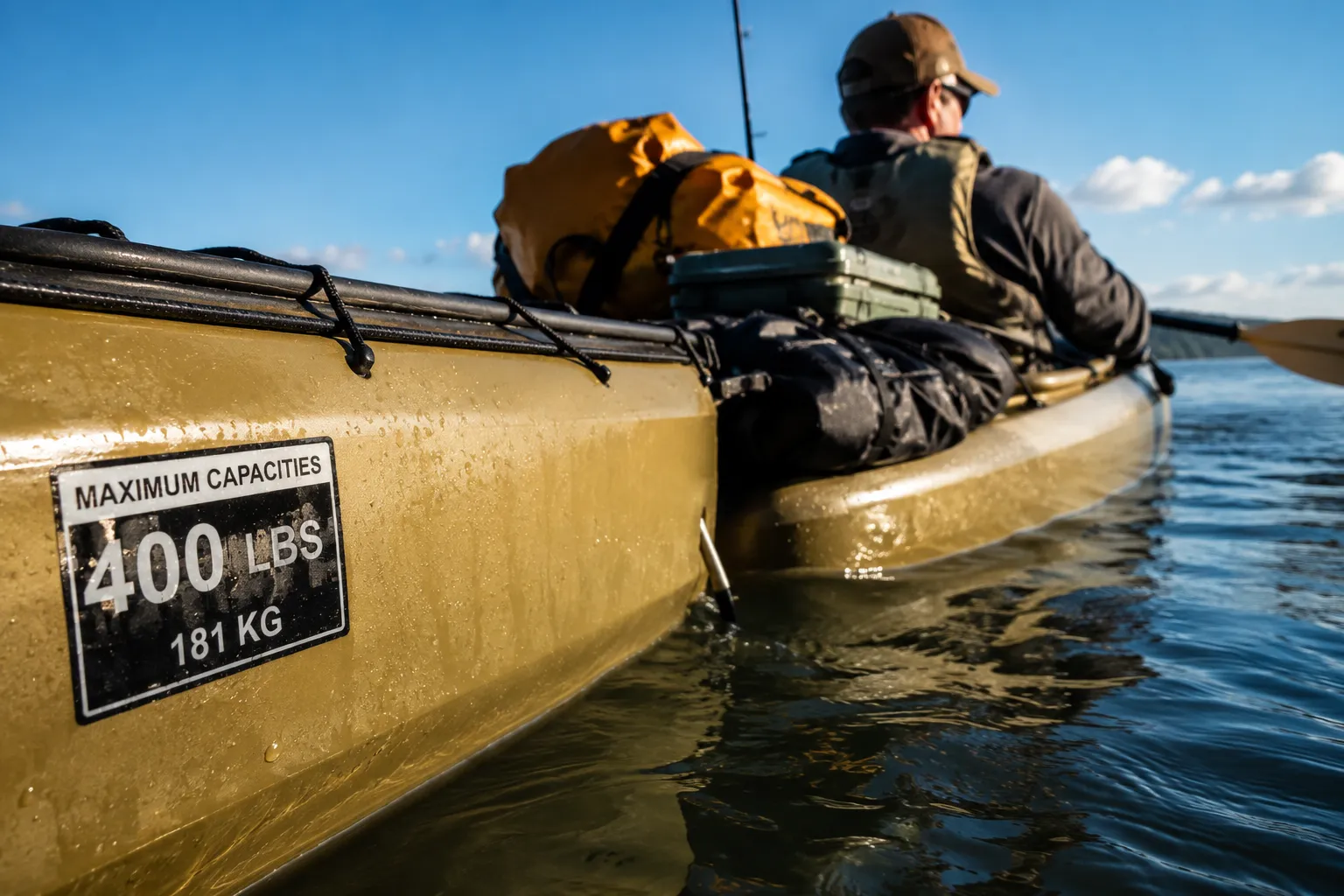
Kayak weight capacity is the maximum total weight a kayak can support while remaining buoyant and not sinking. This number includes the paddler’s body weight, all gear, equipment, clothing, and anything else you load into or onto the kayak.
Manufacturers determine this rating through flotation calculations based on the kayak’s volume and hull displacement. They’re measuring the point at which the kayak’s gunwales (top edges) reach the waterline and the boat can no longer support additional weight without taking on water.
Here’s what the capacity rating includes:
- Your body weight (with wet clothes and shoes)
- Paddle, life vest, and safety equipment
- Fishing rods, tackle boxes, and bait
- Coolers with food and drinks
- Dry bags with extra clothing
- Anchor, anchor trolley, and rope
- Fish finders, batteries, and electronics
- Any fish you catch during your trip
The problem is that this number tells you when the kayak will sink, not when it will stop paddling well. A kayak loaded to its maximum capacity will technically float, but it will sit so low in the water that every small wave washes over the deck, steering becomes nearly impossible, and stability drops dramatically.
Common mistake: Paddlers often forget to account for gear weight when checking if they’re within capacity. A 200-pound angler might see a 300-pound capacity and think they have 100 pounds to spare, but after adding 60 pounds of fishing gear, they’re already at 260 pounds with no margin for safety or performance.
Why Is Kayak Weight Capacity Misleading?
Kayak weight capacity numbers are misleading because manufacturers list the absolute maximum flotation limit, not the weight at which the kayak actually performs safely or handles well. This creates a dangerous gap between what the number suggests and what you’ll experience on the water.
The rating system prioritizes legal liability over paddler experience. Manufacturers want to advertise the highest possible number to make their kayaks seem more capable, and they’re technically not lying since the kayak will float at that weight. But floating and paddling are two completely different things.
Why manufacturers use maximum flotation numbers:
- Marketing advantage, higher numbers look better in comparison charts
- Legal protection, they can claim the kayak didn’t sink, so they met their stated capacity
- No industry standard, there’s no regulated testing method for “performance capacity”
- Covers liability, if you stay under the listed weight and have problems, that’s a handling issue, not a capacity failure
When you load a kayak to its maximum capacity, several problems emerge immediately. The kayak sits lower in the water, reducing freeboard (the distance from the waterline to the deck). This means waves and wakes wash over the deck constantly. The hull’s designed waterline changes, affecting how the kayak tracks and turns. Stability decreases because you’re sitting higher relative to the water’s surface, raising your center of gravity.
Real-world example: A kayak rated for 400 pounds might perform beautifully with a 180-pound paddler and 40 pounds of gear (220 total). Load that same kayak with a 250-pound paddler and 80 pounds of gear (330 total), and you’re still 70 pounds under capacity, but the kayak will feel sluggish, unstable, and difficult to control. Add any wind or current, and it becomes genuinely dangerous.
The truth is that kayak weight capacity explained (why the number lies) comes down to the difference between engineering limits and practical performance. Engineers calculate when physics says the boat will sink. Paddlers need to know when the boat will handle poorly, tire them out, or put them at risk.
How Much Gear Weight Should I Subtract From Kayak Capacity?
Subtract 40-80 pounds from your kayak’s capacity for gear before calculating if your body weight fits safely. Fishing kayaks typically require more gear than recreational paddling, and that weight accumulates faster than most people expect.
Typical fishing kayak gear weights:
- Fishing rods and reels: 5-10 pounds (2-4 rods)
- Tackle boxes and bags: 10-20 pounds when fully loaded
- Cooler with ice and drinks: 15-25 pounds
- Anchor and rope: 8-15 pounds
- Life vest (PFD): 2-3 pounds
- Paddle: 2-4 pounds
- Dry bag with extra clothes: 5-8 pounds
- Fish finder and battery: 8-12 pounds
- Safety kit and first aid: 3-5 pounds
- Catch (fish you keep): 5-20 pounds
A fully equipped fishing kayak setup easily reaches 60-80 pounds of gear. If you’re a minimalist paddler just out for exercise, you might only carry 30-40 pounds (paddle, PFD, water bottle, small dry bag).
Decision rule: If you’re buying a kayak for fishing, assume you’ll carry at least 60 pounds of gear. For recreational paddling or fitness, assume 35-40 pounds. Add your body weight to your gear weight, then make sure that total is 30-35% below the kayak’s listed capacity.
For example, if you weigh 220 pounds and plan to fish, your loaded weight will be around 280 pounds. To stay in the safe performance range, you need a kayak rated for at least 400 pounds (280 is 70% of 400, leaving you 30% under capacity).
Common mistake: Forgetting that gear gets heavier throughout the day. You start with an empty cooler, but by afternoon it holds fish, ice melt has added water weight, and you’ve accumulated wet towels and rain gear. Always build in a 10-15 pound buffer for items you’ll add during your trip.
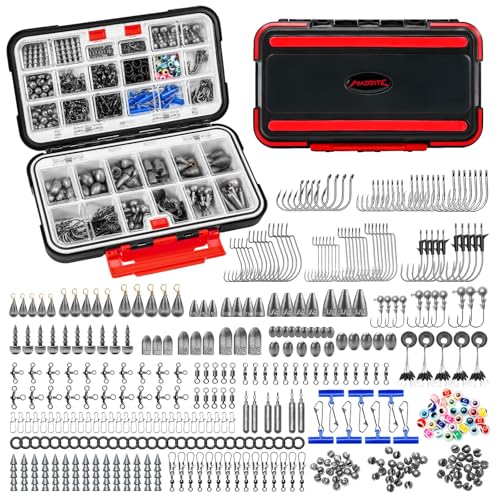
Endorsed by Fishing Expert for Freshwater Excellence: The MadBite by KastKing 400-Piece Freshwater Terminal Tackle Kit features custom rig combinations personally recommended by Al Noraker, a fishing industry veteran with over 50 years of experience, former President of KastKing, and former VP of Product Development at Eagle Claw. Whether you're a beginner or a seasoned fisherman, you'll find the selection and performance of this kit ideal for any freshwater outing

✔INCLUDE:Complete kayaking/paddle board anchoring kit including anchor(3.5lb), premium 8mm double braided 30ft nylon rope, spring hook, Float and storage bag.

【Complete Fishing Tackle Kit】- PLUSINNO 397pcs fishing gear is loaded with 12 fishing rigs for fishing enthusiasts and beginners. It collects nearly all fishing accessories including Fishing Hooks, Round Jig Heads, Round Split Shot, Egg Sinker, Dipsey Swivel Sinker, Drop Shot Weights, Bullet Weights, Nail Weights, Neko Sinkers, Fishing Snap, 4 kinds of different Fishing Swivels, Fishing Sinker Slider, Fish Eye Beads, Wacky Rings and Bobber Stops
Difference Between Maximum Capacity and Performance Weight Limit
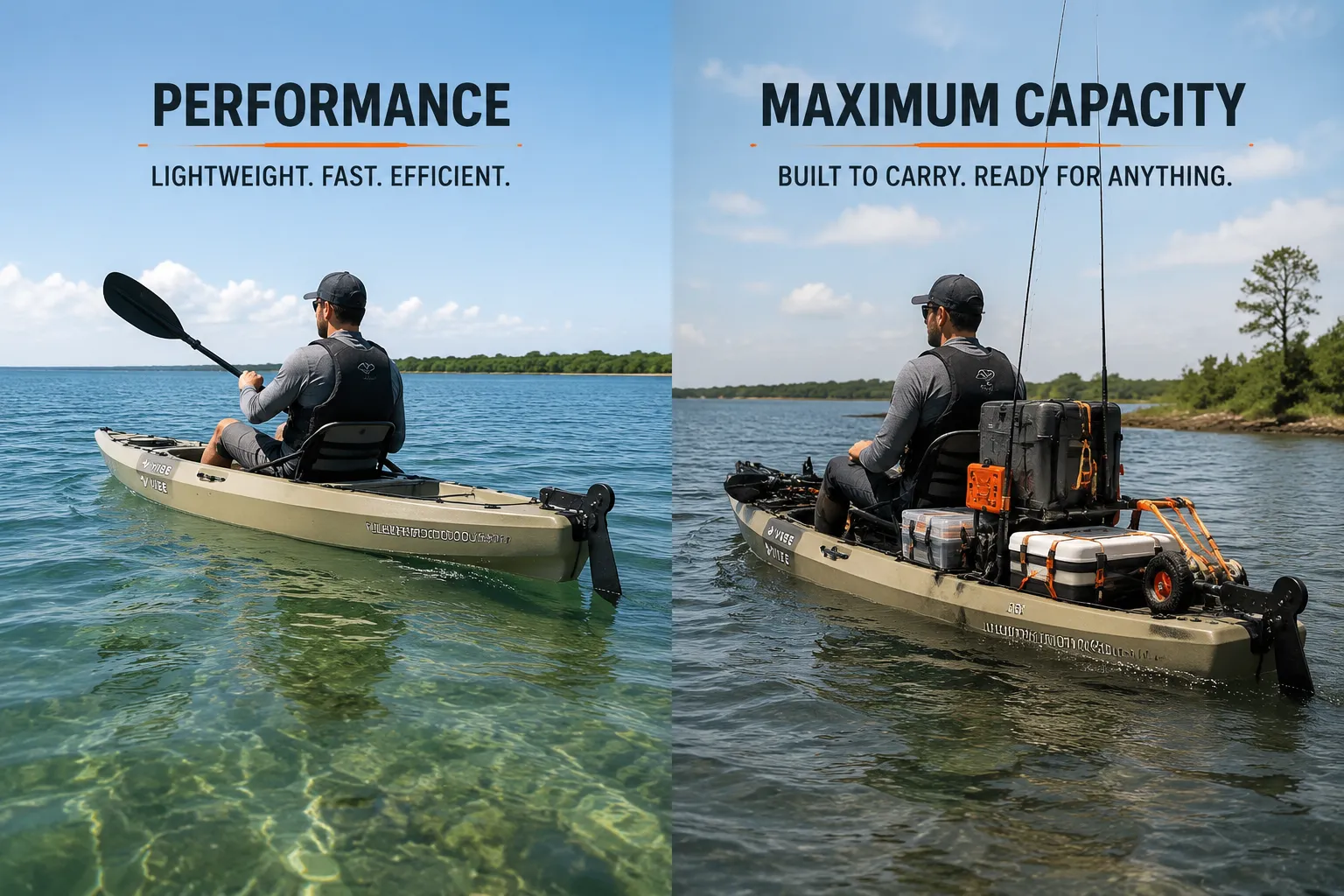
Maximum capacity is the weight at which a kayak will sink or become unsafe to paddle, while performance weight limit is the weight at which the kayak handles well, tracks properly, and remains stable in typical conditions. The performance limit is typically 65-70% of the maximum capacity.
Manufacturers don’t advertise performance limits because there’s no standardized definition or testing protocol. Maximum capacity is a hard number based on displacement and volume. Performance is subjective and varies based on paddler skill, water conditions, and intended use.
Maximum capacity characteristics:
- Kayak sits at or near the waterline
- Minimal freeboard (1-3 inches)
- Water washes over the deck regularly
- Sluggish response to paddle strokes
- Poor tracking and difficult turning
- Reduced primary and secondary stability
- Acceptable only in perfectly calm conditions
Performance weight limit characteristics:
- Kayak sits well above the waterline
- Good freeboard (4-8 inches)
- Deck stays dry in small waves and wakes
- Responsive to steering and paddle input
- Tracks straight with minimal correction
- Stable enough for standing (in fishing kayaks designed for it)
- Handles moderate wind, current, and chop safely
The gap between these two numbers is where kayak weight capacity explained (why the number lies) becomes critical for safety. A 350-pound maximum capacity kayak has a realistic performance limit around 240-245 pounds. If you weigh 200 pounds and carry 50 pounds of gear, you’re at 250 pounds total, within the maximum capacity but over the performance limit.
Choose maximum capacity if: You’re only paddling in a swimming pool or perfectly calm pond with no wind, and you don’t care about handling or speed. (This is almost never the right choice.)
Choose performance weight limit if: You’re paddling in real-world conditions with any wind, current, boat traffic, or waves, and you want the kayak to handle predictably and safely. (This is the right choice for 99% of paddlers.)
What Happens If You Exceed Kayak Weight Limit?
Exceeding the maximum weight limit causes the kayak to sit dangerously low in the water, with the deck at or below the waterline, making it unstable, nearly impossible to control, and at high risk of swamping or capsizing. Even exceeding just the performance limit (while staying under maximum capacity) results in poor handling, exhausting paddling, and reduced safety margins.
Immediate effects of exceeding maximum capacity:
- Water constantly washes over the deck
- The kayak feels “tippy” and unstable
- Steering requires excessive effort
- Paddle strokes feel ineffective
- The kayak sits so low that small waves can swamp it
- Increased risk of capsizing in any conditions
- Difficult or impossible to re-enter after a capsize
Effects of exceeding performance limit (but under max capacity):
- Kayak tracks poorly and requires constant correction
- Reduced speed despite normal paddling effort
- Stability decreases, especially in waves or wakes
- Fatigue sets in much faster
- Difficult to handle in wind or current
- Reduced maneuverability around obstacles
- Less enjoyable paddling experience overall
The danger multiplies when conditions deteriorate. A kayak that feels manageable when overloaded on a calm morning becomes genuinely hazardous when afternoon wind picks up or boat traffic creates wakes. You have no safety margin to absorb changing conditions.
Real scenario: A 280-pound paddler with 40 pounds of gear (320 total) takes out a kayak rated for 325 pounds. On flat water at launch, everything seems fine. An hour later, wind creates 1-foot chop, and every wave washes over the deck. The paddler can’t make progress against the wind, water accumulates in the cockpit or tank well, and the kayak becomes progressively harder to control. What started as a minor overload becomes a rescue situation.
Edge case: Some paddlers intentionally overload kayaks for very short distances in protected water (moving a kayak across a small pond to a cabin, for example). This is risky but survivable if you stay within sight of shore, wear a PFD, and accept that you might swim. Never overload a kayak for actual paddling trips or in any water where swimming to shore isn’t trivial.
How to Calculate Real Usable Weight Capacity for Kayaking
To calculate real usable weight capacity, take the manufacturer’s maximum capacity and multiply by 0.65 to 0.70, which gives you the performance weight limit where the kayak will handle well and remain safe in typical conditions. Your total loaded weight (body plus all gear) should stay at or below this number.
Step-by-step calculation:
- Find the manufacturer’s maximum capacity (usually listed in specs as “weight capacity” or “max capacity”)
- Multiply by 0.65 for conservative performance limit (best for beginners, rough water, or heavy gear loads)
- Or multiply by 0.70 for moderate performance limit (acceptable for experienced paddlers in calmer conditions)
- Calculate your loaded weight: body weight + all gear weight
- Compare: If your loaded weight is below the performance limit, you’re good. If it’s above, you need a higher-capacity kayak.
Example calculation:
- Kayak maximum capacity: 375 pounds
- Conservative performance limit: 375 × 0.65 = 244 pounds
- Moderate performance limit: 375 × 0.70 = 263 pounds
- Your weight: 210 pounds
- Your gear: 55 pounds
- Total loaded weight: 265 pounds
- Result: You’re over the conservative limit and slightly over the moderate limit. This kayak is too small for you with a full gear load.
Quick reference table:
| Max Capacity | Conservative Limit (65%) | Moderate Limit (70%) |
|---|---|---|
| 250 lbs | 163 lbs | 175 lbs |
| 300 lbs | 195 lbs | 210 lbs |
| 350 lbs | 228 lbs | 245 lbs |
| 400 lbs | 260 lbs | 280 lbs |
| 450 lbs | 293 lbs | 315 lbs |
| 500 lbs | 325 lbs | 350 lbs |
Decision rule: Use the conservative 65% calculation if you’re new to kayaking, plan to paddle in wind or current, fish in tidal areas, or want maximum stability for standing. Use the moderate 70% calculation if you’re an experienced paddler, stick to protected waters, and prioritize speed over maximum stability.
Common mistake: Calculating based on your current weight without accounting for seasonal changes. If you weigh 190 pounds in summer but 205 in winter with heavier clothing, use the higher number for your calculations. Also remember that wet clothes and shoes add 5-10 pounds compared to what you weigh on a bathroom scale.

PROTECTIVE HINGED COVER: Features a hinged, hard cover that protects the keys and display when stored, making this handheld calculator durable and easy to carry safely....
Best Kayaks for Heavy Paddlers Over 250 Pounds
Heavy paddlers over 250 pounds need kayaks with maximum capacities of at least 450-500 pounds to maintain good performance, which typically means choosing wider fishing kayaks or tandem kayaks rather than narrow touring models. Beam width (the kayak’s width at its widest point) matters more than length for supporting heavier paddlers.
Key features for heavy paddlers:
- Minimum 450-500 pound capacity (to stay within the 65-70% performance range)
- Beam width of 33-36+ inches (wider hulls provide more initial stability and volume)
- Sit-on-top design (generally handles weight better than sit-inside)
- Flat or pontoon-style hull (more stable than V-shaped touring hulls)
- Reinforced deck and hull (cheaper kayaks may flex or deform under heavier loads)
- Higher weight limit on seat (some kayak seats have their own weight ratings)
Kayak categories that work well for heavy paddlers:
Fishing kayaks: Most fishing kayaks are designed with 400-550 pound capacities because manufacturers assume paddlers will carry significant gear. These boats are typically 32-36 inches wide, providing excellent stability. The wider beam does reduce speed, but stability and capacity matter more for heavier paddlers.
Tandem kayaks: Even if you’re paddling solo, tandem kayaks offer 500-650 pound capacities and can easily handle a heavy paddler with full gear. The extra length (typically 12-14 feet) provides more volume without sacrificing tracking. You can position yourself in the center seat or rear seat for better balance.
Recreational sit-on-tops: Wide recreational kayaks (34+ inches) with 400-500 pound capacities work well for casual paddling. They’re slower than touring kayaks but much more stable and forgiving for heavier paddlers.
What to avoid:
- Narrow touring kayaks (under 28 inches wide), designed for lighter, experienced paddlers
- Whitewater kayaks, low volume and low capacity
- Inflatable kayaks with capacities under 400 pounds, they lose rigidity when heavily loaded
- Ultra-lightweight kayaks, often sacrifice structural strength for reduced weight
Decision rule: If you weigh 250-280 pounds, look for kayaks with 450-500 pound capacities and 33-34 inch beams. If you weigh 280-320 pounds, target 500-550 pound capacities and 34-36 inch beams. Above 320 pounds, consider tandem kayaks or specialized high-capacity models.
Testing tip: If possible, test paddle a kayak before buying. Bring your typical gear load and paddle in conditions similar to where you’ll actually use the boat. A kayak that feels great in the store’s calm demo pond might feel unstable in wind or current.
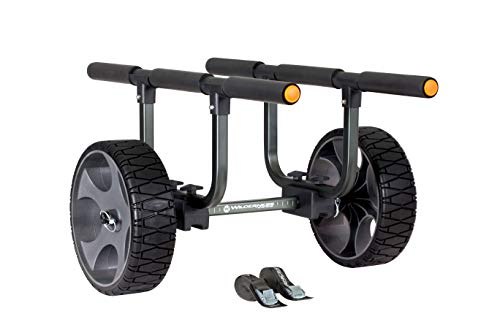
Paddling magazine's 2018 winner in the "best transport/storage/launching' Category

SUPER-TOUGH – 3-ply laminate construction combined with SuperStrong enhanced molecular formulation PVC provides superior structural strength and unmatched resistance to damage from abrasion, impact and sunlight, while allowing more pressure for rigidity
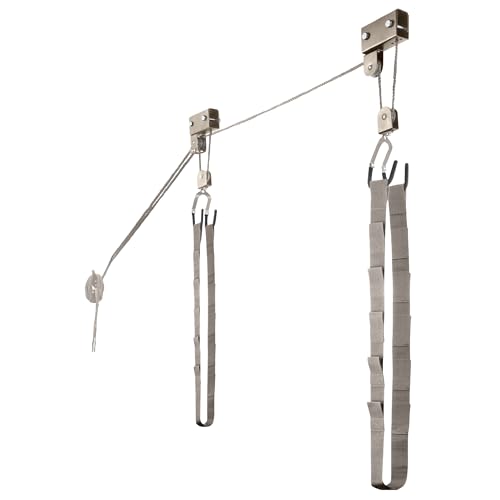
KAYAK HOIST - The kayak hoist pulley system easily lifts and stores any style watercraft, bicycle, or ladder up to 125lbs overhead. The kayak hanger can accommodate many sizes of kayaks for convenient storage in your garage or shed.
Do Kayak Manufacturers Inflate Weight Capacity Numbers?
Kayak manufacturers don’t typically inflate weight capacity numbers in the sense of lying about flotation, but they do list the absolute maximum flotation limit rather than a realistic performance limit, which creates a misleading impression of how much weight the kayak can handle in real-world paddling. This isn’t illegal, but it is deceptive marketing.
The numbers are technically accurate for what they measure (the point at which the kayak will sink), but they’re practically useless for what paddlers actually need to know (the point at which the kayak will handle poorly or become unsafe).
Why the system persists:
- No regulatory oversight, there’s no government agency or industry body that mandates performance-based capacity ratings
- Competitive pressure, if one manufacturer lists performance capacity (lower numbers) and competitors list maximum capacity (higher numbers), the honest manufacturer looks worse in comparison charts
- Liability concerns, listing a lower “recommended” capacity might imply that the higher number is unsafe, opening manufacturers to lawsuits
- Consumer ignorance, most first-time kayak buyers don’t know the difference between maximum and performance capacity
Some manufacturers do provide guidance in their manuals or websites about staying below maximum capacity for better performance, but this information is rarely prominent in marketing materials or on the kayak itself.
Better manufacturers will:
- Include a “recommended capacity” or “optimal capacity” in addition to maximum
- Provide guidance like “for best performance, stay 25-30% below maximum capacity”
- Offer detailed weight distribution recommendations
- Include performance notes in their specifications
Worse manufacturers will:
- Only list maximum capacity with no context
- Use phrases like “up to 400 pounds!” in marketing without explaining limitations
- Show photos of kayaks with minimal loads despite high capacity ratings
- Provide no guidance on performance versus maximum capacity
What you can do: When researching kayaks, look for reviews from actual paddlers at various weights rather than relying solely on manufacturer specs. Online kayaking forums and YouTube reviews often include real-world experiences from heavier paddlers that reveal how a kayak actually performs when loaded.
How Much Under the Weight Limit Should I Stay on a Kayak?
You should stay 30-35% under the maximum weight limit for safe, enjoyable paddling with good handling and stability in typical conditions. This means if a kayak is rated for 400 pounds, your total loaded weight (body plus gear) should be no more than 260-280 pounds.
This 30-35% buffer is where kayak weight capacity explained (why the number lies) becomes actionable advice. The buffer accounts for the difference between flotation and performance, and it provides a safety margin for unexpected conditions.
Why 30-35% specifically:
- Maintains proper freeboard (4-6 inches of hull above waterline)
- Preserves designed hull characteristics (the kayak floats at its intended waterline)
- Ensures responsive handling (the kayak turns and tracks as designed)
- Provides stability (lower center of gravity relative to waterline)
- Allows for condition changes (wind, waves, and current become manageable)
- Reduces fatigue (efficient paddling rather than fighting a sluggish boat)
Adjusting the buffer for conditions:
- Calm, protected water: 25-30% buffer is acceptable for experienced paddlers
- Moderate wind or current: 30-35% buffer recommended
- Rough water, ocean, or tidal areas: 35-40% buffer for safety
- Cold water (under 60°F): Larger buffer reduces capsize risk when consequences are severe
Example scenarios:
Scenario 1: 180-pound paddler, 40 pounds of gear, 220 total. Kayak rated for 325 pounds. Buffer: 32%. Result: Good for most conditions.
Scenario 2: 240-pound paddler, 70 pounds of gear, 310 total. Kayak rated for 400 pounds. Buffer: 23%. Result: Acceptable only in calm water; risky in wind or waves.
Scenario 3: 200-pound paddler, 50 pounds of gear, 250 total. Kayak rated for 375 pounds. Buffer: 33%. Result: Ideal for varied conditions and comfortable paddling.
Edge case for experienced paddlers: Some advanced kayakers with excellent skills and strong rolling ability (for sit-inside kayaks) can safely paddle closer to maximum capacity in controlled conditions. However, this requires significant experience, proper safety gear, and acceptance of reduced performance. This is not recommended for recreational or fishing kayakers.
Sit-On-Top vs Sit-Inside Kayak Weight Capacity Differences
Sit-on-top kayaks generally handle weight better than sit-inside kayaks of similar length because they have higher total volume, more buoyancy distributed across the hull, and a design that keeps the paddler’s weight lower relative to the waterline. For heavier paddlers or those carrying substantial gear, sit-on-top designs offer better stability and performance at higher loads.
Sit-on-top advantages for weight capacity:
- Higher volume hulls, the entire hull is sealed and provides flotation
- Wider beam designs, most sit-on-tops are 30-36 inches wide for stability
- Lower center of gravity, you sit closer to the water’s surface
- Better weight distribution, gear can be distributed across the deck and tank well
- More forgiving when loaded, performance degrades more gradually as weight increases
- Self-bailing, scupper holes drain water that comes over the deck
Sit-inside advantages (despite lower practical capacity):
- Better in cold weather, the cockpit provides wind and spray protection
- More efficient hull designs, narrower beams mean faster paddling
- Lower profile in wind, less surface area for wind to push against
- Drier paddling, when properly loaded, you stay drier in waves
Capacity comparison example:
A 12-foot sit-on-top fishing kayak might have a 400-pound capacity with a 33-inch beam. A 12-foot sit-inside touring kayak might have a 325-pound capacity with a 28-inch beam. Both are the same length, but the sit-on-top can handle 75 more pounds due to its higher volume and wider, more stable design.
Decision rule: If you weigh over 220 pounds or plan to carry more than 50 pounds of gear, choose a sit-on-top design for better performance and stability. If you weigh under 200 pounds, paddle in cold weather, or prioritize speed over stability, a sit-inside kayak can work well as long as you stay well under its capacity.
Common mistake: Assuming a longer kayak automatically has higher capacity. A 14-foot narrow touring kayak might have lower capacity than a 12-foot wide fishing kayak because volume and beam matter more than length alone.
Common Mistakes When Choosing Kayak Based on Weight Capacity
The most common mistake is choosing a kayak where your loaded weight is close to the maximum capacity, leaving no performance buffer and resulting in poor handling, instability, and an unpleasant paddling experience. Paddlers also frequently forget to include gear weight in their calculations or fail to account for conditions beyond flat, calm water.
Top mistakes and how to avoid them:
Mistake 1: Using only your body weight
Many paddlers see a 300-pound capacity, weigh 220 pounds, and think they have 80 pounds of margin. They forget that gear adds 40-80 pounds, leaving them with little or no buffer.
Fix: Always calculate body weight + gear weight, then ensure that total is 30-35% below maximum capacity.
Mistake 2: Trusting the capacity number without context
Beginners assume the manufacturer’s capacity is a safe operating limit rather than an absolute maximum flotation limit.
Fix: Treat the listed capacity as “the weight at which this kayak becomes dangerous,” not “the weight this kayak is designed to carry.”
Mistake 3: Choosing based on length instead of width
Paddlers think a longer kayak automatically handles more weight, but beam width and hull volume matter more for capacity and stability.
Fix: For heavier paddlers or gear-heavy fishing, prioritize beam width (33+ inches) over length.
Mistake 4: Not accounting for conditions
A kayak that feels acceptable when overloaded on a calm pond becomes dangerous in wind, current, or boat wakes.
Fix: Choose capacity based on the worst conditions you’ll encounter, not the best. If you’ll paddle in wind or current, build in extra buffer.
Mistake 5: Ignoring seasonal weight changes
Your weight in summer shorts versus winter waders can differ by 15-20 pounds, and wet gear is heavier than dry gear.
Fix: Use your heaviest seasonal weight plus wet gear weight for calculations.
Mistake 6: Buying based on price instead of fit
Budget-conscious buyers choose a cheaper, smaller kayak even though they need higher capacity, then struggle with poor performance.
Fix: A properly sized kayak that you enjoy paddling is worth the extra cost. An undersized kayak that handles poorly will sit unused.
Mistake 7: Assuming you’ll “grow into” a smaller kayak
Some paddlers buy a kayak that’s too small, thinking they’ll lose weight or carry less gear eventually. This rarely happens, and they’re stuck with an unsuitable boat.
Fix: Buy for your current weight and typical gear load, not for aspirational future conditions.
Will My Kayak Sink If I’m at the Max Weight Limit?
Your kayak will not sink if you’re exactly at the maximum weight limit in calm water, but it will sit dangerously low with minimal freeboard, making it extremely unstable and at high risk of swamping from any waves, wakes, or movement. Any additional weight beyond the maximum, or any water that comes over the deck, will cause the kayak to sink or capsize.
The maximum capacity is calculated as the point where the kayak’s gunwales (top edges) reach the waterline. At this weight, the kayak is technically still floating, but there’s no margin for error. A single wave washing over the deck adds weight and can push the kayak below the waterline. Shifting your weight to one side can dip that side underwater.
What happens at maximum capacity:
- Freeboard of 0-2 inches, the deck is at or just above the waterline
- Any wave or wake washes over the deck, water accumulates in the cockpit or tank well
- Extremely unstable, the kayak feels like it could flip at any moment
- Unresponsive to steering, paddle strokes have minimal effect
- Exhausting to paddle, you’re pushing maximum displacement through the water
- High capsize risk, any weight shift or external force can flip the kayak
Sit-on-top kayaks at max capacity: Water will constantly wash over the deck through the scupper holes (drain holes). While the scuppers will drain some water, they can’t keep up with continuous washing in waves. The kayak becomes progressively more waterlogged and harder to control.
Sit-inside kayaks at max capacity: Water that comes over the deck enters the cockpit. Without constant bailing or a spray skirt (which most recreational paddlers don’t use), the cockpit fills with water, adding weight and making the kayak even lower in the water. This creates a dangerous cycle where more water comes in, the kayak sits lower, and even more water comes in.
Edge case: In a swimming pool or perfectly calm, protected pond with no wind and no boat traffic, you could technically paddle at maximum capacity without sinking. But this is a theoretical scenario with no practical application. Real-world paddling always involves some water movement, wind, or wakes.
Safety note: If you find yourself on the water at or near maximum capacity, stay extremely close to shore, wear your PFD, and be prepared to swim. Do not venture into deeper water, current, or areas with boat traffic.
How to Test If a Kayak Can Handle Your Weight Safely
To test if a kayak can handle your weight safely, load it with your typical gear, launch in calm, shallow water close to shore, and check for adequate freeboard (4-6 inches of hull above the waterline), stable feel when shifting weight, and responsive handling when paddling. If the kayak sits low, feels tippy, or handles sluggishly, it’s too small for your weight.
Step-by-step testing process:
Step 1: Load the kayak completely
Include all gear you’d typically carry: fishing equipment, cooler, safety gear, anchor, etc. Don’t test with minimal gear if you plan to fish fully loaded.
Step 2: Choose a safe test location
Pick calm water with no current, minimal wind, and a shallow, easy exit point. Stay within 50 feet of shore for your first test.
Step 3: Check freeboard before entering
Load your gear first, then carefully enter the kayak. Once seated, look at how much hull remains above the waterline. You want 4-6 inches of freeboard minimum.
Step 4: Test stability while stationary
Shift your weight side to side and forward and back. The kayak should feel stable and return to center. If it feels like it could tip easily, it’s overloaded.
Step 5: Paddle in calm water
Take 20-30 paddle strokes. The kayak should respond to steering, track reasonably straight, and feel efficient. If it feels sluggish or unresponsive, you’re too heavy for it.
Step 6: Test in small waves or wakes
If available, paddle through small boat wakes or wind chop (still close to shore). Water should not regularly wash over the deck. If the deck is constantly wet, you’re overloaded.
Step 7: Practice a controlled capsize (optional but recommended)
In shallow water where you can stand, intentionally tip the kayak to practice recovery. If you can’t easily re-enter or the kayak is difficult to flip upright, it’s too small.
Red flags that indicate the kayak is too small:
- Freeboard less than 3 inches when loaded
- Water regularly washing over the deck in small waves
- Kayak feels unstable when you shift weight
- Difficult to steer or requires excessive paddle effort
- Kayak sits noticeably lower than in manufacturer photos
- You feel anxious or uncomfortable about stability
Green lights that indicate good capacity match:
- 4-6+ inches of freeboard when fully loaded
- Deck stays dry in small waves and wakes
- Stable feel when shifting weight for fishing or gear access
- Responsive steering and efficient paddling
- Comfortable, confident feeling on the water
Decision rule: If you’re on the fence after testing, choose the next size up. It’s better to have excess capacity than to struggle with an undersized kayak. A kayak with extra capacity will still paddle well, but an overloaded kayak will always handle poorly.
Does Kayak Weight Capacity Include the Paddler and Gear?
Yes, kayak weight capacity includes everything: the paddler’s body weight, all clothing and footwear, the paddle, life vest, fishing equipment, coolers, electronics, safety gear, and any fish or items you collect during your trip. The capacity rating is the total weight the kayak can support, not the weight available after accounting for the paddler.
This is a critical point of confusion for first-time kayak buyers. When you see a kayak rated for 350 pounds, that’s not 350 pounds of gear plus your body weight. It’s 350 pounds total, including you.
Everything included in weight capacity:
The paddler:
- Your body weight (as you’d weigh on a scale)
- All clothing (wet clothes weigh more than dry)
- Shoes or boots
- Life vest (PFD)
- Any clothing layers you add during the trip
Gear and equipment:
- Paddle (2-4 pounds)
- Fishing rods and reels
- Tackle boxes and bags
- Cooler with food, drinks, and ice
- Anchor and rope
- Dry bags with extra clothing
- Fish finder, battery, and electronics
- Camera or phone
- Safety kit and first aid
- Bilge pump or bailer
- Spare paddle (if carried)
Items acquired during the trip:
- Fish you catch and keep
- Water that accumulates in the cockpit or tank well
- Wet towels or rain gear
- Any trash or items you pick up
Common misconception: Some paddlers think the capacity is “how much gear you can bring” and forget to subtract their own body weight first. A 200-pound paddler with a 300-pound capacity kayak has 100 pounds available for gear, not 300 pounds.
Calculation example:
- Kayak capacity: 375 pounds
- Your weight: 215 pounds
- Remaining for gear: 160 pounds
- Typical fishing gear: 65 pounds
- Total loaded weight: 280 pounds
- Percentage of capacity used: 75%
- Buffer remaining: 25%
This example shows a paddler who’s right at the edge of acceptable loading (you want 30-35% buffer, and they have 25%). They could reduce gear by 15-20 pounds or choose a higher-capacity kayak.
Pro tip: Weigh yourself fully dressed with your PFD and wet shoes to get an accurate paddler weight. This number is 5-10 pounds higher than your bathroom scale weight in dry clothes, and it’s the number you should use for capacity calculations.
Conclusion
Kayak weight capacity ratings are technically accurate but practically misleading because they measure flotation rather than performance. The number on the spec sheet tells you when the kayak will sink, not when it will handle poorly, feel unstable, or become dangerous in real-world conditions.
The solution is simple: stay 30-35% below the maximum capacity for safe, enjoyable paddling. This buffer maintains proper freeboard, preserves the kayak’s designed handling characteristics, and provides a safety margin for changing conditions. Calculate your total loaded weight (body plus all gear), then choose a kayak where that weight represents 65-70% of the maximum capacity.
Your action steps:
- Calculate your loaded weight: Add your body weight (in wet clothes) plus all typical gear (40-80 pounds for fishing, 30-40 for recreation)
- Divide by 0.65 or 0.70: This gives you the minimum kayak capacity you need
- Shop for kayaks at or above that capacity: Don’t compromise on capacity to save money or get a “faster” boat
- Test before committing: If possible, test paddle with your full gear load in conditions similar to where you’ll actually paddle
- Prioritize width for heavy loads: Beam width (33+ inches) matters more than length for supporting weight and maintaining stability
Remember that conditions change throughout the day. A kayak that feels acceptable when slightly overloaded on a calm morning can become genuinely dangerous when wind picks up or boat traffic creates wakes. Build in margin for the worst conditions you’ll encounter, not the best.
The kayak industry won’t change its capacity rating system anytime soon, so it’s up to you as a paddler to understand what the numbers really mean and make informed decisions. A properly sized kayak transforms paddling from a struggle into an enjoyable experience. Don’t let misleading capacity numbers push you into a boat that’s too small.