Tidal movement drives baitfish behavior, concentrates predators in feeding zones, and determines whether you’ll paddle through a highway of current or drift peacefully over structure. Learning how to read tides for kayak fishing means understanding tide charts, recognizing slack versus moving water, and timing your launch to match the bite, not just the convenience of your schedule.
Key Takeaways
- High tide floods structure and shorelines, bringing fish into shallow feeding zones; low tide concentrates baitfish and predators in deeper channels and cuts.
- Moving tides (incoming or outgoing) trigger feeding activity as current pushes bait and creates ambush points; slack tide often slows the bite.
- Tide charts show predicted height and timing for high and low tides; the steeper the curve between tides, the stronger the current.
- Incoming tides are often better for beginners because they push you toward shore and flood new feeding areas gradually.
- Tides matter most in coastal and tidal river systems; lakes and non-tidal rivers are unaffected by lunar cycles.
- Strong tidal currents can be dangerous for kayak anglers, always check current speed, have an exit plan, and avoid paddling against peak flow.
- Moon phase directly affects tidal range: new and full moons create stronger spring tides with bigger swings and faster currents.
- Slack tide is the 30-60 minute window between tide changes when current stops; fish often pause feeding, but it’s the safest time to reposition.
- Plan kayak fishing trips 3-7 days ahead using tide apps to identify optimal tide windows that align with dawn, dusk, or structure access.
- Common mistakes include ignoring current direction, launching at the wrong tide stage, and confusing tidal height with tidal flow,both matter, but flow drives fish behavior more.
What Does High Tide and Low Tide Mean for Kayak Fishing?
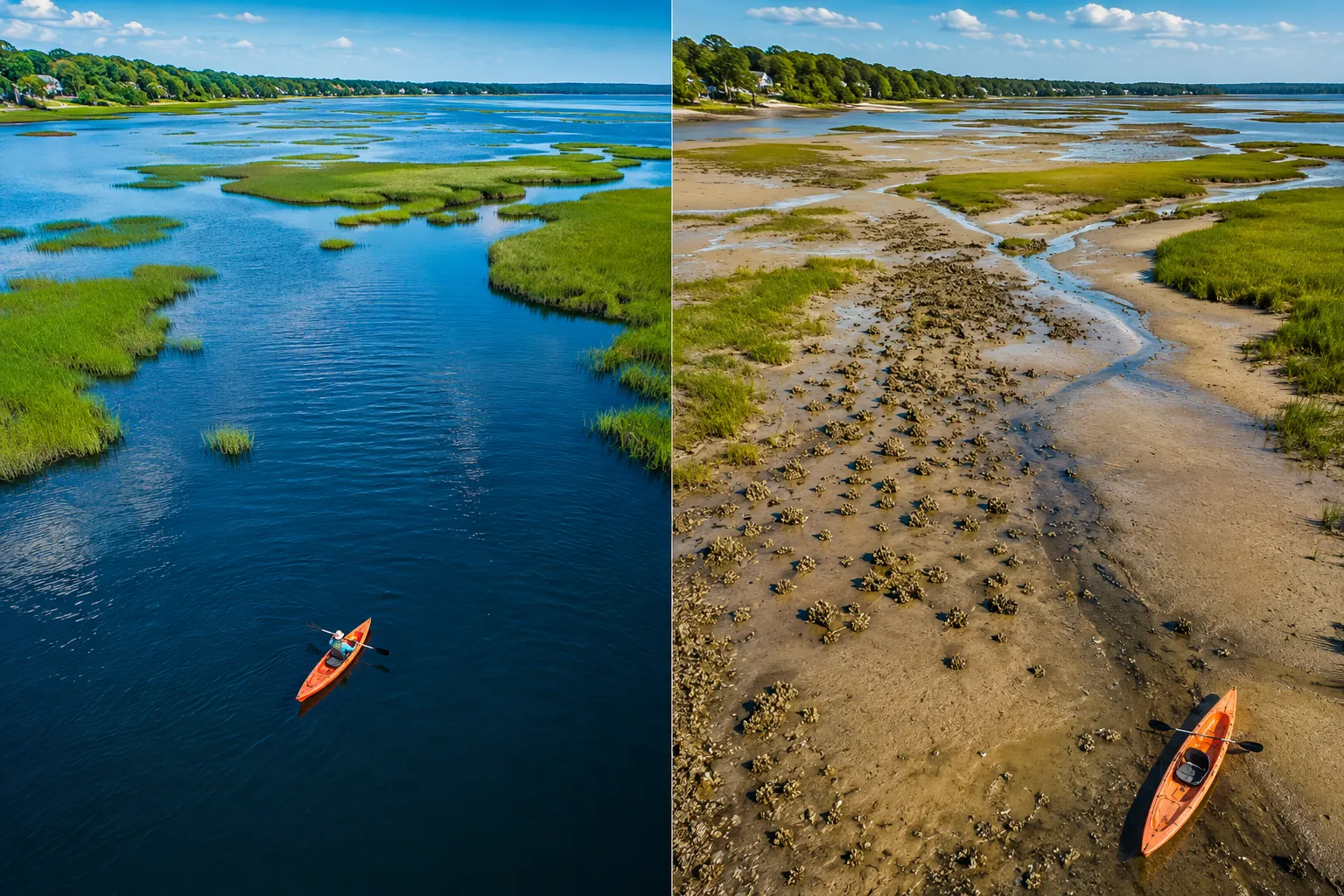
High tide occurs when water reaches its maximum height in a tidal cycle, flooding shorelines, grass flats, oyster bars, and mangrove roots. Low tide is when water drops to its minimum level, exposing structure and concentrating fish in deeper channels, cuts, and holes. For kayak anglers, these stages dictate where fish will be and how accessible those spots are from your kayak.
At high tide, predators like redfish, snook, and flounder move onto flats and into backwater areas to hunt shrimp, crabs, and baitfish that emerge from cover. You can paddle over structure that would be exposed at low tide, accessing skinny water that boats can’t reach. However, fish are more spread out, and you’ll need to cover more water or target specific ambush points like dock pilings, grass edges, and drop-offs.
At low tide, fish retreat to deeper water, channels, creek mouths, jetties, and drop-offs become prime targets. Baitfish are funneled into smaller areas, and predators stack up to feed. The downside: you may need to portage your kayak over mudflats or time your launch to avoid getting stranded on a falling tide.
Key decision rule: Fish high tide if you want to explore flats and backwaters; fish low tide if you want to target concentrated fish in predictable deeper zones. Always scout your launch and exit points at the tide stage you plan to fish, what’s navigable at high tide may leave you stuck at low.
How Do Slack Tides Affect Fishing From a Kayak?
Slack tide is the brief period (typically 30-60 minutes) between high and low tide when tidal current slows to nearly zero before reversing direction. During slack tide, water movement stops, baitfish disperse, and predatory fish often pause their feeding activity. For most kayak anglers, slack tide is the slowest fishing window of the tidal cycle.
However, slack tide has strategic value. It’s the safest and easiest time to paddle, reposition, or move between fishing spots without fighting current. If you’re fishing a location with strong tidal flow, use slack tide to relocate, set up an anchor trolley, or adjust your drift path. Some species, like flounder or sheepshead, remain active during slack because they’re ambush feeders that don’t rely on current to push bait.
Common mistake: Assuming slack tide lasts longer than it does. Tidal current can resume quickly, especially during spring tides (new and full moon phases). If you’re repositioning during slack, keep an eye on the time and be ready to paddle before the current picks up again.
Choose slack tide if you need to move long distances, you’re a beginner learning to navigate tidal waters, or you’re targeting structure-oriented species that don’t depend on current. Otherwise, plan to fish the hour before and after high or low tide when current is moving and fish are feeding.
Best Tide Conditions for Kayak Fishing Beginners
Beginners should target incoming tide during the first or last two hours before high tide. Incoming tide pushes you toward shore (a safety advantage), gradually floods new structure, and triggers feeding as baitfish move into shallow areas. The current is predictable, and if you misjudge timing, you’ll drift toward land rather than out to sea.
Start by fishing one to two hours before high tide. This window offers moderate current, active fish, and enough water depth to paddle comfortably without getting stuck. Avoid fishing the peak of high tide (slack) or the rapid drop of outgoing tide until you’re confident reading current speed and direction.
Beginner-friendly tide checklist:
- Launch 90 minutes before high tide
- Fish structure that floods as tide rises (grass edges, oyster bars, dock pilings)
- Stay within sight of your launch point
- Monitor current direction, if it reverses, paddle back before it strengthens
- Avoid fishing during spring tides (new/full moon) when currents are strongest
Edge case: If you’re fishing a tidal river or creek with a narrow channel, incoming tide can create surprisingly strong current. Always scout the area at low tide first (on foot or via satellite imagery) to identify hazards like submerged logs, oyster beds, or shallow bars that become invisible at high tide.
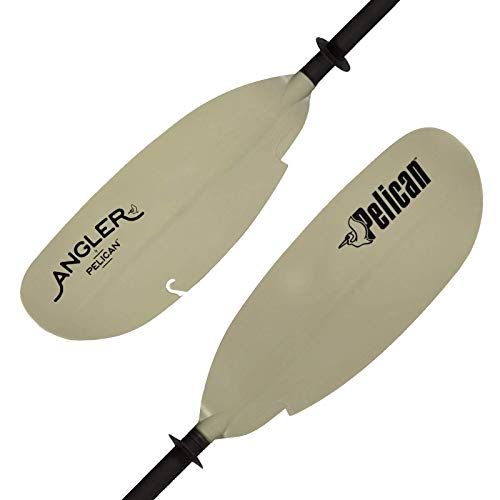
The Poseidon Angler Kayak Paddle is ideal for angler paddlers taller than 5'5". Measuring 98.5” (250cm) long, this paddle is the perfect match for wider fishing kayaks

Length: Measuring 240 (94.5"), this quality paddle is ideal for angler paddlers over 152 cm (5'5") in kayaks over 86 cm (34") wide.

【90.5in Recreational Kayak Paddle】Designed for recreational kayaking, fishing kayaks, inflatable kayaks, canoes, and small boats, this 90.5in / 230cm kayak paddle offers a balanced length for most casual paddlers and weekend water trips.
Incoming vs Outgoing Tide: Which Is Better for Kayak Fishing?
Both incoming and outgoing tides trigger feeding, but they create different fishing scenarios. Incoming tide (rising water) pushes baitfish onto flats, into marshes, and over structure, drawing predators into shallow ambush zones. Outgoing tide (falling water) pulls baitfish out of backwaters and funnels them through channels, creek mouths, and cuts, where predators wait to intercept.
Incoming tide advantages:
- Safer for beginners (current pushes you toward shore)
- Floods new feeding areas gradually
- Fish move shallow and are easier to sight-cast
- Longer fishing window as water rises over structure
Outgoing tide advantages:
- Concentrates baitfish in predictable choke points
- Stronger current often triggers aggressive feeding
- Easier to target specific ambush zones (channel edges, creek mouths, jetties)
- Fish stack up in smaller areas, increasing catch rates
Which is better? It depends on your target species and location. Redfish and snook often feed aggressively on incoming tide as they push onto flats. Speckled trout and flounder may prefer outgoing tide when baitfish are funneled through deeper channels. Striped bass and bluefish in tidal rivers often hit hard on outgoing tide as current sweeps bait past structure.
Decision rule: If you’re fishing grass flats, oyster bars, or backwater areas, fish the incoming tide. If you’re fishing channels, creek mouths, jetties, or bridge pilings, fish the outgoing tide. When in doubt, fish the last hour of incoming and first hour of outgoing,this transition period often produces the best action.

Easy-to-Use Knot Tying Guide: Features step-by-step instructions with visual diagrams for quickly mastering various fishing knots, perfect for both beginners and experienced anglers.

Comprehensive Fish Information: Includes size, weight, location, food quality, and coloring details for accurate species identification

Comprehensive Fish Information: Includes size, weight, location, water temperature, fishing methods, food quality, and coloring for each species
How to Read a Tide Chart for Fishing
A tide chart (also called a tide table) shows the predicted times and heights of high and low tides for a specific location. Most charts display tide height in feet above or below mean lower low water (MLLW), along with the time each tide stage occurs. Learning how to read a tide chart for kayak fishing means identifying when tides change and how fast water will move between those changes.
Key elements of a tide chart:
- High tide time and height, When water reaches maximum level
- Low tide time and height, When water drops to minimum level
- Tidal range, The difference in feet between high and low tide (bigger range = stronger current)
- Tide curve, A graph showing how quickly water rises or falls (steeper curve = faster current)
How to interpret the chart:
- Steep curve between tides = strong current (good for feeding, harder to paddle)
- Gradual curve = weak current (easier paddling, slower bite)
- Large tidal range (6+ feet) = expect strong current and significant water level change
- Small tidal range (1-2 feet) = minimal current, less dramatic fish movement
Example: A chart shows high tide at 7:00 AM (5.2 feet) and low tide at 1:00 PM (0.8 feet). The tidal range is 4.4 feet over six hours. The steepest part of the curve is between 9:00 AM and 11:00 AM, meaning current will be strongest during that window, prime feeding time, but also the hardest paddling.
Common mistake: Using a tide chart for the wrong location. Tide timing can vary by 30-60 minutes or more between nearby spots. Always select the tide station closest to where you’ll actually fish, not just the nearest city.
Do I Need to Check Tides for Lake Kayak Fishing or Just Ocean?
You only need to check tides for coastal ocean, bays, estuaries, tidal rivers, and tidal creeks. Freshwater lakes, non-tidal rivers, and reservoirs are not affected by lunar tidal cycles. However, some large lakes and reservoirs experience water level changes due to wind-driven seiches, dam releases, or seasonal drawdowns,these are not tides, but they can still affect fish behavior and kayak access.
Where tides matter:
- Ocean coastlines
- Bays and sounds
- Tidal rivers (rivers connected to the ocean where saltwater or tidal influence reaches inland)
- Tidal creeks and marshes
- Estuaries (where freshwater rivers meet saltwater)
Where tides do NOT matter:
- Inland freshwater lakes
- Non-tidal rivers (rivers with no connection to tidal waters)
- Ponds and reservoirs
Edge case: Some rivers have tidal influence dozens of miles inland, even in freshwater. For example, the Hudson River in New York has tidal influence over 150 miles upstream. If you’re fishing a river that connects to the ocean, check whether tidal current reaches your fishing area, local fishing reports or tide apps will indicate if the location is tidal.
Decision rule: If your fishing spot is connected to the ocean and within the tidal zone, check tides. If it’s a landlocked lake or upstream of tidal influence, focus on weather, barometric pressure, and water temperature instead.
What Happens If I Kayak Fish During the Wrong Tide?
Fishing during the wrong tide stage usually means slower action, harder paddling, or getting stranded. If you launch at peak high tide (slack), you’ll miss the feeding window and face a long outgoing current when you try to return. If you launch on a strong outgoing tide without planning your route, you may paddle against heavy current or get swept away from your launch point.
Consequences of poor tide timing:
- Launching at slack tide: Fish are inactive, and you waste prime fishing time repositioning
- Launching on strong outgoing tide: You may drift too far from your launch and struggle to paddle back
- Fishing low tide in shallow areas: You may get stuck on mudflats, oyster bars, or sandbars and have to wait hours for water to return
- Ignoring tidal range: A 6-foot tidal swing can turn a navigable channel into a mudflat in two hours
Real example: An angler launches at high tide to fish a grass flat. Two hours later, the tide has dropped three feet, and the flat is now six inches deep. The kayak is grounded 200 yards from the nearest channel. The angler must either drag the kayak (risking damage) or wait four hours for the tide to return.
How to avoid it:
- Check tide charts before every trip
- Scout your fishing area at low tide (in person or via satellite imagery) to identify hazards
- Plan your paddle route so current helps you return to the launch
- Set a timer or check your watch, don’t lose track of tide stage while fishing
If you do get caught: Stay calm, assess your options, and prioritize safety. If you’re stranded on a falling tide, secure your kayak, stay with it, and wait for water to return. If current is pushing you offshore, paddle at an angle toward shore rather than directly against the flow.
Tide Apps for Kayak Anglers That Actually Work
Modern tide apps provide real-time predictions, current speed, moon phase, and location-specific data, all critical for planning kayak fishing trips. The best apps combine NOAA tide data with user-friendly interfaces, offline access, and features tailored to anglers.
Top tide apps for kayak fishing in 2026:
| App Name | Key Features | Best For | Cost |
|---|---|---|---|
| Tide Alert | NOAA data, customizable alerts, moon phase, sunrise/sunset | Coastal anglers who fish multiple spots | Free (ads) / $2.99 (ad-free) |
| Navionics Boating | Tide data + detailed charts, depth contours, GPS tracking | Anglers who want navigation + tides in one app | $14.99/year |
| Fishidy | Tide predictions, fishing reports, catch logs, social features | Anglers who want community intel + tide data | Free (limited) / $9.99/month (premium) |
| Tides Near Me | Simple interface, 7-day forecast, tide graphs, offline mode | Beginners who want fast, reliable tide info | Free (ads) / $1.99 (ad-free) |
| Windy | Tide data + wind, waves, weather overlays, animated maps | Kayakers who need weather + tide in one view | Free (premium features $18.99/year) |
What to look for in a tide app:
- NOAA or official data source (avoid apps that use crowdsourced or unverified predictions)
- Location accuracy (ability to select the exact tide station nearest your fishing spot)
- Tide curve graph (visual representation of current strength, not just high/low times)
- Moon phase display (helps predict spring vs. neap tides)
- Offline mode (critical if you fish areas with poor cell service)
Pro tip: Cross-reference your app with NOAA’s official tide predictions (available at tidesandcurrents.noaa.gov) before a big trip. Apps occasionally have data sync issues or use outdated station information.

HANDS-FREE PEDAL POWER: Cover more water with a responsive propeller drive system that delivers instant forward and reverse control for precise maneuvering. This pedal kayak gives you the agility needed for kayak fishing in tight spots, open water, and changing conditions.

A multi chine flat bottom hull ensures the stability needed when casting lines and reeling in fish.

Accurate Sonar & Wide Depth Range: Enhance underwater detection with precision. This portable fish finder features a high-performance transducer supporting a 200kHz single beam frequency with a 45° beam cone. It delivers detailed detection from a shallow 2ft down to a depth of328ft, ensuring consistent tracking whether fishing in shallow streams or deep lakes.
How Much Does Moon Phase Affect Tides When Kayak Fishing?
Moon phase directly controls tidal range and current strength. During new moon and full moon phases, the sun, moon, and Earth align, creating spring tides,larger tidal swings (higher highs, lower lows) and stronger currents. During first and third quarter moons, the sun and moon are at right angles, producing neap tides,smaller tidal ranges and weaker currents.
Spring tides (new and full moon):
- Tidal range increases by 20-40% compared to neap tides
- Current flows faster and lasts longer
- Fish feed more aggressively due to stronger baitfish movement
- Caution: Stronger currents are harder to paddle and more dangerous for beginners
Neap tides (first and third quarter moon):
- Tidal range decreases
- Current is weaker and shorter in duration
- Fish may be less active, but bite windows are more predictable
- Easier and safer paddling conditions
Does moon phase matter more than tide timing? No. Tide timing (incoming vs. outgoing) matters more than moon phase for triggering feeding behavior. However, spring tides amplify the effect, an outgoing tide during a full moon will have stronger current and more concentrated baitfish than the same tide during a neap phase.
Decision rule: If you’re a beginner or fishing a location with strong current, avoid spring tides (new/full moon ±2 days). If you’re experienced and want aggressive feeding action, target spring tides and fish the peak current windows.
Can You Kayak Fish in Strong Tidal Currents Safely?
Yes, but only with proper planning, experience, and safety gear. Strong tidal currents (2+ knots or roughly 2.3 mph) can overpower even experienced paddlers, sweep you into hazards, or prevent you from returning to your launch. Kayak fishing in strong current requires understanding current speed, using eddies and slack water, and having an exit strategy.
Safety rules for fishing strong tidal current:
- Check current speed before launching, Use a tide app or NOAA current predictions; avoid currents over 2 knots unless you’re experienced
- Paddle with the current, not against it, Plan your route so current helps you return to the launch
- Use eddies and slack water, Paddle close to shorelines, behind structure, or in back eddies where current is weaker
- Wear a PFD (personal flotation device) at all times, Non-negotiable in tidal waters
- Carry a whistle, VHF radio, or PLB (personal locator beacon), Essential if you’re swept into open water
- Fish with a partner or tell someone your plan, Include launch time, location, and expected return
When to avoid strong current:
- You’re a beginner with less than 10 hours of kayak fishing experience
- Wind and current are moving in opposite directions (creates choppy, unstable water)
- You’re fishing alone in a remote area
- Current speed exceeds your comfortable paddling pace
Edge case: Some species, like striped bass, tarpon, and snook, feed most aggressively in strong current near structure. If you want to target these fish, position yourself upstream of the structure and drift or anchor so current brings your bait to the fish. Never anchor in the middle of strong current without an anchor trolley and quick-release system.
Difference Between Tidal Flow and Tidal Height for Fishing
Tidal height is the vertical measurement of water level (how high or low the water is). Tidal flow (or tidal current) is the horizontal movement of water (how fast and in what direction water is moving). Both affect kayak fishing, but tidal flow drives fish behavior more directly because it moves baitfish and triggers feeding.
Tidal height matters for:
- Access: Can you launch your kayak? Will you be able to paddle over structure or through channels?
- Fish location: High water pushes fish onto flats; low water concentrates them in channels
- Safety: Low tide exposes hazards like oyster bars, rocks, and mudflats
Tidal flow matters for:
- Feeding activity: Moving current triggers predatory fish to feed
- Bait movement: Current pushes baitfish into ambush zones
- Paddling difficulty: Strong flow makes it harder to control your kayak
- Drift fishing: Current speed determines how fast you drift over structure
Example: A tide chart shows high tide at 5.0 feet and low tide at 1.0 feet (4-foot tidal range). The height tells you water depth will change by four feet. The tide curve (slope of the graph) tells you how fast water will move. A steep curve between 9 AM and 11 AM means strong tidal flow during that window, prime time to fish current-driven ambush points like creek mouths or channel edges.
Common mistake: Focusing only on high/low tide times and ignoring current speed. Fish often feed hardest during mid-tide (halfway between high and low) when current is strongest, not at slack tide when water is highest or lowest.
Decision rule: Use tidal height to plan access and fish location. Use tidal flow (current) to time your fishing for peak feeding activity.
Common Mistakes Reading Tide Tables for Kayak Fishing
Even experienced anglers misread tide tables or misapply tidal data. These mistakes lead to missed fish, dangerous paddling conditions, or wasted trips.
Top mistakes and how to avoid them:
1. Using the wrong tide station
Tide timing varies by location. A chart for a city 10 miles away may be off by 30-60 minutes.
Fix: Select the tide station closest to your actual fishing spot, not the nearest city.
2. Ignoring tidal range
A 1-foot tidal range produces weak current; a 6-foot range creates strong, fast-moving water.
Fix: Check the difference between high and low tide height, bigger range = stronger current.
3. Confusing tide height with current speed
High tide doesn’t mean strong current. Current is strongest between high and low tide.
Fix: Look at the tide curve (graph) to see when water is moving fastest.
4. Launching at slack tide
Slack tide is the worst time to fish (inactive fish) but the best time to paddle.
Fix: Launch 1-2 hours before high or low tide so you’re fishing during moving water.
5. Not accounting for wind
Wind can push water and create “wind tides” that override lunar tides, especially in shallow bays.
Fix: Check wind speed and direction, strong wind can delay or amplify tidal current.
6. Forgetting about moon phase
Spring tides (new/full moon) create 20-40% stronger current than neap tides.
Fix: Check moon phase in your tide app and adjust your plan for stronger or weaker current.
7. Assuming tide predictions are exact
Tide charts are predictions, not guarantees. Weather, barometric pressure, and river discharge can shift timing.
Fix: Treat tide charts as a guide, not gospel. Always have a backup plan.
How Far in Advance Should I Plan Kayak Fishing Around Tides?
Plan kayak fishing trips 3-7 days in advance to identify optimal tide windows that align with your schedule, target species, and preferred fishing times (dawn, dusk, or midday). Tides are predictable months ahead, but weather, wind, and personal schedules require flexibility.
Planning timeline:
- 7 days out: Check tide charts and moon phase; identify 2-3 potential fishing windows
- 3 days out: Confirm weather and wind forecast; adjust tide window if conditions are poor
- 1 day out: Finalize launch time, route, and backup plan; download offline tide data
- Morning of trip: Recheck tide timing and current speed; adjust if weather has changed
What to look for when planning:
- Tide stage that matches your target species (incoming for flats fish, outgoing for channel fish)
- Moderate current (avoid spring tides if you’re a beginner)
- Tide timing that aligns with dawn or dusk (low-light periods often produce best action)
- Safe launch and exit conditions (enough water depth to launch, current that helps you return)
Example plan: You want to fish a grass flat for redfish at dawn. High tide is at 7:30 AM. You plan to launch at 6:00 AM (90 minutes before high tide) so you’re fishing during the last of the incoming current. You check the moon phase, it’s a first quarter moon (neap tide), so current will be moderate. Wind forecast is 5-10 mph from the southeast (favorable). You set a timer to start paddling back by 8:30 AM before outgoing current strengthens.
Edge case: If you’re fishing a multi-day trip or traveling to a new area, download tide data for the entire week and scout launch points in advance. Some remote areas have limited cell service, and you won’t be able to check tides on the water.
Do Tides Matter More for Inshore or Offshore Kayak Fishing?
Tides matter significantly more for inshore kayak fishing (bays, estuaries, flats, tidal rivers) than offshore fishing. Inshore environments have shallow water, narrow channels, and structure that amplify tidal effects, current pushes baitfish into predictable zones, and water level changes dictate fish location. Offshore, tidal influence weakens, and other factors (wind, water temperature, bait schools) become more important.
Inshore (tides are critical):
- Shallow water amplifies current speed
- Structure (grass flats, oyster bars, creek mouths) creates tidal ambush points
- Water level changes expose or flood feeding areas
- Fish movement is tightly linked to tide stage
Offshore (tides matter less):
- Deeper water reduces current speed
- Fish relate more to structure (reefs, wrecks, ledges) than tidal flow
- Wind, water temperature, and bait schools drive fish location
- Tidal current still affects bait movement near structure, but less dramatically
Exception: Offshore structure near inlets, jetties, or channels can still experience strong tidal current. If you’re kayak fishing near an inlet or around a reef within a few miles of shore, tides still matter, current sweeps baitfish past structure and triggers feeding.
Decision rule: If you’re fishing inshore (within bays, estuaries, or tidal rivers), make tides your top planning priority. If you’re fishing offshore (beyond the surf zone or around deep structure), focus on weather, wind, and bait schools first, then consider tides as a secondary factor.
Frequently Asked Questions
What is the best tide to catch fish from a kayak?
The best tide is the first or last two hours of incoming or outgoing tide when current is moving and fish are actively feeding. Avoid slack tide (the period between tides) when current stops and fish become less active.
How do I know if the tide is incoming or outgoing?
Check a tide chart or app. If the next predicted tide is higher than the current level, the tide is incoming (rising). If the next tide is lower, the tide is outgoing (falling). You can also observe water movement, incoming tide flows toward shore; outgoing flows toward open water.
Can I kayak fish at low tide?
Yes, but fish will be concentrated in deeper channels, cuts, and holes rather than spread across flats. Low tide is ideal for targeting structure like creek mouths, jetties, and drop-offs. Be cautious of exposed hazards like oyster bars and mudflats.
Do I need a tide chart if I’m fishing a river?
Only if the river is tidal (connected to the ocean and within the tidal zone). Non-tidal rivers are not affected by lunar tides. Check local fishing reports or a tide app to confirm whether your river has tidal influence.
What is a spring tide and should I avoid it?
A spring tide occurs during new and full moon phases when tidal range and current are strongest. Beginners should avoid spring tides because current is harder to paddle and more dangerous. Experienced anglers target spring tides for aggressive feeding action.
How accurate are tide predictions?
Tide predictions from NOAA and official sources are highly accurate (within 10-15 minutes and a few inches of height) under normal conditions. However, weather, wind, and barometric pressure can shift timing and height slightly.
What happens if I get caught in strong tidal current?
Stay calm, paddle at an angle toward shore rather than directly against the current, and use eddies or slack water near the shoreline to rest. If you can’t make progress, signal for help using a whistle or VHF radio and stay with your kayak.
Do tides affect freshwater lakes?
No. Freshwater lakes are not affected by lunar tides. However, some lakes experience water level changes due to wind, dam releases, or seasonal drawdowns, these are not tides but can still affect fish behavior.
How long does slack tide last?
Slack tide typically lasts 30-60 minutes, though it can be shorter during spring tides or longer during neap tides. Use this window to reposition, rest, or move between fishing spots.
Should I fish high tide or low tide for redfish?
Redfish often feed aggressively during incoming high tide as they push onto grass flats and into shallow backwaters to hunt shrimp and crabs. Target the last two hours of incoming tide and the first hour of high tide.
Can I use the same tide chart for multiple fishing spots?
Only if the spots are very close together (within a mile or two). Tide timing can vary significantly between locations. Always select the tide station closest to where you’ll actually fish.
What is the difference between a tide chart and a current chart?
A tide chart shows water level (height) and timing of high and low tides. A current chart shows the speed and direction of tidal flow. Both are useful, tide charts help you plan access and fish location; current charts help you time feeding activity and paddle safely.
Conclusion
Learning how to read tides for kayak fishing transforms guesswork into strategy. By understanding tide stages, current flow, and moon phase, you can predict where fish will be, when they’ll feed, and how to position your kayak for success. Start by checking tide charts 3-7 days before your trip, targeting the first or last two hours of incoming or outgoing tide, and avoiding slack tide when fish are least active. Use tide apps with NOAA data, plan your paddle route so current helps you return, and always prioritize safety in strong tidal flow.
Next steps:
- Download a reliable tide app (Tide Alert, Navionics, or Tides Near Me) and bookmark the tide station closest to your fishing area
- Scout your fishing spot at low tide (in person or via satellite imagery) to identify hazards and structure
- Plan your next trip around an incoming tide 1-2 hours before high tide, this is the most beginner-friendly window
- Practice reading tide curves to identify when current will be strongest (steeper curve = faster flow)
- Keep a fishing log that tracks tide stage, current strength, and catch results, patterns will emerge over time
Tides are the heartbeat of coastal kayak fishing. Once you learn to read them, you’ll spend less time searching and more time catching.