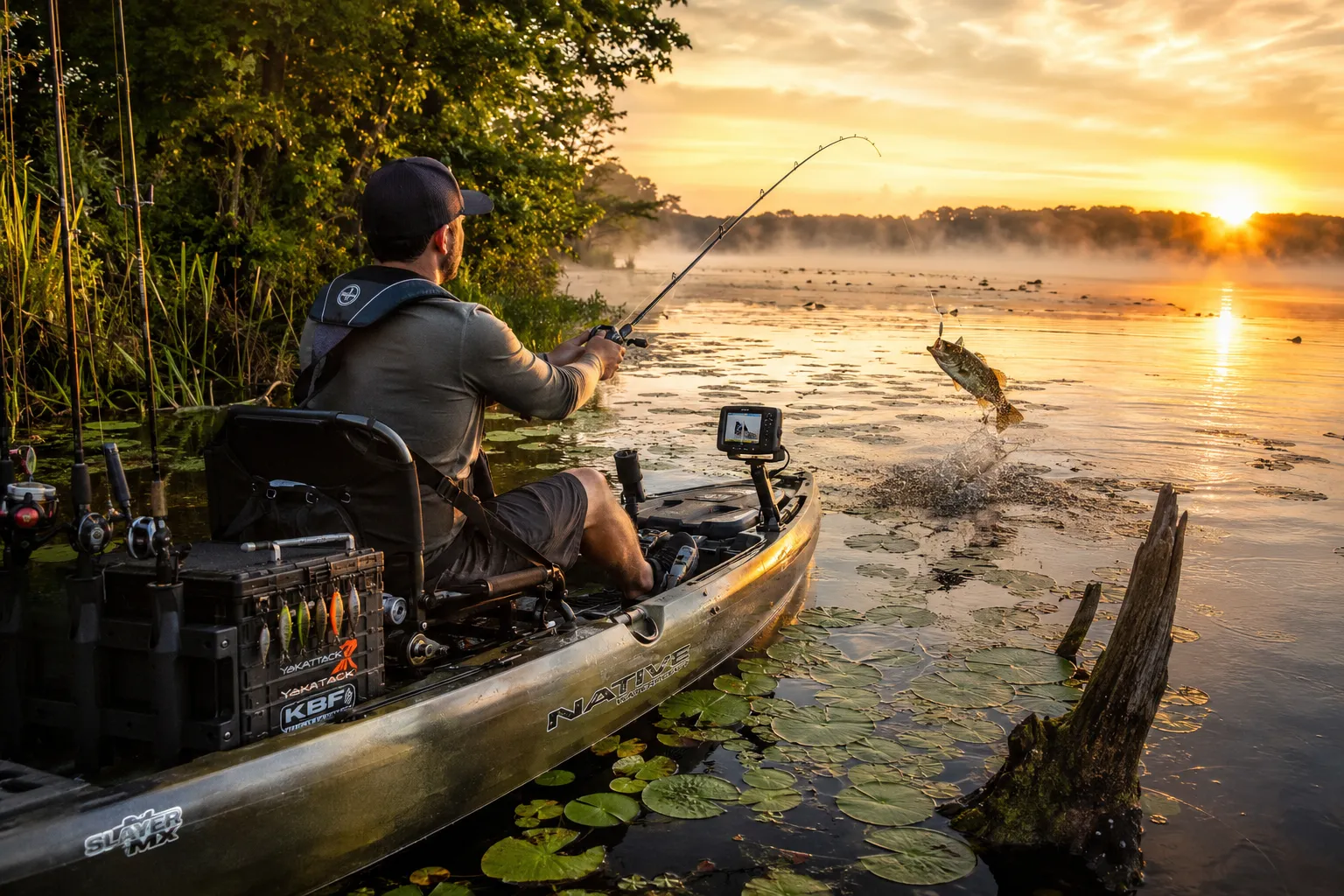
Quick Answer: Bass fishing from a kayak requires a stable sit-on-top kayak (at least 10-12 feet long and 32+ inches wide), basic fishing gear adapted for compact spaces, and techniques for casting while seated, anchoring in position, and safely landing fish without tipping. Kayaks let you access shallow water, lily pads, and shoreline structure that boat anglers and shore fishermen can’t reach, making them highly effective for targeting largemouth and smallmouth bass in lakes, rivers, and ponds.
Key Takeaways
- Sit-on-top kayaks are better than sit-inside models for bass fishing because they offer easier gear access, self-draining decks, and simpler re-entry if you capsize
- A kayak 10-12 feet long and at least 32 inches wide provides the best balance of stability and maneuverability for bass fishing with gear
- Anchor trolley systems let you anchor from bow or stern safely, preventing dangerous side-anchoring that can flip your kayak in current or wind
- Casting from a seated position with proper weight distribution keeps you stable; standing is possible only in wide, flat-bottomed kayaks designed for it
- Kayaks give you stealth access to shallow water, lily pads, and tight cover where bass hide but boats and shore anglers can’t reach
- Essential gear includes a quality PFD, paddle leash, anchor system, 6.5-7 foot medium-action rods, compact tackle storage, and a landing net
- Common beginner mistakes include overloading gear, anchoring from the side, standing in unstable kayaks, and not practicing wet exits before fishing
- Landing big bass requires keeping your rod tip up, fighting the fish from a seated position, and using a net to avoid leaning over the side
- Budget-friendly fishing kayaks under $1,000 offer solid performance for beginners, while premium pedal-drive models ($2,000+) free your hands for fishing
- Kayak bass fishing works well for kids and beginners in calm, protected waters with proper supervision, safety gear, and stable tandem or wide solo kayaks
What Gear Do I Need for Kayak Bass Fishing?
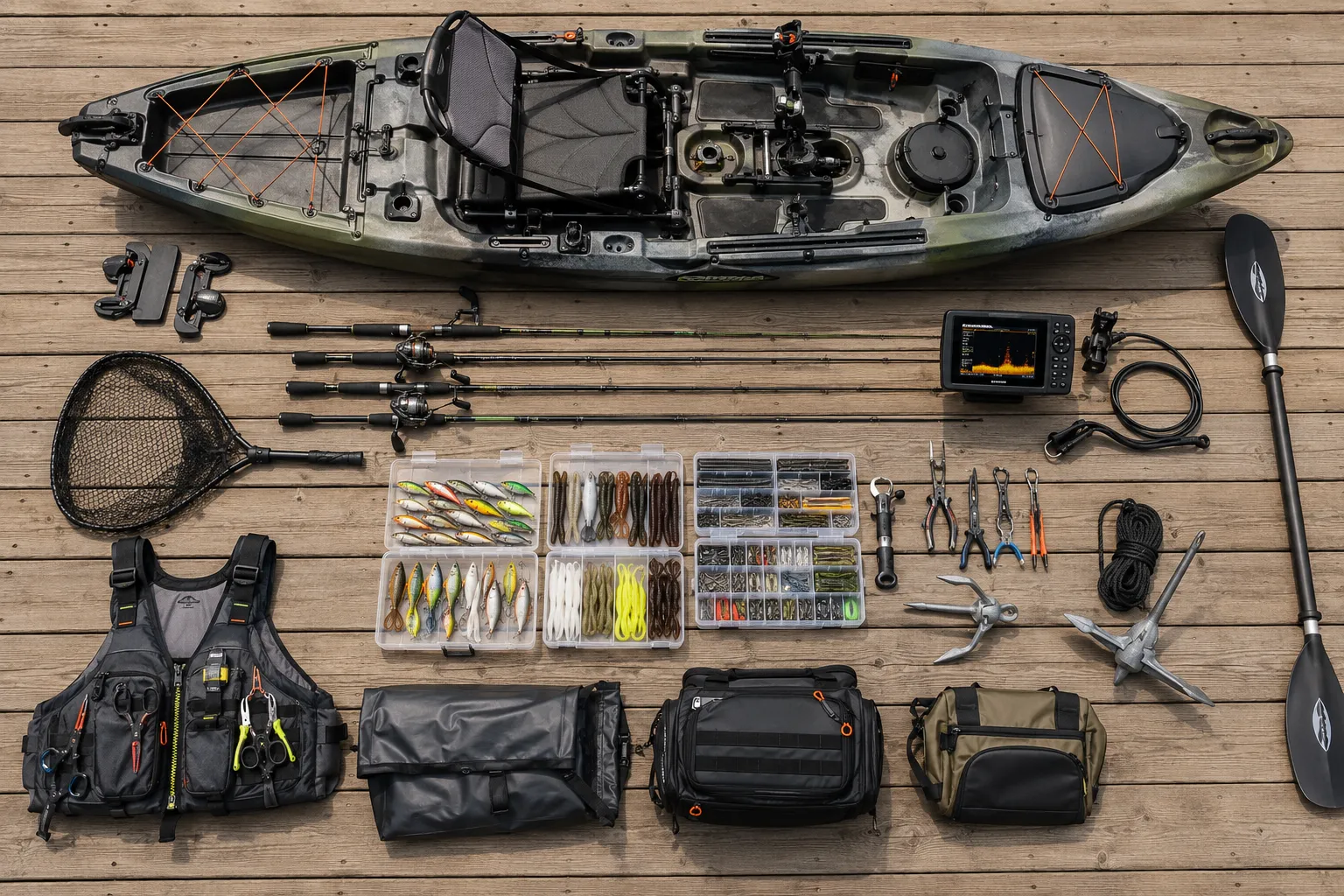
You need a stable fishing kayak, personal flotation device (PFD), paddle, anchor system with trolley, 2-3 fishing rods (6.5-7 feet), tackle box with bass lures, landing net, rod holders, and waterproof storage for electronics and personal items. This core setup lets you fish effectively while keeping essential gear secure and accessible in the limited space of a kayak.
Essential kayak fishing gear checklist:
- Kayak: Sit-on-top model, 10-12 feet long, 32+ inches wide, with rod holders and gear tracks
- Safety equipment: Coast Guard-approved PFD (worn at all times), whistle, paddle leash, bilge pump
- Anchor system: 3-5 lb folding anchor, 50+ feet of rope, anchor trolley installed on kayak rails
- Fishing rods: 6.5-7 foot medium or medium-heavy rods (shorter than boat rods for easier handling)
- Reels: Baitcasting or spinning reels spooled with 10-17 lb monofilament or 20-30 lb braid
- Tackle: Soft plastics (worms, creature baits), jigs, crankbaits, topwater lures, terminal tackle
- Landing tools: Rubber-coated landing net, fish grips, measuring board, stringer or livewell
- Storage: Waterproof dry bags for phone/keys, tackle boxes that fit in hatches or tank wells
- Accessories: Pliers, line cutters, sunscreen, hat, polarized sunglasses, first aid kit
Choose compact, kayak-specific versions of fishing gear when possible. Standard boat rods (7+ feet) are too long and awkward in a kayak. Tackle storage should be small, waterproof containers that won’t slide around. Mount rod holders within easy reach so you can secure rods while paddling or landing fish.
Common mistake: Bringing too much gear on your first trips. Start with one rod, one small tackle box with 5-6 proven lures, and basic safety equipment. You can always add more as you learn what you actually use on the water.

Ergolounge seating system : Extra-thick cushioning and an extra high and wide padded backrest.
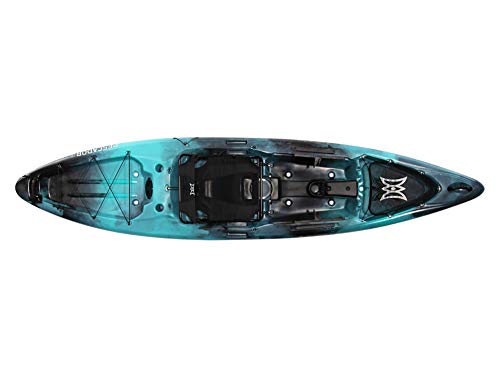
Premium Fishing Experience: The Perception Pescador Pro 12 is a sit-on-top kayak designed for the recreational angler. Equipped with a large front and rear storage area, it provides ample space for all your fishing gear and personal items.
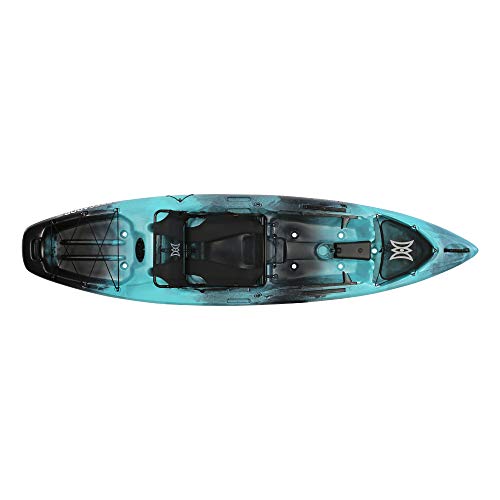
Premium Fishing Experience: The Perception Pescador Pro 10 is a sit-on-top kayak designed for the recreational angler. Equipped with a large front and rear storage area, it provides ample space for all your fishing gear and personal items.
Best Kayak for Bass Fishing Under $1000
The best bass fishing kayaks under $1,000 include the Perception Pescador Pro 12 ($899), Lifetime Tamarack Angler 100 ($499), and Vibe Sea Ghost 110 ($899), all offering stable sit-on-top designs with fishing-specific features like rod holders, gear tracks, and ample storage. These models provide solid performance for beginners and budget-conscious anglers without the premium price of pedal-drive or high-end rigged kayaks.
Top budget-friendly options:
| Kayak Model | Price Range | Length | Width | Weight Capacity | Best For |
|---|---|---|---|---|---|
| Lifetime Tamarack Angler 100 | $400-$550 | 10′ | 31″ | 275 lbs | Beginners, calm water |
| Perception Pescador Pilot 12 | $800-$900 | 12′ | 33.5″ | 375 lbs | Pedal-drive on budget |
| Vibe Sea Ghost 110 | $850-$950 | 11′ | 33″ | 425 lbs | Versatile, stable platform |
| Old Town Heron 9XT | $600-$700 | 9′ | 32″ | 300 lbs | Small ponds, portability |
What to look for in a budget fishing kayak:
- Stability over speed: Wider hulls (32+ inches) are more stable for casting and landing fish
- Built-in rod holders: At least 2 flush-mount rod holders save you from aftermarket installations
- Gear tracks: Aluminum or plastic rails let you add accessories (rod holders, fish finders, camera mounts)
- Decent weight capacity: Your weight plus 75-100 lbs of gear (cooler, tackle, anchor, paddle)
- Comfortable seat: Adjustable, padded seats make long fishing days bearable
- Scupper holes with plugs: Self-draining holes keep water out but can be plugged in cold weather
Choose the Lifetime Tamarack if you’re testing whether you like kayak fishing before investing more. Choose the Perception Pescador Pilot if you want pedal power at the lowest price point. Choose the Vibe Sea Ghost if you want maximum features and stability under $1,000.
Edge case: If you’re over 250 lbs or plan to bring a lot of gear, prioritize weight capacity and width over length. A shorter, wider kayak will feel more stable than a longer, narrower one at the same price point.
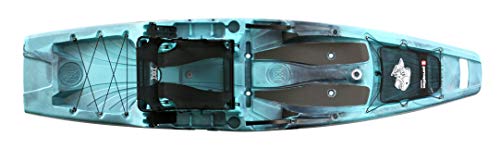
Ultimate Fishing & Storage Space: Perception Outlaw 11.5 is a fishing-optimized sit on top kayak with superior stability and an impressive weight capacity of 425 lbs. It boasts a large rear tankwell and front storage area for all your fishing and personal gear.

UV-Protected HDPE Construction for Durability: Built with high-density polyethylene (HDPE) plastic, this kayak is both lightweight and highly durable, offering long-lasting protection against UV rays for years of use in various conditions. Paddle included.
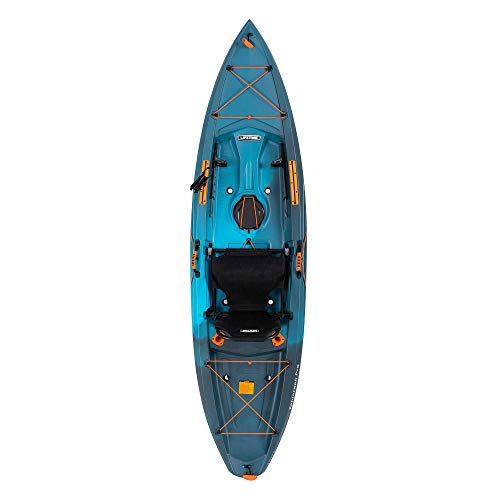
Equipped for Fishing: Built in rod holders (1 Adjustable, 2 Flush Mounted), accessory mounting, tackle box storage, and a ruler to measure your catch.
How to Anchor a Kayak While Bass Fishing
Anchor your kayak using an anchor trolley system that lets you position the anchor line at the bow or stern, never from the side. Deploy a 3-5 lb folding anchor on 50+ feet of rope, adjust the trolley to position your kayak bow-first or stern-first into wind or current, and always keep the anchor line running through the trolley cleat so you can quickly release if conditions change.
Step-by-step anchoring process:
- Install an anchor trolley before your first trip (two pulleys mounted on each end of your kayak rail, connected by a continuous loop of rope with a cleat)
- Tie your anchor line to the trolley ring (the part that slides along the trolley rope)
- Position your kayak where you want to fish, accounting for wind and current drift
- Lower the anchor slowly until it hits bottom, then let out extra line (scope) equal to 3-4 times the water depth
- Adjust the trolley by pulling the ring forward (bow anchor) or backward (stern anchor) to position your kayak
- Cleat the trolley line once you’re positioned correctly
- Test your hold by pulling gently on the anchor line to ensure it’s set
Why you should never anchor from the side: Side-anchoring creates a dangerous pivot point. Wind, current, or boat wakes can push against the side of your kayak, causing it to tip or even capsize. Water can pour over the side rail, swamping your kayak. Always anchor from bow or stern so your kayak naturally points into the force pushing against it.
Anchor trolley benefits:
- Lets you adjust your angle without pulling up the anchor
- Keeps you positioned over structure (drop-offs, weed edges, submerged timber)
- Allows quick release in emergencies by uncleating the trolley line
- Prevents dangerous side-anchoring that can flip your kayak
Alternative anchoring methods: Stake-out poles work well in shallow water (under 5 feet) and let you silently position without splashing an anchor. Drift socks slow your drift in wind without fully anchoring, useful when covering water while fishing.
Common mistake: Using too light an anchor for the conditions. A 1-2 lb anchor won’t hold in current or wind. Invest in a proper 3-5 lb folding anchor designed for kayaks.
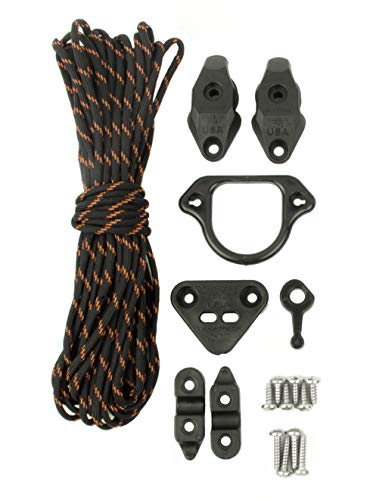

Anchor ring,pad eyes and carabiner of the kayak anchor trolley system are all made of 316 stainless steel,which is more anti-rust and wear resistance,strong and durable,enhance the stability and safety of the anchor trolley system.
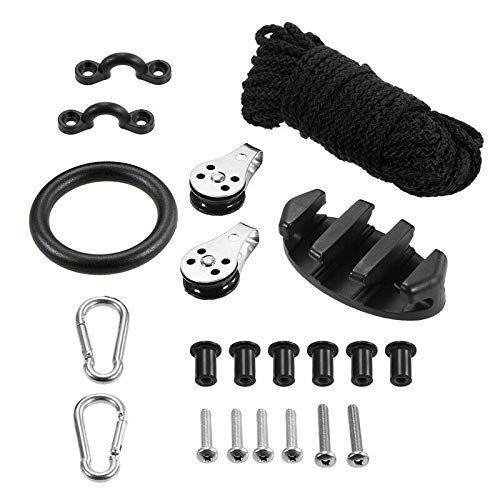
✔Feature:Durable, Seaworthy Materials: Made of tough, corrosion-proof stainless steel, nylon hardware and an ultra-strong paracord (USA made) with a reflective tracer that adds visibility in low-light situations.
Sit on Top vs Sit Inside Kayak for Bass Fishing
Sit-on-top kayaks are better for bass fishing because they offer easier gear access, self-draining scupper holes, simpler re-entry after capsizing, and more space for tackle and rods. Sit-inside kayaks provide better protection from weather and waves but trap water if you flip, limit gear storage, and make it harder to land fish or access tackle while fishing.
Sit-on-top advantages for fishing:
- Self-draining deck: Scupper holes automatically drain water from rain, splashes, or waves
- Easy gear access: Open deck lets you reach tackle boxes, coolers, and gear without opening hatches
- Simple re-entry: If you fall off, you can climb back on from the water (practice this before fishing)
- More fishing space: No cockpit walls means easier casting, landing fish, and moving around
- Better for warm weather: You stay cooler without being enclosed in a cockpit
- Easier to customize: Flat deck accepts gear tracks, rod holders, fish finders, and accessories
Sit-inside disadvantages for fishing:
- Traps water: If you capsize, the cockpit fills with water and is difficult to empty on the water
- Limited gear access: Tackle and gear stored in hatches requires stopping fishing to open compartments
- Harder re-entry: Getting back in a sit-inside kayak after falling out requires advanced skills
- Less casting room: Cockpit walls restrict your casting motion and rod movement
- Difficult fish landing: Landing a big bass over the cockpit rim is awkward and unstable
When sit-inside might work: If you fish in very cold weather or rough water where you need a spray skirt for protection, a sit-inside kayak makes sense. But for 90% of bass fishing situations (calm to moderate conditions, warm weather, lakes and rivers), sit-on-top is the clear winner.
Decision rule: Choose sit-on-top unless you specifically need cold-weather protection or fish in ocean surf conditions. Even then, many anglers prefer sit-on-top with proper clothing over the limitations of sit-inside designs.
How to Cast From a Kayak Without Tipping Over
Cast from a seated position with your weight centered, using shorter rods (6.5-7 feet) and sidearm or underhand casting motions instead of overhead casts. Keep your center of gravity low, brace your feet or knees against the kayak sides, and avoid leaning far to either side during the cast. Practice in calm, shallow water before fishing in deeper or moving water.
Stable casting techniques:
- Sit upright with your back against the seat, not leaning forward or to the side
- Use sidearm casts that keep your rod parallel to the water instead of overhead casts
- Brace your body: Press your knees or feet against the kayak sides for stability
- Cast across your body: Right-handers cast to the left side, left-handers to the right (more stable than casting to your dominant side)
- Keep movements smooth: Jerky, aggressive casting motions destabilize your kayak
- Use shorter rods: 6.5-7 foot rods are easier to control in a kayak than 7.5+ foot boat rods
Weight distribution while casting:
Your kayak is most stable when your weight is centered over the hull. Leaning to reach a casting spot shifts your center of gravity and can tip you. Instead of leaning, paddle to position your kayak so you can cast comfortably from a centered position.
Practice drill: In calm, shallow water (waist-deep), practice casting while seated. Intentionally lean slightly to feel when your kayak becomes unstable. This teaches you the limits of your specific kayak’s stability and builds confidence in your balance.
Rod selection matters: A 6.5-7 foot medium or medium-heavy rod gives you enough casting distance for bass fishing while being short enough to control in tight spaces. Longer rods (7.5+ feet) used on bass boats are too unwieldy in a kayak.
Common mistake: Standing up to cast in a kayak not designed for standing. Most recreational fishing kayaks are too narrow and unstable for standing. Only stand in kayaks specifically designed with wide, flat decks and standing platforms (see the section on standing below).
What Are Common Mistakes Beginners Make Kayak Bass Fishing
Beginners commonly overload their kayak with too much gear, anchor from the side instead of bow or stern, attempt to stand in unstable kayaks, fail to practice wet exits before fishing, and don’t secure loose items that can fall overboard. These mistakes lead to capsizing, lost gear, and dangerous situations that are easily avoided with proper preparation and technique.
Top 10 beginner mistakes:
- Bringing too much gear: Overloading reduces stability and makes everything harder to find
- Side-anchoring: Creates a dangerous pivot point that can flip your kayak in wind or current
- Not wearing a PFD: Even strong swimmers can be incapacitated by cold water or head injuries
- Standing in unstable kayaks: Most kayaks under 34 inches wide aren’t designed for standing
- Loose gear: Tackle boxes, phones, and tools that aren’t secured will fall overboard
- Wrong anchor weight: Too light (won’t hold) or too heavy (hard to retrieve, dangerous if you need to cut loose)
- Ignoring weather: Wind and storms are more dangerous in a kayak than from shore or a boat
- No paddle leash: Losing your paddle leaves you stranded and drifting
- Skipping practice: Not practicing re-entry, anchoring, and casting before fishing in deep water
- Poor rod storage: Rods placed loosely in the kayak get tangled, stepped on, or fall overboard
How to avoid these mistakes:
- Start minimal: One rod, one small tackle box, safety gear only for your first few trips
- Install an anchor trolley before fishing (or use a stake-out pole in shallow water)
- Always wear your PFD from launch to landing, not just “nearby” in the kayak
- Practice in shallow water: Capsize intentionally in waist-deep water to learn re-entry
- Use gear leashes: Attach pliers, paddle, and expensive items to the kayak with coiled leashes
- Check weather before launching: Wind over 10-15 mph makes kayak fishing difficult and dangerous
- Secure everything: Use bungee cords, rod holders, and dry bags to keep gear in place
Edge case: If you’re fishing in current (rivers, tidal areas), practice anchoring and releasing your anchor quickly in calm water first. Current amplifies every mistake and makes recovery harder.
How to Land a Big Bass From a Kayak Safely
Land big bass by keeping your rod tip up to maintain pressure, fighting the fish from a seated position with your weight centered, and using a rubber-coated landing net to scoop the fish headfirst once it’s tired. Never lean far over the side to grab the fish by hand, and always net or lip the bass while it’s still in the water alongside your kayak, not by lifting it over the rail.
Step-by-step landing process:
- Hook set and initial fight: Keep your rod tip up, let your drag and rod absorb runs
- Stay seated and centered: Don’t stand or lean to the side during the fight
- Use your paddle: If the fish pulls you off position, paddle to follow it (if not anchored)
- Tire the fish: Fight it until it’s swimming in circles near the surface, not making strong runs
- Prepare your net: Have your landing net ready in your non-rod hand
- Position the fish: Guide the bass alongside your kayak, not in front or behind
- Net headfirst: Scoop the net under the fish’s head in one smooth motion while it’s in the water
- Lift carefully: Bring the netted fish into your lap or onto the deck, keeping your weight centered
Landing net requirements:
- Rubber-coated mesh: Protects the fish’s slime coat better than knotted nylon
- Large hoop: At least 18-20 inches for bass up to 5+ lbs
- Short handle: 12-18 inch handle is easier to manage in a kayak than long boat nets
- Floating design: If you drop it, a floating net stays on the surface
Alternative: Lip grip tools (like Boga Grips) let you grab the bass by the lower jaw without a net. This works well for experienced anglers but requires leaning slightly over the side, which is less stable than netting.
What not to do:
- Don’t lean far over the side to grab the fish, this is the #1 cause of capsizing while landing fish
- Don’t try to lift a big bass over the rail by the line, the line can break or the hook can pull
- Don’t horse the fish with heavy drag, let it tire naturally to avoid break-offs
- Don’t stand up to land the fish unless you’re in a kayak designed for standing
Common mistake: Trying to land the fish too quickly. A green (not tired) bass will thrash violently when you try to net it, potentially pulling you off balance or breaking your line. Be patient and let the fish tire before attempting to net it.
Is Kayak Fishing Better Than Shore Fishing for Bass
Kayak fishing is better than shore fishing for bass because it gives you access to deeper water, submerged structure, weed edges, and shoreline cover that’s out of casting range from the bank. Kayaks let you position precisely over fish-holding spots and move quietly between locations, while shore anglers are limited to accessible banks and whatever’s within casting distance.
Kayak advantages over shore fishing:
- Access to structure: Reach submerged timber, drop-offs, weed edges, and mid-lake humps
- Stealth approach: Paddle quietly to spooky fish in shallow water without bank vibrations
- 360-degree casting: Fish all sides of cover (docks, lily pads, points) instead of just the shore-facing side
- Mobility: Move between spots quickly without hiking through brush or around obstacles
- Depth control: Position over specific depths shown on your fish finder
- Less pressure: Fish spots that shore anglers and boats can’t reach (too shallow for boats, too far for shore casts)
Shore fishing advantages:
- No equipment investment: Just rod, reel, and tackle, no kayak, PFD, or accessories needed
- Easier for beginners: No paddling, anchoring, or balance required
- Better in bad weather: Wind, rain, and storms are safer on land
- More comfortable: Stand, sit, move freely without stability concerns
- Easier fish handling: Land and photograph fish on solid ground
When shore fishing works better:
- Small ponds where you can reach most of the water from the bank
- Heavily vegetated shorelines where bass hold tight to the bank within casting range
- Cold or rough weather when kayaking is uncomfortable or dangerous
- Quick sessions when you don’t want to rig and launch a kayak
Decision rule: If you fish the same accessible spots repeatedly and catch fish consistently, shore fishing is fine. If you find yourself wishing you could reach “that spot out there” or notice bass activity beyond casting range, a kayak opens up new water and significantly improves your catch rate.
Hybrid approach: Many successful bass anglers use both methods, kayak for exploring new water and reaching prime spots, shore fishing for quick sessions or when conditions aren’t kayak-friendly.
What Size Kayak Do I Need for Bass Fishing With Gear
For bass fishing with gear, you need a kayak 10-12 feet long and at least 32 inches wide, with a weight capacity of at least 100 lbs over your body weight to accommodate tackle, cooler, anchor, and accessories. Longer kayaks (12+ feet) track straighter and paddle faster but are harder to maneuver in tight spots, while shorter kayaks (10-11 feet) turn easier but require more effort to paddle long distances.
Kayak sizing guide:
| Your Weight | Minimum Kayak Capacity | Recommended Length | Recommended Width |
|---|---|---|---|
| Under 150 lbs | 300 lbs | 10-11 feet | 32-34 inches |
| 150-200 lbs | 350 lbs | 11-12 feet | 32-34 inches |
| 200-250 lbs | 400 lbs | 12-13 feet | 33-36 inches |
| Over 250 lbs | 450+ lbs | 12-14 feet | 34-36 inches |
Length considerations:
- 10-11 feet: Best for small ponds, creeks, and tight spaces; easier to transport and store; slower on open water
- 12-13 feet: Best all-around length for lakes and rivers; good balance of speed and maneuverability
- 14+ feet: Best for large lakes and covering distance; tracks very straight; harder to turn and transport
Width (beam) considerations:
- Under 30 inches: Too narrow for fishing, designed for speed and touring, not stability
- 30-32 inches: Minimum for fishing; stable enough for seated fishing in calm water
- 32-34 inches: Sweet spot for most anglers; stable for casting, landing fish, and moderate conditions
- 34-36 inches: Very stable; allows standing in some models; slower to paddle; harder to transport
- Over 36 inches: Maximum stability for standing; very slow; requires more effort to paddle
Weight capacity reality check:
Manufacturers rate kayaks for maximum capacity in ideal conditions. For comfortable, safe fishing, stay at least 100 lbs under the rated capacity. A kayak rated for 350 lbs should carry no more than 250 lbs (your weight plus gear) for good performance and stability.
Gear weight estimate:
- Tackle, rods, and fishing gear: 20-30 lbs
- Cooler with drinks and snacks: 10-20 lbs
- Anchor, rope, and safety gear: 10-15 lbs
- Electronics (fish finder, battery): 5-10 lbs
- Total gear weight: 45-75 lbs
Choose a shorter, wider kayak if you fish small waters, need maximum stability, or have limited vehicle space. Choose a longer, narrower kayak if you paddle long distances, fish large lakes, or prioritize speed over stability.
How to Fish Lily Pads From a Kayak
Fish lily pads from a kayak by paddling quietly to the edge of the pad field, anchoring or using a stake-out pole to hold position, and casting topwater frogs, Texas-rigged worms, or flipping jigs into openings and along the edges. Kayaks excel at lily pad fishing because you can position in shallow water where boats can’t go and approach silently without spooking bass hiding under the pads.
Lily pad fishing techniques:
- Topwater frogs: Cast over the pads, walk the frog across the surface, pause at openings
- Punching: Use heavy weights (1-1.5 oz) to punch through thick pads with creature baits
- Flipping: Flip jigs or Texas-rigged worms into pockets and along pad edges
- Weedless spoons: Flutter spoons over submerged pads and through sparse vegetation
Kayak positioning for lily pads:
- Approach from deep water: Paddle from deeper water toward the pads to avoid spooking fish
- Stay on the edge: Position your kayak at the edge of the pad field, not in the middle
- Use a stake-out pole: In shallow water (under 5 feet), a stake-out pole holds you silently without anchor splash
- Cast into the pads: Target pockets, edges, and transitions from pads to open water
- Work systematically: Fish one section thoroughly before moving to the next
Why kayaks are ideal for lily pad fishing:
- Shallow draft: Kayaks float in 6-8 inches of water, letting you access pad edges where bass feed
- Silent approach: Paddling is quieter than a trolling motor, crucial for spooky shallow-water bass
- Precise positioning: Anchor or stake out exactly where you want to fish without drifting
- Maneuverability: Navigate around pad fields and into narrow channels boats can’t reach
Gear considerations:
- Heavy line: Use 20-30 lb braid or 15-20 lb fluorocarbon to pull bass out of pads
- Stout rod: Medium-heavy to heavy power rod to horse fish away from cover
- Weedless lures: Frogs, Texas rigs, and jigs with weed guards to avoid constant snags
- Landing net: Essential for netting bass in the pads without tangling your line
Common mistake: Paddling through the middle of lily pad fields, which spooks every bass in the area. Instead, work the edges and cast into the pads from outside the vegetation.
Edge case: In very thick, matted pads, you may need to paddle onto the pads themselves. Use your paddle to push pads aside and create a path, moving slowly to avoid noise. This works best in stable, wide kayaks.
Can You Stand Up in a Fishing Kayak to Cast
You can stand up to cast only in fishing kayaks specifically designed for standing, which typically measure 34+ inches wide with flat, stable hulls and often include standing platforms or braces. Most recreational fishing kayaks under 34 inches wide are too unstable for standing, and attempting to stand in them risks capsizing. Always practice standing in shallow water before trying it while fishing.
Kayaks designed for standing:
- Width: 34-42 inches (wider = more stable)
- Hull design: Flat or pontoon-style hulls, not rounded touring hulls
- Standing features: Textured standing pads, grab rails, or elevated platforms
- Examples: Bonafide SS127, Jackson Big Rig, Native Slayer Propel MAX, Hobie Pro Angler
How to practice standing safely:
- Start in shallow water: Waist-deep water where you can touch bottom
- Position your feet: Place feet shoulder-width apart, centered over the kayak’s widest point
- Use a wide stance: Wider stance = more stability
- Rise slowly: Push up gradually, don’t stand up quickly
- Bend your knees: Keep knees slightly bent to absorb movement and maintain balance
- Practice sitting back down: Controlled descent is as important as standing up
- Repeat until comfortable: Practice 10-20 times before trying it while fishing
When standing is worth it:
- Sight fishing: Spotting bass in clear, shallow water
- Casting distance: Standing adds 10-20 feet of casting distance
- Visibility: See over vegetation and structure to locate fish
- Hook sets: More powerful hook sets on topwater and frog bites
When to stay seated:
- Windy conditions: Wind makes standing dangerous even in stable kayaks
- Waves or current: Moving water reduces stability significantly
- While fighting fish: Always sit down before landing a fish
- In narrow kayaks: If your kayak is under 34 inches wide, stay seated
Common mistake: Buying a narrow kayak and trying to add aftermarket standing platforms. Platforms don’t make an unstable kayak stable, they just give you a higher place to fall from. If standing is important to you, buy a kayak designed for it from the start.
Alternative: If you can’t afford a standing kayak, invest in quality polarized sunglasses for sight fishing and practice accurate casting from a seated position. Many successful kayak bass anglers never stand and still catch plenty of fish.
Where to Mount a Fish Finder on a Bass Fishing Kayak
Mount your fish finder display on a RAM ball mount or gear track near the cockpit where you can see the screen while seated and paddling, typically on the side gunwale or in front of the seat. Install the transducer in a scupper hole using a scupper transducer mount, or mount it to the hull near the stern using a transducer arm, ensuring the transducer face is parallel to the water and submerged while the kayak is loaded.
Display mounting locations:
- Side gunwale: Most common, mount on the left or right rail within arm’s reach
- Center console: Some kayaks have gear tracks in front of the seat for center mounting
- Dashboard area: Premium kayaks may have dedicated electronics mounts
- Swivel mount: RAM ball mounts let you adjust screen angle for sun glare and viewing position
Transducer mounting options:
- Scupper hole mount: Fits in existing scupper holes; easiest installation; works for most sit-on-top kayaks
- Transducer arm: Mounts to side or stern; adjustable angle; keeps transducer in water at all times
- Through-hull: Permanent installation; best performance; requires drilling (not recommended for beginners)
Installation tips:
- Cable management: Route cables along the kayak rails using zip ties or cable clips to prevent tangling
- Waterproof connections: Use dielectric grease on all electrical connections
- Battery placement: Mount battery in a waterproof box in the rear tank well or hatch
- Test before fishing: Paddle around to ensure the transducer reads correctly at various speeds
Fish finder features useful for kayak bass fishing:
- Down imaging: Shows structure, vegetation, and fish directly below your kayak
- Side imaging: Scans to the sides, helping you find structure without paddling over it
- GPS/mapping: Marks productive spots and creates routes back to the launch
- Shallow water mode: Reads accurately in 2-10 feet of water where bass often hold
Do you need a fish finder? Not for your first trips. Learn to read water visually, look for structure, vegetation changes, depth transitions, and surface activity. A fish finder helps you fish more efficiently once you understand bass behavior, but it’s not essential for catching fish.
Common mistake: Mounting the transducer at the wrong angle. The transducer face must be parallel to the water surface and fully submerged when the kayak is loaded with your weight and gear. Test it in the water before permanently securing it.
How to Paddle Quietly When Approaching Bass
Paddle quietly by using smooth, controlled strokes with the blade entering the water at an angle rather than slapping the surface, keeping the paddle shaft low to avoid dripping water into the kayak, and using a J-stroke or sweep stroke that minimizes splash. Approach bass-holding structure from deeper water, paddle slowly, and stop paddling 20-30 feet away to let your kayak glide silently into casting range.
Quiet paddling techniques:
- Blade entry: Slice the paddle blade into the water at a 45-degree angle, don’t slap it flat on the surface
- Smooth strokes: Use long, slow strokes instead of short, choppy ones
- Minimize drip: Keep the paddle low during recovery to prevent water dripping from the blade
- J-stroke: Finish each stroke with a slight outward push to keep the kayak tracking straight without switching sides
- Feathered blade: If your paddle has feathered blades, use them to reduce wind resistance and drip
Approach strategies:
- Plan your approach: Identify where you want to cast before paddling close
- Approach from deep water: Bass face shallow water, so approaching from deep water keeps you behind them
- Use wind and current: Let wind or current drift you into position when possible
- Stop paddling early: Coast the last 20-30 feet to your casting spot
- Anchor or stake out: Once in position, anchor quietly (lower the anchor slowly, don’t drop it)
Why stealth matters for bass:
Bass in shallow water (under 10 feet) are extremely sensitive to noise and vibration. A paddle slapping the water, an anchor splashing, or a kayak bumping into structure can spook bass and shut down feeding activity. Kayaks are naturally stealthy compared to boats with motors, but only if you paddle quietly.
Kayak advantages for stealth:
- No motor noise: Paddling is silent compared to even electric trolling motors
- Low profile: Kayaks sit low in the water, making you less visible to fish
- Minimal wake: Kayaks create almost no wake, reducing disturbance
- Shallow draft: Approach shallow water without spooking fish in deeper water nearby
Common mistake: Paddling right up to your target spot and then trying to cast. This spooks fish before you make your first cast. Instead, stop paddling 20-30 feet away and let your kayak glide silently into position.
Edge case: In windy conditions, you may need to paddle continuously to maintain position. In this case, use a stake-out pole or anchor to hold position silently rather than fighting the wind with constant paddle strokes.
Is Kayak Bass Fishing Good for Kids or Beginners
Kayak bass fishing is good for kids and beginners in calm, protected waters like small ponds and lakes with adult supervision, proper safety gear (PFDs), and stable tandem or wide solo kayaks. Start with short trips (1-2 hours) in warm weather, practice basic paddling and safety skills before fishing, and choose simple fishing techniques like bobber fishing or casting spinners to build confidence before advancing to more complex bass tactics.
Requirements for kids and beginners:
- Age: Kids should be at least 6-8 years old and able to swim (younger kids can ride in tandem kayaks with adults)
- Supervision: Adult supervision required for kids under 12-14, depending on experience and water conditions
- Safety gear: Properly fitted PFDs worn at all times, whistle, paddle leash
- Water conditions: Calm, protected water with no current, minimal wind, and warm temperatures
- Kayak type: Stable tandem kayak for parent and child, or wide (34+ inches) solo kayak for older kids/beginners
Best practices for teaching kids:
- Start on land: Practice paddling, casting, and safety skills on dry ground first
- Shallow water practice: Practice in waist-deep water where kids can stand if needed
- Short sessions: Keep first trips to 1-2 hours to avoid fatigue and frustration
- Simple fishing: Use bobbers, live bait, or easy lures (spinners) before teaching bass techniques
- Focus on fun: Catching any fish is success, don’t pressure kids to catch bass specifically
- Build gradually: Add distance, time, and complexity as skills and confidence grow
Tandem kayak benefits:
- Adult control: Parent can paddle and steer while child fishes
- Shared experience: Build memories and teach skills together
- Safety: Adult is immediately available if problems arise
- Confidence building: Child feels secure with parent in the same kayak
When kids are ready for solo kayaks:
- Swimming ability: Strong swimmer comfortable in deep water
- Paddling skills: Can paddle straight, turn, and stop the kayak
- Safety awareness: Understands weather, water conditions, and when to head to shore
- Fishing skills: Can cast, hook fish, and land them without help
- Maturity: Makes good decisions and doesn’t take unnecessary risks
Common mistake: Taking kids on long trips in challenging conditions before they’re ready. This creates negative experiences that can turn kids off kayak fishing permanently. Start easy and build gradually.
Alternative for very young kids: Consider a stable, wide kayak where a parent fishes while the child rides along in a front or rear seat. This introduces kids to kayak fishing without requiring them to paddle or fish independently.
Frequently Asked Questions
What is the best time of day to bass fish from a kayak?
Early morning (dawn to 9 AM) and late evening (5 PM to dusk) are the best times for kayak bass fishing because bass feed actively in low light, water temperatures are cooler, and wind is typically calmer, making paddling easier. Midday can be productive in spring and fall, but summer midday fishing requires targeting deeper water and shaded structure.
Do I need a fishing license to fish from a kayak?
Yes, you need a valid state fishing license to fish from a kayak in the same way you need one for shore or boat fishing. Kayak anglers must follow all state fishing regulations including size limits, bag limits, and seasonal restrictions. Some states also require kayak registration depending on length and propulsion type.
How far can you paddle a fishing kayak in a day?
Most anglers comfortably paddle 3-5 miles in a fishing kayak during a full day of fishing, though experienced paddlers can cover 8-10 miles in good conditions. Fishing kayaks are slower than touring kayaks due to wider hulls and gear weight, and you’ll spend time anchored and fishing rather than constantly paddling.
Can you fish from a kayak in the rain?
Yes, you can fish from a kayak in light rain if you dress appropriately with rain gear and the weather is otherwise safe (no lightning, strong winds, or storms). Sit-on-top kayaks drain rain water through scupper holes, and bass often feed actively during light rain. Always leave the water immediately if lightning is present or forecast.
What happens if you hook a fish too big for your kayak?
If you hook a fish too large to land safely, keep steady pressure to tire it, stay seated and centered, and either net it if possible or cut the line if the fish is pulling you into dangerous situations. Very large bass (8+ lbs) can pull a kayak around but are landable with proper technique, heavy line, and patience.
How do you transport a fishing kayak?
Transport fishing kayaks on roof racks with J-cradles or saddles, using cam straps to secure the hull and bow/stern tie-downs to prevent movement. Alternatively, some fishing kayaks fit inside pickup truck beds or large SUVs with seats folded down. Always secure the kayak at multiple points and check straps after the first few miles of driving.
Should you remove scupper plugs while fishing?
Remove scupper plugs in warm weather and calm conditions to let water drain automatically from the deck. Install plugs in cold weather to keep cold water off the deck, in rough water to prevent waves from coming up through the holes, or when you want a drier ride. Most anglers fish with plugs out in summer and in during spring and fall.
Can you use a trolling motor on a fishing kayak?
Yes, you can add a small electric trolling motor (30-55 lb thrust) to many fishing kayaks using motor mounts designed for kayaks. Trolling motors free your hands for fishing and work well in wind, but they add weight, require battery maintenance, and reduce the stealth advantage of paddling. Pedal-drive kayaks offer a good middle ground.
How do you stay dry in a sit-on-top kayak?
You won’t stay completely dry in a sit-on-top kayak because water splashes onto the deck and comes up through scupper holes, but you can minimize wetness by wearing quick-dry clothing, using scupper plugs in cold weather, and choosing kayaks with higher sides. Sit-on-top kayaks are designed for wet conditions, embrace getting a little wet or choose a sit-inside kayak with a spray skirt.
What should you do if your kayak flips while fishing?
If your kayak flips, stay calm, hold onto your paddle and kayak, flip the kayak right-side up, and climb back on from the side by pulling yourself up while kicking your legs. Practice this re-entry technique in shallow water before fishing in deep water. Your PFD will keep you afloat while you recover.
Can you fish at night from a kayak?
Yes, you can fish at night from a kayak if you have proper navigation lights (white 360-degree light visible from all directions), wear a PFD, stay in familiar waters, and fish with a partner when possible. Night fishing for bass can be very productive in summer, but it requires extra safety precautions and experience with your kayak and the water.
How much does a good fishing kayak cost?
Good fishing kayaks cost $600-$1,200 for quality paddle-powered models, $1,500-$2,500 for pedal-drive kayaks, and $2,500-$4,000+ for premium models with advanced features. Budget models under $600 work for beginners but may lack durability and features. Used kayaks offer good value if they’re in good condition and from reputable brands.
Conclusion
Bass fishing from a kayak opens up water that shore anglers can’t reach and boats can’t access, giving you a stealth advantage in shallow cover where big bass hide. Success comes down to choosing the right kayak (stable, sit-on-top, 10-12 feet long, 32+ inches wide), mastering basic techniques (seated casting, proper anchoring, quiet paddling), and prioritizing safety with a quality PFD and practiced skills.
Start with short trips on calm, familiar water to build confidence and skills. Focus on one or two proven bass techniques, Texas-rigged worms in lily pads or crankbaits along weed edges, rather than trying to master everything at once. Practice capsizing and re-entry in shallow water before fishing in deep water, and always check weather conditions before launching.
Your next steps:
- Choose your kayak: Prioritize stability and fishing features over speed; rent or borrow before buying if possible
- Get essential safety gear: Quality PFD, paddle leash, whistle, and anchor system with trolley
- Practice on land and in shallow water: Paddling, casting, anchoring, and re-entry skills
- Start local: Fish small, calm ponds or protected lake coves for your first trips
- Keep it simple: One rod, one tackle box, basic techniques until you’re comfortable
- Join the community: Connect with local kayak fishing groups or online forums for tips and fishing partners
Kayak bass fishing combines the accessibility of shore fishing with the mobility of boat fishing, all while getting you closer to nature and the fish. With proper preparation and respect for safety, it’s one of the most rewarding ways to target bass in 2026.