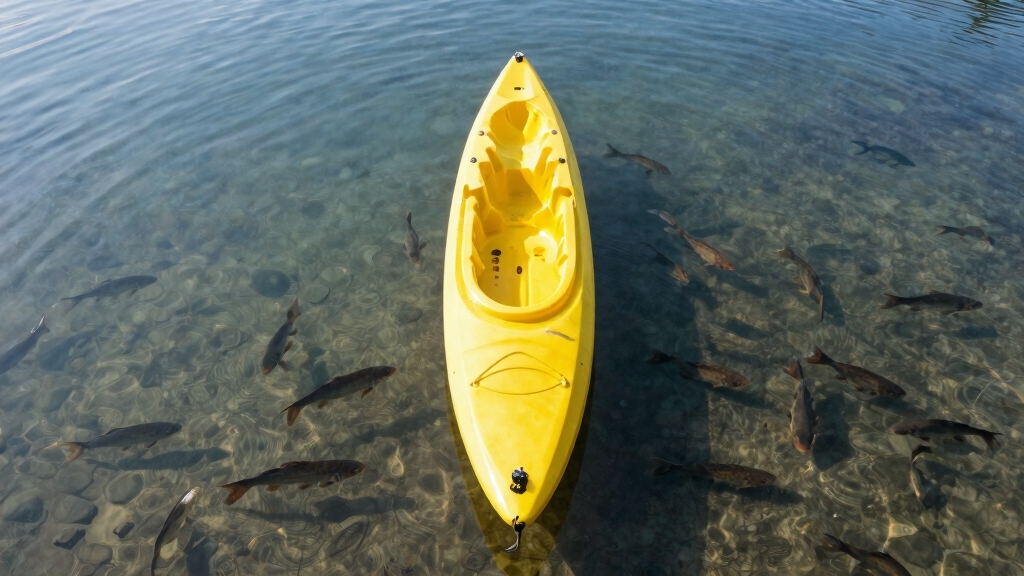
Bright kayak colors do not scare fish in most fishing situations. Fish primarily see objects from below and to the sides, where your kayak appears as a dark silhouette regardless of its topside color. Water clarity, your movement, noise, and shadow have far more impact on spooking fish than whether your kayak is neon yellow or camouflage green.
Key Takeaways
- Fish see kayaks as dark silhouettes from below, making topside color largely irrelevant to spooking fish in most conditions
- Bright kayak colors improve safety by making you visible to other boaters, which is especially critical in high-traffic areas
- Water clarity matters more than color – murky water hides your presence; crystal-clear shallow water exposes any kayak regardless of color
- Movement and noise spook fish far more than color – paddle splash, hull slap, and sudden shadows trigger flight responses
- Most fishing kayaks come in bright colors for safety and visibility reasons, not because manufacturers ignore fish behavior
- Professional kayak anglers use both bright and dark kayaks depending on their fishing environment and safety priorities
- Camouflage kayaks offer minimal fishing advantage in most scenarios but can reduce glare and heat absorption
- The best kayak color balances safety and fishing conditions – choose bright for open water and high traffic, darker tones for solo fishing in remote areas
Do Fish See Colors Underwater?
Fish do see colors underwater, but their color perception differs significantly from humans and varies by species. Most fish have color vision that’s adapted to their specific habitat – shallow-water species often see a broader color spectrum than deep-water fish, and some can even detect ultraviolet light that humans cannot see.
The key factor isn’t whether fish see color, but how water filters and distorts those colors. Water absorbs light wavelengths progressively as depth increases:
- Red disappears first (within 15-20 feet)
- Orange and yellow fade next (30-40 feet)
- Green and blue penetrate deepest (100+ feet)
In shallow fishing scenarios where most kayak fishing occurs, fish can see colors reasonably well. However, they’re viewing your kayak from below or the side, where the hull color and silhouette matter more than the bright deck color you’re sitting on.
Common mistake: Anglers often assume fish have the same visual perspective they do. Fish rarely see the top deck of your kayak – they see the bottom hull and the shadow it casts, which appears dark regardless of your topside color choice.
What Colors Are Most Visible to Fish?
Fish see contrasting colors and movement most clearly, with blue and green being the most visible colors in most water conditions. Yellow and chartreuse also stand out well in murky or stained water because they maintain visibility when other colors fade.
Here’s how different colors appear to fish in typical fishing conditions:
High-visibility colors to fish:
- Blue and green – penetrate water best, visible at greater depths
- Chartreuse and yellow – highly visible in stained or murky water
- White and silver – create strong contrast, especially in low light
Low-visibility colors to fish:
- Red and orange – appear gray or black below 15 feet
- Brown and tan – blend with natural bottom structure
- Black – creates silhouette but minimal color contrast
The important distinction: these visibility rules apply to lures and bait that fish are actively hunting. Your kayak is a large overhead object that fish perceive primarily as a shadow and silhouette, not as a color target.
Edge case: In extremely clear, shallow water (less than 3 feet) where fish can see the topside of your kayak, bright colors might create more visual disturbance. In these conditions, approach and positioning matter more than color – a slow, quiet approach in a bright kayak beats a noisy approach in camouflage.
Can Fish See the Bottom of a Kayak from Below?
Fish see the bottom of your kayak as a dark silhouette against the brighter surface, regardless of the hull color. This phenomenon, called “countershading,” means that objects viewed from below appear dark because they block overhead light, while the water surface appears bright.
When a fish looks up at your kayak, it sees:
- A dark shape blocking sunlight – the primary visual cue
- The outline and profile of your hull
- Movement and shadow changes as you paddle or shift weight
- Minimal color differentiation – most hull colors appear similarly dark
The physics of light transmission through water means that even a white or light-colored hull appears as a dark silhouette from below. The contrast between the bright water surface and any solid object creates this effect naturally.
What actually spooks fish from below:
- Sudden shadow movement – quick paddle strokes or position changes
- Hull slap – waves hitting the bottom of your kayak
- Vibrations – transmitted through water from movement inside the kayak
- Rapid approach – moving too quickly over fish-holding structure
Choose your fishing kayak based on features like stability, storage, and comfort rather than worrying about hull color visibility to fish.
Do Bright Colored Kayaks Spook Fish in Shallow Water?
Bright colored kayaks can potentially spook fish in extremely shallow, clear water (less than 2-3 feet) where fish have a clear view of the kayak’s topside. However, in most shallow-water fishing scenarios, your approach technique, noise level, and shadow management have far greater impact than kayak color.
In shallow water, fish are already on high alert because they have less escape depth and feel more vulnerable. What triggers their flight response:
Primary spooking factors (in order of impact):
- Sudden shadows – casting a dark shape over fish-holding areas
- Noise – paddle splash, gear rattling, hull bumping bottom
- Wake and waves – disturbance on the water surface
- Rapid movement – quick approaches or sudden position changes
- Vibrations – transmitted through water from inside the kayak
Minor spooking factors:
- Bright reflections or glare off the kayak deck
- High-contrast colors in ultra-clear, calm conditions
- Unnatural shapes or patterns (though fish adapt quickly)
Decision rule for shallow water: If you’re fishing gin-clear flats under 2 feet deep in bright sun, a darker or more muted kayak color might offer a slight advantage. For all other shallow-water scenarios – stained water, rippled surface, depths over 3 feet, low-light conditions – kayak color makes virtually no difference to catch rates.
Many successful shallow water fishing guides use bright kayaks because the safety benefits outweigh any minimal stealth disadvantage.

Quality Construction: Constructed of uv-protected high-density polyethylene. Multiple footrest positions for different size riders. Stable flat bottom
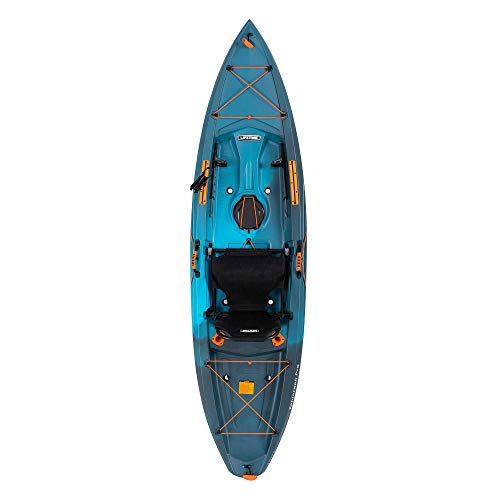
Equipped for Fishing: Built in rod holders (1 Adjustable, 2 Flush Mounted), accessory mounting, tackle box storage, and a ruler to measure your catch.

Ultimate Comfort: Experience enhanced comfort with the sit-inside design suitable for adults and kids, perfect for long hours on the water.
Does Kayak Color Matter for Saltwater Fishing?
Kayak color matters very little for saltwater fishing success. Saltwater fish are accustomed to seeing boats, kayaks, and other surface objects regularly, and they focus on prey movement and bait rather than the color of overhead vessels.
Saltwater environments present unique considerations:
Why color matters less in saltwater:
- Greater water depths – most saltwater fishing occurs in water deep enough that fish can’t see topside colors clearly
- Wave action and surface chop – breaks up visual patterns and reduces visibility from below
- Fish are boat-acclimated – saltwater species regularly see vessels and don’t associate them with direct threats
- Feeding behavior dominates – actively feeding saltwater fish focus on bait schools, not kayak colors
What actually matters in saltwater kayak fishing:
- Stability – handling waves and wind
- Visibility to other boats – critical safety factor in busy coastal waters
- Heat management – lighter colors reflect sun and stay cooler
- Durability – UV resistance and saltwater corrosion protection
For ocean kayak fishing, prioritize bright colors for safety. The Coast Guard and other boaters need to see you from a distance, especially in choppy conditions or fog. A bright yellow, orange, or lime kayak could literally save your life in an emergency situation.
Saltwater species that are color-sensitive: Very few. Some sight-feeding species like redfish or bonefish in ultra-shallow flats might react to sudden overhead movements or shadows, but even then, your approach technique matters exponentially more than your kayak’s color.
Camouflage Kayak vs Bright Kayak for Fishing
Camouflage kayaks offer minimal fishing advantages over bright kayaks in most scenarios, while bright kayaks provide significant safety benefits. The choice should be based on your fishing environment, traffic levels, and personal safety priorities rather than the assumption that camo helps you catch more fish.
Camouflage kayak advantages:
- Reduced glare – less reflective surface in bright sun
- Cooler deck temperature – darker patterns may absorb less heat than solid dark colors
- Aesthetic preference – some anglers prefer the look
- Minimal visibility to wildlife – helpful for waterfowl hunting or wildlife photography (not fishing)
Camouflage kayak disadvantages:
- Poor visibility to other boaters – serious safety concern in trafficked waters
- Harder to spot in emergencies – rescue personnel struggle to locate camo kayaks
- No proven fishing advantage – catch rates don’t improve with camo patterns
- Often more expensive – specialty patterns cost more than solid colors
Bright kayak advantages:
- Excellent visibility – other boaters see you from greater distances
- Safety in emergencies – easier for rescue personnel to locate
- Better for group fishing – you can spot your fishing partners easily
- Reflects heat – lighter bright colors stay cooler than dark colors
- Lower cost – standard bright colors are usually less expensive
Bright kayak disadvantages:
- Potential glare – in very bright conditions, reflections off the deck
- More visible to wildlife – matters for hunting, not fishing
Choose camouflage if: You fish exclusively in remote, low-traffic areas where you’ll never encounter other boats, and you’re confident in your self-rescue skills. You also accept that you’re sacrificing safety for aesthetics with no proven fishing benefit.
Choose bright colors if: You fish anywhere with boat traffic, you value being visible in emergencies, or you fish with groups. This covers the vast majority of kayak anglers. Check out our fishing kayak buying guide for more selection criteria.

SUPER LOUD survival whistle: double tubes emergency whistle, high pitched powerful noise maker with dual sound chambers, can provide up to 120 decibel dB sound power, enough to be heard over a mile away. Cannot be overblown, works great as signal whistle.
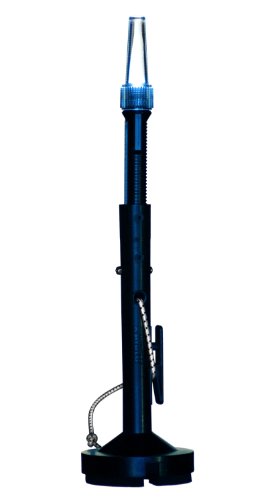
High-performance portable navigation light, for kayak, SOT, SUP, canoe, dinghy, inflatable, scull.

SUPER BRIGHT LED KAYAK LIGHT KIT: 1000+ ft visibility keeps you safe when night kayaking. 3 powerful lights per device give you high visibility. Red, green & white lights for bow and stern with 3 lighting modes: steady, flash, strobe. Compact size, sleek design, up to 100 hours battery life.
Why Do Most Fishing Kayaks Come in Bright Colors?
Most fishing kayaks come in bright colors primarily for safety reasons, not because manufacturers ignore fish behavior. Kayak companies prioritize making their products visible to other boaters, which dramatically reduces collision risk and improves emergency rescue outcomes.
Primary reasons for bright kayak colors:
- Legal and liability considerations – manufacturers reduce risk by making kayaks highly visible
- Coast Guard recommendations – bright colors align with maritime safety guidelines
- Customer safety – companies prioritize keeping anglers alive over unproven stealth theories
- Market research – data shows bright kayaks don’t reduce catch rates
- Visibility in retail – bright colors stand out in showrooms and online listings
Industry insight: Major kayak manufacturers have consulted with marine biologists and professional anglers. The consensus is clear: kayak color has minimal impact on fishing success, but massive impact on safety outcomes. Companies choose bright colors because they save lives, not because they’re ignorant of fish behavior.
Color options available: While bright colors dominate, most manufacturers now offer several choices:
- Safety bright – yellow, orange, lime, red
- Moderate visibility – blue, green, gray
- Low visibility – tan, brown, camouflage patterns
The fact that professional tournament anglers consistently win using bright-colored kayaks reinforces that color isn’t a limiting factor in fishing success.
Do Professional Kayak Anglers Use Bright or Dark Kayaks?
Professional kayak anglers use both bright and dark kayaks, with the majority choosing bright colors for safety and sponsorship visibility. Tournament results show no correlation between kayak color and catch rates – pros win in yellow kayaks as often as they win in camouflage.
What pros actually prioritize:
- Kayak stability and features – platform quality matters most
- Sponsor requirements – many pros use specific colors for brand visibility
- Safety in tournament conditions – bright colors help tournament directors track competitors
- Personal preference – comfort and confidence in their equipment
Notable examples:
- Many Hobie pro-staff anglers use bright yellow or orange kayaks
- Native Watercraft pros often use their signature green or tan models
- Old Town pros frequently choose bright colors for visibility
- Tournament winners span the entire color spectrum
What this tells recreational anglers: If professionals who make their living fishing from kayaks don’t worry about color scaring fish, recreational anglers shouldn’t either. Focus on learning fish behavior, improving your technique, and choosing a kayak with the right features for your fishing style.
For those just starting out, our beginner kayak fishing resources cover the fundamentals that actually impact your success.
Best Kayak Colors for Fishing
The best kayak color for fishing balances safety visibility with your specific fishing environment. For most anglers, bright colors (yellow, orange, lime) offer the best overall choice because they maximize safety with no proven fishing disadvantage.
Best colors by fishing scenario:
Open water and high-traffic areas:
- Top choice: Bright yellow, safety orange, or lime green
- Why: Maximum visibility to other boaters, critical for safety
- Fish impact: None – fish in these areas are boat-acclimated
Remote, low-traffic lakes and rivers:
- Top choice: Blue, green, or gray
- Why: Adequate visibility for emergencies, less visual impact for you
- Fish impact: Minimal – approach and technique matter more
Ultra-clear, shallow flats (under 3 feet):
- Top choice: Tan, light gray, or muted green
- Why: Reduces potential visual disturbance in extreme conditions
- Fish impact: Slight possible advantage, but technique still dominates
Night fishing:
- Top choice: Any color with reflective tape or lights added
- Why: Color is irrelevant at night; reflective materials and lights are essential
- Fish impact: None – fish don’t see colors in darkness
Heat management consideration: In hot climates, lighter colors (white, light yellow, light blue) reflect more sun and keep the deck cooler than dark colors. This comfort factor often matters more than any fishing consideration.
Decision framework:
- Assess your primary fishing environment’s boat traffic level
- Consider emergency rescue scenarios – how easily could someone spot you?
- Evaluate water clarity and depth where you fish most often
- Choose the brightest color you’re comfortable with that meets your safety needs
For more guidance on selecting the right kayak for your needs, explore our fishing kayak comparison resources.

Stylish Fish Print: An elegant unique fish artwork adds style and character to this fishing shirts. The stylish print and graphics on this cool shirts to make you outstanding.
【Size Information】1/8" Diameter with 25 feet length,Bright yellow.

CONTROLLED STRETCH: Nylon gives under load, which cushions a hookset and keeps treble hooks pinned when a fish surges boatside or a light drag takes a sudden headshake
Does Water Clarity Affect Whether Fish See Kayak Color?
Water clarity significantly affects whether fish can see your kayak’s color, but it also affects whether they can see your kayak at all. In murky or stained water, fish have limited visibility in all directions, which means your kayak color is irrelevant because fish can’t see you clearly regardless. In crystal-clear water, fish can see more detail, but they still view your kayak primarily as a silhouette from below.
Water clarity scenarios:
Murky or stained water (visibility under 2 feet):
- Fish cannot see kayak colors clearly
- Your presence is hidden until you’re very close
- Noise and vibration matter more than visual cues
- Best approach: Move quietly, any kayak color works
Moderate clarity (visibility 2-6 feet):
- Fish see kayaks as shapes and shadows
- Color distinction is minimal from below
- Movement and shadow trigger awareness
- Best approach: Slow approaches, any color works
Clear water (visibility 6-15 feet):
- Fish see kayak silhouettes clearly from below
- Topside colors may be visible in shallow areas
- Approach technique becomes critical
- Best approach: Long casts, stealthy positioning, color has minor impact
Gin-clear water (visibility 15+ feet):
- Fish see everything, including topside details in shallow water
- Ultra-wary fish in these conditions
- Every aspect of approach matters
- Best approach: Extreme stealth, long casts, muted colors offer slight advantage
Key insight: Water clarity affects your overall visibility to fish far more than it affects whether they can distinguish your kayak’s color. In clear water, even a perfectly camouflaged kayak will spook fish if you approach too quickly or cast a sudden shadow.
Are There Any Fish Species That Are Scared by Bright Colors?
No fish species are specifically scared by bright colors on kayaks. Fish react to threats based on movement, vibration, shadow, and predator shapes – not to color patterns on overhead objects. While some fish species are more wary than others, their wariness relates to fishing pressure and natural predator avoidance, not to kayak color.
Wary species and what actually spooks them:
Bonefish and permit (flats species):
- Spook trigger: Sudden shadows, rapid approaches, splashing
- Color impact: None – they react to movement and silhouette
- Best practice: Slow approaches, long casts, quiet poling
Trout (especially in clear streams):
- Spook trigger: Overhead shadows, vibrations, unnatural movements
- Color impact: None – they’re shadow-sensitive, not color-sensitive to kayaks
- Best practice: Approach from downstream, minimize shadow
Redfish in shallow water:
- Spook trigger: Sudden movements, loud noises, rapid approaches
- Color impact: Minimal – they’re more tolerant than bonefish
- Best practice: Steady, slow movements
Bass (largemouth and smallmouth):
- Spook trigger: Repeated fishing pressure, loud noises
- Color impact: None – bass are relatively tolerant of kayaks
- Best practice: Quiet approaches to unpressured fish
Muskie and pike:
- Spook trigger: Very little – these are aggressive predators
- Color impact: None – they often follow boats out of curiosity
- Best practice: Standard approaches work fine
The pattern: No species reacts negatively to bright kayak colors specifically. Wary species react to poor approach techniques, and those same fish would spook from a camouflage kayak if you approached incorrectly.
Should I Get a Bright Kayak for Safety or Dark for Stealth Fishing?
Get a bright kayak for safety unless you fish exclusively in remote, zero-traffic areas and are highly experienced in self-rescue. The safety benefits of bright colors far outweigh any theoretical stealth advantage of dark colors, and catch rates don’t support the idea that dark kayaks help you catch more fish.
Choose bright colors (yellow, orange, lime) if:
- You fish anywhere with motorboat traffic
- You fish in coastal or open water environments
- You’re a beginner or intermediate kayak angler
- You fish with groups or in tournaments
- You value being visible in emergencies
- You fish in areas with fog, rain, or low-light conditions
Consider darker colors (blue, gray, green) if:
- You fish exclusively in remote, private waters with zero boat traffic
- You’re an expert in self-rescue and kayak safety
- You fish primarily at dawn or dusk when visibility is already low
- You want a cooler deck in hot climates (lighter shades of these colors)
Avoid camouflage or very dark colors unless:
- You never encounter other boats
- You always fish with a partner who has a bright kayak
- You add high-visibility flags or lights to compensate
- You’re using the kayak for hunting, not fishing
Safety statistics matter: While specific kayak-collision data is limited, maritime safety research consistently shows that high-visibility colors reduce accident rates. In an emergency – capsizing, injury, sudden weather – a bright kayak can be spotted from much greater distances by rescue personnel.
The fishing reality: Thousands of anglers catch fish daily from bright yellow, orange, and lime kayaks. Tournament winners use bright kayaks. Fishing guides use bright kayaks. If bright colors significantly reduced catch rates, the market would have shifted to darker colors years ago.
Make your decision based on safety first, fishing conditions second, and aesthetics last. For most anglers, that means choosing the brightest color you’re comfortable paddling. Learn more about kayak safety to make informed decisions.
Mistakes Beginners Make Choosing Fishing Kayak Color
Beginners often overestimate the importance of kayak color for fishing success while underestimating its importance for safety. The most common mistake is choosing a dark or camouflage kayak based on the assumption that it will help them catch more fish, when in reality it primarily makes them harder to see in emergencies.
Common color-selection mistakes:
Mistake 1: Prioritizing stealth over safety
- The error: Choosing camo or dark colors to “not spook fish”
- The reality: Color has minimal impact on catch rates but major impact on visibility
- The fix: Choose bright colors for safety, improve your approach technique for stealth
Mistake 2: Ignoring heat absorption
- The error: Choosing dark colors in hot climates
- The reality: Dark kayaks absorb more heat, making the deck uncomfortably hot
- The fix: Choose lighter colors (even light gray or tan) to reflect heat
Mistake 3: Buying based on looks alone
- The error: Choosing a color because it looks cool in the showroom
- The reality: You’ll spend hundreds of hours in this kayak – function matters more
- The fix: Consider where and how you’ll fish, then choose color accordingly
Mistake 4: Assuming pros use camo for a reason
- The error: Thinking pro anglers choose colors for stealth advantages
- The reality: Pros choose colors based on sponsors, personal preference, and safety
- The fix: Research what pros actually say about color – most confirm it doesn’t matter
Mistake 5: Not considering resale value
- The error: Choosing unusual or custom colors
- The reality: Standard bright colors have broader appeal and better resale value
- The fix: If you might sell the kayak later, stick with popular colors
Mistake 6: Forgetting about accessories and visibility aids
- The error: Thinking kayak color alone determines visibility
- The reality: Flags, lights, and reflective tape dramatically improve visibility
- The fix: Add high-visibility accessories regardless of kayak color
What beginners should focus on instead:
- Kayak stability and comfort for your body type
- Storage and rigging options for your fishing style
- Weight and portability for your vehicle and launch sites
- Budget and overall value
Color should be one of the last decisions you make, after you’ve narrowed down kayaks based on features, performance, and fit. Check out resources for kayak for beginners to learn what really matters when starting out.
Frequently Asked Questions
Do fish see kayaks from underwater?
Yes, fish see kayaks from underwater as dark silhouettes against the brighter water surface. They see the hull shape and shadow rather than topside colors, which means kayak color has minimal impact on whether fish detect your presence.
What is the best color kayak for fishing?
Bright yellow, orange, or lime green are the best colors for most fishing situations because they maximize safety visibility with no proven fishing disadvantage. Choose darker colors only if you fish exclusively in remote, zero-traffic waters.
Will a bright yellow kayak scare fish away?
No, a bright yellow kayak will not scare fish away in typical fishing conditions. Fish see kayaks primarily as overhead silhouettes, and the topside color is largely irrelevant to their behavior. Movement, noise, and shadows have far greater impact.
Do camouflage kayaks help you catch more fish?
No, camouflage kayaks do not help you catch more fish. There is no evidence that camo patterns improve catch rates, and many successful anglers and tournament winners use bright-colored kayaks exclusively.
Can fish see bright colors in murky water?
Fish have limited visibility in murky water regardless of color. In stained or turbid water, your kayak’s color is irrelevant because fish cannot see you clearly until you’re very close, at which point movement and noise matter more than color.
Should I avoid red kayaks for fishing?
Red kayaks are fine for fishing. While red light doesn’t penetrate water deeply and appears dark to fish at depth, your kayak is viewed from below as a silhouette anyway. Choose red if you like it, but brighter colors offer better safety visibility.
Do bass care about kayak color?
Bass do not care about kayak color. Bass are relatively tolerant of kayaks and boats, and they focus on prey and cover rather than overhead vessel colors. Successful bass anglers use kayaks of all colors.
Is a white kayak good for fishing?
White kayaks are excellent for fishing. They offer high visibility for safety, reflect heat to stay cooler, and don’t spook fish any more than other colors. The main consideration is that white shows dirt and scuff marks more easily.
Do fish get used to seeing kayaks?
Yes, fish in regularly fished waters become acclimated to seeing kayaks and boats. They learn that these overhead objects don’t pose an immediate threat, which is why catch rates remain high even with frequent kayak traffic.
What color kayak is safest on the water?
Bright yellow, safety orange, and lime green are the safest kayak colors because they’re most visible to other boaters from the greatest distance. These colors also stand out in fog, rain, and low-light conditions.
Should I add a flag to a dark-colored kayak?
Yes, always add a high-visibility flag to a dark-colored kayak. A bright orange or yellow flag mounted at least 4 feet above the waterline dramatically improves your visibility to other boaters and compensates for a low-visibility hull color.
Do kayak colors fade in the sun?
Yes, kayak colors fade over time with UV exposure, especially darker and brighter colors. Quality kayaks use UV-resistant materials and pigments to slow fading, but all kayaks will show some color change after years of sun exposure. This doesn’t affect fishing performance.
Conclusion
The question “Do bright kayak colors scare fish?” has a clear answer backed by fish biology, angler experience, and professional tournament results: bright kayak colors do not scare fish in any meaningful way. Fish view kayaks primarily as overhead silhouettes, and your approach technique, noise level, and water conditions have exponentially more impact on fishing success than your kayak’s color.
Key points to remember:
- Fish see kayaks from below as dark shapes, regardless of topside color
- Bright colors dramatically improve your safety and visibility to other boaters
- Professional anglers win tournaments in bright-colored kayaks regularly
- Water clarity affects overall visibility more than color distinction
- Movement, shadow, and noise spook fish far more than color ever could
Action steps for choosing your kayak color:
Assess your fishing environment – How much boat traffic do you encounter? This should be your primary color consideration.
Prioritize safety – Choose the brightest color you’re comfortable with, especially if you fish in coastal areas, large lakes, or anywhere with motorboat traffic.
Consider heat management – In hot climates, lighter colors will keep your deck cooler and more comfortable during long fishing sessions.
Add visibility accessories – Regardless of your kayak color, add a high-visibility flag, reflective tape, and lights for low-light conditions.
Focus on what matters – Spend your research time on kayak stability, features, and comfort rather than worrying about color. These factors will impact your fishing success far more than whether your kayak is yellow or camouflage.
Improve your technique – Work on quiet approaches, understanding fish behavior, and reading water conditions. These skills will catch you more fish than any color choice ever could.
The fishing kayak market offers colors ranging from safety orange to full camouflage for a reason – personal preference and specific use cases vary. But for the vast majority of kayak anglers, a bright-colored kayak offers the best combination of safety, visibility, and fishing performance. Don’t let color myths keep you from choosing a kayak that could save your life in an emergency while catching just as many fish as any other color on the water.