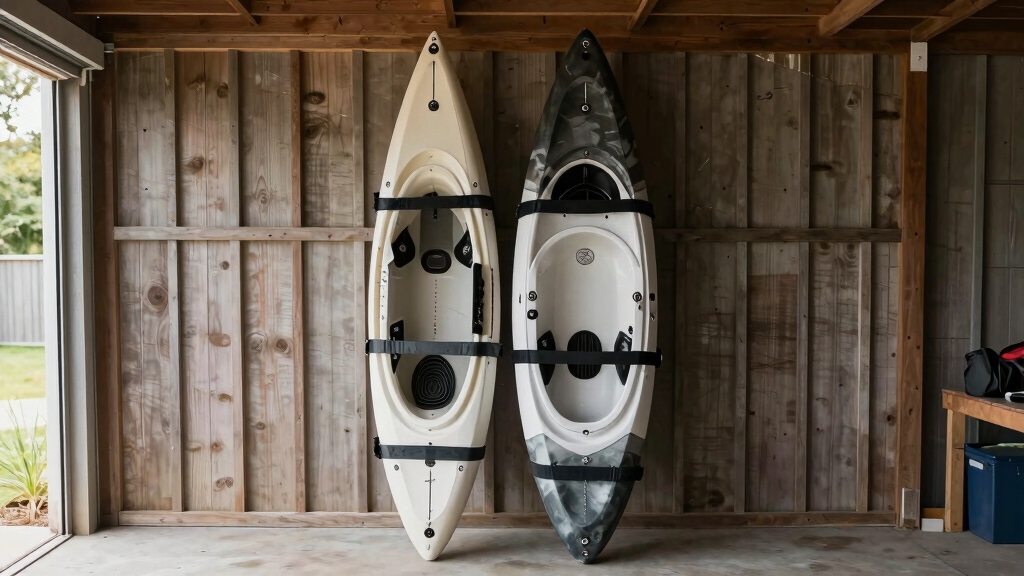
Quick Answer: Yes, you can safely store a kayak vertically, and it’s often the best space-saving solution for garages and small storage areas. Vertical storage works well for most kayak types when you use proper wall-mount racks that support the kayak along its side rather than concentrating weight on the bow or stern. The key is ensuring the hull is supported at multiple points to prevent warping over time.
Key Takeaways
- Vertical storage is safe for most kayak types including plastic, composite, and fiberglass models when proper support is used
- Space savings are significant – vertical storage uses 75-80% less floor space than horizontal storage
- Wall-mount racks should support the kayak along its side at two or more points, never hanging from bow or stern alone
- Plastic kayaks are most forgiving of vertical storage and rarely warp when properly supported
- Composite and fiberglass kayaks need extra care with padded contact points to prevent stress cracks
- Inflatable kayaks should not be stored vertically when inflated; deflate and roll them instead
- Minimum wall space needed is typically 4-5 feet of height and 2-3 feet of width depending on kayak length
- Sit-on-top fishing kayaks store vertically very well due to their rigid hull construction
- Long-term vertical storage (months or years) is fine as long as support points remain properly positioned
- Common mistakes include hanging kayaks by bow/stern loops, using single-point contact, and storing in direct sunlight
Is It Safe to Store a Kayak on Its Side or Standing Up?
Storing a kayak on its side (vertically against a wall) is completely safe and often recommended for long-term storage. The hull experiences minimal stress when supported properly along its length, and this method prevents the flat-spot deformation that can occur with some horizontal storage methods.
Standing a kayak upright on its stern (tail end) is less ideal because it concentrates the entire weight on a small surface area. However, if you rotate the kayak every few weeks and use padding under the stern, even this method works for short-term storage.
The safest vertical storage approach:
- Mount wall racks that cradle the kayak along its side
- Position support arms 3-4 feet apart for kayaks over 10 feet long
- Use padded or rubberized contact points to distribute weight
- Keep the kayak away from heat sources and direct sunlight
- Check support points monthly to ensure they haven’t shifted
Choose vertical storage if you have limited floor space, want easy access to your fishing kayak, or need to store multiple kayaks in one area. Avoid it only if your walls can’t support the weight or if you’re storing a very old, brittle kayak with existing cracks.
How to Store a Kayak Vertically Without Damaging the Hull
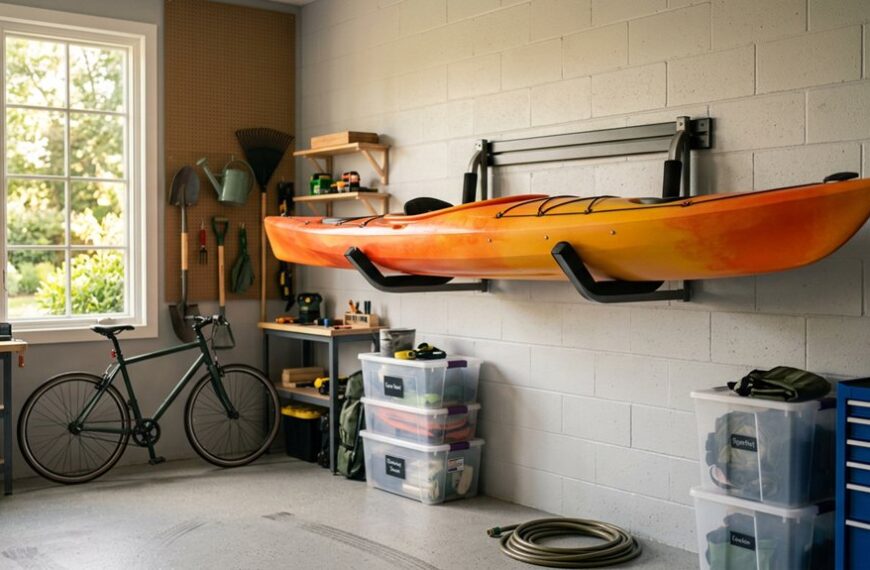
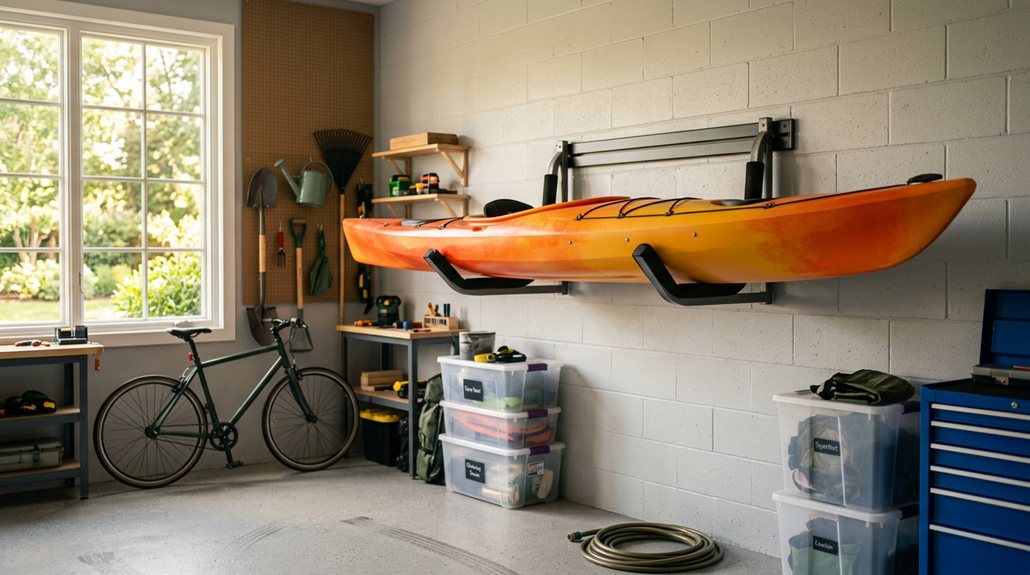
Proper vertical storage requires supporting the kayak at multiple points along its side to distribute weight evenly across the hull. The goal is to prevent any single area from bearing too much load, which could cause warping or stress cracks over time.
Step-by-step vertical storage setup:
- Choose the right wall location – Select a wall that can support 80-150 pounds (depending on your kayak weight) and has at least 5 feet of vertical clearance
- Install wall-mount brackets – Position two support arms 3-4 feet apart, angled slightly upward (10-15 degrees) to prevent the kayak from sliding
- Add padding – Wrap foam pipe insulation or pool noodles around contact points, or use racks with built-in rubber padding
- Position the kayak – Lift the kayak and rest it on its side against the supports, with the hull’s curve fitting naturally into the cradles
- Secure with straps – Use kayak straps or bungee cords to prevent the kayak from tipping forward, but don’t over-tighten
Common mistake: Many people hang kayaks from bow and stern carry handles. These handles are designed for short-term carrying, not long-term weight bearing. This method can stretch or tear the handles and create stress points in the hull.
For fishing kayaks with accessories: Remove heavy items like fish finders, rod holders, and tackle storage before storing vertically. The added weight of accessories can stress mounting points and cause the kayak to become unbalanced on the rack.

STURDY CONSTRUCTION – Built from high-quality low-carbon steel, these heavy-duty garage wall hooks feature a rust-resistant powder-coated finish. They support up to 100lbs and include EVA arm protectors to prevent damage to your gear

Heavy-Duty Load Capacity This durable kayak rack is stronger than standard kayak racks; holds up to 120 pounds; also functions as a reliable canoe rack for heavy gear

Versatile Kayak Storage Hooks: Kayak rack for wall is great for garage storage organization, suitable for lightweight kayak, surfboard, canoe, folded chairs, ladders, snowboards, garden hoses, lumber, and much more
Vertical vs Horizontal Kayak Storage: Which Is Better?
Vertical storage wins for space efficiency and convenience, while horizontal storage offers slightly more hull protection for very long-term storage (years). For most fishing kayak enthusiasts, vertical storage is the better choice because it maximizes garage space and makes it easier to access your kayak for frequent trips.
Vertical storage advantages:
- Uses 75-80% less floor space
- Allows multiple kayaks in small areas
- Easier to clean and inspect the hull
- Better air circulation around the entire kayak
- Quick access without moving other gear
Horizontal storage advantages:
- Distributes weight across a larger surface area
- Slightly less risk of warping for very thin-hulled kayaks
- Can double as a work surface for maintenance
- No wall mounting required
Decision rule: Choose vertical storage if you use your kayak regularly (monthly or more), have limited garage or shed space, or own a sit-on-top kayak with a rigid hull. Choose horizontal storage if you have abundant floor space, store your kayak for entire seasons without use, or own a very lightweight recreational kayak with a thin hull.
For most fishing kayaks, which tend to be heavier and more robust than recreational kayaks, vertical storage poses no risk and offers significant practical benefits.

Heavy-Duty Wall Storage Built with sturdy metal construction this kayak storage rack supports up to 125 lbs for strong reliable storage It securely holds kayaks paddleboards and SUPs off the floor helping keep your garage shed or storage space neat and organized

SET OF 2 WALL HOOKS - This set of 2 kayak storage wall hooks maximizes floor space by neatly hanging your kayak, snowboard, paddleboard, canoe, or surfboard on the wall of your garage. These hooks are a great way to keep your equipment in good condition.

KAYAK WALL RACK - The kayak hanger provides an easy way to mount your kayak, snowboard, paddleboard, canoe, or surfboard neatly on the wall of your garage or shed to free up vital floor space.
What Happens If You Store a Kayak Vertically for Too Long?
Storing a kayak vertically for extended periods (months or even years) causes no damage when proper support is maintained. The hull material – whether polyethylene plastic, composite, or fiberglass – is designed to handle its own weight in any orientation as long as stress is distributed evenly.
The only risk with long-term vertical storage comes from neglecting the setup. If support points shift, padding deteriorates, or the kayak settles into an awkward position, localized stress can develop over time.
What to monitor during long-term vertical storage:
- Support point integrity – Check monthly that brackets remain firmly attached to the wall and haven’t loosened
- Padding condition – Replace foam or rubber padding annually or when it shows compression or cracking
- Hull contact areas – Inspect every 2-3 months for any flat spots or stress marks where the kayak rests on supports
- Strap tension – Ensure securing straps haven’t loosened or tightened excessively due to temperature changes
Edge case: If you store a kayak vertically in an unheated garage or shed where temperatures swing from below freezing to over 100°F, plastic kayaks may become slightly more pliable during heat waves. In this scenario, check the kayak mid-summer to ensure it hasn’t sagged or shifted on its supports. A quick adjustment prevents any permanent deformation.
For fishing kayaks that see regular use, long-term vertical storage is rarely an issue because you’re constantly removing and replacing the kayak, which naturally redistributes any minor stress points.
Best Wall Mount Racks for Vertical Kayak Storage
The best wall-mount racks for vertical kayak storage feature padded arms that support the kayak along its side at multiple points, adjustable spacing to accommodate different kayak lengths, and a weight capacity of at least 100 pounds. Look for racks made from powder-coated steel or heavy-duty aluminum that mount directly into wall studs.
Top features to prioritize:
- Dual-arm design with 3-4 feet of adjustable spacing between support points
- Padded contact surfaces using rubber, foam, or carpeted cradles
- Upward angle of 10-15 degrees to prevent kayak from sliding forward
- Strap or bungee attachment points for additional security
- 150+ pound weight capacity to handle heavier fishing kayaks with gear
Popular rack styles:
- J-cradle racks – Arms form a “J” shape that cradles the kayak’s hull curve; excellent for most kayak types
- Horizontal arm racks – Straight arms with padding; simple and effective for sit-on-top kayaks
- Folding racks – Arms fold flat against the wall when not in use; ideal for shared garage spaces
- Freestanding racks – No wall mounting required; good for renters or temporary storage
Installation tip: Always mount racks into wall studs, not just drywall. Use 3-inch lag bolts or heavy-duty wall anchors rated for at least 200 pounds. For concrete or block walls, use masonry anchors and ensure they’re rated for the combined weight of your kayak plus a 50% safety margin.
Budget consideration: Quality wall-mount racks range from $40-150 per kayak. Spending $80-100 gets you adjustable, padded racks that will last decades. Cheaper racks often lack padding or use thin metal that can bend under load.

StoreYourBoard Kayak Storage Rack Wall Mount, Holds 2 Kayaks, Padded Arms
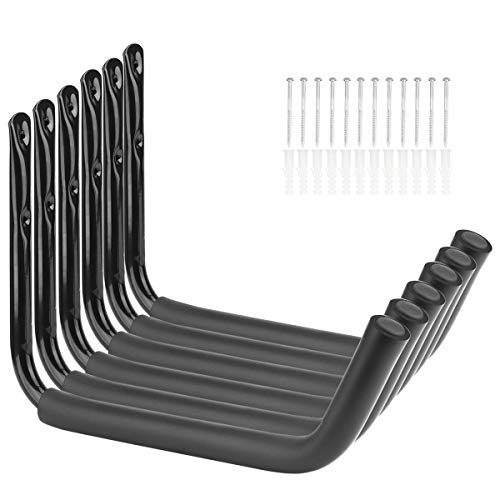
VARIOUS FUNCTIONS: Garage storage hooks great for organization ladders, folded chairs, bicycles, garden tools, garden hoses, lumber, sport equipment and other bulky items.

StoreYourBoard Kayak Storage Rack Wall Mount, Holds 2 Kayaks, Padded Arms
Can You Store an Inflatable Kayak Vertically?
Inflatable kayaks should not be stored vertically while inflated because the concentrated weight on the bottom can stress seams and cause uneven pressure distribution. Instead, deflate your inflatable kayak completely, clean and dry it thoroughly, then roll or fold it according to manufacturer instructions and store it in a cool, dry place.
Proper inflatable kayak storage steps:
- Deflate completely, removing all air from chambers
- Clean with mild soap and water, rinse thoroughly
- Dry completely – any moisture can cause mildew during storage
- Roll loosely or fold following manufacturer guidelines
- Store in the provided bag or a breathable storage container
- Keep in a temperature-controlled area away from rodents
Why vertical storage doesn’t work for inflatables: When inflated and stored vertically, the bottom chambers bear all the weight, which can stretch the material and weaken seams over time. Additionally, inflatable kayaks stored inflated for long periods can develop permanent creases or lose air pressure, requiring frequent re-inflation.
Exception: If you use your inflatable kayak weekly and want to keep it inflated between trips, you can store it horizontally on a padded surface for up to 2-3 weeks without issues. Just avoid vertical storage even for short periods.
For fishing kayak enthusiasts who own both hard-shell and inflatable models, reserve your vertical wall racks for the hard-shell kayaks and dedicate a shelf or storage bin for your deflated inflatable.
Does Vertical Storage Warp or Bend a Kayak Over Time?
Vertical storage does not warp or bend a properly supported kayak, regardless of how long it remains in storage. Modern kayak materials – including polyethylene plastic, ABS composite, and fiberglass – maintain their shape under their own weight when stress is distributed across multiple support points.
Warping occurs only when a kayak is stored improperly: resting on a single point, hanging from bow/stern handles, or stored in extreme heat without support. The hull material itself is designed to handle far more stress than vertical storage creates.
Why warping fears are overblown:
- Kayak hulls are engineered to handle water pressure, impacts, and the weight of paddlers (150-400+ pounds)
- Vertical storage distributes the kayak’s 40-80 pound weight across 2-3 support points
- The stress per square inch is minimal compared to normal use conditions
- Quality racks with padding spread load even further
Real warping risks to avoid:
- Storing a kayak flat on the ground without support – this can create a flat spot on the bottom
- Leaving a kayak in direct sunlight on hot pavement – heat softens plastic, allowing deformation
- Hanging a kayak from a single point (bow or stern) – concentrates weight dangerously
- Storing a kayak in a hot attic or against a heat source – extreme temperatures make plastic pliable
Material-specific considerations: Plastic kayaks are most resistant to warping and can handle less-than-perfect storage conditions. Composite and fiberglass kayaks are more rigid but can develop stress cracks if support points are too narrow or hard. Always use wide, padded supports for composite kayaks.
For fishing kayaks, which typically feature thicker, more robust hulls than recreational models, warping from vertical storage is virtually impossible with proper rack setup.
How Much Wall Space Do You Need for Vertical Kayak Storage?
Vertical kayak storage requires 4-6 feet of wall height and 2-3 feet of width, depending on your kayak’s length and the rack design. A typical 10-foot kayak needs about 5 feet of vertical clearance when stored on its side, while a 12-foot kayak requires 6 feet or more.
Space requirements by kayak length:
- 8-10 foot kayaks: 4-5 feet of wall height, 2 feet of width
- 10-12 foot kayaks: 5-6 feet of wall height, 2.5 feet of width
- 12-14 foot kayaks: 6-7 feet of wall height, 3 feet of width
- 14+ foot kayaks: 7+ feet of wall height, 3-4 feet of width
Additional clearance considerations:
- Add 6-12 inches of clearance on each side for easy loading and unloading
- Ensure at least 2 feet of clearance in front of the kayak to walk past comfortably
- Account for any protruding accessories like rod holders or rudders
- Leave space above for lifting the kayak onto and off the rack
Small garage solutions: If wall height is limited, consider angled storage where the kayak leans at 45-60 degrees rather than fully vertical. This reduces height requirements by 1-2 feet while still saving significant floor space compared to horizontal storage.
Multiple kayak storage: To store two kayaks vertically side by side, allocate 5-6 feet of total wall width. For three kayaks, plan for 8-10 feet of wall space. Staggering the heights (one higher, one lower) can reduce width requirements if wall height allows.
Should Sit-On-Top Kayaks Be Stored Vertically or Flat?
Sit-on-top kayaks are ideal candidates for vertical storage because their rigid, self-bailing hull design handles vertical orientation exceptionally well. The thick polyethylene or composite construction of most sit-on-top fishing kayaks makes them more resistant to deformation than sit-inside recreational kayaks.
Why sit-on-tops excel in vertical storage:
- Thicker hull material (often 3-5mm vs. 2-3mm for sit-inside kayaks)
- Self-supporting structure without a cockpit opening that could stress
- Heavier weight distributed across a robust frame
- Designed for rough use, making them more durable in storage
Storage recommendation for sit-on-top fishing kayaks: Store vertically on wall-mount racks to maximize garage space and maintain easy access for frequent fishing trips. The hull will maintain its shape indefinitely with proper support.
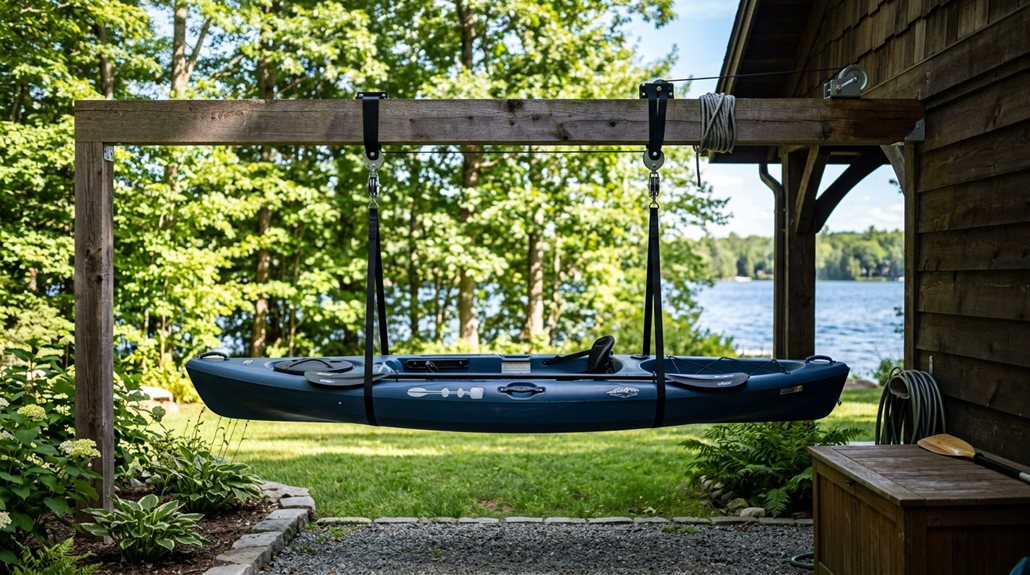
Flat storage considerations: While sit-on-tops can be stored flat, this method offers no advantage and wastes valuable floor space. The only scenario where flat storage makes sense is if you’re stacking multiple kayaks using a ceiling-mounted hoist system or suspended straps.
For fishing kayak enthusiasts who own wider, more stable kayaks designed for standing and casting, vertical storage is particularly beneficial because these kayaks take up considerable floor space when stored horizontally. A 36-inch-wide fishing kayak stored flat occupies 3 feet of floor width, while the same kayak stored vertically uses just 12-18 inches of wall depth.
Common Mistakes When Storing Kayaks Upright Indoors
The most common mistake when storing kayaks vertically is hanging them from bow or stern carry handles, which concentrates weight on attachment points never designed for long-term load bearing. This can stretch handles, create stress cracks, and even cause the kayak to fall if a handle fails.
Top mistakes to avoid:
- Single-point suspension – Hanging from one handle or hook creates dangerous stress concentration
- No padding on contact points – Hard metal or wood racks can create pressure points and damage the hull
- Improper wall anchoring – Mounting racks into drywall alone rather than studs leads to rack failure
- Storing in direct sunlight – UV exposure degrades plastic and causes fading and brittleness
- Over-tightening securing straps – Excessive strap pressure can dent or deform the hull over time
- Ignoring kayak width – Racks spaced too close together can pinch the hull or prevent proper seating
- Storing with gear inside – Leaving heavy items in storage compartments adds unnecessary weight and stress
- Neglecting to clean first – Storing a dirty kayak can lead to mold, mildew, and odors
Real-world example: A fishing kayak owner stored his 80-pound sit-on-top by hanging it from the bow handle attached to a single ceiling hook. After six months, the handle mounting point cracked, and the kayak fell, damaging both the kayak and a car parked below. Proper wall-mount racks with dual support points would have prevented this entirely.
Prevention checklist:
- Use racks with at least two support points 3-4 feet apart
- Verify all mounting hardware is rated for 2x your kayak’s weight
- Add padding to all contact surfaces
- Remove all gear and accessories before storage
- Clean and dry the kayak thoroughly
- Position away from windows and heat sources
- Check the setup monthly for any signs of stress or shifting
Do Plastic Kayaks Get Damaged From Vertical Storage?
Plastic kayaks (polyethylene) are the most durable option for vertical storage and rarely suffer any damage when properly supported. The material’s flexibility and thickness make it highly resistant to deformation, and it naturally returns to its original shape even after minor stress.
Why plastic kayaks handle vertical storage well:
- Polyethylene is self-healing and flexible, resisting permanent deformation
- Most fishing kayaks use rotomolded plastic 3-5mm thick, providing excellent structural integrity
- The material’s memory allows it to return to shape after temporary stress
- Plastic is less prone to stress cracks than composite materials
Temperature considerations: Plastic kayaks can become more pliable in extreme heat (above 100°F) and more brittle in extreme cold (below 0°F). If storing in an unheated garage or shed, check the kayak during temperature extremes to ensure it hasn’t shifted on its supports.
Long-term plastic kayak storage best practices:
- Use padded racks to distribute weight evenly
- Store away from direct heat sources (furnaces, water heaters, direct sunlight)
- Check support points seasonally, especially after temperature swings
- Avoid storing in attics where temperatures can exceed 130°F in summer
Comparison to other materials: Plastic kayaks are more forgiving than fiberglass or composite kayaks, which can develop stress cracks if support points are too narrow or hard. If you own multiple kayak types, prioritize your composite kayaks for the best-padded racks and use simpler racks for plastic models.
For budget-conscious fishing kayak enthusiasts, the durability of plastic kayaks in vertical storage is a significant advantage. You can use more affordable rack systems without worrying about damage, whereas composite kayaks require premium padded racks for safe long-term storage.
Vertical Kayak Storage Ideas for Small Garages
Small garages benefit most from vertical kayak storage because it reclaims floor space for vehicles, workbenches, and other gear. Creative solutions include ceiling-mounted pulleys, corner racks, and multi-level systems that store multiple kayaks in a compact footprint.
Space-saving vertical storage solutions:
1. Corner mounting: Install racks in garage corners where wall space is often wasted. Two walls meeting at 90 degrees can support a kayak diagonally, using even less linear wall space.
2. Above-door storage: Mount racks above garage doors or entry doors where ceiling height is typically higher. This keeps kayaks completely out of the way while remaining accessible with a step stool.
3. Folding racks: Use racks with arms that fold flat against the wall when not in use. This allows you to park vehicles closer to the wall when the kayak is out on the water.
4. Multi-level racks: Stack two or three kayaks vertically on the same wall section using racks at different heights. This stores multiple kayaks in the footprint of one.
5. Ceiling-mounted vertical hoists: Pulley systems that lift kayaks vertically against the ceiling, then lower them for access. These work well in garages with 9+ foot ceilings.
6. Behind-vehicle storage: Mount racks on the wall behind where you park your vehicle, utilizing the space between the car’s front bumper and the wall.
DIY budget option: Create simple vertical racks using 2×4 lumber and pool noodles for padding. Mount two horizontal 2x4s to wall studs 3-4 feet apart, wrap them with pool noodles, and rest your kayak against them. Total cost: under $20.
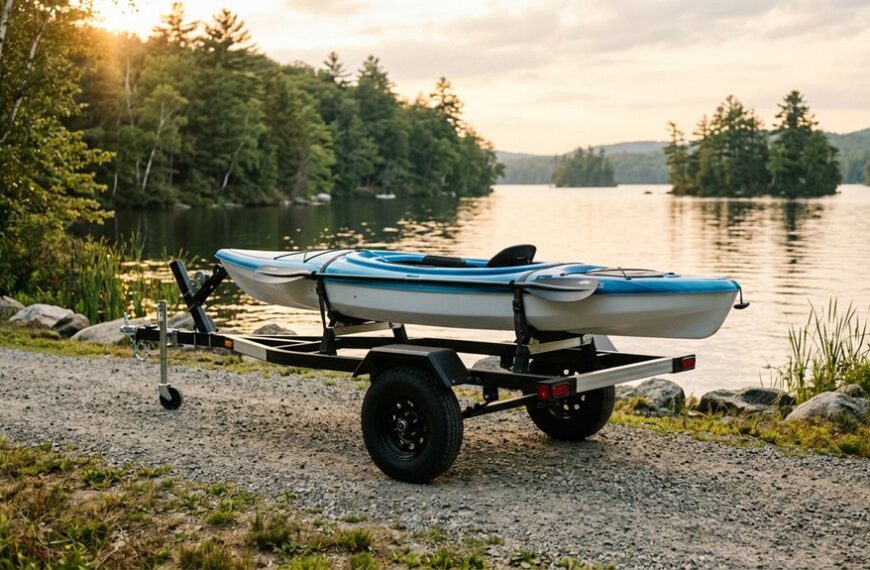
For fishing kayak owners with limited space: Prioritize vertical storage for your primary kayak and consider alternative storage (overhead garage storage, outdoor shed, or kayak transport solutions) for secondary kayaks or seasonal gear.
Is Vertical Storage Bad for Composite or Fiberglass Kayaks?
Vertical storage is safe for composite and fiberglass kayaks when you use well-padded racks with wide contact surfaces. These materials are more rigid than plastic and can develop stress cracks if supported by narrow or hard contact points, but proper rack selection eliminates this risk entirely.
Key differences from plastic kayaks:
- Composite and fiberglass are less flexible, so they don’t absorb stress as well as polyethylene
- These materials can develop hairline cracks at pressure points if racks are too narrow
- They’re typically lighter than plastic kayaks, reducing overall stress on support points
- UV exposure is more damaging to composite resins than to plastic
Best practices for composite/fiberglass vertical storage:
- Use racks with wide (4-6 inch), padded contact surfaces
- Choose foam or rubber padding rather than carpet, which can trap moisture
- Position support points at the kayak’s bulkheads or reinforced areas if possible
- Inspect contact points every 2-3 months for any signs of stress marks or cracking
- Avoid racks with narrow metal hooks or hard plastic arms
Material-specific tip: If your composite kayak has a gel coat finish, ensure rack padding is clean and free of debris. Dirt or sand trapped between the padding and hull can scratch the gel coat over time.
When to choose horizontal storage instead: If you own a very expensive composite or carbon fiber kayak (over $3,000) and have adequate floor space, horizontal storage on padded sawhorses or a suspended strap system provides the absolute gentlest storage method. However, for most composite fishing kayaks in the $1,500-2,500 range, vertical storage with quality padded racks is perfectly safe and more practical.
For fishing kayak enthusiasts considering an upgrade to a composite model, don’t let storage concerns deter you. Investing $100-150 in premium padded wall racks provides complete protection for even the most expensive composite kayaks.
Frequently Asked Questions
Can I hang my kayak from the ceiling vertically?
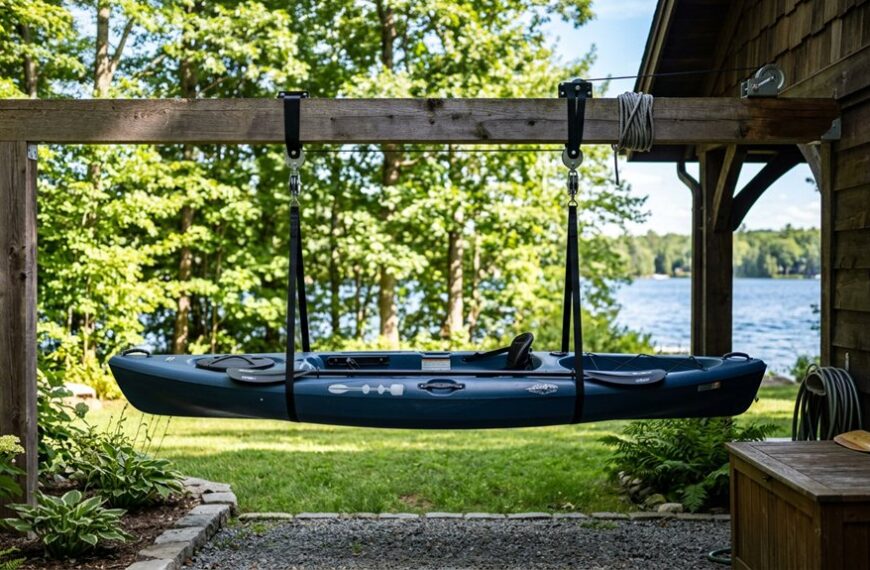
Yes, but only if you use a proper hoist system with straps that support the kayak along its length, not from bow/stern handles. Ceiling-mounted vertical storage works well in garages with 9+ foot ceilings and keeps floor space completely clear.
How long can a kayak be stored vertically without damage?
Indefinitely, as long as proper support is maintained. Kayaks can be stored vertically for years without any damage when using padded racks with multiple support points. Check the setup every few months to ensure nothing has shifted.
Should I remove accessories before storing my kayak vertically?
Yes, remove heavy accessories like fish finders, rod holders, and tackle storage before vertical storage. This reduces stress on mounting points and prevents accessories from being damaged or falling off during storage.
Can I store a tandem kayak vertically?
Yes, tandem kayaks can be stored vertically using the same principles as solo kayaks, but you’ll need heavier-duty racks rated for 150-200+ pounds and should use three support points instead of two due to the increased length and weight.
What’s the best way to store a kayak in an apartment?
For apartments, use freestanding vertical racks that don’t require wall mounting, or store the kayak on a balcony using a weatherproof cover. Inflatable kayaks are ideal for apartment living since they deflate and store in a closet.
Does storing a kayak vertically affect its performance?
No, vertical storage has zero impact on kayak performance. The hull maintains its shape and stability characteristics regardless of storage orientation when proper support is used.
Can I store a kayak vertically outside?
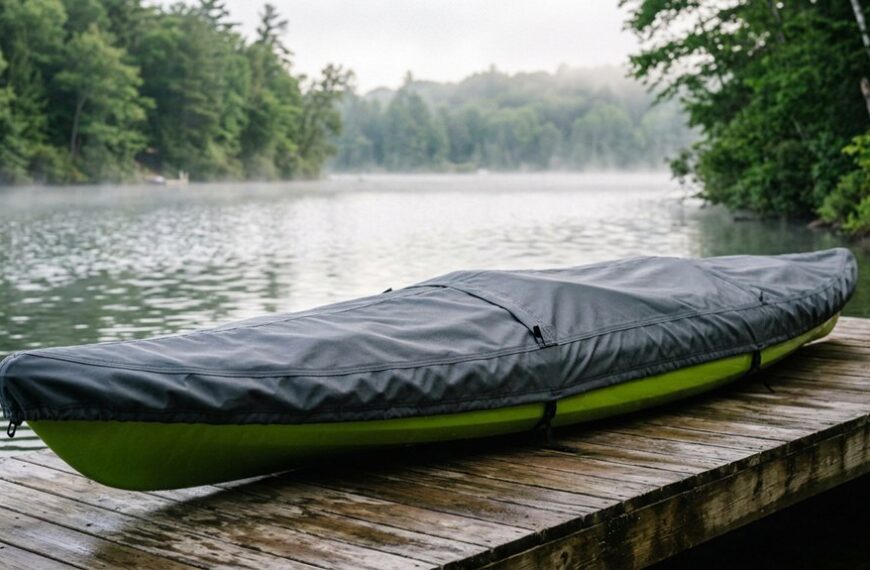
Yes, but protect it from UV exposure and weather with a kayak cover designed for outdoor use. Ensure the rack is made from weather-resistant materials (stainless steel or powder-coated aluminum) and that the kayak is secured against wind.
How do I store a wide fishing kayak vertically?
Wide fishing kayaks (34-40 inches) store vertically the same way as narrower kayaks, but you’ll need racks with deeper arms (12-18 inches) to accommodate the width. The wider hull actually makes vertical storage more stable.
Should I loosen straps during long-term vertical storage?
Keep straps snug enough to prevent the kayak from tipping forward, but not so tight that they create pressure points. Check strap tension monthly and adjust as needed, especially after temperature changes that can cause materials to expand or contract.
Can I store a pedal-drive kayak vertically?
Yes, but remove the pedal drive unit first to reduce weight and prevent damage to the drive mechanism. Store the drive unit separately in a protected area. The kayak itself stores vertically just like any other fishing kayak.
What’s the minimum ceiling height needed for vertical kayak storage?
You need at least 6-7 feet of ceiling height for most fishing kayaks stored vertically. Measure your kayak’s length and add 6-12 inches for clearance. Garages with 8-foot ceilings work well for kayaks up to 12 feet long.
Do I need to cover my kayak when storing it vertically indoors?
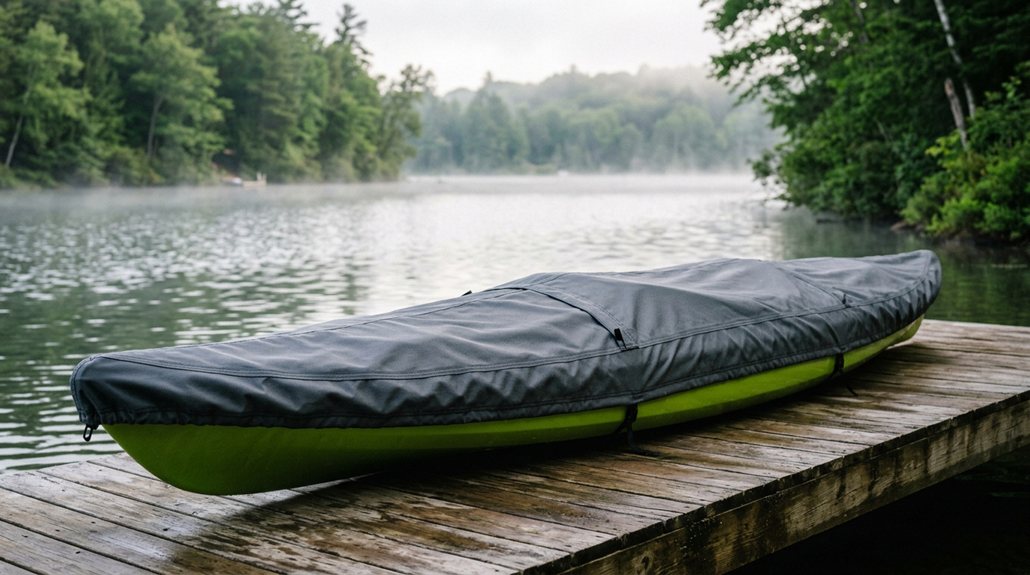
Indoor vertical storage doesn’t require a cover unless your garage is dusty or you want to protect the kayak from accidental bumps. Covers can trap moisture, so only use breathable kayak covers if you choose to cover it.
Conclusion
Storing your kayak vertically is not only safe but often the smartest choice for fishing kayak enthusiasts with limited space. When you use proper wall-mount racks with padded support points positioned along the kayak’s side, vertical storage prevents warping, maximizes garage space, and keeps your kayak ready for your next fishing adventure.
The key to successful vertical storage lies in the details: mount racks into wall studs, use wide padded contact surfaces, position support points 3-4 feet apart, and check your setup periodically. Whether you own a plastic sit-on-top, a composite fishing kayak, or multiple boats, vertical storage accommodates them all with the right rack system.
Take action now:
- Measure your available wall space and kayak dimensions
- Choose quality wall-mount racks rated for your kayak’s weight
- Install racks into wall studs using proper hardware
- Add padding to all contact points
- Remove accessories and clean your kayak before storage
- Set a reminder to inspect your setup every 2-3 months
For more guidance on maintaining and transporting your fishing kayak, explore our resources on kayak gear and kayak fishing tips. Your kayak is built to last decades with proper care, and vertical storage is a proven method that protects your investment while keeping it accessible for every fishing trip.