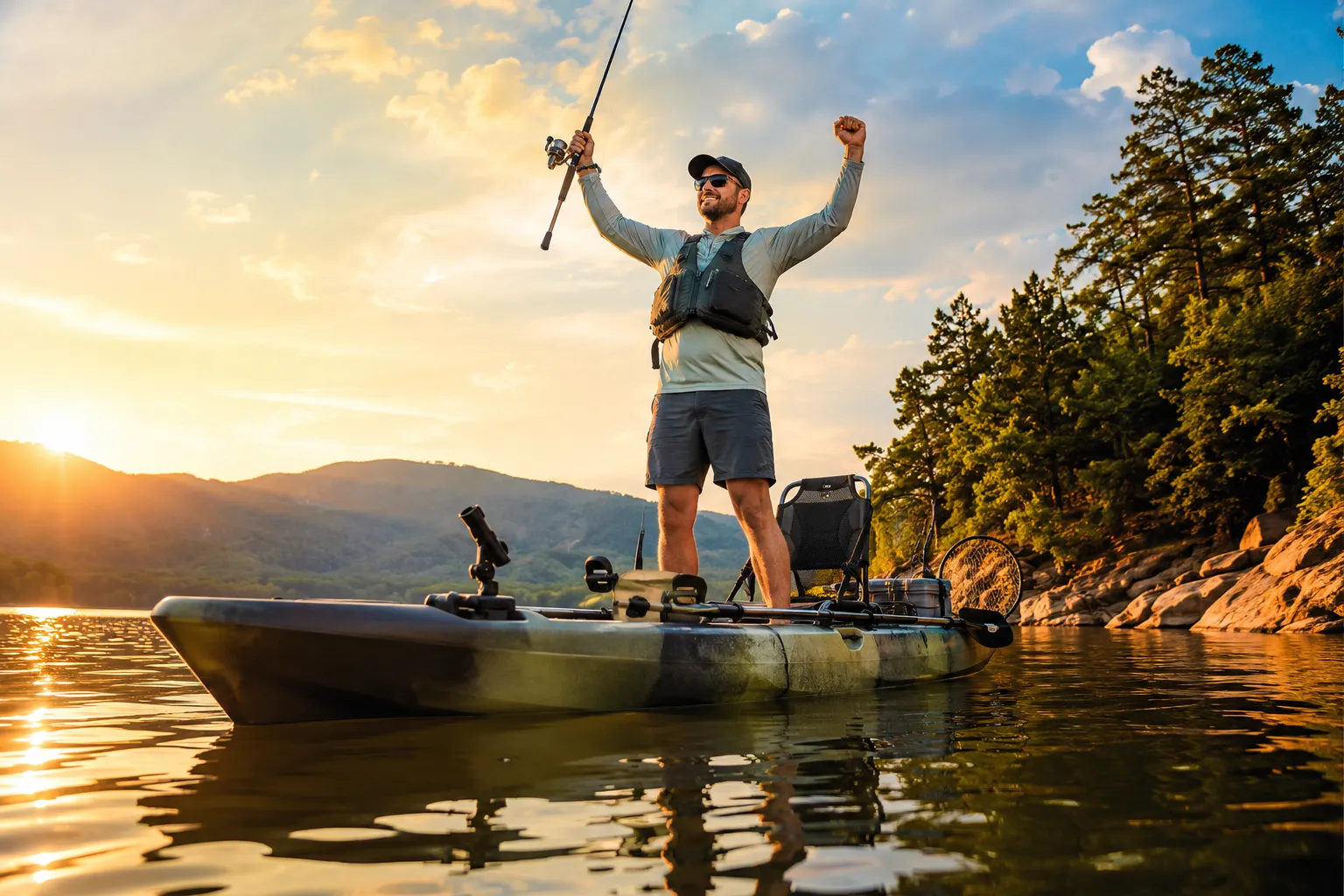
Quick Answer: Yes, you can stand up in a fishing kayak, but only if it’s specifically designed for standing with adequate width (typically 33+ inches), a stable hull design, and a flat standing platform. Standard recreational kayaks are too narrow and unstable for safe standing, while purpose-built fishing kayaks offer the stability needed to stand, cast, and sight-fish effectively.
Key Takeaways
- Width matters most: Fishing kayaks need to be at least 33 inches wide for safe standing, with 36+ inches being ideal for beginners
- Hull design is critical: Pontoon-style and flat-bottom hulls provide far better standing stability than rounded recreational hulls
- Sit-on-top kayaks are better: The open deck design of sit-on-top models makes standing safer and easier than sit-inside kayaks
- Not all fishing kayaks support standing: Budget models under $600 often lack the width and stability features needed for standing
- Practice in shallow water first: Even with a stable kayak, standing requires technique and should be practiced in controlled conditions
- Outriggers aren’t always necessary: Wide, well-designed fishing kayaks provide adequate stability without aftermarket stabilizers
- Standing in rough water is risky: Even experienced anglers should remain seated when waves exceed 1-2 feet
- Beginners can learn to stand: With the right kayak and proper technique, most people can safely stand within a few practice sessions
What Makes a Kayak Stable Enough to Stand In
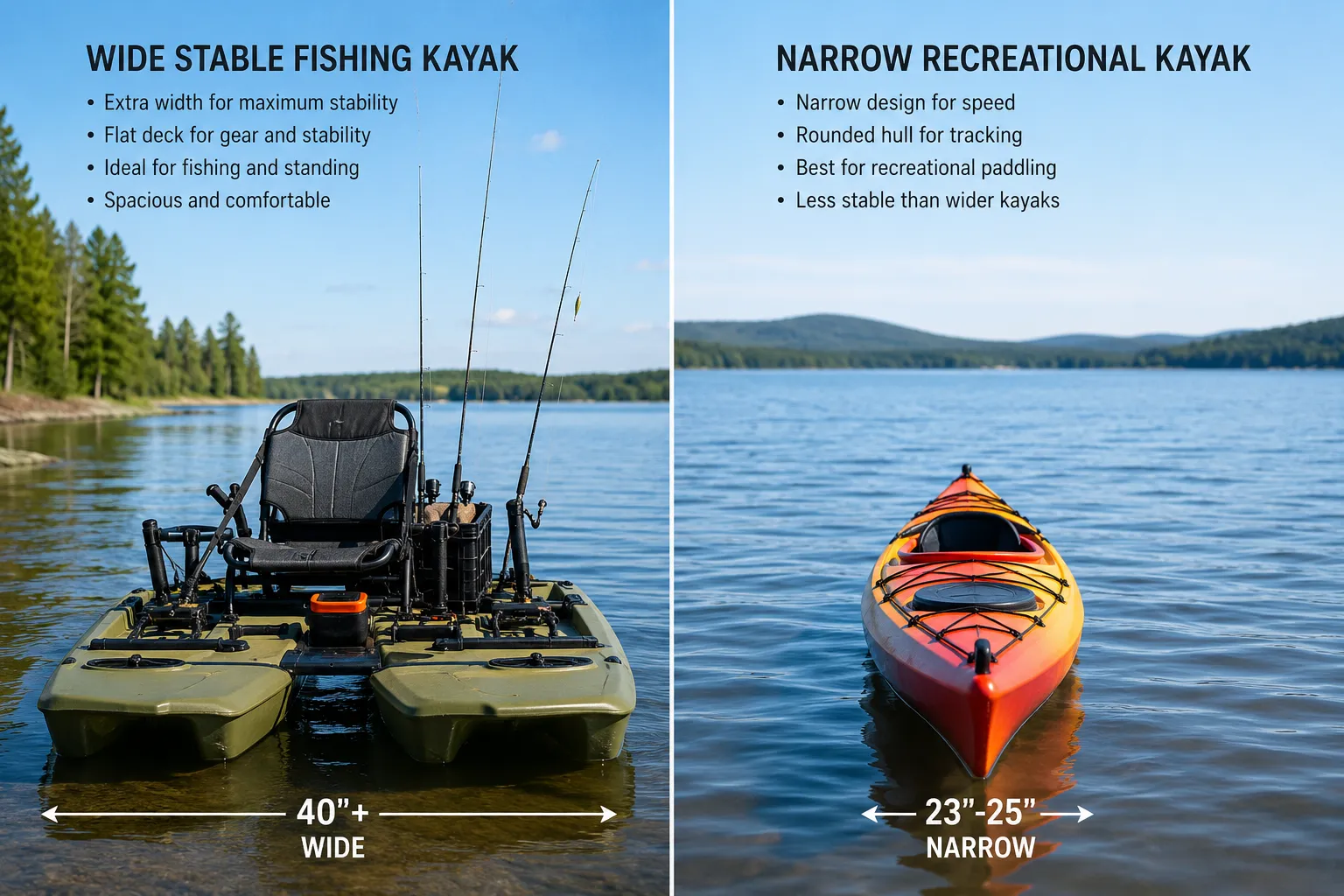
A kayak’s standing stability depends on three primary factors: beam width, hull shape, and deck design. Kayaks built for standing typically feature a beam (width) of 33-37 inches, compared to 24-28 inches for standard recreational kayaks. This extra width dramatically increases the kayak’s secondary stability, which is what keeps you upright when your weight shifts to one side.
Key stability features include:
- Pontoon or tunnel hull designs that create a wide, flat base on the water
- Flat or slightly rounded bottoms rather than V-shaped hulls that prioritize speed
- Standing platforms or textured deck areas that provide secure footing
- Lower center of gravity achieved through seat positioning and hull depth
- Chine rails (the edges where the bottom meets the sides) that resist tipping
The physics are straightforward: a wider base creates more resistance to rolling. When you stand in a 36-inch-wide kayak, your weight can shift several inches to either side before the kayak begins to tip. In a 26-inch kayak, that margin is cut nearly in half.
Common mistake: Assuming all fishing kayaks are stable enough for standing. Many entry-level fishing kayaks are simply recreational kayaks with rod holders added. Always check the manufacturer’s specifications and whether standing is explicitly mentioned as a feature.
Difference Between Sit-On-Top and Sit-Inside Kayaks for Standing
Sit-on-top kayaks are significantly better for standing than sit-inside models. The open deck design of a sit-on-top kayak provides a clear, flat surface to stand on, while sit-inside kayaks require you to stand inside a confined cockpit with your legs partially below the deck line.
Why sit-on-top kayaks win for standing:
- Unrestricted movement: You can place your feet anywhere on the deck for optimal balance
- Lower center of gravity: Standing on top of the hull rather than above it keeps your weight closer to the waterline
- Easier recovery: If you lose balance, you can quickly sit back down or step to a wider stance
- Better visibility: The elevated position on a sit-on-top gives you a higher vantage point for sight-fishing
Sit-inside kayaks do offer some advantages in cold weather and rough water, but standing in them is awkward and dangerous. The cockpit rim limits your foot placement, and if you fall, you’re more likely to capsize the kayak completely rather than simply getting wet.
Choose a sit-on-top if: You plan to stand regularly, fish in warm climates, or want the easiest entry and exit. Choose a sit-inside only if you prioritize warmth and dryness over standing capability.

UV-Protected HDPE Construction for Durability: Built with high-density polyethylene (HDPE) plastic, this kayak is both lightweight and highly durable, offering long-lasting protection against UV rays for years of use in various conditions. Paddle included.

Powerful & Responsive Propeller Drive System: Take control with our smooth kayak propeller drive system, offering hands-free power, quiet acceleration, and easy reverse maneuvering. Perfect for tight spaces, docks, or mangrove fishing

Ergolounge seating system : Extra-thick cushioning and an extra high and wide padded backrest.
How Wide Does a Kayak Need to Be to Stand Up Safely
A fishing kayak should be at least 33 inches wide for safe standing, though 36 inches or wider is recommended for beginners or larger anglers. The relationship between width and stability isn’t linear; each additional inch of beam width provides disproportionately more stability.
Width guidelines by experience level:
- 33-34 inches: Minimum for experienced paddlers with good balance, calm water only
- 35-36 inches: Comfortable for most anglers, suitable for light chop
- 37+ inches: Excellent stability for beginners, larger anglers (200+ lbs), or rougher conditions
Keep in mind that extreme width comes with tradeoffs. Kayaks wider than 38 inches become harder to paddle efficiently and may not fit standard kayak trailers or roof racks. They also catch more wind, making them difficult to control in breezy conditions.
Real-world example: A 34-inch kayak might feel stable when you’re standing still in calm water, but the moment you cast or reach for a fish, that narrow margin disappears. A 36-inch kayak gives you the buffer to move naturally without constant fear of tipping.
Edge case: Exceptionally tall anglers (6’3″+) may need even wider kayaks because their higher center of gravity amplifies instability. If you’re over 6 feet tall, test-stand in any kayak before buying.

Abundant Quantity: our adhesive tape measure stickers for fishing provides an ample pack of 2 fish measuring tape stickers; Each fishing tape measures stickers providing ample length to measure a variety of fish; Before application, please ensure the area to be adhered is thoroughly desiccation for the nice adhesive outcome

WATERPROOF & UV-RESISTANT FOR YEARS OF USE: Built for harsh marine environments, this 36" fish ruler sticker is proudly made in USA & resists fading, peeling, and damage from saltwater, sunlight, dirt, soap & more. The tough matte ruler outer layer shields against wear, while industrial marine grade adhesives ensure long-term grip.

Durable 304 Stainless Material: constructed from 304 stainless material with mirror polished finish, designed for long-term use in saltwater and freshwater environments; Helps reduce corrosion issues commonly found in standard fishing clips, making it suitable for frequent outdoor fishing trips and underwater use
Can Beginners Stand Up in a Fishing Kayak
Yes, beginners can safely learn to stand in a fishing kayak if they choose the right model and practice proper technique. Most people can stand comfortably in a 36-inch-wide fishing kayak within 2-3 practice sessions, even with no prior kayaking experience.
Beginner-friendly features to look for:
- 36+ inch beam width for maximum forgiveness
- Textured standing pads that prevent slipping
- Grab handles or rails to hold while transitioning to standing
- Stable pontoon-style hull rather than a rounded bottom
- Lower seat position that makes the transition from sitting to standing easier
The learning curve is shorter than most people expect. The key is building confidence gradually rather than trying to stand on your first outing. Start by kneeling, then progress to a crouch, and finally to a full standing position once you understand how the kayak responds to your movements.
Common beginner mistake: Standing with feet too close together. A wide stance (shoulder-width or wider) dramatically improves stability. Think of it like standing on a balance board; the wider your base, the easier it is to stay upright.
Who should wait: If you have significant balance issues, inner ear problems, or mobility limitations that make it difficult to quickly sit back down, practice extensively in shallow water with a buddy nearby before attempting to stand in deeper areas.
What Happens If You Try to Stand in a Regular Kayak
Standing in a standard recreational kayak (24-28 inches wide) will almost certainly result in an immediate capsize. These kayaks are designed for seated paddling only, with rounded hulls that prioritize speed and tracking over stability.
What you’ll experience:
The moment you shift your weight to stand, the kayak will begin rolling to one side. Unlike a wide fishing kayak that resists this motion, a narrow kayak accelerates the roll. By the time you’re halfway to standing, the kayak is already past its tipping point. Most people end up in the water before they’re fully upright.
The physics problem: Recreational kayaks have minimal secondary stability. Their rounded hulls are designed to slice through water efficiently, which means they offer little resistance to rolling once they start to tip. It’s like trying to stand on a floating log versus standing on a raft.
Safety concern: Capsizing in a recreational kayak is more dangerous than in a sit-on-top fishing kayak. You may become trapped in the cockpit, and re-entering a capsized sit-inside kayak requires advanced skills that most casual paddlers don’t have.
If you must try: Only attempt standing in a recreational kayak in waist-deep water where you can touch bottom, and accept that you will get wet. Never try this in deep water, cold water, or areas with current.
Do You Need Outriggers to Stand in a Fishing Kayak
No, you don’t need outriggers if you have a properly designed fishing kayak with adequate width (36+ inches) and a stable hull. Outriggers are aftermarket stabilizers that attach to the sides of your kayak, but they’re primarily useful for narrow kayaks or extreme conditions, not for standard standing.
When outriggers make sense:
- You own a narrower kayak (32-34 inches) and can’t afford to upgrade
- You fish in consistently rough or choppy water
- You have balance or mobility issues that make standing difficult
- You need to stand and move around extensively (like bowfishing)
Downsides of outriggers:
- Added weight: Most systems add 15-30 pounds to your kayak
- Storage hassle: They’re bulky and awkward to transport
- Reduced maneuverability: The wide footprint makes it harder to navigate tight spaces
- Cost: Quality outrigger systems run $150-400
- Setup time: You’ll spend 10-15 minutes installing them before each trip
Most anglers who buy a kayak specifically designed for standing find that outriggers are unnecessary. The kayak’s inherent stability is sufficient for casting, fighting fish, and general standing. Outriggers become a crutch that prevents you from developing proper standing technique.
Better solution: If your kayak feels too unstable for standing, invest in a wider kayak rather than adding outriggers. A 36-inch kayak without outriggers will outperform a 32-inch kayak with them, and you’ll avoid the hassle.

The canoe stand assist strap is easy to grab the handle to pulling yourself stand up from a sitting position when fishing on the kayak, canoe, or SUP

Comfortable handle to help move from seated to standing

【Multifunctional 】This multi-functional kayak tow rope not only maintains balance while standing, but also helps the kayak exit the dock,tow onto a ramp,and even tie it tightly when pulling on a trailer or car, This kayak standing assist strap tool is the perfect gift for kayakers
Standing Kayak vs Regular Kayak Price Comparison
Fishing kayaks designed for standing typically cost $800-2,500, compared to $300-700 for standard recreational kayaks. The price difference reflects the specialized hull design, wider beam, reinforced deck, and additional features that make standing safe and practical.
Price tiers for standing-capable fishing kayaks:
Budget tier ($800-1,200):
- Basic standing capability with 33-34 inch beam
- Simpler hull designs, often rotomolded plastic
- Fewer accessories and mounting points
- Examples: Perception Pescador Pilot, Lifetime Tamarack Angler
Mid-range ($1,200-1,800):
- 35-36 inch beam with dedicated standing platforms
- Better hull designs with improved stability
- More storage, rod holders, and accessory mounts
- Examples: Bonafide SS127, Old Town Topwater 120
Premium tier ($1,800-2,500+):
- 36+ inch beam with optimized standing features
- Advanced hull materials and designs
- Pedal drive options, premium seats, extensive rigging
- Examples: Hobie Pro Angler, Native Slayer Propel
Is the premium worth it? If you plan to stand frequently and fish in varied conditions, yes. Premium kayaks offer noticeably better stability, comfort, and features. But if you’re just starting out or fish occasionally, a mid-range kayak provides 90% of the performance at 60% of the cost.
Hidden costs to consider: Don’t forget to budget for a quality PFD ($80-150), paddle ($100-200), and transportation system ($150-400). These essentials can add $400-800 to your total investment.
How to Practice Standing Up in a Kayak Without Tipping
Start in shallow, calm water where you can touch bottom, and progress through a systematic sequence: kneeling, crouching, and finally standing. This gradual approach builds muscle memory and confidence while minimizing the risk of capsizing.
Step-by-step practice method:
- Choose the right location: Waist-deep water with a sandy or muddy bottom, no current, minimal wind
- Start kneeling: Get on your knees in the center of the kayak, hands on the sides for balance
- Feel the kayak’s response: Rock gently side to side to understand how the kayak reacts to weight shifts
- Progress to a crouch: Place your feet where your knees were, staying low with hands still on the sides
- Stand slowly: Rise gradually, keeping your weight centered and knees slightly bent
- Find your stance: Position feet shoulder-width or wider, toes pointed slightly outward
- Practice sitting back down: This is often harder than standing up; lower yourself slowly with control
Pro tips for stability:
- Keep your knees slightly bent at all times; locked knees reduce your ability to absorb the kayak’s movement
- Look at the horizon, not down at your feet; this helps maintain balance
- Engage your core muscles to stabilize your upper body
- Start with 30-second standing sessions and gradually increase duration
- Practice in different conditions (light wind, small waves) as you improve
Common mistake: Rushing the progression. Spend at least 15-20 minutes at each stage (kneeling, crouching, standing) before moving to the next. Muscle memory takes time to develop.
Safety rule: Always wear a PFD during practice, even in shallow water. If you fall awkwardly, you want flotation to keep your head above water while you regain your bearings.
Are Inflatable Kayaks Stable Enough to Stand In
Modern inflatable fishing kayaks with drop-stitch floor technology are stable enough for standing, provided they’re at least 36 inches wide and properly inflated to the manufacturer’s recommended PSI. Older-style inflatable kayaks with soft floors are not suitable for standing.
What makes an inflatable kayak stand-worthy:
- Drop-stitch construction: This technology creates a rigid, flat floor that feels similar to a hard-shell kayak when fully inflated
- High-pressure inflation: These kayaks inflate to 8-15 PSI, creating a firm platform
- Wide beam design: Look for 36+ inches, just like hard-shell kayaks
- Multiple air chambers: Separate chambers for floor, sides, and pontoons provide redundancy and stability
Advantages of inflatable fishing kayaks:
- Easier to transport and store (they pack into a large duffel bag)
- Lighter weight than comparable hard-shell kayaks
- More forgiving if you run aground on rocks or obstacles
- Often less expensive than premium hard-shell models
Limitations to consider:
- Require 10-15 minutes to inflate and deflate before and after each trip
- More susceptible to punctures from sharp objects (though quality models are quite durable)
- Slightly less responsive handling compared to hard-shell kayaks
- Can be affected more by wind due to higher profile when inflated
Recommended models: Sea Eagle FishSkiff 16, Advanced Elements StraitEdge, and Aquaglide Blackfoot Angler are all designed for standing and receive positive reviews from anglers who regularly stand while fishing.
Common Mistakes When Standing Up in a Fishing Kayak for the First Time
The most common first-time mistake is standing up too quickly with feet too close together, which eliminates the stability advantage of a wide kayak. New anglers also tend to look down at their feet instead of at the horizon, which disrupts balance and increases the likelihood of tipping.
Top mistakes and how to avoid them:
Standing with narrow foot placement:
- Problem: Feet closer than shoulder-width create an unstable base
- Solution: Position feet at or beyond shoulder-width, toes slightly outward
Rising too quickly:
- Problem: Fast movements create momentum that destabilizes the kayak
- Solution: Take 3-4 seconds to transition from sitting to standing, moving smoothly
Locking your knees:
- Problem: Straight legs can’t absorb the kayak’s natural movement
- Solution: Keep knees slightly bent at all times, like a shock absorber
Looking down at your feet:
- Problem: Disrupts your inner ear’s balance mechanism
- Solution: Focus on the horizon or a fixed point at eye level
Gripping the paddle while standing:
- Problem: The paddle’s length and weight create leverage that can pull you off balance
- Solution: Set the paddle down or secure it before attempting to stand
Standing in the wrong spot:
- Problem: Standing too far forward or back shifts the kayak’s center of gravity
- Solution: Stand in the center of the kayak, typically just behind or at the seat
Wearing the wrong footwear:
- Problem: Smooth-soled shoes slip on wet kayak decks
- Solution: Wear water shoes or sandals with textured, non-slip soles
Attempting to stand in wind or waves:
- Problem: External forces make balance exponentially harder for beginners
- Solution: Practice only in calm conditions until you’ve mastered the technique
Can You Stand Up in a Kayak in Rough Water
Standing in rough water is possible for experienced kayak anglers in very stable kayaks (36+ inches wide), but it’s risky and generally not recommended when waves exceed 1-2 feet. Even in a stable fishing kayak, standing in choppy conditions requires advanced balance skills and constant attention to the water’s movement.
Factors that determine whether it’s safe:
- Wave height: 6-12 inch waves are manageable for experienced anglers; 2+ foot waves are dangerous even for experts
- Wave period: Slow, rolling swells are easier to handle than short, choppy chop
- Kayak width: 37+ inches provides a meaningful advantage in rough water
- Your experience level: You should be completely comfortable standing in calm water first
- Water temperature: Cold water (below 60°F) makes any capsize potentially life-threatening
Technique adjustments for rougher water:
- Widen your stance even more than usual
- Bend your knees deeper to lower your center of gravity
- Face into the waves rather than taking them from the side
- Time your movements between waves rather than during them
- Keep sessions short; standing in rough water is physically exhausting
When to stay seated:
- Waves consistently over 2 feet
- Strong, gusty wind (15+ mph)
- Cold water conditions where hypothermia is a risk
- When you’re alone with no nearby boaters
- Any time you feel uncomfortable or uncertain
Real-world perspective: Most experienced kayak anglers choose to remain seated in anything beyond light chop. The slight advantage of standing (better sight-fishing, easier casting) is rarely worth the risk of capsizing when conditions are rough. Save standing for calm days.
Who Should Not Try Standing in a Fishing Kayak
People with significant balance disorders, severe mobility limitations, or certain medical conditions should avoid standing in kayaks or only attempt it under controlled conditions with supervision. Age alone isn’t a disqualifier, but physical limitations that affect balance, strength, or the ability to quickly recover from instability make standing risky.
Specific considerations:
Balance or vestibular disorders:
- Inner ear problems, vertigo, or diagnosed balance disorders make standing dangerous
- The kayak’s constant micro-movements can trigger episodes
- Consider seated fishing or consulting a doctor before attempting
Mobility limitations:
- Difficulty transitioning from sitting to standing on solid ground
- Limited range of motion in knees, hips, or ankles
- Inability to quickly lower yourself back to seated position
Cardiovascular concerns:
- Recent heart surgery or serious heart conditions
- Conditions where sudden immersion in cold water could trigger cardiac events
- Always consult your physician before kayak fishing if you have heart concerns
Neurological conditions:
- Seizure disorders (standing increases injury risk during an episode)
- Conditions affecting coordination or proprioception
- Neuropathy that reduces sensation in feet
Pregnancy:
- Later-stage pregnancy shifts your center of gravity and affects balance
- Risk of falling into water poses concerns for both mother and baby
- Seated kayak fishing is generally safe with doctor approval
Extreme weight:
- Exceeding the kayak’s weight capacity (typically 350-500 lbs for fishing kayaks)
- Very high BMI can raise the center of gravity beyond what the kayak can safely stabilize
That said: Many people with minor limitations successfully stand in kayaks by choosing extra-wide models (37+ inches), practicing extensively in controlled conditions, and knowing their personal limits. The key is honest self-assessment and prioritizing safety over ego.
Frequently Asked Questions
Can you stand in a 10-foot fishing kayak?
Yes, if it’s at least 33 inches wide with a stable hull design. Length affects tracking and speed, but width and hull shape determine standing stability. A 10-foot kayak that’s 36 inches wide will be more stable for standing than a 12-foot kayak that’s only 30 inches wide.
How long does it take to learn to stand in a kayak?
Most people can stand comfortably in a properly designed fishing kayak within 2-3 practice sessions of 30-45 minutes each. Building confidence to stand while casting or fighting fish may take 5-10 outings. The learning curve is faster than most beginners expect.
Is standing in a kayak worth the risk?
For sight-fishing, casting distance, and spotting structure, standing provides significant advantages. In a properly designed fishing kayak with adequate width, the risk is minimal in calm conditions. The benefits usually outweigh the risks for anglers who fish clear, shallow water regularly.
Can you stand in a kayak with a pedal drive?
Yes, most pedal-drive fishing kayaks are specifically designed for standing and typically feature extra-wide beams (36+ inches) and stable hulls. The pedal drive mechanism doesn’t interfere with standing; you simply lift your feet out of the pedals and stand on the deck.
What’s the minimum weight capacity for a standing kayak?
Choose a kayak with a weight capacity at least 100-150 pounds above your body weight plus gear. For a 200-pound angler with 50 pounds of gear, look for a minimum 350-pound capacity. Higher capacity generally correlates with better stability.
Do you need special shoes to stand in a kayak?
Water shoes or sandals with textured, non-slip soles work best. Avoid smooth-soled shoes that slip on wet surfaces. Many anglers prefer shoes with drainage holes that don’t hold water. Going barefoot is an option in warm weather but offers less protection.
Can you stand in a kayak while wearing waders?
Yes, but it’s more challenging and riskier. Waders restrict leg movement and make it harder to quickly sit back down. If you capsize while wearing waders, they can fill with water and make swimming difficult. Only attempt this if you’re experienced and in calm, shallow water.
How do you get back in a kayak after falling out while standing?
For sit-on-top kayaks, approach from the side, place both hands on the deck, kick your legs to the surface, and pull yourself up and across the kayak, then rotate to a seated position. Practice this re-entry technique in shallow water before fishing in deep areas.
Is it easier to stand in a pedal or paddle kayak?
Pedal kayaks are often easier because they’re typically designed with standing in mind and feature wider beams and more stable hulls. The pedal drive itself doesn’t affect standing difficulty; it’s the overall kayak design that matters. Both types can be excellent for standing if properly designed.
Can kids stand in fishing kayaks?
Children can stand in fishing kayaks if the kayak is appropriately sized and stable, and the child has developed adequate balance and swimming skills. Always supervise children closely, ensure they wear properly fitted PFDs, and practice in shallow, calm water first.
What wind speed is too much for standing in a kayak?
Sustained winds above 10-12 mph make standing significantly more difficult, and winds above 15 mph are generally too challenging for most anglers. Wind creates both waves and direct force against your body, multiplying the balance challenge. Check weather forecasts before your trip.
Do fishing kayaks with standing platforms cost more?
Yes, kayaks specifically designed for standing typically cost $800-2,500, compared to $300-700 for standard recreational kayaks. The price reflects specialized hull designs, wider beams, reinforced decks, and additional features. Mid-range models ($1,200-1,800) offer good value for most anglers.
Conclusion
Standing in a fishing kayak opens up new possibilities for sight-fishing, casting, and overall fishing effectiveness, but it requires the right equipment and proper technique. The key factors are kayak width (36+ inches for most anglers), stable hull design (pontoon or flat-bottom styles), and the open deck of a sit-on-top kayak. While standard recreational kayaks are dangerously unstable for standing, purpose-built fishing kayaks provide the platform you need to stand safely.
Your next steps:
- Assess your needs: Determine how often you’ll actually stand while fishing and whether it’s worth the investment in a wider, more stable kayak
- Test before buying: Visit a kayak dealer that offers demo days or rentals so you can test-stand in different models
- Start with the right width: Don’t compromise on beam width; 36 inches should be your baseline for comfortable standing
- Practice systematically: Begin in shallow, calm water and progress through kneeling, crouching, and standing before attempting to fish while standing
- Prioritize safety: Always wear a PFD, practice re-entry techniques, and know your limits regarding water conditions
Standing in a fishing kayak isn’t just for experts. With the right kayak and a few practice sessions, most anglers can master the technique and enjoy the advantages it brings to their fishing. The investment in a quality standing-capable kayak pays dividends in fishing success and overall enjoyment on the water.