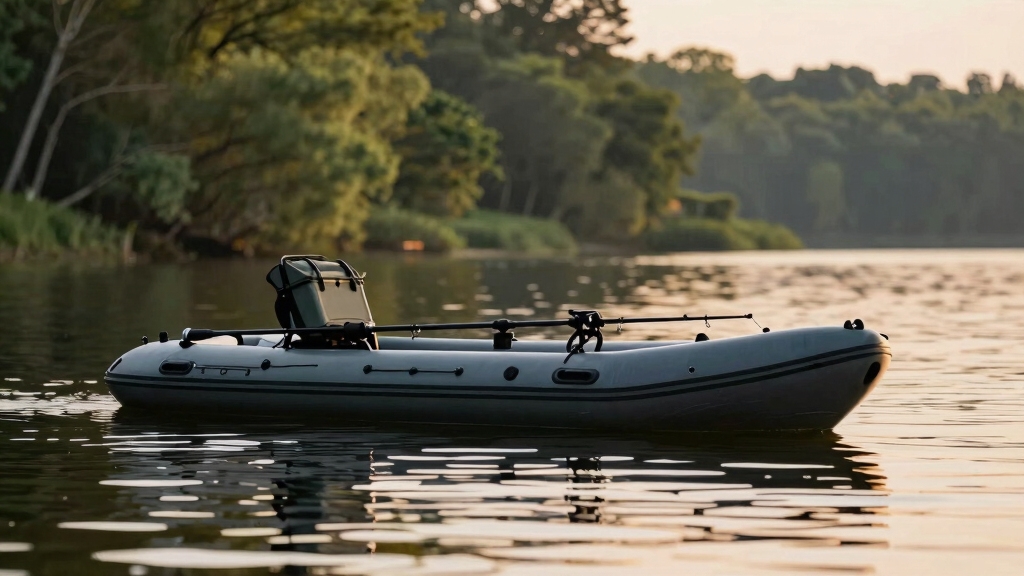
Inflatable fishing kayaks have come a long way from pool toys. Modern inflatable fishing kayaks are built with military-grade materials, drop-stitch floors, and multi-chamber designs that rival hard-shell kayaks in durability and performance. For most anglers, especially those with limited storage space or who fish diverse water types, inflatable fishing kayaks offer an excellent balance of portability, stability, and fishing capability at a lower price point than comparable hard-shell models.
Key Takeaways
- Modern inflatables use drop-stitch technology that creates rigid floors comparable to hard-shell kayaks, with typical PSI ratings of 8-15
- Puncture resistance is high thanks to military-grade PVC and reinforced materials; catastrophic failures are rare with proper care
- Decent models start around $400-$600 for beginners, while premium fishing-specific inflatables range from $800-$2,000
- Stability often exceeds hard-shells due to wider beam designs and lower center of gravity, making them ideal for standing while fishing
- Lifespan averages 5-10 years with proper maintenance and storage away from UV exposure
- Weight capacity typically matches or exceeds comparable hard-shell kayaks, often supporting 400-600 pounds
- Portability is the biggest advantage – most pack into a backpack and weigh 25-45 pounds deflated
- Emergency punctures are manageable with repair kits, and multi-chamber designs keep you afloat even if one chamber fails
What Are the Main Advantages of Inflatable Fishing Kayaks Over Hard Shell?
Inflatable fishing kayaks offer three primary advantages: portability, storage convenience, and initial cost savings. A typical inflatable weighs 25-45 pounds deflated and packs into a backpack or duffel, while a comparable hard-shell kayak weighs 60-90 pounds and requires roof racks or a trailer. This makes inflatables ideal for anglers who live in apartments, lack vehicle roof racks, or want to hike into remote fishing spots.
Key advantages include:
- No storage space required – fits in a closet, garage corner, or car trunk when deflated
- Easy solo transport – one person can carry most models without assistance
- Lower entry cost – quality fishing inflatables start at $400 vs. $800+ for hard-shells
- Versatility across water types – the same kayak works well in lakes, rivers, and calm coastal waters
- Travel-friendly – can be checked as luggage or shipped to destination fishing spots
- Softer landings – the inflated chambers absorb impacts better than rigid hulls when bumping rocks or docks
The trade-off is setup time. Inflating a kayak takes 5-15 minutes with a good pump, while hard-shells are ready immediately. For anglers who fish frequently from the same location, a hard-shell may be more convenient. But for those who value flexibility and easy storage, inflatable fishing kayaks deliver unmatched practicality.
Do Inflatable Kayaks Puncture Easily When Fishing?
Modern inflatable fishing kayaks are highly puncture-resistant and rarely fail catastrophically. Most quality models use 1000-denier PVC or reinforced Nitrylon materials – the same fabrics used in military rafts and commercial whitewater boats. These materials can withstand scrapes against rocks, oyster beds, and submerged branches that would scratch a hard-shell kayak.
The multi-chamber design provides critical redundancy. A typical fishing inflatable has 3-5 separate air chambers, so even if you puncture one section, the remaining chambers keep you afloat and stable enough to paddle to shore. This is actually safer than a hard-shell kayak, which can crack and take on water with no backup buoyancy.
Common puncture scenarios and their reality:
- Fish hooks – The biggest actual risk, but easily prevented by using hook guards and designated tackle areas
- Sharp rocks – Rarely cause punctures unless you’re dragging the kayak across jagged surfaces; normal contact is fine
- Oyster shells – Can abrade the material over time but rarely cause immediate leaks
- Tree branches – Smooth branches pose no threat; sharp broken stubs require caution when navigating tight spaces
Most “punctures” are actually slow leaks from valve issues or seam wear, not dramatic blowouts. A quality repair kit (included with most kayaks) can patch small holes in 10-15 minutes, and the repair holds permanently. Choose a kayak with reinforced bottom panels if you plan to fish rocky rivers or ocean environments where abrasion is more likely.
How Much Do Decent Inflatable Fishing Kayaks Cost?
Decent inflatable fishing kayaks for beginners start at $400-$600, mid-range fishing-specific models run $700-$1,200, and premium options with advanced features cost $1,300-$2,000. This is generally 20-40% less expensive than comparable hard-shell fishing kayaks with similar features and capacity.
Price tiers and what you get:
Budget tier ($300-$600):
- Basic recreational inflatables adapted for fishing
- 1-2 rod holders, minimal storage
- 300-400 lb weight capacity
- Good for calm lakes and ponds
- Examples: Intex Challenger, Sea Eagle 330
Mid-range ($600-$1,200):
- Purpose-built fishing designs
- Drop-stitch floors for rigidity
- 3-4 rod holders, gear tracks, storage hatches
- 400-500 lb capacity
- Suitable for rivers and coastal bays
- Examples: Advanced Elements StraitEdge, Sea Eagle FishSkiff
Premium ($1,200-$2,000+):
- High-performance fishing platforms
- Standing-height stability
- Integrated motor mounts
- 500-600 lb capacity
- Advanced tracking and speed
- Examples: Saturn Triton, Advanced Elements AirVolution
For most anglers, the $700-$1,000 range offers the best value. These kayaks include the essential fishing features and durability for regular use without the premium price of top-tier models. When comparing costs, factor in that inflatables don’t require roof racks ($150-$400) or kayak trailers ($500-$1,500), which hard-shell owners often need. Check out our fishing kayak buying guide for detailed comparisons.

SUPER-TOUGH – 3-ply laminate construction combined with SuperStrong enhanced molecular formulation PVC provides superior structural strength and unmatched resistance to damage from abrasion, impact and sunlight, while allowing more pressure for rigidity

SUPER-TOUGH – 3-ply laminate construction combined with SuperStrong enhanced molecular formulation PVC provides superior structural strength and unmatched resistance to damage from abrasion, impact and sunlight, while allowing more pressure for rigidity
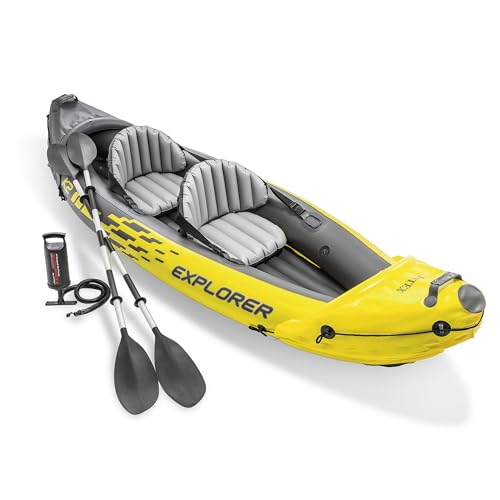
EASY TRANSPORT – Lightweight and compact, this kayak is easy to assemble and, with the Boston valve, it inflates and deflates in minutes; paddles come apart and the pieces can be conveniently stored with the boat in the included carrying bag allowing you to take the fun of kayaking wherever you go
Best Inflatable Fishing Kayak for Beginners
The best inflatable fishing kayak for beginners balances ease of use, stability, and fishing features at an accessible price point. Look for models in the $500-$800 range with drop-stitch floors, at least two rod holders, and a weight capacity of 400+ pounds. The Sea Eagle 370 Pro and Advanced Elements StraitEdge are consistently top-rated for new kayak anglers.
Essential features for beginner-friendly models:
- Wide beam (36+ inches) for confidence-building stability
- Drop-stitch floor that creates a rigid standing platform
- Multiple air chambers for safety and peace of mind
- Built-in rod holders so you don’t need to add accessories immediately
- D-rings and bungee storage for securing gear
- Included pump and repair kit to get on the water quickly
- Removable seats with back support for all-day comfort
Beginners should prioritize stability over speed. A wider, slower kayak is more forgiving while you learn paddle technique and fish-handling skills. Avoid ultra-budget models under $300 – they typically lack the rigidity and features needed for actual fishing and will frustrate rather than encourage you.
Common beginner mistake: Buying too small. A kayak rated for 300 pounds sounds adequate for a 180-pound angler, but you need capacity for your weight plus 80-100 pounds of gear, cooler, and fish. Always choose a model rated at least 100 pounds above your body weight. For more guidance, see our beginner kayak fishing resources.
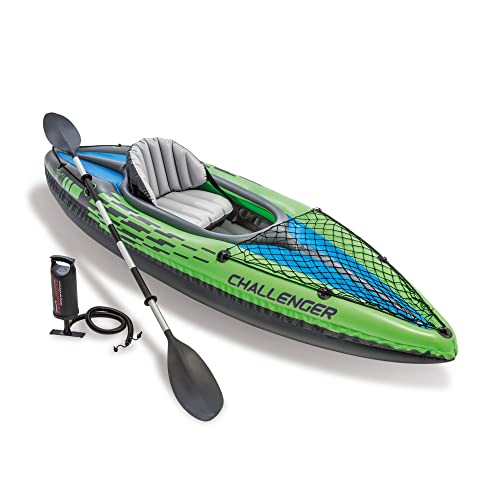
SUPER-STRONG – SuperStrong enhanced molecular formulation PVC provides superior strength and durability, ensuring high impact and abrasion resistance
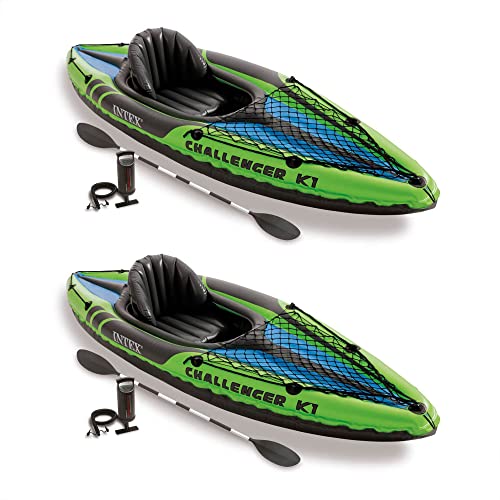
Pack of (2) one-person inflatable kayaks with a maximum weight capacity of 220 pounds and ideal for lakes and mild rivers with oars and air pump; Durable nylon carry bag and repair patch included

Can Inflatable Kayaks Handle Rough Water and Waves?
Quality inflatable fishing kayaks handle moderate chop, river currents, and coastal swells surprisingly well, though they have limitations in truly rough conditions. The inflated tubes provide excellent buoyancy and help the kayak ride over waves rather than cutting through them. Most fishing inflatables are rated for Class II-III whitewater and 2-3 foot ocean swells when properly loaded.
The performance depends heavily on design. Longer inflatables (12+ feet) with pointed bows and skegs track better and handle waves more predictably than short, wide recreational models. Drop-stitch floors prevent the kayak from flexing and folding in waves, maintaining hull shape and stability.
Water conditions and inflatable suitability:
- Calm lakes and ponds – Excellent performance, no limitations
- Slow rivers and streams – Very good; the flexible hull absorbs impacts from rocks
- Moderate river currents (Class II-III) – Good with proper technique; choose models with reinforced bottoms
- Coastal bays and estuaries – Good in 1-2 foot chop; manageable in 2-3 foot swells
- Open ocean beyond surf zone – Possible but requires experience; wind affects inflatables more than hard-shells
- Heavy surf or Class IV+ rapids – Not recommended; hard-shells are safer
Wind is the bigger challenge than waves. The higher profile of an inflatable catches wind more than a low-profile hard-shell, making it harder to maintain course in strong crosswinds. Add a skeg or tracking fin to improve directional stability, and avoid fishing in winds above 15 mph until you’re experienced.
For river kayak fishing, inflatables excel because they bounce off rocks rather than cracking. For serious offshore ocean fishing, a hard-shell or specialized inflatable designed for open water is a better choice.
How Long Do Inflatable Fishing Kayaks Last?
A well-maintained inflatable fishing kayak typically lasts 5-10 years of regular use, with some premium models exceeding 15 years. Lifespan depends primarily on UV exposure, storage conditions, and maintenance habits rather than time on the water. The materials themselves are extremely durable – it’s environmental degradation that limits longevity.
Factors that extend lifespan:
- Proper storage – Keep deflated and stored indoors away from direct sunlight and temperature extremes
- UV protection – Use 303 Protectant or similar UV spray on the material every season
- Thorough drying – Always dry completely before storing to prevent mold and material breakdown
- Valve maintenance – Clean and lubricate valves annually with silicone grease
- Pressure management – Don’t over-inflate; follow manufacturer PSI recommendations
- Gentle handling – Avoid dragging across rough surfaces when possible
Factors that shorten lifespan:
- Leaving inflated in direct sun – UV damage is the #1 killer of inflatable kayaks
- Storing wet or damp – Promotes mold, mildew, and material degradation
- Over-inflation in hot weather – Air expands in heat; over-pressurized chambers can stress seams
- Harsh chemical cleaners – Use mild soap only; harsh chemicals break down PVC and glue
- Neglecting small repairs – Small leaks become big problems if ignored
The seams and valves typically fail before the material itself. Quality kayaks use welded seams rather than glued, which last much longer. If you notice a seam starting to separate or a valve leaking, repair it immediately – these fixes are simple and inexpensive when caught early.
With proper care, your inflatable will outlast many hard-shell kayaks, which can crack, warp, or develop hull damage that’s difficult to repair. The key is treating UV exposure as seriously as you would with any outdoor gear.
Are Inflatable Kayaks Stable Enough for Standing While Fishing?
Modern inflatable fishing kayaks with drop-stitch floors are stable enough for standing while fishing, often exceeding the stability of comparably-sized hard-shell kayaks. The wide beam (typically 36-42 inches) and low center of gravity created by the inflated floor chambers provide a solid platform for sight-fishing, casting, and landing fish.
Drop-stitch technology is the game-changer. This construction method uses thousands of polyester threads connecting the top and bottom layers of the floor, allowing inflation to 8-15 PSI. The result is a rigid, flat surface that doesn’t flex or wobble underfoot – it feels remarkably similar to standing on a hard-shell kayak.
Standing stability factors:
- Width matters most – Look for 36+ inches of beam; 38-42 inches is ideal for confident standing
- Drop-stitch floors are essential – Traditional I-beam floors flex too much for safe standing
- Proper inflation – Under-inflated kayaks lose rigidity and stability
- Weight distribution – Keep heavy gear low and centered
- Foot position – Stand with feet shoulder-width apart, perpendicular to the kayak’s length
- Calm water – Practice standing in protected water before attempting it in current or wind
Most anglers find they can stand comfortably in inflatable kayaks rated for fishing, but it requires the same balance and technique as standing in any kayak. The inflatable’s wider beam actually makes it easier than standing in a narrow hard-shell touring kayak.
Common mistake: Trying to stand in budget recreational inflatables without drop-stitch floors. These models flex and feel unstable because the floor isn’t rigid. If standing is important to your fishing style, invest in a model specifically designed for it. For more on stability considerations, visit our kayak stability guide.
What Happens If an Inflatable Kayak Gets a Hole While on the Water?
If an inflatable kayak gets a hole while on the water, you’ll typically experience a slow leak rather than a dramatic deflation, and the multi-chamber design keeps you afloat and stable enough to paddle to shore safely. Most punctures are small and take 15-30 minutes to significantly affect performance, giving you plenty of time to reach land.
Quality fishing inflatables have 3-5 independent air chambers. If one chamber loses pressure, the others maintain buoyancy and stability. You might notice the kayak sitting slightly lower or feeling less rigid, but you won’t suddenly sink. This redundancy makes inflatables arguably safer than hard-shell kayaks, which can crack and flood with no backup flotation.
Immediate response steps:
- Stay calm – You’re not in immediate danger with multiple chambers
- Identify the leak – Listen for hissing or feel for escaping air
- Head to shore – Paddle steadily toward the nearest landing spot
- Redistribute weight – Shift gear away from the deflating section if needed
- Use emergency inflation – Some kayaks include manual pump tubes for on-water inflation
On-shore repair process:
- Dry the area around the puncture completely
- Roughen the surface with sandpaper (included in repair kits)
- Apply PVC glue to both the patch and kayak
- Wait 2-3 minutes for glue to become tacky
- Press patch firmly and hold for 60 seconds
- Wait 15-20 minutes before re-inflating
- Test in shallow water before continuing
Always carry a repair kit in your kayak – most include patches, glue, sandpaper, and valve tools. Practice a repair at home so you’re confident in the process. The repair is permanent and often stronger than the original material.
Prevention tips: Use a kayak pad or mat in areas with sharp rocks or shells, secure all hooks in rod holders or tackle boxes, and inspect your kayak before each trip for wear spots that might develop into leaks.
Inflatable vs Hard Shell Kayak for Saltwater Fishing
For saltwater fishing, both inflatable and hard-shell kayaks perform well, but the choice depends on your specific fishing style and logistical needs. Hard-shells offer better tracking and speed for covering distance to offshore spots, while inflatables provide easier transport, storage, and comparable stability for inshore and bay fishing.
Inflatable advantages in saltwater:
- Corrosion-free – No metal parts to rust; PVC and Nitrylon are unaffected by salt
- Easy beach launching – Lighter weight makes solo launching through surf easier
- Storage between trips – Rinse, dry, and store in apartment or garage
- Travel to destinations – Fly or drive to different fishing locations
- Softer on fish – Inflated surfaces are gentler when landing and releasing fish
- Lower cost – Leaves more budget for fishing gear and trips
Hard-shell advantages in saltwater:
- Better tracking – Rigid hull cuts through water more efficiently
- Higher speed – Reach distant fishing spots faster
- No setup time – Launch immediately upon arrival
- More accessory options – Easier to mount electronics, rod holders, and fish finders
- Wind resistance – Lower profile handles strong coastal winds better
- Durability in oyster beds – Thick plastic resists sharp shells better than even reinforced fabric
For inshore fishing in bays, estuaries, and protected coastal waters, inflatables are excellent. The stability is ideal for sight-fishing redfish and speckled trout in shallow flats. For offshore fishing beyond the surf zone or in strong currents, a hard-shell’s superior tracking and speed are worth the storage hassle.
Saltwater-specific considerations: Rinse your inflatable thoroughly with fresh water after every saltwater trip. Salt crystals left in seams or valves will accelerate wear. Apply UV protectant more frequently in sunny coastal environments. Consider a model with reinforced bottom panels if you’ll be fishing areas with oyster bars or rocky bottoms.
Many serious saltwater anglers own both types and choose based on the day’s fishing plan. For more on saltwater considerations, see our ocean kayak fishing resources.

Premium Durability & Stability – Crafted with heavy-duty 2600g/m² PVC material and 0.9mm reinforced stitching, this 141.73" x 38.58" inflatable kayak ensures superior strength and stability. The 3mm drop-stitch EVA padded floor adds comfort and durability, making it perfect for fishing, touring, or casual paddling

EASY TRANSPORT – Lightweight and compact, each kayak is easy to assemble and, with the Boston valve, they inflates and deflates in minutes; paddles come apart and the pieces can be conveniently stored with the boat in the included carrying bag allowing you to take the fun of kayaking wherever you go

⚡ 46LB THRUST 12V or 24V TROLLING MOTOR – THE PERFECT BALANCE OF POWER & EFFICIENCY: Step up to a 46lb thrust trolling motor that delivers stronger push while staying efficient. Ideal for kayaks, inflatables, and small boats needing more control
Common Mistakes People Make with Inflatable Fishing Kayaks
The most common mistakes with inflatable fishing kayaks are over-inflation in hot weather, improper storage while wet, and neglecting UV protection. These errors significantly shorten the kayak’s lifespan and lead to premature failures that owners mistakenly blame on the inflatable design rather than their maintenance habits.
Top mistakes and how to avoid them:
Over-inflation: Air expands in heat. If you inflate to maximum PSI in cool morning temperatures, the kayak can become over-pressurized by afternoon, stressing seams and valves. Inflate to 80-90% of maximum PSI and let thermal expansion do the rest, or release a bit of air if the kayak feels rock-hard in hot sun.
Storing wet or damp: Rolling up a wet kayak traps moisture against the material, promoting mold, mildew, and material breakdown. Always dry completely – inside and out – before storing. This might mean leaving it inflated in your garage overnight after a trip.
Skipping UV protection: Direct sunlight degrades PVC and Nitrylon faster than any other factor. Apply UV protectant spray (303 Protectant is the gold standard) at the start of each season and after every 5-10 uses. Store out of direct sunlight.
Dragging across rough surfaces: While inflatables are tough, repeatedly dragging them across concrete, gravel, or barnacle-covered docks causes unnecessary abrasion. Carry the kayak to the water’s edge or use a kayak cart.
Ignoring small leaks: A slow leak that loses 2-3 PSI overnight seems minor, but it indicates a problem that will worsen. Repair small leaks immediately – the fix takes 20 minutes and prevents a bigger failure later.
Using harsh cleaners: Bleach, ammonia-based cleaners, and petroleum-based products damage the material and adhesives. Use only mild soap and water for cleaning.
Leaving inflated for weeks: While it’s fine to leave your kayak inflated for a weekend camping trip, storing it inflated for months keeps the material under constant stress and takes up unnecessary space. Deflate for long-term storage.
Inadequate inflation: An under-inflated kayak flexes and wobbles, performs poorly, and stresses seams in different ways than over-inflation. Use a pressure gauge and inflate to the manufacturer’s recommended PSI.
For more maintenance guidance, check our fishing kayak gear section.
Are Inflatable Kayaks Worth It for Serious Anglers?
Inflatable kayaks are worth it for serious anglers who value versatility, portability, and the ability to fish diverse locations, though dedicated tournament anglers or those fishing primarily from one location may prefer hard-shells. Many experienced anglers use inflatables as their primary fishing platform or as a complement to a hard-shell for specific situations.
When inflatables make sense for serious anglers:
- Multi-location fishing – You fish different lakes, rivers, and coastal spots regularly
- Travel fishing – You take fishing trips to different states or countries
- Limited storage – You live in an apartment or have a small garage
- Solo operation – You fish alone and need to handle all transport yourself
- Diverse water types – You fish everything from small ponds to coastal bays
- Hiking to remote spots – You access backcountry lakes or hidden river sections
- Budget for multiple kayaks – An inflatable complements your hard-shell for specific trips
When hard-shells are better for serious anglers:
- Tournament fishing – Speed and tracking matter for covering water quickly
- Daily fishing from home water – Setup time becomes annoying with frequent use
- Heavy electronics – Multiple fish finders, GPS, and power systems are easier to mount permanently
- Offshore fishing – Open ocean conditions favor rigid hulls
- Pedal drive preference – Most pedal systems require hard-shell kayaks
- Maximum speed – Hard-shells are 10-20% faster for the same paddling effort
The performance gap between quality inflatables and hard-shells has narrowed significantly. Modern drop-stitch inflatables track well, handle wind reasonably, and provide excellent fishing platforms. The question isn’t whether they’re “good enough” – it’s whether the trade-offs match your fishing style.
Many serious anglers discover that an inflatable’s portability opens fishing opportunities they couldn’t access with a hard-shell. Being able to throw your kayak in the car trunk for an impromptu evening session or hike a mile to an unfished mountain lake changes how and where you fish.
Pro tip: If you’re serious about kayak fishing, consider starting with a mid-range inflatable ($700-$1,000). Fish it for a season to learn what features matter most to you, then decide whether to upgrade to a premium inflatable or switch to a hard-shell. The inflatable will retain good resale value and remain useful for travel fishing even if you add a hard-shell later.
How to Store and Maintain an Inflatable Fishing Kayak
Proper storage and maintenance of an inflatable fishing kayak involves thorough cleaning and drying after each use, storing deflated in a cool dry place away from UV exposure, and performing seasonal maintenance on valves and seams. This routine takes 20-30 minutes after each trip but extends the kayak’s lifespan by years.
After-trip cleaning routine:
- Rinse thoroughly – Use fresh water to remove all dirt, salt, fish slime, and debris
- Scrub if needed – Use a soft brush and mild soap for stubborn grime
- Rinse again – Remove all soap residue
- Dry completely – Leave inflated in shade or indoors until 100% dry (both sides)
- Inspect for damage – Check for punctures, abrasions, or seam separation
- Deflate properly – Open valves and roll from opposite end to push air out
- Fold loosely – Avoid sharp creases; fold differently each time to prevent wear lines
Long-term storage:
- Store in the included bag or a breathable container (not sealed plastic)
- Keep in a climate-controlled space (basement, closet, garage)
- Avoid temperature extremes (below 32°F or above 100°F)
- Store away from windows and direct sunlight
- Keep away from chemicals, solvents, and petroleum products
- Don’t place heavy objects on top of the stored kayak
Seasonal maintenance (start and end of season):
- Apply UV protectant spray to all exterior surfaces
- Lubricate valves with silicone grease
- Inspect seams closely for any separation
- Check all D-rings and attachment points
- Test inflate to full pressure and check for leaks
- Clean and organize repair kit; replace used patches
Common maintenance questions:
How often should you inflate it? Inflate at least once every 2-3 months during off-season to keep material flexible and check for slow leaks.
Can you store it inflated? For a few days or a week, yes. For months, no – deflate for long-term storage.
What about winter storage? Same as summer, but ensure it’s completely dry and stored where temperatures stay above freezing. Extreme cold can make materials brittle.
Valve care? Valves are the most common failure point. Keep them clean, don’t force them, and lubricate annually. Replacement valves are inexpensive if one fails.
Proper maintenance is the difference between a kayak that lasts 3 years and one that lasts 10. The time investment is minimal compared to the cost of premature replacement.
Can You Use an Inflatable Kayak in Cold Weather?
You can use an inflatable kayak in cold weather, but the material becomes less flexible in temperatures below 40°F, and you must account for air pressure changes as temperature drops. The bigger concern is cold-water safety – hypothermia risk is the same whether you’re in an inflatable or hard-shell kayak, so proper clothing and safety gear are essential.
Cold weather considerations:
Material flexibility: PVC and Nitrylon become stiffer in cold temperatures. Inflate the kayak indoors or in a warm vehicle if possible, then transport it inflated to the water. Trying to unroll and inflate a frozen kayak can stress seams and material.
Pressure changes: Air contracts in cold. A kayak inflated to 10 PSI in a 70°F garage might drop to 8 PSI in 35°F water. Bring a pump and check pressure after the kayak acclimates to outdoor temperature. Under-inflation reduces performance and stability.
Setup time: Cold fingers make valve operation and inflation more difficult. Allow extra time and wear gloves that allow dexterity.
Safety equipment: Cold-water immersion is the real danger. Water below 60°F requires a wetsuit or drysuit. The “120 rule” applies – if air temperature plus water temperature is less than 120°F, wear thermal protection. Always wear a PFD and carry safety gear.
Performance: Inflatables actually perform well in cold water. The material doesn’t become brittle unless temperatures drop well below freezing, and the kayak’s flexibility helps it handle ice chunks better than rigid hulls.
Storage after cold-weather use: Bring the kayak indoors to warm up before deflating. Deflating while the material is cold and stiff can create permanent creases. Let it warm to room temperature, then follow normal cleaning and storage procedures.
Lower temperature limit: Most manufacturers recommend not using inflatable kayaks when air temperatures are below 20°F or when the kayak has been stored in sub-freezing temperatures. The material can crack or tear when flexed while frozen.
For winter fishing, inflatables work fine with proper preparation. The portability is actually an advantage – you can inflate in your warm garage, load it on your vehicle, and launch without the challenge of lifting a frozen hard-shell kayak onto roof racks with numb fingers.
Weight Capacity of Inflatable Fishing Kayaks Compared to Regular Kayaks
Inflatable fishing kayaks typically match or exceed the weight capacity of comparable-length hard-shell kayaks, with most fishing-specific inflatables rated for 400-600 pounds compared to 300-500 pounds for hard-shells of similar size. The inflated chambers provide exceptional buoyancy, allowing inflatables to support more weight while maintaining stability and performance.
Typical weight capacities by kayak length:
10-11 foot kayaks:
- Inflatable: 400-500 lbs
- Hard-shell: 300-400 lbs
12-13 foot kayaks:
- Inflatable: 500-600 lbs
- Hard-shell: 350-450 lbs
14+ foot kayaks:
- Inflatable: 600-750 lbs
- Hard-shell: 400-550 lbs
The higher capacity of inflatables comes from the air chambers providing distributed buoyancy across the entire kayak, while hard-shells rely on hull displacement. This makes inflatables particularly good for larger anglers or those who carry extensive gear.
Practical capacity considerations:
Rated capacity vs. comfortable capacity: The manufacturer’s weight rating is the maximum before the kayak becomes unstable or rides dangerously low. For best performance, stay at 70-80% of rated capacity. A kayak rated for 500 pounds performs best with 350-400 pounds of angler plus gear.
Weight distribution matters: Inflatables are more sensitive to weight distribution than hard-shells. Keep heavy items (coolers, tackle boxes, batteries) low and centered. Poor weight distribution affects tracking and stability more than total weight.
Gear weight adds up quickly: A 200-pound angler might think they have 300 pounds of capacity remaining in a 500-pound kayak, but gear adds up fast:
- Paddle: 2-3 lbs
- PFD and safety gear: 5 lbs
- Tackle and rods: 15-25 lbs
- Cooler with ice and drinks: 20-30 lbs
- Fish: 10-50 lbs
- Anchor and rope: 10-15 lbs
- Total: 62-123 lbs of gear
Choose capacity based on: Your weight + 100-150 lbs for gear + margin for safety and performance = minimum rated capacity needed.
For tandem fishing or fishing with a child, look for kayaks rated at 600+ pounds. The extra capacity ensures the kayak performs well fully loaded rather than wallowing low in the water.
Performance at capacity: Inflatables maintain stability better than hard-shells when heavily loaded because the wide beam and distributed buoyancy prevent the kayak from becoming tippy. However, speed and tracking suffer when overloaded, just like any kayak.
For more on choosing the right size, visit our kayak size guide.
FAQ
How long does it take to inflate a fishing kayak?
Most inflatable fishing kayaks take 5-10 minutes to inflate with a quality electric pump, or 10-15 minutes with a manual pump. High-pressure drop-stitch floors require more pumping effort than basic recreational inflatables. Budget an extra 5 minutes for attaching seats, securing gear, and final setup.
Can you leave an inflatable kayak inflated overnight?
Yes, you can safely leave an inflatable kayak inflated for several days or a weekend camping trip. Just avoid leaving it in direct sunlight, which causes UV damage and heat expansion. For storage longer than a week, deflate the kayak to reduce material stress and save space.
Do inflatable kayaks flip easily?
Quality inflatable fishing kayaks are actually more stable and flip-resistant than many hard-shell kayaks due to their wide beam and low center of gravity. The inflated chambers provide excellent secondary stability. Flipping is rare unless you’re in rough water beyond the kayak’s rating or make sudden movements while standing.
What PSI should an inflatable fishing kayak be?
Most inflatable fishing kayaks should be inflated to 2-3 PSI for the main chambers and 8-15 PSI for drop-stitch floors. Always follow the manufacturer’s specifications printed on the kayak or in the manual. Use a pressure gauge rather than guessing – proper inflation is critical for performance and safety.
Can you add a motor to an inflatable fishing kayak?
Yes, many inflatable fishing kayaks support trolling motors up to 55 lbs thrust. Look for models with reinforced motor mounts or transom attachments. The motor adds weight, so ensure your kayak has adequate capacity. Electric trolling motors work well; avoid gas motors due to weight and fumes.
Are inflatable kayaks good for rivers?
Inflatable kayaks excel on rivers because the flexible hull absorbs impacts from rocks that would damage hard-shells. They’re rated for Class II-III whitewater depending on the model. The softer material bounces off obstacles rather than cracking. Choose a model with a reinforced bottom for rocky rivers.
How do you transport an inflatable kayak?
Transport an inflatable kayak deflated in its storage bag in your car trunk, back seat, or truck bed. No roof rack needed. If inflated, secure it like a hard-shell kayak on roof racks or in a truck bed. Most anglers deflate for transport to save space and avoid wind resistance.
Can inflatable kayaks handle saltwater?
Yes, inflatable kayaks handle saltwater excellently. The PVC and Nitrylon materials are unaffected by salt, unlike metal components on hard-shells that corrode. Always rinse thoroughly with fresh water after saltwater use to remove salt crystals that can abrade the material over time.
What’s the best way to dry an inflatable kayak?
Leave the kayak inflated in a shaded area or indoors until completely dry, typically 2-4 hours. Wipe down the interior with a towel to speed drying. Ensure both the exterior and interior are 100% dry before deflating and storing to prevent mold and mildew growth.
Do you need a special pump for inflatable kayaks?
High-pressure drop-stitch floors require a pump capable of reaching 8-15 PSI, which most standard pumps can’t achieve. Use a dual-stage pump (high volume for initial inflation, high pressure for final PSI) or an electric pump designed for inflatable kayaks. Most quality kayaks include an appropriate pump.
Can you fish standing up in an inflatable kayak?
Yes, inflatable fishing kayaks with drop-stitch floors and wide beams (36+ inches) provide stable standing platforms comparable to hard-shell kayaks. The rigid floor and low center of gravity make standing safe for casting and sight-fishing. Practice in calm water before attempting it in current or wind.
How do you repair a puncture in an inflatable kayak?
Clean and dry the area, roughen with sandpaper, apply PVC glue to both the patch and kayak, wait 2-3 minutes until tacky, press firmly for 60 seconds, and let cure for 15-20 minutes. The repair is permanent and often stronger than the original material. Most kayaks include repair kits with patches and glue.
Conclusion
Are inflatable fishing kayaks any good? Absolutely – modern inflatables deliver performance, durability, and fishing capability that rivals hard-shell kayaks while offering unmatched portability and storage convenience. For anglers who value versatility, easy transport, and the freedom to fish diverse locations without the hassle of roof racks and trailers, inflatable fishing kayaks are an excellent choice.
The key is choosing the right model for your needs. Budget recreational inflatables won’t satisfy serious anglers, but purpose-built fishing inflatables with drop-stitch floors, adequate capacity, and fishing-specific features perform exceptionally well. Expect to invest $600-$1,200 for a quality fishing inflatable that will serve you well for years.
Your next steps:
- Assess your fishing style – Where do you fish most? Do you need portability or is convenience more important?
- Set a realistic budget – Plan for $700-$1,000 to get a capable fishing platform with room to grow
- Prioritize key features – Drop-stitch floor, 400+ lb capacity, and 36+ inch beam for stability
- Read detailed reviews – Look for long-term user experiences, not just initial impressions
- Consider trying before buying – Rent an inflatable for a day or demo at a local shop if possible
- Invest in quality accessories – A good pump, repair kit, and UV protectant are essential
- Plan for proper maintenance – Commit to the cleaning and storage routine that extends lifespan
Inflatable fishing kayaks have evolved far beyond their recreational origins. Today’s models are legitimate fishing platforms that open new water to anglers who couldn’t manage the logistics of hard-shell kayaks. Whether you’re a beginner exploring kayak fishing or an experienced angler adding versatility to your fleet, a quality inflatable deserves serious consideration.
Start with our fishing kayak comparison resources to evaluate specific models, and check out fishing kayaks for more guidance on choosing the right kayak for your needs.