Choosing the wrong rod length can turn a productive kayak fishing day into a frustrating tangle of line wraps, missed hooksets, and awkward casts. Rod length for kayak fishing explained comes down to balancing casting distance, maneuverability in confined spaces, and the specific techniques you’ll use on the water. Most kayak anglers find their sweet spot between 6.5 and 7.5 feet, but the right choice depends on your fishing environment, target species, and kayak setup.
Key Takeaways
- Most kayak anglers use rods between 6.5 and 7.5 feet for the best balance of casting ability and maneuverability in a seated position
- Shorter rods (6-6.5 feet) excel in tight spaces like mangrove tunnels, rivers with overhanging branches, and when fishing around structure
- Longer rods (7-8 feet) provide better casting distance in open water but can be cumbersome in confined areas or when landing fish
- Sit-on-top kayaks allow slightly longer rods than sit-inside models because of easier rod positioning and more working space
- Different techniques require different lengths: jigging and vertical presentations work best with shorter rods, while topwater and long-distance casting benefit from longer options
- Professional kayak tournament anglers typically carry 2-3 rods in different lengths (usually 6.5, 7, and 7.5 feet) to adapt to changing conditions
- The biggest mistake is choosing a rod based on shore fishing experience rather than considering the unique constraints of fishing from a seated, low position
- Your kayak’s width and stability matter: wider, more stable platforms can handle longer rods more easily than narrow, tippy kayaks
What Is the Ideal Rod Length for Kayak Fishing?
The ideal rod length for kayak fishing falls between 6.5 and 7.5 feet for most anglers and situations. This range provides enough reach for effective casting while maintaining control in the confined space of a kayak cockpit. Unlike shore or boat fishing where you stand upright, kayak fishing happens from a seated position just inches above the water, which fundamentally changes how rod length affects your casting mechanics and fish-fighting ability.
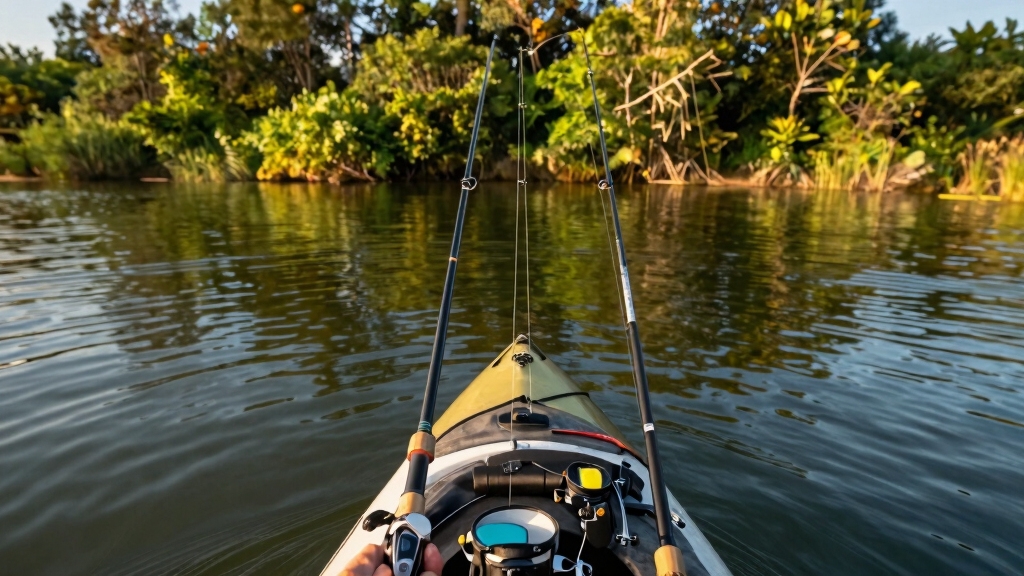
When you’re seated in a fishing kayak, a 7-foot rod typically extends about 3-4 feet beyond your kayak’s bow when held at a comfortable angle. This length allows you to:
- Cast effectively without the rod tip hitting the water on your backcast
- Set hooks firmly with enough leverage from a seated position
- Maneuver around rod holders and other deck-mounted gear
- Land fish without the rod being so long it becomes unwieldy
- Store the rod in horizontal rod holders when paddling between spots
The “ideal” length shifts based on your specific situation. Inshore anglers fishing mangroves often prefer 6.5-foot rods, while open-water kayak anglers targeting pelagic species might push toward 7.5 or even 8 feet. Your physical size matters too—taller anglers with longer arms can handle longer rods more comfortably than shorter anglers.
Choose a 6.5-foot rod if: You fish primarily in tight quarters, target species under 5 pounds, or use techniques like jigging and vertical presentations.
Choose a 7-7.5-foot rod if: You fish open water, need maximum casting distance, target larger species, or frequently use topwater lures and soft plastics.
Why Do Kayak Anglers Use Shorter Rods?
Kayak anglers use shorter rods because the seated fishing position and limited working space make longer rods difficult to manage effectively. A 6-6.5-foot rod provides better control when fighting fish, reduces the risk of hitting the rod tip on the kayak or water during casts, and makes it much easier to navigate around deck-mounted accessories like rod holders, fish finders, and anchor systems.
The physics of casting from a seated position changes everything. When you’re sitting just 12-18 inches above the water surface, your rod tip starts much lower than it would when standing on a boat or pier. This means:
- Backcast clearance becomes critical – longer rods are more likely to hit the water behind you
- Leverage works differently – shorter rods provide better mechanical advantage when your pivot point is so low
- Wind resistance increases – longer rods catch more wind, which is amplified when you’re in an unstable platform
- Fatigue sets in faster – holding a longer rod at awkward angles for hours is exhausting
Shorter rods also shine when landing fish. In a kayak, you can’t walk backward or move around to manage a fish’s run. You’re fighting from a fixed, seated position, often with the fish directly below or beside your kayak. A 6.5-foot rod lets you keep the rod tip high enough to maintain pressure while still having room to maneuver without hitting your kayak’s deck or your own body.
Common mistake: Assuming that shorter rods mean shorter casts. Modern rod materials and designs allow 6.5-foot rods to cast nearly as far as 7-foot models when technique is dialed in, especially with the right line and lure weight combinations.
Difference Between 6 Foot and 7 Foot Rod for Kayak Fishing
A 6-foot rod offers maximum maneuverability and control in tight spaces, while a 7-foot rod provides noticeably better casting distance and leverage for fighting larger fish. The 12-inch difference might seem small, but it translates to roughly 15-20% more casting distance and significantly different handling characteristics in a kayak cockpit.
Here’s how they compare in real-world kayak fishing scenarios:
6-Foot Rod Advantages:
- Fits easily in most kayak rod holders without extending far beyond the bow or stern
- Ideal for pitching and flipping lures into tight cover
- Less likely to tangle with other rods when carrying multiple setups
- Better for techniques requiring precise, short-range presentations
- Easier to store and transport
- More comfortable for all-day fishing in confined spaces
7-Foot Rod Advantages:
- Adds 10-15 feet to your maximum casting range
- Provides better line control when working topwater lures
- Offers more leverage when fighting fish over 10 pounds
- Keeps more line off the water, reducing drag in windy conditions
- Better for techniques like walking-the-dog with topwater plugs
- More effective for covering water quickly with search baits
The practical difference: In a sit-on-top kayak with good stability, most anglers won’t notice much handling difference between 6 and 7 feet. In a narrower, less stable kayak or when fishing in tight quarters like rivers or mangrove tunnels, that extra foot becomes a significant liability.
For bass fishing in ponds and lakes, a 7-foot rod is often the better all-around choice. For inshore saltwater fishing around structure, a 6-foot rod typically wins. Many experienced kayak anglers split the difference with a 6.5 or 6.8-foot rod as their primary setup.

DURABLE MATERIAL-The kayak paddle lanyard is made up of nylon fabric, which features with nice anti-corrosion performance and longer service life, and the fixed elongation will not overstretch and lose its elasticity.

Beauty & Performance Rod:The contrast between the black finish and the custom shark graphics skin decorative wrap and silver features that perfectly into the blue camouflage handles.Designed with an ergonomic camouflage handle that provides a comfortable grip, reducing fatigue during long fishing sessions

DURABLE MATERIAL-The kayak paddle lanyard is made up of nylon fabric, which features with nice anti-corrosion performance and longer service life, and the fixed elongation will not overstretch and lose its elasticity.
Best Rod Length for Fishing from a Sit-On-Top Kayak
The best rod length for sit-on-top kayak fishing is 7 to 7.5 feet because these kayaks offer more working space, easier rod positioning, and better stability than sit-inside models. Sit-on-top designs place you higher above the water and provide 360-degree access around your seat, which eliminates many of the clearance issues that make longer rods problematic in sit-inside kayaks.
Sit-on-top kayaks designed for fishing typically measure 32-36 inches wide, compared to 24-28 inches for sit-inside models. This extra width provides:
- A more stable casting platform that can handle the weight shift of casting longer rods
- Better rod storage options with flush-mount holders that don’t interfere with longer rods
- Easier fish landing since you can swing fish over the side without cockpit walls in the way
- More room for rod manipulation when setting hooks or working lures
The elevated seating position on most sit-on-tops also changes your casting mechanics. You’re typically sitting 4-6 inches higher than in a sit-inside kayak, which gives your backcast more clearance and allows you to generate more casting power with longer rods.
For inshore fishing from a sit-on-top: A 7-foot medium or medium-heavy rod handles everything from redfish to small tarpon. Pair it with 15-20 lb braided line for the best balance of casting distance and strength.
For offshore fishing from a sit-on-top: Consider a 7.5-foot rod when targeting larger pelagic species like mahi, kingfish, or tuna. The extra length helps manage long runs and provides the leverage needed to turn powerful fish away from structure.
Edge case: If you fish primarily in extremely tight mangrove tunnels or narrow creeks, even from a sit-on-top, drop down to a 6.5-foot rod. The extra maneuverability outweighs the casting distance advantage in these specific environments.

Ergolounge seating system : Extra-thick cushioning and an extra high and wide padded backrest.

UV-Protected HDPE Construction for Durability: Built with high-density polyethylene (HDPE) plastic, this kayak is both lightweight and highly durable, offering long-lasting protection against UV rays for years of use in various conditions. Paddle included.

Quality Construction: Constructed of uv-protected high-density polyethylene. Multiple footrest positions for different size riders. Stable flat bottom
How to Choose Rod Length for Inshore Kayak Fishing
Choose a 6.5 to 7-foot rod for inshore kayak fishing, with the shorter end of that range for structure-heavy environments and the longer end for open flats and beaches. Inshore fishing typically involves targets like redfish, speckled trout, snook, and flounder in water depths from 1 to 10 feet, where casting accuracy often matters more than maximum distance.
When selecting rod length for inshore fishing, consider these specific factors:
Water Depth and Structure:
- Shallow grass flats (1-3 feet): 7-foot rod for longer casts to spooky fish
- Oyster bars and docks (2-6 feet): 6.5-foot rod for precise presentations
- Mangrove shorelines: 6-6.5-foot rod to navigate overhanging branches
- Open beaches and surf zones: 7-7.5-foot rod for distance and wave management
Target Species Behavior:
- Sight-fishing redfish: 7-foot rod for longer, quieter presentations
- Dock fishing for snook: 6.5-foot rod for tight-quarters casting
- Trout over grass: 7-foot rod for covering water with topwater plugs
- Flounder in channels: 6.5-foot rod for vertical jigging and precise bottom contact
Lure Types:
- Topwater plugs: 7-foot rod for better walking action and hooksets
- Soft plastics: 6.5-7-foot rod depending on presentation style
- Spoons and jigs: 6.5-foot rod for better feel and control
- Live bait: 7-foot rod for longer casts and better line management
Decision rule: If more than 50% of your fishing happens within 40 feet of your kayak or involves heavy structure, choose 6.5 feet. If you’re regularly casting 50+ feet or fishing open water, go with 7 feet.
Most inshore kayak specialists carry two rods: a 6.5-foot medium-power spinning rod for finesse presentations and a 7-foot medium-heavy for larger lures and bigger fish. This combination covers 90% of inshore scenarios.

2 in 1 Kayak Rod Holder - PLUSINNO rod holders for fishing boat feature a cutting-edge design compatible with both track-mounted and deck-mounted kayak or boat. This kayak fishing rod holder fits most vessels and is ideal for boat fishing enthusiasts. Compatibility issues are easily resolved. Simply install this easy-to-use rod holder in minutes, easy of mounting and adjustments, perfect kayak accessories.

[ NO LOSS ] The kayak lanyard stops the paddle or rods from floating away, secure net and wading stick for fly fishing

3 ball bearings plus one-way clutch instant anti-reverse bearing for smooth gear feel and quick hook sets
Can I Use an 8 Foot Rod on a Kayak?
You can use an 8-foot rod on a kayak, but it’s practical only for specific situations like surf fishing, offshore trolling, or targeting large pelagic species in open water. For most kayak fishing applications, an 8-foot rod creates more problems than it solves, including difficult storage, awkward casting angles, and challenging fish-fighting dynamics from a seated position.
An 8-foot rod makes sense when:
- Surf launching and fishing through breaking waves where you need maximum casting distance
- Trolling for pelagic species like tuna, wahoo, or sailfish where the rod stays in a holder
- Fishing extremely large bodies of water where covering distance is critical
- Targeting species over 30 pounds that require maximum leverage
The challenges of 8-foot rods in kayaks include:
- Storage difficulties – most kayak rod holders can’t accommodate 8-foot rods horizontally
- Paddle interference – the rod extends so far it often hits your paddle blade
- Casting awkwardness – the low seated position makes it hard to load an 8-foot rod properly
- Landing problems – getting fish close enough to net or lip becomes difficult
- Fatigue – holding an 8-foot rod at the angles required in a kayak is exhausting
Common mistake: Buying an 8-foot rod because you fish from shore and want to use the same rod in your kayak. The casting dynamics are completely different, and you’ll likely find the longer rod frustrating in the kayak environment.
Better approach: If you need the casting distance of an 8-foot rod, consider a 7.5-foot model with a faster action and lighter weight. Modern materials allow shorter rods to achieve impressive casting distances when matched with the right line and lure weights.
For ocean kayak fishing in open water, some anglers successfully use 8-foot rods, but they typically dedicate these rods to specific techniques like live bait fishing or trolling rather than using them as all-purpose casting rods.
Rod Length for Kayak Fishing in Tight Spaces vs Open Water
For tight spaces like rivers, creeks, and mangrove tunnels, use a 6 to 6.5-foot rod to maximize maneuverability and avoid constant tangles with overhanging vegetation. For open water like bays, lakes, and offshore environments, use a 7 to 7.5-foot rod to maximize casting distance and line control in wind.
The environment dictates rod length more than any other factor in kayak fishing:
Tight Spaces (6-6.5 feet):
- Mangrove tunnels and shorelines
- Small creeks and streams
- Rivers with overhanging trees
- Dock fishing with limited clearance
- Fishing around bridge pilings and structure
- Any environment where you need to make short, accurate casts under or around obstacles
Open Water (7-7.5 feet):
- Large bays and estuaries
- Open ocean and nearshore waters
- Big lakes and reservoirs
- Grass flats with long sight-casting opportunities
- Beach and surf fishing
- Any environment where casting distance and covering water matters
The transition zone: Many kayak anglers fish environments that include both tight and open areas. For example, you might paddle through a narrow creek to reach an open bay, or fish both mangrove edges and open flats on the same trip. In these mixed environments, a 6.8 to 7-foot rod provides the best compromise.
Pro tip: If you frequently fish both environments, consider a two-rod system. Keep a 6.5-foot rod rigged with a jig or soft plastic for tight-quarters fishing, and a 7-foot rod rigged with a topwater or search bait for open water. This lets you adapt quickly without re-rigging.
For river kayak fishing, where you’re often dealing with current, overhanging branches, and tight casting lanes, the 6 to 6.5-foot range is almost always the better choice. The improved control and reduced snag risk outweigh any casting distance advantages.
What Rod Length Do Professional Kayak Fishermen Use?
Professional kayak tournament anglers typically use rods between 6.5 and 7.5 feet, with most carrying multiple rods in different lengths to adapt to changing conditions throughout a competition day. The most common setup includes a 6.5-foot rod for finesse techniques, a 7-foot all-purpose rod, and a 7.5-foot rod for distance casting and larger lures.
Tournament pros choose rod length based on:
Technique-Specific Requirements:
- Flipping and pitching: 6.5-7 feet for accuracy and control
- Topwater: 7-7.5 feet for better walking action and hookset leverage
- Crankbaits: 7-7.5 feet for casting distance and fish-fighting cushion
- Jigs and soft plastics: 6.5-7 feet for sensitivity and hookset power
- Spinnerbaits: 7-7.5 feet for casting distance and blade control
Competition Considerations:
- Covering water quickly to locate fish favors longer rods (7-7.5 feet)
- Fishing high-percentage spots with precision favors shorter rods (6.5-7 feet)
- Adapting to changing conditions requires multiple rod lengths ready to deploy
- Landing fish efficiently for measurement and release favors moderate lengths (7 feet)
Professional kayak bass anglers often favor 7-foot medium-heavy rods as their primary setup because this length handles the widest variety of bass fishing techniques. Saltwater kayak tournament pros tend toward slightly longer rods (7-7.5 feet) because they’re often targeting larger, more powerful fish in open water environments.
Notable pattern: Very few professional kayak anglers use rods shorter than 6.5 feet or longer than 7.5 feet in competition. This narrow range has emerged through thousands of hours of on-water testing and represents the practical sweet spot for tournament-level kayak fishing.
The key difference between professional and recreational kayak anglers isn’t necessarily rod length, but rather having multiple rods rigged and ready. Pros can switch techniques quickly by grabbing a different rod rather than re-rigging, which is a significant advantage when fish are actively feeding or when trying to pattern fish across different depths and structures.
Common Mistakes When Choosing Kayak Fishing Rod Length
The most common mistake when choosing kayak fishing rod length is selecting a rod based on shore or boat fishing experience without considering the unique constraints of fishing from a seated, low position in a confined space. Many anglers buy 7.5 to 8-foot rods because they’re accustomed to using them from shore, only to discover these longer rods are awkward and frustrating in a kayak.
Top mistakes to avoid:
Mistake 1: Prioritizing casting distance over maneuverability
- Many anglers assume longer always means better casting distance
- In reality, a well-designed 6.5-foot rod with proper technique casts nearly as far as a 7.5-foot rod
- The maneuverability you lose with a longer rod often outweighs the minor casting distance gain
Mistake 2: Not considering rod storage and transport
- Longer rods are harder to store in rod holders while paddling
- They extend far beyond your kayak’s bow or stern, increasing snag risk
- Transport becomes more difficult, especially with shorter vehicles
Mistake 3: Ignoring your primary fishing environment
- Buying a 7.5-foot rod when you fish primarily in tight mangrove creeks
- Choosing a 6-foot rod when you fish open bays and need casting distance
- Not matching rod length to the specific water you fish most often
Mistake 4: Overlooking kayak stability and width
- Trying to use a 7.5-foot rod in a narrow, unstable kayak
- Not considering how your kayak’s design affects rod handling
- Failing to test rod length in your specific kayak before buying
Mistake 5: Buying only one rod
- Expecting a single rod length to handle all situations
- Not building a small collection of different lengths for different techniques
- Refusing to adapt rod length to changing conditions
Mistake 6: Focusing on power and action while ignoring length
- Buying the right power (medium, medium-heavy) but wrong length
- Not understanding that length affects casting and fighting dynamics as much as power
- Choosing based on target species alone without considering presentation method
Decision framework: Before buying, ask yourself: “Where will I fish this rod most often?” If the answer involves the words “tight,” “narrow,” “creek,” “river,” or “structure,” go shorter (6-6.5 feet). If the answer includes “open,” “bay,” “lake,” “beach,” or “distance,” go longer (7-7.5 feet).
For beginner kayak fishing setups, a single 7-foot medium-power spinning rod is the most versatile starting point. It handles 80% of situations reasonably well while you learn your preferences and fishing style.
Is a Longer Rod Better for Casting Distance from a Kayak?
A longer rod does provide better casting distance from a kayak, but the advantage is smaller than most anglers expect—typically only 10-20% more distance compared to a rod 12 inches shorter. The seated fishing position and limited range of motion in a kayak reduce the casting distance advantage that longer rods provide when fishing from shore or a standing position on a boat.
How rod length affects casting distance in kayaks:
From a seated position, your casting stroke is shorter and your leverage is reduced compared to standing. A 7.5-foot rod might give you an extra 15 feet of casting distance compared to a 6.5-foot rod, but only if you have the technique and space to load the rod properly. In many kayak fishing situations, the confined space prevents you from achieving a full casting stroke, which negates much of the length advantage.
Factors that matter more than length for kayak casting distance:
- Rod action and taper – a fast-action rod with a progressive taper loads more efficiently from a seated position
- Line choice – thin-diameter braided line reduces friction and wind resistance
- Lure weight – matching lure weight to rod specifications maximizes loading and energy transfer
- Casting technique – proper timing and smooth acceleration matter more than raw rod length
- Wind conditions – longer rods catch more wind, which can actually reduce distance in strong winds
When length matters most for distance:
- Fishing from very stable, wide kayaks where you can generate a full casting stroke
- Using heavy lures (1+ ounces) that fully load the rod
- Fishing in calm conditions where wind doesn’t interfere
- Targeting species that require long casts to avoid spooking (sight-fishing redfish, for example)
When length matters less:
- Fishing in wind where longer rods become harder to control
- Using light lures that don’t fully load longer rods
- Fishing from narrow, less stable kayaks where casting motion is restricted
- Situations where accuracy matters more than distance
Reality check: Most kayak fishing happens within 60 feet of the kayak. The difference between a 6.5-foot and 7.5-foot rod in this range is minimal—maybe 5-10 feet of maximum casting distance. Unless you’re regularly fishing situations that require 70+ foot casts, prioritize rod length for maneuverability and comfort over maximum casting distance.
For anglers focused on casting distance, improving technique and using appropriate line and lure combinations will yield bigger gains than simply buying a longer rod.
Best Rod Length for Kayak Bass Fishing vs Saltwater
For kayak bass fishing, a 7-foot medium to medium-heavy rod is ideal for handling the variety of techniques and lure sizes bass fishing requires. For saltwater kayak fishing, a 6.5 to 7.5-foot medium-heavy to heavy rod works best, with the specific length depending on whether you’re fishing inshore structure (shorter) or open water (longer).
Bass Fishing Rod Length (Freshwater):
Bass fishing involves frequent technique changes and a wide variety of lure types, from finesse worms to large swimbaits. A 7-foot rod provides the versatility to handle most bass fishing situations:
- Topwater lures: 7-7.5 feet for walking action and long-distance hooksets
- Soft plastics: 6.5-7 feet depending on presentation style (Texas rig, drop shot, etc.)
- Crankbaits: 7-7.5 feet for casting distance and fish-fighting cushion
- Jigs and flipping: 6.5-7 feet for accuracy and power
- Spinnerbaits: 7-7.5 feet for casting distance and blade control
Most kayak bass anglers carry 2-3 rods: a 6.5-foot medium-power for finesse, a 7-foot medium-heavy for general use, and sometimes a 7.5-foot for topwater and long-distance casting.
Saltwater Rod Length (Inshore and Nearshore):
Saltwater fishing typically involves larger, more powerful fish and heavier tackle. Rod length choice depends heavily on your specific saltwater environment:
Inshore (bays, flats, mangroves):
- 6.5-7 feet for most inshore species (redfish, trout, snook)
- Medium-heavy to heavy power to handle 15-30 lb fish
- Shorter end (6.5 feet) for structure-heavy fishing
- Longer end (7 feet) for open flats and sight-casting
Nearshore and offshore:
- 7-7.5 feet for larger pelagic species (kingfish, mahi, small tuna)
- Heavy to extra-heavy power for fish over 20 pounds
- Longer rods provide better leverage for long fights
- Consider 8 feet only for specialized offshore trolling or live bait fishing
Key differences:
| Factor | Bass Fishing | Saltwater Fishing |
|---|---|---|
| Typical rod length | 7 feet | 6.5-7.5 feet |
| Power range | Medium to medium-heavy | Medium-heavy to heavy |
| Line weight | 8-20 lb test | 15-40 lb test |
| Lure weight | 1/8 to 1 oz | 1/4 to 3 oz |
| Target fish size | 1-10 lbs | 3-30+ lbs |
| Corrosion resistance | Less critical | Essential |
Choose bass-specific length (7 feet) if: You fish primarily freshwater, use a wide variety of techniques, and target fish under 10 pounds.
Choose saltwater-specific length (6.5-7.5 feet) if: You fish inshore or nearshore saltwater, target species over 10 pounds regularly, and need corrosion-resistant components.
Many anglers who fish both freshwater and saltwater find that a 7-foot medium-heavy rod serves as a good crossover option, though dedicated rods for each environment will always perform better in their specific applications.
Problems with Using Too Long of a Rod in a Kayak
Using too long of a rod in a kayak creates problems with storage, maneuverability, casting mechanics, and fish landing. Rods over 7.5 feet become increasingly difficult to manage in the confined space of a kayak cockpit, leading to frustration, reduced fishing efficiency, and increased risk of equipment damage.
Specific problems with overly long rods:
Storage and Transport Issues:
- Rod extends far beyond kayak bow or stern when stored in holders
- Increased risk of hitting docks, trees, or other obstacles while paddling
- Difficult to secure properly without custom rod holder positioning
- May not fit in vehicle without special roof racks or rod tubes
- Takes up excessive space when storing multiple rods
Casting Problems:
- Backcast hits water surface more frequently from low seated position
- Difficult to generate proper rod loading with restricted range of motion
- Wind catches longer rod blank more easily, reducing accuracy
- Harder to make accurate short-range casts to nearby targets
- Increased fatigue from holding longer rod at awkward angles
Fish Fighting Challenges:
- Difficult to keep rod tip high enough when fish is directly below kayak
- Less control when fish makes runs close to the kayak
- Harder to apply side pressure to turn fish away from structure
- Rod tip may hit kayak deck or other equipment during fight
- Reduced leverage from seated position with longer rod
Landing Difficulties:
- Can’t bring fish close enough to net or lip without standing (dangerous)
- Rod length prevents proper fish handling position
- Increased risk of losing fish at kayak-side
- Harder to control fish for quick measurement and release
Safety Concerns:
- Long rod more likely to catch wind and affect kayak stability
- Increased risk of rod tip hitting other kayakers in groups
- Harder to manage in rough water or strong current
- May interfere with paddle strokes in emergency situations
Practical limit: For most kayak fishing applications, 7.5 feet represents the practical maximum rod length. Beyond this, the problems outweigh any potential benefits unless you’re fishing very specific situations like offshore trolling or surf fishing where the kayak serves mainly as a stable platform rather than a mobile fishing vessel.
Solution: If you find yourself struggling with a rod that feels too long, don’t try to adapt—simply switch to a shorter rod. The improvement in comfort and fishing efficiency will be immediately noticeable. Many anglers who downsize from 7.5 to 7 feet or from 7 to 6.5 feet report that they don’t miss the extra length and appreciate the improved handling.
Do I Need Different Rod Lengths for Different Kayak Fishing Techniques?
Yes, different kayak fishing techniques perform better with specific rod lengths, though a single 7-foot medium-heavy rod can handle most techniques adequately. Serious kayak anglers typically own 2-4 rods in different lengths optimized for specific presentations, while recreational anglers can get by with one or two versatile rods in the 6.5-7.5-foot range.
Technique-specific rod length recommendations:
Topwater Fishing:
- Optimal length: 7-7.5 feet
- Why: Longer rods provide better lure action for walking-the-dog presentations, improve hookset leverage on long-distance strikes, and keep more line off the water for better lure control
- Alternative: A 7-foot rod works fine for most topwater applications
Jigging and Vertical Presentations:
- Optimal length: 6-6.5 feet
- Why: Shorter rods provide better sensitivity for detecting subtle bites, more direct control for vertical jigging, and easier fish fighting when fish are directly below the kayak
- Alternative: A 6.5-7-foot rod handles most jigging situations
Soft Plastic Fishing:
- Optimal length: 6.5-7 feet
- Why: Medium length provides good casting distance while maintaining sensitivity for bite detection and power for hooksets
- Alternative: Length depends on presentation style—Texas rigs work well with 7 feet, while wacky rigs and drop shots prefer 6.5 feet
Crankbait Fishing:
- Optimal length: 7-7.5 feet
- Why: Longer rods with moderate action provide better casting distance, help maintain proper crankbait depth, and offer cushion to prevent pulling treble hooks during the fight
- Alternative: A 7-foot moderate-action rod handles most crankbait fishing
Spinnerbait and Chatterbait Fishing:
- Optimal length: 7-7.5 feet
- Why: Longer rods help cover water quickly, provide better blade control, and improve hookset leverage on reaction strikes
- Alternative: A 7-foot medium-heavy rod works well for most moving baits
Flipping and Pitching:
- Optimal length: 6.5-7 feet
- Why: Shorter rods provide better accuracy for short-range presentations, more power for pulling fish from heavy cover, and easier maneuverability around structure
- Alternative: A 7-foot heavy-power rod handles most flipping situations
Live Bait Fishing:
- Optimal length: 7-7.5 feet
- Why: Longer rods provide better casting distance for live bait, help keep bait in the strike zone longer, and offer more cushion during the fight
- Alternative: A 7-foot medium-power rod works for most live bait applications
Practical approach for building a rod collection:
One-rod setup: 7-foot medium-heavy spinning or casting rod (covers 70% of techniques)
Two-rod setup:
- 6.5-foot medium-heavy (finesse and close-range)
- 7-foot medium-heavy (general purpose and distance)
Three-rod setup:
- 6.5-foot medium (finesse and jigging)
- 7-foot medium-heavy (all-purpose)
- 7.5-foot medium-heavy (topwater and distance casting)
Four-rod setup:
- 6-foot medium (ultra-finesse and tight spaces)
- 6.5-foot medium-heavy (jigging and soft plastics)
- 7-foot medium-heavy (general purpose)
- 7.5-foot medium-heavy (topwater and long-distance)
Most kayak anglers find that 2-3 rods cover their needs without creating storage and transport challenges. Choose rod lengths based on the techniques you use most often rather than trying to have a dedicated rod for every possible situation.
For those just starting with kayak fishing, invest in one quality 7-foot rod and learn to adapt your techniques to that length before expanding your collection. You’ll develop a better understanding of what additional lengths you actually need through on-water experience.
Frequently Asked Questions
What is the most versatile rod length for kayak fishing?
A 7-foot medium-heavy rod is the most versatile length for kayak fishing, handling everything from finesse presentations to larger lures and fish. This length provides good casting distance while maintaining maneuverability in a kayak cockpit, and it works well for both freshwater and inshore saltwater fishing.
Can I use my shore fishing rods in a kayak?
You can use shore fishing rods in a kayak, but rods longer than 7.5 feet will be awkward and frustrating. Shore rods are designed for standing positions with full range of motion, while kayak fishing requires shorter rods optimized for seated, confined-space fishing. Consider buying kayak-specific rods for better performance.
How does kayak width affect rod length choice?
Wider, more stable kayaks (32+ inches) can accommodate longer rods (7-7.5 feet) more easily because they provide a more stable casting platform and more working space. Narrower kayaks (under 30 inches) work better with shorter rods (6.5-7 feet) because they’re less stable and offer less room to maneuver longer rods.
Should I use different rod lengths for sit-inside vs sit-on-top kayaks?
Yes, sit-inside kayaks typically require shorter rods (6.5-7 feet) because of the confined cockpit space and lower seating position. Sit-on-top kayaks can handle longer rods (7-7.5 feet) because they offer more working space, easier rod positioning, and a higher seating position that improves casting mechanics.
What rod length is best for kayak fishing in wind?
Shorter rods (6.5-7 feet) perform better in windy conditions because they catch less wind and are easier to control. Wind resistance increases significantly with rod length, making longer rods harder to cast accurately and more likely to affect kayak stability in strong winds.
Do professional kayak anglers use shorter rods than recreational anglers?
Professional kayak anglers use similar rod lengths (6.5-7.5 feet) as recreational anglers, but they typically own more rods in different lengths to optimize for specific techniques and conditions. The main difference is having multiple rods rigged and ready rather than using significantly different lengths.
How much does rod length affect casting accuracy in a kayak?
Shorter rods (6-6.5 feet) generally provide better casting accuracy in kayaks because they’re easier to control from a seated position and less affected by wind. The difference is most noticeable when making short, precise casts to specific targets like dock pilings or mangrove roots.
Can I use an ultralight rod in a kayak?
You can use ultralight rods in kayaks, but they’re best suited for calm water and small fish. Ultralight rods are typically 5-6 feet long, which works well in kayaks, but their light power makes them impractical for most kayak fishing situations where you need to handle wind, current, and larger fish.
What’s the best rod length for kayak fishing with kids?
For kids kayak fishing, use 5.5 to 6.5-foot rods depending on the child’s age and size. Shorter rods are easier for kids to handle, less likely to tangle, and safer in the confined space of a kayak. Match rod length to the child’s arm length and strength rather than using adult-sized rods.
How does rod length affect fish landing in a kayak?
Shorter rods (6.5-7 feet) make landing fish easier in kayaks because they allow you to bring fish closer to the kayak without standing up. Longer rods create a larger arc that makes it difficult to control fish at kayak-side, often requiring you to reach dangerously far or stand up to land fish.
Should I choose rod length based on target species or fishing location?
Choose rod length primarily based on fishing location (tight spaces vs open water), then fine-tune based on target species. Location determines the practical constraints of casting and maneuvering, while species determines power and action. A 7-foot rod works for bass in open lakes but would be frustrating in tight creeks regardless of species.
What rod length works best for kayak trolling?
For kayak trolling, use 7 to 8-foot rods that can be secured in rod holders while you paddle. Longer rods keep lines separated when trolling multiple rods and provide better shock absorption when fish strike. The rod stays in the holder during the fight, so the handling challenges of longer rods are less relevant.
Conclusion
Rod length for kayak fishing explained comes down to matching your rod to your fishing environment, target species, and preferred techniques. Most kayak anglers find their sweet spot between 6.5 and 7.5 feet, with 7 feet being the most versatile all-around choice. Shorter rods (6-6.5 feet) excel in tight spaces and for vertical presentations, while longer rods (7-7.5 feet) provide better casting distance and leverage in open water.
The biggest factor in choosing rod length is your primary fishing environment. If you fish tight mangrove creeks, rivers with overhanging branches, or structure-heavy areas, prioritize maneuverability with a 6.5-foot rod. If you fish open bays, large lakes, or offshore waters where casting distance matters, opt for a 7 to 7.5-foot rod. When in doubt, a 7-foot medium-heavy rod handles 80% of kayak fishing situations effectively.
Take action now:
- Evaluate your fishing environment – Make a list of where you fish most often and whether those locations are tight spaces or open water
- Consider your kayak type – Sit-on-top kayaks can handle longer rods than sit-inside models
- Start with one versatile rod – A 7-foot medium-heavy spinning or casting rod covers most situations
- Test before buying – If possible, borrow or demo different rod lengths in your kayak before purchasing
- Build your collection gradually – Add specialized lengths (6.5 or 7.5 feet) as you identify specific needs through experience
Remember that rod length is just one factor in successful kayak fishing. Proper technique, quality line, appropriate lure selection, and understanding fish behavior matter just as much as having the perfect rod length. Focus on mastering the fundamentals with a versatile 7-foot rod, then expand your collection as your skills and specific needs develop.
For more guidance on selecting the right fishing kayak and fishing gear to match your rod choices, explore our comprehensive fishing kayak buying guide and fishing techniques resources.