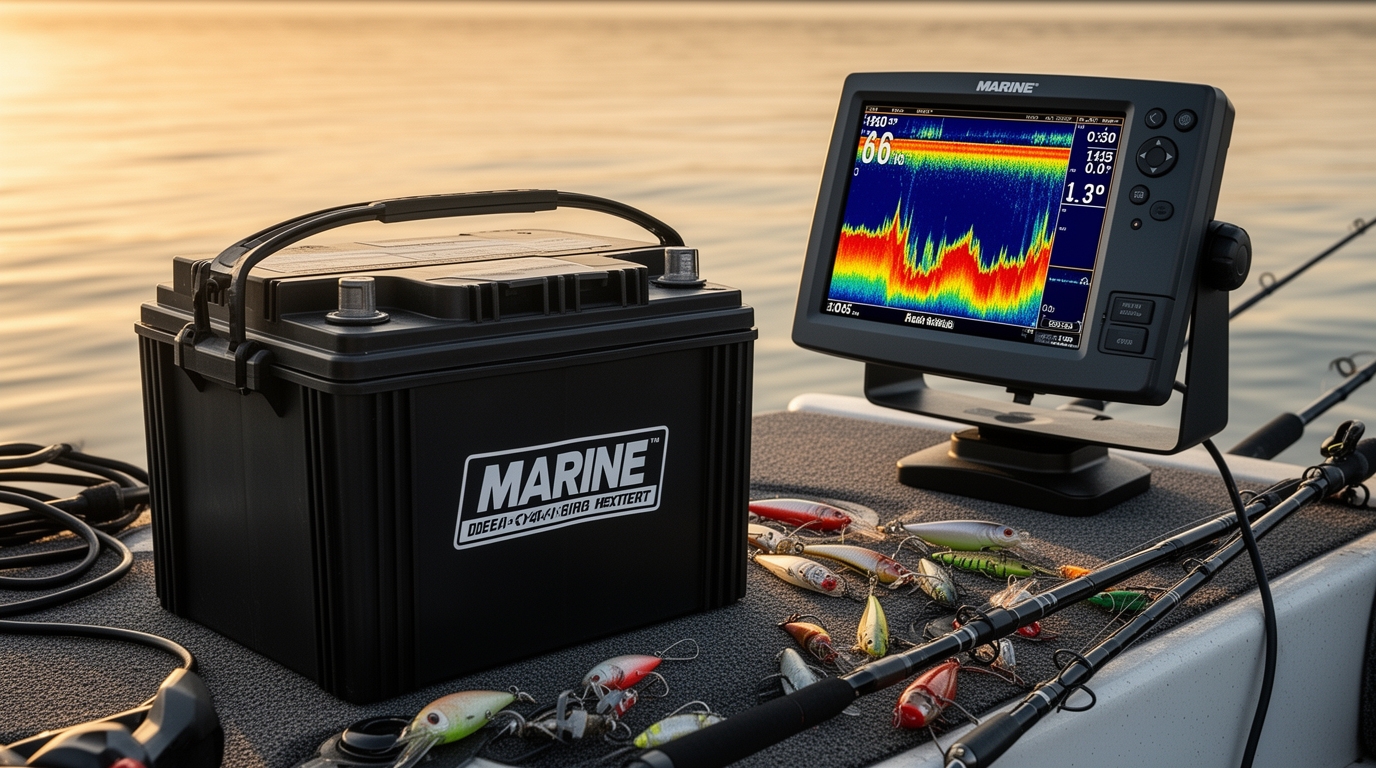
A typical fish finder battery lasts between 4 to 40 hours on a single charge, depending on the battery capacity (measured in amp-hours), the fish finder’s power consumption (measured in watts), and usage patterns like screen brightness and sonar frequency. Most kayak anglers using a 12V 7Ah battery with a standard fish finder drawing 3-5 watts can expect 8-12 hours of runtime, while larger 20Ah lithium batteries can power the same unit for 30+ hours.
Key Takeaways
- Runtime varies widely: A 12V 7Ah battery typically runs a standard fish finder for 8-12 hours, while a 20Ah battery can last 30-40 hours with the same unit
- Power draw matters most: Fish finders consume 3-15 watts depending on screen size, brightness, and sonar mode (CHIRP and side-imaging use more power)
- Lithium beats lead-acid: Lithium batteries provide 2-3x more usable capacity, weigh 60% less, and last 5-10 years versus 2-3 years for lead-acid
- Calculate your needs: Divide battery amp-hours by fish finder amp draw to estimate runtime (example: 10Ah ÷ 0.5A = 20 hours)
- Common drains: Maximum screen brightness, continuous side-imaging, and leaving the unit on between spots can cut battery life in half
- Deep-cycle is essential: Car batteries fail quickly under repeated discharge; marine deep-cycle or lithium batteries are designed for fish finder use
- Proper sizing prevents issues: Match battery capacity to your typical fishing duration plus 25% safety margin
How Long Does a Fish Finder Battery Last on a Single Charge?
A fish finder battery lasts anywhere from 4 to 40+ hours on a single charge, with most kayak setups averaging 10-15 hours. The actual runtime depends on three main factors: battery capacity (amp-hours), the fish finder’s power consumption (watts or amps), and how you use the device.
For kayak anglers, the most common scenario involves a 12V 7-10Ah battery paired with a mid-range fish finder (like a Garmin Striker or Humminbird Helix 5) that draws 3-5 watts. This combination typically delivers 8-12 hours of continuous use, which covers most full-day fishing trips.
Runtime by common battery sizes:
- 7Ah battery: 6-10 hours with a 5-watt fish finder
- 10Ah battery: 10-15 hours with a 5-watt fish finder
- 20Ah battery: 25-35 hours with a 5-watt fish finder
- 35Ah battery: 40+ hours with a 5-watt fish finder
Keep in mind that these estimates assume moderate use. Running your fish finder at maximum brightness, using power-hungry features like side-imaging continuously, or operating in cold weather can reduce runtime by 30-50%. Conversely, dimming the screen and using 2D sonar only can extend battery life significantly.
When planning your kayak fishing setup, always size your battery for your longest typical outing plus a 25% buffer. Running a battery completely dead repeatedly shortens its overall lifespan.
What Size Battery Do I Need for My Fish Finder?
You need a battery with enough amp-hour (Ah) capacity to run your fish finder for your typical fishing duration plus a safety margin. For most kayak anglers fishing 6-8 hours, a 10-12Ah battery works well with standard fish finders, while all-day anglers (10+ hours) should consider 20Ah or larger.
Choose your battery size based on:
- Your fish finder’s power draw – Check the manual or back panel for wattage or amp rating (typically 3-15 watts for kayak units)
- Your typical fishing duration – Add 25-30% buffer to your usual trip length
- Features you use – Side-imaging and CHIRP sonar draw more power than basic 2D sonar
- Battery chemistry – Lithium batteries deliver more usable capacity than lead-acid of the same Ah rating
Quick sizing guide for kayak anglers:
- Half-day trips (4-6 hours): 7-10Ah battery
- Full-day trips (8-10 hours): 12-15Ah battery
- Extended trips (12+ hours): 20-35Ah battery
- Multi-day or tournament use: 35Ah+ or dual battery system
A common mistake is buying the smallest battery that technically meets your needs. Batteries last longer and perform better when you don’t regularly drain them below 50% capacity. If your calculation shows you need exactly 10Ah, buy a 12-15Ah battery instead.
For beginner kayak fishing setups, a 12V 10Ah lithium battery offers the best balance of weight, runtime, and cost for most situations.
How to Calculate Fish Finder Battery Life Based on Watts
To calculate fish finder battery life, divide the battery’s watt-hours (Wh) by the fish finder’s wattage, then multiply by 0.8 to account for real-world efficiency losses. Alternatively, divide battery amp-hours (Ah) by the fish finder’s amp draw for a quick estimate.
Step-by-step calculation method:
- Find your fish finder’s power consumption – Look for watts (W) or amps (A) in the manual or on the device label
- Convert amps to watts if needed – Multiply amps by voltage (usually 12V): Watts = Amps × 12V
- Calculate battery watt-hours – Multiply battery Ah by voltage: Wh = Ah × 12V
- Divide and adjust – Runtime (hours) = (Battery Wh ÷ Fish Finder Watts) × 0.8
Example calculation:
- Fish finder: 5 watts (0.42 amps at 12V)
- Battery: 12V 10Ah (120 watt-hours)
- Calculation: (120Wh ÷ 5W) × 0.8 = 19.2 hours theoretical runtime
Simplified amp-hour method:
If your fish finder lists amp draw directly, just divide battery Ah by fish finder amps:
- 10Ah battery ÷ 0.42A fish finder = 23.8 hours (multiply by 0.8 for real-world = 19 hours)
The 0.8 multiplier (80% efficiency) accounts for battery discharge characteristics, temperature effects, and the fact that you shouldn’t drain batteries completely. Lead-acid batteries should only be discharged to 50%, so multiply their result by 0.5 instead of 0.8 for usable runtime.
This calculation gives you a baseline. Actual runtime varies based on screen brightness, sonar mode, water depth, and temperature. Always test your specific setup before relying on it for a long trip.
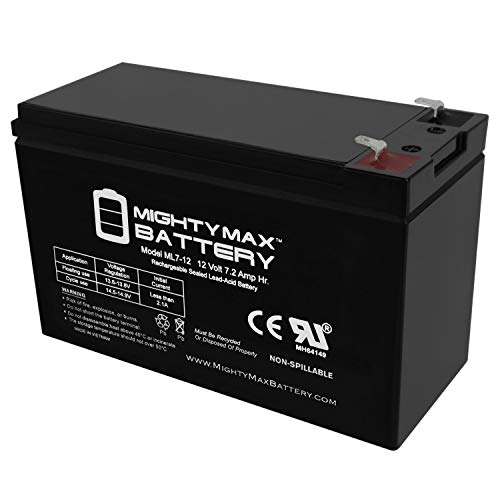
Ml7-12 Sla Is A 12V 7 2Ah Sealed Lead Acid (Sla) Rechargeable Maintenance Free Battery

【Superior Performance】: Lithium iron phosphate battery has high energy density, Long cycle life, Good safety performance, No memory effect, etc. NERMAK LiFePO4 battery has built-in BMS protection to prevent overcharge, Over-discharge, Over-current and short circuit, and very low self-discharge rate. (Not motorcycle starter battery)

【The Ultimate Lead-Acid Battery Replacement】 Identical in size to a standard 12V 7Ah SLA battery (5.95 x 2.56 x 3.7 in), it delivers a higher energy density within the same physical footprint. Weighing in at just 2.1 lbs—half the weight of a traditional battery—its compact dimensions and lightweight design allow it to be installed anywhere, making it the ideal replacement for lead-acid batteries.
How Long Will a 12V 7Ah Battery Run a Fish Finder?
A 12V 7Ah battery will run a typical kayak fish finder for 6-10 hours, depending on the unit’s power consumption. With a standard 3-5 watt fish finder, expect 8-9 hours of runtime under normal conditions, while power-hungry units drawing 7-10 watts will only last 4-6 hours.
The 7Ah (amp-hour) rating means the battery can theoretically deliver 7 amps for one hour, or 0.7 amps for 10 hours. Most fish finders suitable for kayaks draw between 0.3 and 0.8 amps at 12 volts.
Real-world runtime examples with 7Ah battery:
- Garmin Striker 4 (3.6W / 0.3A): 9-10 hours
- Humminbird Helix 5 (4.8W / 0.4A): 7-8 hours
- Lowrance Hook Reveal 5 (6W / 0.5A): 6-7 hours
- Garmin Echomap with side-imaging (9W / 0.75A): 4-5 hours
A 7Ah battery works well for half-day trips or as a lightweight option for minimalist kayak setups. However, it’s too small for all-day fishing or units with large screens and advanced sonar features. The battery also shouldn’t be drained below 50% capacity if it’s lead-acid (which gives you only 3-5 hours of usable runtime), while lithium versions can safely discharge to 80-90% (6-8 hours usable).
For serious kayak anglers planning 8+ hour trips, a 10-12Ah battery provides better reliability and battery longevity. The small weight savings of a 7Ah unit (typically 2-3 pounds less) isn’t worth the anxiety of running out of power mid-trip.
Fish Finder Battery Life Comparison: Lithium vs Lead Acid
Lithium batteries deliver 2-3 times more usable runtime than lead-acid batteries of the same amp-hour rating, weigh 60% less, and last 5-10 years compared to 2-3 years for lead-acid. For kayak fishing, lithium batteries are worth the higher upfront cost due to their superior performance, weight savings, and total cost of ownership over time.
Head-to-head comparison:
| Feature | Lithium (LiFePO4) | Sealed Lead-Acid (SLA) |
|---|---|---|
| Usable capacity | 80-90% of rated Ah | 50% of rated Ah |
| Weight (10Ah) | 2-3 lbs | 6-8 lbs |
| Lifespan | 2,000-5,000 cycles | 300-500 cycles |
| Years of use | 5-10 years | 2-3 years |
| Discharge curve | Flat voltage until depleted | Voltage drops steadily |
| Cold weather | Good to 20°F | Poor below 40°F |
| Cost (10Ah) | $80-150 | $25-40 |
Why lithium wins for kayak fishing:
- Weight matters on kayaks – A 20Ah lithium battery weighs less than a 10Ah lead-acid, making it easier to transport and leaving more capacity for fishing gear
- True capacity – A 10Ah lithium battery provides as much usable power as a 20Ah lead-acid because you can safely discharge it to 10% versus only 50% for lead-acid
- Consistent voltage – Lithium maintains 12.8V throughout discharge, so your fish finder screen stays bright and sonar performs consistently
- Longer lifespan – Even at $120, a lithium battery that lasts 7 years costs less per year than replacing a $35 lead-acid battery every 2 years
When lead-acid still makes sense:
- Extremely tight budgets where $35 is the maximum you can spend
- Backup batteries that sit unused most of the time
- Situations where weight doesn’t matter (larger boats, shore fishing)
For anyone serious about kayak fish finder setups in 2026, lithium LiFePO4 batteries are the clear choice. The technology has matured, prices have dropped, and the performance advantages are undeniable.

[Superior Performance]: Discover superior performance with our upgraded 12V 20Ah LiFePO4 battery. This rechargeable lithium battery offers impressive energy density, long cycle life, and advanced safety features. Equipped with a built-in 20A BMS protection system, it guards against overcharging, over-discharging, over-current, and short circuits. Additionally, its low self-discharge rate ensures trouble-free storage for up to one year
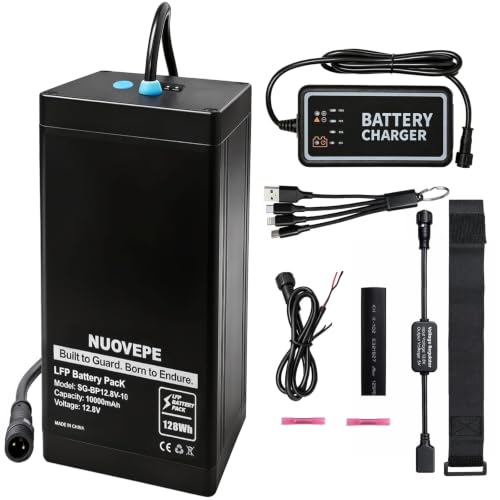
Say goodbye to the hassle of charging multiple devices: This 12V lithium battery kit includes a 4-in-1 charging cable that supports USB‑C, Micro USB, and Lightning connectors. It can charge smartphones, GPS devices, cameras, Android phones, tablets, and other electronic devices simultaneously, Paired with this lithium battery, it keeps your devices fully charged anytime, anywhere outdoors

Premium A-Grade Cells with Robust 30A BMS: Engineered for reliability, ERYY 12V lithium iron phosphate battery is built with top-tier A-Grade cells for 5000+ cycles (10+ years!) and stable performance from -20°C to 60°C. The advanced 30A BMS provides ultimate protection against overcharge, over-discharge, short circuits, and overheating, while balancing cells for maximum efficiency and lifespan. Reliably powers fish finders, portable outdoor speakers, car vacuum cleaners, and more as a 12V deep cycle marine battery
How to Make Fish Finder Battery Last Longer
To make your fish finder battery last longer, reduce screen brightness to 50-70%, turn off the unit when moving between spots, use 2D sonar instead of side-imaging when possible, and keep the battery charged between trips. These simple habits can extend runtime by 30-50% and double the battery’s overall lifespan.
Immediate runtime-extending tactics:
- Dim the screen – Brightness accounts for 30-40% of power draw; reduce to the minimum readable level
- Disable unused features – Turn off GPS tracking, Wi-Fi, and Bluetooth if you’re not using them
- Use 2D sonar primarily – Switch to side-imaging or down-imaging only when actively searching structure
- Reduce ping rate – Lower the sonar ping frequency in shallow water (less than 20 feet)
- Turn off between spots – Don’t leave the unit running while paddling to new locations
- Use auto-off features – Enable sleep mode if your unit supports it
Battery care for longer lifespan:
- Charge after every trip – Don’t store batteries in a discharged state
- Avoid extreme temperatures – Store batteries indoors, not in hot garages or freezing sheds
- Don’t fully discharge – Stop using the fish finder when voltage drops to 11.5V (lead-acid) or 12V (lithium)
- Use a quality charger – Smart chargers prevent overcharging and extend battery life
- Check connections – Corroded terminals increase resistance and waste power
Common mistakes that drain batteries faster:
- Running maximum brightness in full daylight (use a sun shade instead)
- Leaving the unit on “standby” instead of fully off
- Using side-imaging continuously instead of spot-checking
- Storing batteries in extreme heat or cold
- Letting lead-acid batteries sit uncharged for weeks
One often-overlooked tip: invest in a battery voltage monitor or use your fish finder’s voltage display. When you see voltage dropping below 12V, it’s time to start conserving power or wrap up your trip. This awareness prevents unexpected shutdowns and extends battery life by avoiding deep discharges.
For more tips on optimizing your setup, check out our guide on how to read a fish finder screen efficiently.
Why Does My Fish Finder Battery Die So Fast?
Your fish finder battery dies fast because of excessive power draw from high screen brightness, continuous use of power-hungry features like side-imaging, poor battery health, or undersized battery capacity for your usage pattern. A battery that should last 10 hours but dies in 3-4 hours typically has one or more of these issues.
Top causes of rapid battery drain:
- Screen brightness at maximum – Can double power consumption compared to 50% brightness
- Side-imaging or CHIRP running constantly – These features draw 2-3x more power than basic 2D sonar
- Old or damaged battery – Batteries lose capacity over time; a 3-year-old lead-acid battery may have only 60% of original capacity
- Undersized battery – A 7Ah battery simply can’t power a 10-watt fish finder for a full day
- Parasitic drain – Corroded connections, faulty wiring, or leaving the unit in standby mode
- Cold weather – Batteries lose 20-40% capacity below 40°F
- Wrong battery type – Using a car battery instead of a deep-cycle battery
Troubleshooting steps:
- Test actual runtime – Fully charge the battery, run the fish finder at home, and time how long it lasts
- Check voltage under load – If voltage drops below 11.5V within an hour, the battery is failing
- Measure power draw – Use a multimeter to check actual amp draw; compare to manufacturer specs
- Inspect connections – Look for corrosion, loose terminals, or damaged wiring
- Verify battery age – Lead-acid batteries over 3 years old should be replaced
Quick fixes:
- Reduce screen brightness to 50-60%
- Switch to 2D sonar and use side-imaging only when needed
- Replace batteries older than 3 years (lead-acid) or 7 years (lithium)
- Upgrade to a larger capacity battery (double your current Ah rating)
- Add a battery voltage monitor to catch problems early
If you’ve ruled out settings and the battery is new, you may have a defective unit or wiring issue. Test the fish finder with a known-good battery, or test your battery with a different device to isolate the problem.
Best Battery for Fish Finder Kayak
The best battery for a fish finder kayak is a 12V 10-20Ah lithium LiFePO4 battery, which provides 8-30+ hours of runtime, weighs only 2-5 pounds, and fits easily in most kayak storage compartments. For budget-conscious anglers, a 12V 12Ah sealed lead-acid (SLA) battery offers decent performance at one-third the cost, though it weighs three times as much.
Top battery recommendations for kayak anglers:
Best overall: 12V 12-20Ah Lithium LiFePO4
- Weight: 3-5 lbs
- Runtime: 15-30+ hours (typical fish finder)
- Lifespan: 5-10 years
- Cost: $90-180
- Why it wins: Perfect balance of weight, capacity, and longevity for serious kayak anglers
Best budget: 12V 12Ah Sealed Lead-Acid
- Weight: 8-10 lbs
- Runtime: 6-10 hours usable (50% discharge limit)
- Lifespan: 2-3 years
- Cost: $30-50
- Why it works: Affordable entry point for beginners or occasional anglers
Best for extended trips: 12V 35Ah Lithium
- Weight: 8-10 lbs
- Runtime: 50+ hours
- Lifespan: 5-10 years
- Cost: $250-350
- Why it’s worth it: Multi-day trips, tournaments, or powering multiple devices
Key features to look for:
- Built-in battery management system (BMS) – Protects against overcharge, over-discharge, and short circuits
- Waterproof or water-resistant casing – Essential for kayak environments (look for IP65+ rating)
- Integrated charge indicator – LED lights showing remaining capacity
- Carrying handle – Makes transport easier
- Standard terminal posts – Ensures compatibility with all fish finder wiring
Battery box considerations:
Always use a waterproof battery box for kayak fishing, even with water-resistant batteries. A good box protects terminals from spray, prevents short circuits, and provides a secure mounting point. Look for boxes with:
- Sealed lid with gasket
- Built-in terminal posts on the outside
- Mounting holes or straps
- Room for a small voltage meter
For fishing kayak buying guide purposes, factor in battery weight when calculating your kayak’s total load capacity. A 5-pound lithium battery leaves more room for gear compared to a 10-pound lead-acid battery.

【Superior Performance】: Lithium iron phosphate battery has high energy density, Long cycle life, Good safety performance, No memory effect, etc. NERMAK LiFePO4 battery has built-in BMS protection to prevent overcharge, Over-discharge, Over-current and short circuit, and very low self-discharge rate. (Not motorcycle starter battery)

[5000+ Deep Cycles for Long-Term Reliability]: Built to outperform traditional lead-acid batteries, this lithium iron phosphate battery offers more than 5000 full charge cycles and an estimated service life of up to 10 years. Compared to lead-acid batteries with only 300–500 cycles and shorter lifespan, this LiFePO4 solution delivers greater durability, reduced replacement frequency, and lower lifetime energy costs

【Excellent Performance】: Sefepoder LiFePO4 batteries are made of high quality cells with high energy density, Long cycle life, Good safety performance, no memory effect, etc. The batteries are only 1/3 of the weight of lead-acid batteries of the same capacity!More safety and environmentally friendly than lead-acid batteries.
How Many Amp Hours for Fish Finder Battery?
You need 10-20 amp hours (Ah) for most kayak fish finder setups, with 12-15Ah being the sweet spot for full-day fishing trips. This capacity provides 10-15 hours of runtime with typical fish finders, covers most fishing scenarios, and balances weight, cost, and performance.
Amp-hour sizing by fishing style:
- Casual/half-day (4-6 hours): 7-10Ah
- Full-day (8-10 hours): 12-15Ah
- Extended/tournament (12+ hours): 20-35Ah
- Multi-day or multiple devices: 35-50Ah or dual battery system
How to determine your specific needs:
- Calculate your fish finder’s amp draw – Find wattage in manual, divide by 12 (example: 6W ÷ 12V = 0.5A)
- Multiply by your typical trip duration – 0.5A × 10 hours = 5Ah minimum
- Add 50% safety margin – 5Ah × 1.5 = 7.5Ah (round up to 10Ah)
- Adjust for battery type – If using lead-acid, double the result (10Ah becomes 20Ah) because you can only use 50% capacity
Real-world examples:
- Minimalist kayaker with basic fish finder (3W): 7-10Ah lithium is plenty
- Average angler with mid-range unit (5W): 12Ah lithium or 20Ah lead-acid
- Serious angler with large screen and side-imaging (10W): 20Ah lithium or 35Ah lead-acid
- Tournament angler or guide (multiple devices): 35Ah+ lithium
A common mistake is buying exactly the minimum capacity you need. Batteries perform better and last longer when you don’t regularly drain them below 20-30% remaining charge. If your calculation shows you need 10Ah, buy 12-15Ah instead.
For fish finder installation on kayaks, remember that larger batteries take up more space and add weight. Balance capacity needs with your kayak’s storage limitations and weight capacity.
Can I Use a Car Battery for My Fish Finder?
You can technically use a car battery for a fish finder, but you shouldn’t. Car batteries are designed for short, high-current bursts (starting engines) and fail quickly under the repeated deep discharge cycles that fish finders require. A car battery used for a fish finder typically dies within 6-12 months, compared to 2-3 years for a proper deep-cycle battery.
Why car batteries are wrong for fish finders:
- Wrong discharge profile – Car batteries (starting batteries) deliver high amps for seconds, not low amps for hours
- Rapid capacity loss – Deep discharging a car battery even once can permanently reduce capacity by 10-20%
- Short lifespan – Repeated cycling kills car batteries in months instead of years
- Sulfation damage – Car batteries sulfate quickly when discharged below 80%, reducing performance
- No cost savings – Replacing a $100 car battery every year costs more than buying a $50 deep-cycle battery that lasts 3 years
What to use instead:
- Marine deep-cycle battery – Designed for sustained low-amp draw, handles repeated discharge cycles
- Lithium LiFePO4 battery – Best performance, longest life, lightest weight
- AGM (Absorbed Glass Mat) battery – Sealed, maintenance-free, good middle ground
If you already have a car battery:
You can use it temporarily while you save for a proper battery, but expect poor performance and short life. To minimize damage:
- Never discharge below 12.4V (about 75% capacity)
- Recharge immediately after each use
- Don’t expect more than 20-30 discharge cycles before capacity drops noticeably
Exception: Some newer “dual-purpose” batteries are rated for both starting and deep-cycle use. These work better than pure starting batteries but still don’t match true deep-cycle performance. Check the battery label for “deep cycle” or “marine” designation.
For kayak fishing specifically, car batteries are also too heavy (40-60 lbs) and too large to fit in most kayak battery boxes. A proper 12V 12Ah marine battery weighs 8-10 lbs and provides better runtime in a package one-quarter the size.
Do I Need a Deep Cycle Battery for Fish Finder?
Yes, you need a deep-cycle battery for a fish finder. Deep-cycle batteries are specifically designed to provide steady power over extended periods and handle repeated discharge-recharge cycles, which is exactly how fish finders operate. Using a non-deep-cycle battery (like a car starting battery) will result in poor performance and rapid battery failure.
What makes deep-cycle batteries different:
- Thicker lead plates – Designed for sustained discharge rather than short bursts
- Optimized chemistry – Built to handle 50-80% discharge repeatedly without damage
- Longer cycle life – 300-500 full discharge cycles (lead-acid) or 2,000-5,000 (lithium)
- Stable voltage output – Maintains consistent voltage throughout discharge curve
Types of deep-cycle batteries for fish finders:
- Flooded lead-acid – Cheapest option, requires maintenance, can spill, not ideal for kayaks
- Sealed lead-acid (SLA/AGM) – Maintenance-free, spill-proof, good for kayaks, moderate cost
- Lithium LiFePO4 – Best performance, lightest, longest life, highest cost, ideal for kayaks
- Gel cell – Sealed, deep-discharge tolerant, expensive, less common
For kayak fishing, your best options are:
- Sealed lead-acid (AGM) – Budget-friendly, reliable, readily available
- Lithium LiFePO4 – Premium choice, worth the investment for serious anglers
Both are sealed (won’t leak if tipped), maintenance-free, and designed for the vibration and movement of kayak fishing. Avoid flooded batteries entirely for kayak use due to spill risk.
How to identify a deep-cycle battery:
- Label says “deep cycle,” “marine,” or “trolling motor”
- Amp-hour (Ah) rating is prominently displayed
- Designed for sustained discharge, not “cold cranking amps” (CCA)
- Often has threaded terminal posts rather than automotive-style posts
A proper deep-cycle battery costs only $10-20 more than a car battery but lasts 3-5 times longer in fish finder applications. This makes it cheaper in the long run and far more reliable on the water.
Common Mistakes That Drain Fish Finder Battery Faster
The most common mistakes that drain fish finder batteries faster are running maximum screen brightness, leaving the unit on between fishing spots, using power-hungry sonar modes continuously, and neglecting battery maintenance. These errors can cut battery life in half, turning a 10-hour battery into a 5-hour battery.
Top battery-draining mistakes:
- Maximum brightness in all conditions – Screen brightness can account for 40% of total power draw; reduce to 50-70% for huge savings
- Leaving unit on while moving – Turn off the fish finder when paddling between spots; you’re not fishing anyway
- Running side-imaging or CHIRP constantly – These features draw 2-3x more power; use 2D sonar for general navigation and switch to advanced modes only when actively searching
- Ignoring low-voltage warnings – Continuing to use a fish finder below 11.5V damages the battery and provides poor performance
- Storing batteries discharged – Leaving a battery uncharged for weeks causes sulfation and permanent capacity loss
- Using corroded or loose connections – Poor connections create resistance, wasting power as heat
- Skipping battery maintenance – Not checking water levels (flooded batteries) or cleaning terminals shortens lifespan
- Operating in extreme temperatures – Using batteries in freezing weather without insulation reduces capacity by 30-50%
- Buying undersized batteries – A 7Ah battery for a 10-hour trip forces deep discharge every time, killing the battery quickly
- Mixing old and new batteries – In dual-battery setups, mismatched batteries drain unevenly and fail prematurely
How to avoid these mistakes:
- Create a pre-trip checklist: charge battery, clean terminals, adjust brightness
- Use a battery voltage monitor to track real-time power levels
- Develop power-saving habits: dim screen, turn off between spots, use 2D sonar primarily
- Store batteries properly: charged, indoors, at moderate temperatures
- Replace batteries proactively: every 2-3 years (lead-acid) or when capacity drops noticeably
Quick wins for immediate improvement:
- Reduce brightness from 100% to 60% (saves 30-40% power)
- Turn off GPS tracking if you’re not recording your trip
- Disable Wi-Fi and Bluetooth when not in use
- Use a battery box with insulation in cold weather
One mistake many kayak anglers make is focusing only on battery capacity while ignoring power consumption. Buying a bigger battery doesn’t help if you’re wasting power on unnecessary features. Start by optimizing your usage, then size your battery appropriately.
Fish Finder Draining Battery Too Quickly: Troubleshooting
If your fish finder is draining the battery too quickly, start by checking actual power consumption with a multimeter, testing battery health under load, and verifying all connections are clean and tight. Most rapid-drain issues stem from battery age, excessive power draw from settings, or wiring problems rather than defective fish finders.
Systematic troubleshooting steps:
Step 1: Measure actual runtime
- Fully charge the battery
- Run the fish finder at typical settings (50% brightness, 2D sonar)
- Time how long until voltage drops to 11.5V
- Compare to expected runtime based on battery Ah and fish finder wattage
Step 2: Check battery health
- Measure voltage immediately after charging (should be 12.6-12.8V for lead-acid, 13.2-13.4V for lithium)
- Measure voltage under load after 1 hour of use (should stay above 12V)
- If voltage drops rapidly, the battery has lost capacity and needs replacement
Step 3: Verify power draw
- Use a multimeter in series to measure actual amp draw
- Compare to manufacturer specifications (usually 0.3-0.8A for kayak units)
- If draw is 50%+ higher than specs, you have a problem
Step 4: Inspect all connections
- Check for corrosion on battery terminals (clean with baking soda solution)
- Verify all wire connections are tight and properly crimped
- Look for damaged insulation or exposed wires
- Ensure proper wire gauge (14-16 AWG for most fish finders)
Step 5: Test with known-good battery
- Borrow or buy a new battery
- If runtime improves dramatically, your original battery was the problem
- If runtime is still poor, the issue is with the fish finder or wiring
Common culprits and solutions:
| Problem | Symptoms | Solution |
|---|---|---|
| Old battery | Voltage drops quickly, won’t hold charge | Replace battery |
| High brightness | Battery drains in 3-4 hours instead of 8-10 | Reduce brightness to 50-60% |
| Parasitic drain | Battery loses charge when not in use | Check for standby mode, faulty wiring |
| Undersized battery | Drains completely on every trip | Upgrade to larger capacity |
| Cold weather | Sudden capacity loss below 40°F | Insulate battery, use lithium chemistry |
| Corroded connections | Intermittent power, faster drain | Clean terminals, apply dielectric grease |
Advanced diagnostics:
If basic troubleshooting doesn’t solve the problem:
- Test the fish finder’s power consumption at different settings (brightness levels, sonar modes)
- Check for firmware updates that might improve power efficiency
- Inspect the transducer cable for damage (damaged cables can cause excessive power draw)
- Verify the fish finder isn’t stuck in a high-power mode (some units have “max power” settings)
When to replace vs. repair:
- Replace battery if: Over 3 years old (lead-acid), won’t hold charge, voltage drops rapidly under load
- Replace fish finder if: Power draw is 2x+ manufacturer specs, visible damage, other functions failing
- Repair wiring if: Connections are corroded, wires are damaged, voltage drop between battery and unit exceeds 0.5V
Most battery drain issues are solved by replacing an old battery, reducing screen brightness, or fixing corroded connections. True fish finder defects are rare but do happen, especially with water damage or physical impact.
Portable Fish Finder Battery Runtime
Portable fish finders typically run for 4-8 hours on their built-in rechargeable batteries, with some models lasting up to 12 hours on a single charge. These all-in-one units are designed for shore fishing, ice fishing, or ultra-light kayak setups where minimizing gear is a priority.
Runtime by portable fish finder type:
- Basic castable fish finders (Deeper, iBobber): 4-6 hours
- Handheld units with small screens (Garmin Striker Cast): 6-8 hours
- Portable units with larger displays (Humminbird PiranhaMAX): 5-7 hours
- High-end portable units (Garmin Panoptix LiveScope): 3-5 hours (power-hungry live imaging)
Factors affecting portable fish finder runtime:
- Screen size – Larger screens (5-7 inches) draw more power than small displays (3-4 inches)
- Sonar technology – Basic 2D sonar uses less power than CHIRP or live imaging
- Wireless connectivity – Bluetooth or Wi-Fi to smartphone drains battery faster
- Battery capacity – Built-in batteries range from 2,000mAh to 10,000mAh
- Usage patterns – Continuous use vs. intermittent checking
Extending portable fish finder battery life:
- Reduce screen brightness or timeout settings
- Disable wireless features when not needed
- Use power-saving modes if available
- Carry a portable power bank (10,000mAh adds 1-2 full recharges)
- Turn off between uses rather than leaving in standby
Portable vs. traditional fish finder battery considerations:
Portable fish finders sacrifice runtime for convenience. If you regularly fish 8+ hours, a traditional fish finder with external battery provides better performance:
- Portable: 4-8 hours, no external battery needed, limited upgradeability
- Traditional: 10-40+ hours (depending on battery size), requires external battery, fully customizable
For kayak anglers, portable fish finders work well for short trips or as backup units, but serious anglers benefit from traditional units with larger external batteries. The ability to swap or upgrade batteries gives you unlimited runtime and better long-term value.
Many kayak anglers use a hybrid approach: a portable fish finder for quick evening trips and a traditional setup with a 12Ah battery for full-day adventures. This provides flexibility without the weight and complexity of always carrying a full system.
Frequently Asked Questions
How do I know when my fish finder battery is dying?
Your fish finder battery is dying when voltage drops below 12V (check the unit’s voltage display), the screen dims noticeably, sonar performance degrades, or the unit shuts off unexpectedly. Most fish finders display a low-voltage warning when battery power is critically low. For lead-acid batteries, voltage below 11.5V indicates the battery is nearly dead and should be recharged immediately to prevent damage.
Can I charge my fish finder battery while using it?
Yes, you can charge most fish finder batteries while using them, but it’s not recommended for regular practice. Simultaneous charging and discharging generates heat, reduces charging efficiency, and can confuse battery management systems. If you need extended runtime, use a larger battery or carry a spare rather than relying on charging during use. Solar panels can provide supplemental charging during use but rarely keep up with full power draw.
What’s the difference between Ah and mAh for fish finder batteries?
Ah (amp-hours) and mAh (milliamp-hours) measure the same thing at different scales: 1 Ah equals 1,000 mAh. Fish finder batteries typically use Ah (like 12Ah), while small portable electronics use mAh (like 5,000mAh). A 12Ah battery is the same as a 12,000mAh battery. Always convert to the same unit when comparing capacities.
How often should I replace my fish finder battery?
Replace lead-acid fish finder batteries every 2-3 years or when capacity drops below 70% of original rating, whichever comes first. Lithium batteries last 5-10 years but should be replaced when runtime noticeably decreases or the battery won’t hold a charge. Signs it’s time to replace: rapid voltage drop, won’t reach full charge voltage, physical swelling, or corrosion around terminals.
Can I use a lithium battery with any fish finder?
Yes, lithium LiFePO4 batteries work with all 12V fish finders without modification. The voltage range (12.8-13.2V for lithium vs. 12.6-12.8V for lead-acid) is within tolerance for all fish finder electronics. However, you must use a lithium-compatible charger, not a standard lead-acid charger, as charging profiles differ. Most lithium batteries include built-in protection circuits that make them safe for any 12V application.
What happens if I completely drain my fish finder battery?
Completely draining a lead-acid battery causes permanent damage through sulfation, reducing capacity by 10-30% per deep discharge. Lithium batteries handle deep discharge better but still suffer reduced lifespan. Most fish finders shut off around 10.5-11V to protect themselves, but this is already too low for battery health. Always stop using the fish finder when voltage drops to 11.5V (lead-acid) or 12V (lithium) to preserve battery life.
Do I need a special charger for my fish finder battery?
Yes, use a charger designed for your battery chemistry. Lead-acid batteries need a standard 12V lead-acid charger (smart chargers are best), while lithium batteries require a lithium-specific charger with the correct voltage profile (14.4-14.6V for LiFePO4). Using the wrong charger can damage the battery, reduce lifespan, or create safety hazards. Smart chargers that automatically detect battery type are the safest option.
How do I store my fish finder battery in the off-season?
Store fish finder batteries fully charged in a cool, dry location (50-70°F) away from direct sunlight. Lead-acid batteries should be recharged every 4-6 weeks during storage to prevent sulfation. Lithium batteries can sit for months without maintenance but should be stored at 50-70% charge for optimal longevity. Never store batteries in freezing temperatures or hot garages, as extreme temperatures accelerate degradation.
Can cold weather damage my fish finder battery?
Cold weather doesn’t permanently damage fish finder batteries but reduces available capacity by 20-50% below 40°F. Lead-acid batteries are more affected than lithium. To minimize cold-weather impact, store the battery indoors overnight, insulate the battery box, and allow the battery to warm up before heavy use. Lithium batteries perform better in cold but still lose some capacity. Avoid charging frozen batteries; warm them to room temperature first.
What size wire do I need for my fish finder battery connection?
Use 14-16 AWG wire for most kayak fish finder installations with runs under 10 feet. For longer runs (10-20 feet) or high-power units (10+ watts), use 12 AWG wire to minimize voltage drop. Always use marine-grade tinned copper wire with proper crimp connectors or soldered connections. Undersized wire creates resistance, wastes power as heat, and can cause voltage drops that affect fish finder performance.
How do I dispose of an old fish finder battery?
Take old fish finder batteries to a battery recycling center, automotive parts store, or hazardous waste facility. Never throw batteries in regular trash, as they contain toxic materials (lead, acid, or lithium). Most auto parts stores (AutoZone, O’Reilly, Advance Auto) accept old batteries for free and may offer a core charge credit. Some municipalities have special collection days for hazardous waste including batteries.
Can I connect multiple fish finders to one battery?
Yes, you can connect multiple fish finders to one battery by using a marine-grade fuse block or distribution panel. Calculate total amp draw of all devices and ensure your battery capacity is sufficient (add all device amp draws and multiply by your trip duration). Use appropriate fuses for each device (typically 3-5 amp fuses for fish finders). A 20Ah battery can easily power two typical fish finders for a full day.
Conclusion
Understanding how long a fish finder battery lasts and what factors affect runtime is essential for successful kayak fishing trips. Most kayak anglers will find that a 12V 10-20Ah battery provides the perfect balance of runtime, weight, and cost, delivering 10-30+ hours of use depending on the fish finder’s power consumption and usage patterns.
The key takeaways for maximizing your fish finder battery life are straightforward: choose the right battery chemistry (lithium for best performance, sealed lead-acid for budget builds), size your battery for your typical fishing duration plus a safety margin, reduce screen brightness and disable unused features, and maintain your battery properly with regular charging and storage at moderate temperatures.
Your next steps:
- Calculate your needs – Determine your fish finder’s power draw and typical trip duration, then size your battery accordingly
- Choose your battery – Invest in a quality lithium battery if budget allows, or start with a sealed lead-acid battery and upgrade later
- Optimize your setup – Adjust brightness, disable unnecessary features, and develop power-saving habits
- Test before you depend on it – Run a full test at home to verify actual runtime before relying on your setup for a long trip
- Plan for the future – Budget for battery replacement every 2-3 years (lead-acid) or 5-10 years (lithium)
Remember that battery technology continues to improve, with lithium batteries becoming more affordable and offering better performance each year. What seemed expensive in 2024 is now standard equipment for serious kayak anglers in 2026. The investment in a quality battery and proper setup pays dividends in reliability, convenience, and peace of mind on the water.
Whether you’re just getting started with beginner kayak fishing or upgrading your existing kayak fish finder system, understanding battery life and power management ensures you’ll never miss a fish because your electronics died at the wrong moment.