Quick Answer
Kayak catfishing combines the mobility of a kayak with targeted catfish tactics, requiring a stable platform (typically 32+ inches wide), medium-heavy rods, strong line, proper anchoring systems, and safety gear. Success depends on choosing the right kayak setup, mastering anchor positioning in current, using cut bait or prepared stink baits, and learning safe fish-handling techniques from a seated position. Most anglers can start effectively with a $600-900 sit-on-top kayak, basic catfishing tackle, and an anchor trolley system.
Key Takeaways
- Stability matters most: Choose kayaks 32+ inches wide with flat hulls for fighting large fish safely
- Anchor systems are essential: Install an anchor trolley to position your kayak in current without capsizing
- Rod setup differs from bank fishing: Medium-heavy 7-7.5 foot rods with baitcasting reels work best in confined kayak spaces
- Landing technique is critical: Use long-handled nets and lean away from fish to maintain balance
- Start in protected waters: Beginners should practice in ponds or slow rivers before tackling strong current
- Cut bait dominates: Fresh shad, skipjack, or bluegill chunks outperform artificial lures for kayak catfishing
- Safety gear is non-negotiable: Always wear a PFD and carry a whistle, knife, and paddle float
- Access beats bank fishing: Kayaks reach structure and holes inaccessible from shore
- Fish finders help but aren’t required: Depth finders improve efficiency but aren’t necessary for beginners
- Know your limits: Catfish over 40 pounds pose serious handling challenges from a kayak
What Gear Do You Need to Start Kayak Catfishing
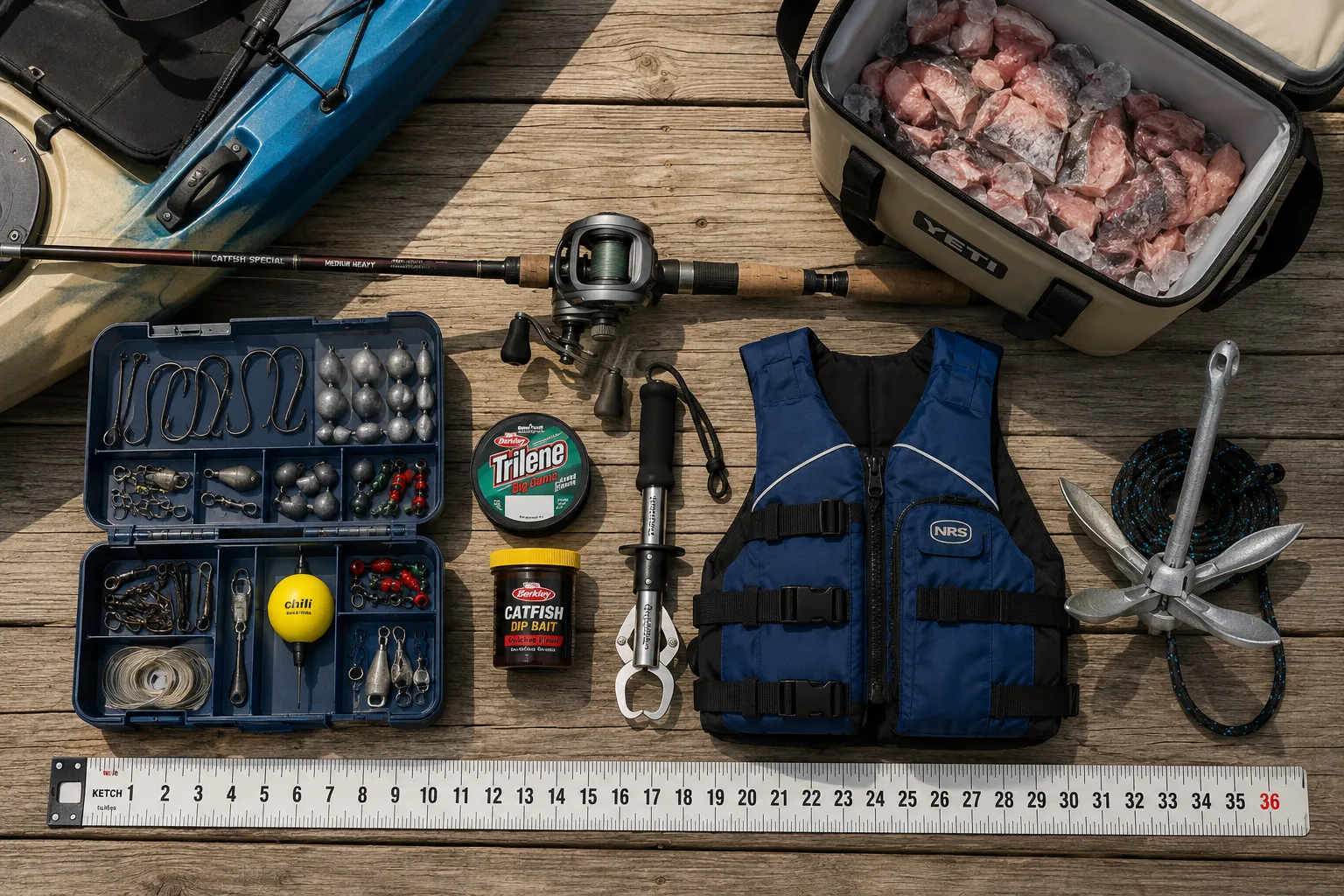
Starting kayak catfishing requires five essential categories: a stable fishing kayak, catfish-specific rods and reels, terminal tackle, an anchoring system, and safety equipment. The total investment typically ranges from $800-1,500 for a functional beginner setup.
Core gear checklist:
- Kayak: Sit-on-top model, 10-12 feet long, 32+ inches wide, with rod holders
- Paddle: 230-250cm length for most anglers
- Rod and reel: 7-foot medium-heavy rod with baitcasting or spinning reel
- Line: 20-30 lb braided main line with 20-40 lb monofilament leader
- Terminal tackle: Circle hooks (3/0-8/0), egg sinkers (1-4 oz), barrel swivels
- Anchor system: 3-5 lb anchor with 50+ feet of rope and anchor trolley
- Safety gear: Coast Guard-approved PFD, whistle, knife, paddle float
- Fish handling: Long-handled net, fish gripper, measuring tape
- Storage: Waterproof dry bag for phone and keys
- Bait: Cooler for cut bait or containers for prepared baits
Choose a sit-on-top kayak if you’re fishing in warm weather, want easy re-entry after a capsize, and need quick access to gear. The open deck design makes landing fish and managing multiple rods much easier than sit-inside models.
Common mistake: Buying a narrow touring kayak because it paddles faster. Speed doesn’t matter when you’re anchored and fishing. Stability is everything when a 20-pound catfish makes its first run.

UV-Protected HDPE Construction for Durability: Built with high-density polyethylene (HDPE) plastic, this kayak is both lightweight and highly durable, offering long-lasting protection against UV rays for years of use in various conditions. Paddle included.

Powerful & Responsive Propeller Drive System: Take control with our smooth kayak propeller drive system, offering hands-free power, quiet acceleration, and easy reverse maneuvering. Perfect for tight spaces, docks, or mangrove fishing

Ergolounge seating system : Extra-thick cushioning and an extra high and wide padded backrest.
Best Kayak for Catfish Fishing Under $1000
The best kayaks for catfishing under $1,000 prioritize width (32+ inches), weight capacity (350+ pounds), and built-in rod holders, with sit-on-top designs dominating this category. Models like the Perception Pescador Pro 12.0, Vibe Sea Ghost 110, and Old Town Topwater 106 offer the stability and features catfish anglers need.
Key features to prioritize:
- Width: 32-34 inches minimum for fighting large fish
- Hull design: Flat or pontoon-style for maximum stability at rest
- Weight capacity: 350-400 pounds to handle angler, gear, and fish
- Rod holders: At least two flush-mount or adjustable holders
- Seat quality: Adjustable, comfortable for 3-4 hour sessions
- Deck space: Room for tackle box, cooler, and landing net
- Anchor trolley compatibility: Pre-drilled or easy to install
Top budget-friendly options (2026 prices):
| Kayak Model | Width | Capacity | Price Range | Best For |
|---|---|---|---|---|
| Perception Pescador Pro 12.0 | 33.5″ | 375 lbs | $800-900 | All-around catfishing |
| Vibe Sea Ghost 110 | 33″ | 425 lbs | $900-1,000 | Heavier anglers, big fish |
| Old Town Topwater 106 | 34″ | 325 lbs | $750-850 | Ponds and slow rivers |
| Lifetime Tamarack Angler 100 | 31″ | 275 lbs | $400-500 | Tight budgets, small waters |
Choose a wider kayak (33+ inches) if you plan to target catfish over 20 pounds or fish in current. The extra width sacrifices paddling speed but provides crucial stability when a fish makes a sudden run under the kayak.
Edge case: If you’re over 220 pounds or carry heavy gear, look for kayaks with 400+ pound capacity ratings. The listed capacity includes everything: your weight, gear, fish, and water that splashes into the hull.

AirPro ACES seat: Embodying easy Adjustability, luxurious Comfort, and fine-tuned Ergonomics. 360 swivel allows left and right continuous movement provides ease of entering and exiting the kayak and 360 degree access all the way around . Relax in the premium, breathable materials and dial in your position for paddling, pedaling, motoring, or making room for gear with the one-handed mechanical lever that adjusts the seat trim on the fly.

Quality Construction: Constructed of uv-protected high-density polyethylene. Multiple footrest positions for different size riders. Stable flat bottom
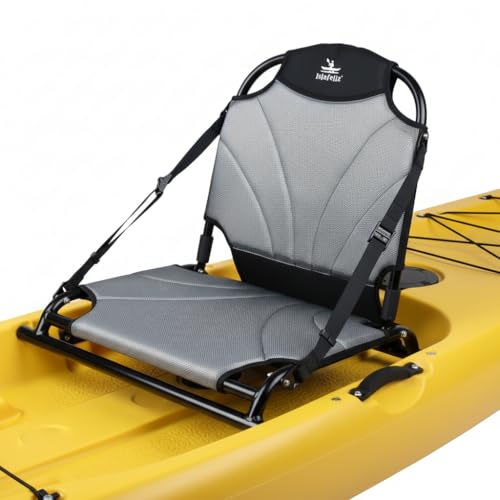
[CRITICAL FITMENT] MEASURE DECK WIDTH FIRST: STOP AND MEASURE: The base dimensions are 22.83'' (W) × 17.5'' (L). It is specifically engineered for wide Sit-On-Top kayaks and fishing boats with flat mounting decks or molded seat wells. Please verify your vessel has enough clearance before purchasing to ensure a perfect, hassle-free upgrade
How to Anchor a Kayak When Catfishing
Anchoring a kayak for catfishing requires an anchor trolley system that lets you adjust the anchor point from bow to stern, allowing you to position the kayak parallel to current or wind. Never tie an anchor directly to the side of a kayak, as this creates a capsizing hazard when current pushes against the broadside hull.
Anchor trolley installation basics:
- Mount pulleys: Install one pulley near the bow and one near the stern on the same side of the kayak
- Run the line: Thread paracord or anchor trolley rope through both pulleys, creating a loop
- Add a ring: Attach a carabiner or ring to the rope where you’ll clip your anchor line
- Position the ring: Pull the trolley line to slide the ring forward or back before anchoring
- Deploy anchor: Clip anchor line to the ring, lower anchor, and adjust kayak angle as needed
Anchor weight guidelines:
- Ponds and lakes: 3 lb folding anchor or mushroom anchor
- Slow to moderate current: 3-5 lb river anchor with flukes
- Strong current: 5-8 lb anchor, but consider if conditions are too dangerous
Proper anchoring technique:
- Position kayak where you want to fish before deploying anchor
- Lower anchor slowly to avoid tangles and noise
- Use 3:1 scope ratio (if water is 10 feet deep, let out 30 feet of rope)
- Adjust trolley to angle kayak bow-into-current for stability
- Keep anchor rope accessible but secured when not in use
Common mistake: Anchoring from the side cleat or handle. When current hits the side of your kayak, it can flip you in seconds. Always use a trolley system that lets you anchor from bow or stern.
Safety rule: If wind or current is strong enough that you struggle to hold position while deploying the anchor, conditions are too rough for safe kayak catfishing. Pack up and return another day.
Kayak Catfishing vs Bank Fishing: Which Is Better
Kayak catfishing offers superior access to structure, holes, and current breaks that bank anglers can’t reach, while bank fishing provides more stability, the ability to fish multiple rods, and no capsizing risk. Kayaks excel in pressured waters where fish have moved away from accessible shorelines.
Kayak catfishing advantages:
- Access to mid-river structure, ledges, and deep holes
- Ability to position directly over fish-holding areas
- Reach spots with no bank access or private shoreline
- Mobility to relocate quickly when fish aren’t biting
- Less competition from other anglers
- Stealth approach to spooky fish in clear water
- Better angles for fishing under overhanging cover
Bank fishing advantages:
- Fish multiple rods legally (where regulations allow)
- No risk of capsizing or swimming with gear
- Easier to handle very large catfish (50+ pounds)
- Can bring more gear, bigger coolers, and chairs
- Better for all-night fishing sessions
- Safer in bad weather or strong current
- No paddling fatigue
- Lower cost barrier to entry
Choose kayak catfishing if you fish pressured public waters where bank spots are crowded, you’re targeting specific structure you can see on maps or electronics, or you want to explore new water efficiently.
Choose bank fishing if you’re targeting trophy catfish over 40 pounds, you want to run multiple rods with different baits, you’re fishing overnight, or you’re introducing beginners to catfishing.
Edge case: Some anglers use a hybrid approach, launching a kayak to reach a prime bank spot on the opposite shore or an island, then fishing from the bank after landing. This combines the access advantage of kayaks with the stability of bank fishing.
What Rod and Reel Setup for Catfish From a Kayak
The ideal catfish rod for kayak fishing is a 7 to 7.5-foot medium-heavy power rod with moderate-fast action, paired with a baitcasting or spinning reel that holds 150+ yards of 20-30 lb braided line. Shorter rods (under 7 feet) work better in kayaks than longer bank fishing rods because they’re easier to manage in the confined space and less likely to tangle with paddle or gear.
Rod specifications:
- Length: 7-7.5 feet (shorter than typical bank rods)
- Power: Medium-heavy to heavy
- Action: Moderate-fast (forgiving but strong backbone)
- Handle: Shorter handle than bank rods for easier storage
- Guides: Larger guides to accommodate braided line
Reel options:
Baitcasting reels (preferred by experienced anglers):
- Better drag systems for big fish
- More line capacity in compact size
- Greater casting accuracy to structure
- Requires practice to avoid backlashes
- Examples: Abu Garcia Ambassadeur C3, Shimano Curado
Spinning reels (better for beginners):
- Easier to cast with one hand
- Less prone to tangles
- Simpler drag adjustment
- Size 4000-6000 for catfish
- Examples: Penn Battle III, Shimano Nasci
Line setup:
- Main line: 20-30 lb braided line for sensitivity and strength
- Leader: 18-24 inches of 20-40 lb monofilament or fluorocarbon
- Connection: Uni-to-uni knot or barrel swivel between braid and leader
Why shorter rods matter in kayaks: A 7-foot rod extends about 3.5 feet beyond the kayak when positioned in a holder, making it manageable when paddling. An 8 or 9-foot bank rod creates constant tangles with your paddle and makes landing fish much harder in the confined space.
Choose a baitcasting setup if you have experience with baitcasters and want maximum control when fighting fish near structure. Choose spinning if you’re new to kayak fishing or want a more forgiving setup that’s easier to operate one-handed while maintaining kayak position.

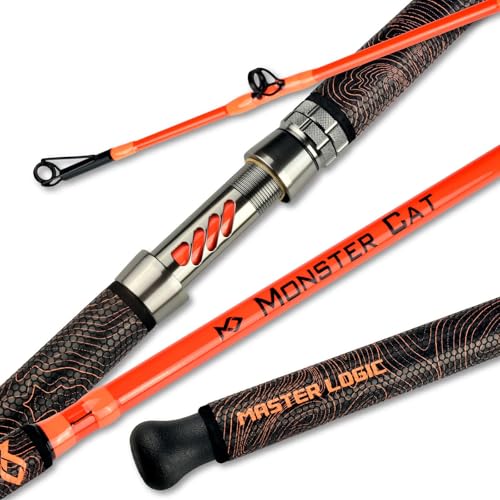
S-Glass & Carbon Composite Catfish Rod: This 7' medium-heavy catfish fishing rod uses an S-glass and carbon fiber blend for dependable strength, flexibility, and bite detection when targeting channel catfish, blue catfish, and flathead catfish.

Beauty & Performance Rod:The contrast between the black finish and the custom shark graphics skin decorative wrap and silver features that perfectly into the blue camouflage handles.Designed with an ergonomic camouflage handle that provides a comfortable grip, reducing fatigue during long fishing sessions
How Do You Land a Big Catfish From a Kayak Safely
Landing a big catfish from a kayak requires a long-handled net (48+ inches), proper body positioning that keeps your weight centered, and a technique that brings the fish alongside the kayak rather than over it. Never lean over the side to grab a fish, as this shifts your center of gravity and can capsize the kayak.
Safe landing sequence:
- Fight the fish from seated position: Keep your weight low and centered
- Tire the fish completely: Don’t rush; let the drag do the work
- Position fish alongside kayak: Guide fish parallel to hull, not at bow or stern
- Grab net with dominant hand: Keep paddle secured
- Lean away from fish: Shift weight to opposite side of kayak
- Net head-first: Scoop under fish in one smooth motion
- Lift net straight up: Don’t swing it over your lap
- Secure net: Place net across your lap or in front of you
Essential landing tools:
- Long-handled net: 48-60 inch handle, large hoop (24+ inches)
- Fish gripper: Boga Grip or similar for jaw control
- Needle-nose pliers: For hook removal while fish is in net
- Measuring tape: Attached to kayak deck for quick measurements
- Gloves: Protect hands from spines and rough handling
Body mechanics that prevent capsizing:
- Keep your butt planted in the seat at all times
- Lean away from the fish as you net it
- Use your core muscles, not your arms, to lift the net
- If the fish is too heavy to lift, leave it in the water and remove the hook there
- Never stand up to land a fish unless you’ve practiced extensively
Common mistake: Trying to lift a big catfish into your lap. A 20-pound catfish thrashing in your lap will throw you off balance instantly. Keep fish in the net, in front of you or to the side, until it’s calmed down.
Know your limits: Catfish over 30-40 pounds are extremely difficult to land safely from a kayak. If you hook a fish that’s clearly too large to handle safely, consider cutting the line rather than risking a capsize or injury.
How to Keep a Kayak Stable When Fighting a Catfish
Maintaining kayak stability while fighting a catfish requires keeping your center of gravity low, using your core muscles instead of leaning, and positioning the rod to keep pressure at an angle that doesn’t pull you sideways. The key is fighting the fish with your arms and rod while your lower body stays planted and centered in the seat.
Stability techniques during the fight:
- Stay seated: Never stand or raise up on your knees
- Plant your feet: Brace feet against foot pegs or inside hull
- Keep rod tip high: Absorb runs with rod bend, not body movement
- Use your core: Rotate from your waist, don’t lean from your shoulders
- Angle the rod: Point rod toward bow or stern, not directly to the side
- Let the drag work: Don’t horse the fish; let equipment do its job
Pre-fight preparation:
- Secure loose gear before casting (paddle, tackle box, cooler)
- Position yourself in the center of the seat
- Adjust foot pegs for solid bracing
- Clear deck space where you’ll land the fish
- Have net within easy reach but secured
When a fish runs under the kayak:
- Don’t panic or make sudden movements
- Keep rod tip high and let line slide under hull
- Use paddle (if needed) to rotate kayak and follow fish
- Let the fish tire itself against the drag
- Guide fish back to the side once it surfaces
Kayak features that improve stability:
- Wide beam: 32+ inches provides stable platform
- Flat hull: Better stability at rest than V-hull designs
- Low seat position: Closer to waterline = lower center of gravity
- Pontoon-style hulls: Maximum stability for fighting big fish
- Standing platforms: Some kayaks have textured standing areas (advanced)
Choose a pontoon-hull kayak if you regularly target catfish over 20 pounds or fish in current. These designs sacrifice speed but provide exceptional stability when a fish is pulling hard.
Practice drill: Before your first catfishing trip, practice fighting an imaginary fish while anchored in calm water. Simulate hard runs, sudden direction changes, and netting motions to build muscle memory for maintaining balance.
Is Kayak Catfishing Safe for Beginners
Kayak catfishing is safe for beginners who start in protected waters (ponds, small lakes, slow rivers), wear proper safety gear, and practice basic kayak skills before adding fishing complexity. The main risks are capsizing, getting pulled overboard by large fish, and anchor-related accidents, all of which are manageable with proper preparation.
Beginner-friendly conditions:
- Calm ponds or small lakes with no boat traffic
- Water temperature above 60°F (reduces cold-water shock risk)
- Depths of 4-12 feet (easier to anchor, safer if you capsize)
- Light wind (under 10 mph)
- Daylight hours only
- Fishing alone or with experienced kayak angler nearby
Essential safety practices:
- Always wear a PFD: Non-negotiable, even in shallow water
- Tell someone your plan: Location and expected return time
- Check weather: Avoid thunderstorms, high winds, temperature extremes
- Start small: Target smaller catfish (under 10 pounds) initially
- Practice capsizing: Know how to re-enter your kayak in controlled conditions
- Carry a whistle: Attached to PFD for signaling help
- Bring a phone: In waterproof case or dry bag
- Know your limits: If conditions feel uncomfortable, head to shore
Skills to practice before catfishing:
- Basic paddling and maneuvering
- Anchoring and retrieving anchor
- Casting from seated position
- Re-entering kayak after intentional capsize (in shallow water with help)
- Managing gear without tipping
Red flags that conditions are too dangerous:
- Whitecaps on the water
- Current strong enough to make paddling difficult
- Water temperature below 50°F
- Thunderstorms in forecast
- You feel uncomfortable or anxious
Choose a guided trip or lesson if you’ve never kayaked before. Many outfitters offer kayak fishing instruction that covers both paddling basics and fishing techniques in a supervised environment.
Common beginner mistake: Overloading the kayak with too much gear on the first trip. Start minimal: rod, small tackle box, anchor, safety gear. Add more equipment as you learn what you actually use.
Common Mistakes When Catfishing From a Kayak
The most common kayak catfishing mistakes include improper anchor placement that causes capsizing, using rods that are too long for the confined space, failing to secure gear before casting, and attempting to land fish that are too large to handle safely. These errors are easily avoided with proper planning and technique.
Top mistakes and solutions:
1. Anchoring from the side
- Problem: Creates capsizing hazard in current
- Solution: Always use an anchor trolley system
2. Using 8-9 foot bank fishing rods
- Problem: Too long for kayak space, tangles with paddle and gear
- Solution: Use 7-7.5 foot rods designed for kayak fishing
3. Not securing loose gear
- Problem: Tackle boxes, pliers, and other items slide overboard when you move
- Solution: Use rod leashes, gear tethers, and secure storage
4. Overloading the kayak
- Problem: Reduces stability and freeboard
- Solution: Bring only essential gear; leave the extra tackle at home
5. Setting the hook too hard
- Problem: Violent hookset can throw you off balance
- Solution: Use circle hooks that set themselves with steady pressure
6. Standing to cast or land fish (without practice)
- Problem: High risk of capsizing for inexperienced anglers
- Solution: Master seated techniques before attempting to stand
7. Fishing in current without proper positioning
- Problem: Kayak drifts into snags or dangerous areas
- Solution: Anchor upstream of target area, use trolley to adjust angle
8. Not checking drag before casting
- Problem: Drag too tight can pull you forward; too loose loses fish
- Solution: Set drag to 25-30% of line strength, test before each trip
9. Ignoring weather changes
- Problem: Sudden wind or storms create dangerous conditions
- Solution: Check forecast, watch sky, head in at first sign of trouble
10. Attempting to land trophy fish alone
- Problem: Fish over 40 pounds can pull you overboard or capsize kayak
- Solution: Know your limits; consider cutting line on fish that’s too large
Edge case: Some anglers make the mistake of fishing too far from shore in their first season. Stay within 100 yards of shore until you’re confident in your kayak handling skills and have practiced capsize recovery.
What Bait Works Best for Kayak Catfishing
Fresh cut bait, particularly shad, skipjack herring, and bluegill, works best for kayak catfishing because it produces strong scent trails in current and stays on the hook during casting and paddling. Prepared baits like chicken liver, dip baits, and stink baits also work well but require special containers to prevent mess in the confined kayak space.
Top kayak catfish baits ranked by effectiveness:
1. Cut shad or skipjack
- Most effective for channel, blue, and flathead catfish
- Cut into 2-3 inch chunks
- Keep on ice in small cooler
- Fresh is better than frozen
2. Live or cut bluegill
- Excellent for flathead catfish
- Use whole for big fish, cut for channels
- Check local regulations (some areas prohibit)
3. Chicken liver
- Readily available, inexpensive
- Works well for channel catfish
- Use treble hooks or liver holders to keep on hook
- Store in sealed containers to prevent spills
4. Prepared dip baits
- Convenient, no refrigeration needed
- Strong scent attracts catfish
- Use with dip bait tubes or sponges
- Less messy than liver in kayak
5. Nightcrawlers
- Good for smaller channel catfish
- Easy to store and use
- Thread multiple worms on hook
6. Hot dogs and other processed baits
- Work in a pinch, especially for smaller fish
- Very convenient for kayak fishing
- Not as effective as natural baits
Bait storage in kayaks:
- Small soft-sided cooler (6-12 can size) for cut bait
- Sealed plastic containers for liver or prepared baits
- Bait bucket with aerator for live bait (adds weight and complexity)
- Zip-lock bags inside cooler for organization
Rigging for kayak catfishing:
- Carolina rig: Egg sinker, bead, swivel, 18-inch leader, circle hook
- Slip sinker rig: Similar to Carolina but sinker slides on main line
- Three-way rig: For fishing in current, keeps bait off bottom
- Float rig: For fishing over snags or vegetation
Choose cut bait if you’re targeting larger catfish (over 5 pounds) and want maximum effectiveness. Choose prepared baits if convenience and cleanliness in the kayak are priorities and you’re okay with slightly lower catch rates.
Pro tip: Pre-cut bait at home and store in individual zip-lock bags. This eliminates the need to bring a cutting board and knife on the kayak, reducing mess and complexity.
Do You Need a Fish Finder for Kayak Catfishing
A fish finder is not required for kayak catfishing, especially for beginners fishing familiar waters, but it significantly improves efficiency by identifying depth changes, bottom structure, and fish-holding areas. Most successful kayak catfish anglers eventually add a fish finder once they’ve mastered basic techniques.
Benefits of fish finders for catfishing:
- Locate depth changes and ledges where catfish hold
- Identify submerged structure (logs, rock piles, humps)
- Read bottom composition (mud, sand, rock)
- Find channels and holes in rivers
- Confirm fish presence before anchoring
- Map productive areas for future trips
When you can skip the fish finder:
- Fishing small ponds where you can see structure
- Targeting visible features (docks, fallen trees, dam faces)
- Fishing familiar waters where you know productive spots
- Budget is tight and you’re just starting out
- Fishing shallow water (under 8 feet) where structure is obvious
Budget-friendly fish finder options for kayaks:
- Portable units: Garmin Striker 4, Humminbird PiranhaMAX (under $150)
- Castable sonar: Deeper PRO, iBobber (under $200, no installation)
- Basic depth finders: Simple flasher-style units (under $100)
Installation considerations:
- Transducer mounting (through-hull, scupper, or transom)
- Power source (rechargeable battery pack)
- Screen visibility in sunlight
- Waterproofing and protection from splashes
- Secure mounting that doesn’t interfere with paddling
Choose a fish finder if you fish large lakes or rivers with varied structure, you want to explore new water efficiently, or you’ve mastered basic kayak catfishing and want to increase your catch rate.
Skip the fish finder if you’re on a tight budget, you fish small waters with obvious structure, or you’re still learning basic kayak handling and fishing techniques. Add electronics after you’re comfortable with the fundamentals.
Edge case: Some anglers use smartphone apps with castable sonar devices as a middle ground. These cost less than traditional fish finders and require no permanent installation, making them ideal for anglers who fish multiple kayaks or want to try electronics before committing to a full installation.
Can You Kayak Catfish in Strong Current
Kayak catfishing in strong current is possible for experienced paddlers using proper anchoring techniques and positioning, but current that requires constant paddling effort to maintain position is too strong for safe fishing. The general rule is that if you can’t hold position with a properly sized anchor, the current is too dangerous for kayak catfishing.
Current assessment guidelines:
- Mild current (under 1 mph): Safe for beginners, easy to anchor
- Moderate current (1-2 mph): Manageable with experience and proper anchor
- Strong current (2-3 mph): Advanced anglers only, requires heavy anchor and perfect technique
- Very strong current (over 3 mph): Too dangerous for kayak catfishing
Techniques for fishing in current:
1. Anchor upstream of target area
- Position kayak 20-30 feet above where you want to fish
- Let current carry bait downstream to target zone
- Use anchor trolley to angle kayak bow-into-current
2. Use heavier weights
- Increase sinker weight to 3-6 ounces to hold bottom
- Bank sinkers or flat sinkers hold better than egg sinkers
- Add weight until bait stays in target zone
3. Choose current breaks
- Fish behind islands, points, or large rocks
- Target eddies where current slows or reverses
- Look for inside bends where current is slower
4. Adjust anchor weight
- Use 5-8 lb anchor in strong current
- Add chain to anchor line for better holding
- Consider grapnel-style anchors that dig into bottom
Safety considerations in current:
- Always wear PFD (even more critical in current)
- Stay close to shore or shallow water
- Have a plan for quick anchor retrieval if needed
- Never anchor in current over 3 mph
- Be aware of downstream hazards (dams, rapids, strainers)
When to avoid current fishing:
- You’re new to kayak fishing (under 10 trips)
- Current is strong enough to make paddling difficult
- Water is high and muddy (harder to see hazards)
- You’re alone (always fish with a partner in current)
- Downstream hazards exist within 1/4 mile
Choose slack water or mild current if you’re learning kayak catfishing. Master the basics in easy conditions before progressing to challenging current. Most productive catfish spots are in moderate current, not the strongest flows.
Where to Position Rod Holders on a Fishing Kayak for Catfish
Rod holders for catfish should be positioned behind the seat at angles between 45-90 degrees from vertical, allowing you to see rod tips for bite detection while keeping rods out of the way during paddling and landing fish. Most kayak catfish anglers use 2-3 rod holders: one on each side behind the seat and optionally one centered behind for a third rod.
Optimal rod holder placement:
Primary holders (2 required):
- Location: 12-18 inches behind seat, one on each side
- Angle: 60-75 degrees from vertical (pointing up and back)
- Height: Rod tips should be visible from seated position
- Type: Flush-mount or adjustable rocket launchers
Optional third holder:
- Location: Centered behind seat or on tank well
- Angle: 45-60 degrees
- Use: For fishing a third line or storing spare rod
Holder types for catfishing:
Flush-mount holders:
- Low profile, don’t interfere with paddling
- Fixed angle (choose angle carefully during installation)
- Most secure for fighting big fish
- Require drilling into kayak
Rocket launcher holders:
- Adjustable angles
- Easy to install on rails or tracks
- Can be repositioned as needed
- Less secure than flush-mounts for big fish
Scotty-style mounts:
- Versatile, can hold various accessories
- Easy to remove when not needed
- Work with Scotty rod holders and other accessories
- Popular for kayak fishing customization
Installation tips:
- Test position before drilling: Use tape or clamps to test holder placement
- Consider your reach: Make sure you can grab rods easily from seated position
- Check paddle clearance: Holders shouldn’t interfere with paddle stroke
- Plan for landing fish: Leave space in front of seat for netting
- Use backing plates: Reinforce mounting points to prevent cracking
Common mistake: Mounting rod holders too far forward where they interfere with paddling or too far back where you can’t reach them easily. The sweet spot is just behind your seat where you can grab a rod with a slight turn and reach.
Edge case: Some anglers mount one holder at the bow for trolling or fishing while drifting. This works but requires careful rod management to avoid tangles with the paddle.
What Size Catfish Is Too Big to Handle From a Kayak
Catfish over 40 pounds pose significant handling challenges from a kayak and require advanced skills, while fish over 60 pounds are generally too large for safe solo handling in most kayaks. The exact limit depends on kayak stability, angler experience, and water conditions, but most kayak anglers target catfish in the 5-30 pound range.
Size guidelines by experience level:
Beginners (first season):
- Target range: 2-10 pounds
- Maximum safe size: 15 pounds
- Focus on technique, not trophy fish
Intermediate (2-3 seasons):
- Target range: 5-20 pounds
- Maximum safe size: 30 pounds
- Can handle most channel catfish
Advanced (3+ seasons, practiced skills):
- Target range: 10-40 pounds
- Maximum safe size: 50 pounds
- Can target blue catfish and larger channels
Experienced (extensive practice, stable kayak):
- Target range: 20-50 pounds
- Maximum safe size: 60-70 pounds
- Trophy catfish hunting
Factors that affect safe handling size:
- Kayak width: Wider kayaks (34+ inches) handle larger fish better
- Hull design: Pontoon-style hulls provide more stability for big fish
- Water conditions: Calm water allows handling larger fish than windy conditions
- Angler size and strength: Larger anglers can handle bigger fish more safely
- Experience level: Practice makes a huge difference in safe handling limits
- Equipment quality: Better nets, grippers, and rods help with larger fish
Signs a fish is too large to handle safely:
- You can’t lift the net with fish in it
- The fish is longer than your kayak is wide
- Fighting the fish pulls you forward in the seat
- You feel unstable or off-balance during the fight
- The fish is making runs that move your anchored kayak
- You’re considering standing up to land it (don’t)
What to do if you hook a fish that’s too large:
- Fight the fish as long as safely possible
- If it becomes clear the fish is too big, tighten the drag
- Point the rod at the fish and let it break off
- Don’t risk capsizing or injury for a single fish
- Consider it a learning experience and a story
Choose lighter tackle if you’re consistently hooking fish that are too large to handle safely. Using lighter line (15-20 lb test instead of 30-40 lb) will break off on truly large fish while still landing fish in your target range.
Trophy catfish consideration: If you specifically want to target catfish over 40 pounds, consider fishing from a larger platform (canoe, jon boat, or bank) rather than a kayak. Some fish are better pursued with equipment that matches their size.
Conclusion
Kayak catfishing combines the mobility and access advantages of kayak fishing with the excitement of targeting one of North America’s most popular gamefish. Success requires choosing a stable platform (32+ inches wide), mastering proper anchoring techniques with a trolley system, using appropriately sized rods (7-7.5 feet), and learning safe fish-handling methods from a seated position.
Start in protected waters like ponds or slow rivers, target smaller catfish (under 15 pounds) while building skills, and always prioritize safety by wearing a PFD and fishing in appropriate conditions. Fresh cut bait, particularly shad or bluegill, produces the best results, though prepared baits offer convenience in the confined kayak space.
Your next steps:
- Choose your kayak: Prioritize width and stability over speed; budget $600-1,000 for a quality beginner setup
- Install an anchor trolley: This single modification dramatically improves safety and effectiveness
- Practice basic skills: Spend time paddling, anchoring, and casting before adding fishing complexity
- Start small: Target accessible waters and smaller fish while learning techniques
- Build gradually: Add electronics, upgrade gear, and pursue larger fish as your skills develop
- Connect with local anglers: Join kayak fishing groups or forums to learn productive local spots and techniques
The learning curve for kayak catfishing is manageable for anyone comfortable in a kayak, and the access to prime catfish habitat makes the effort worthwhile. Start with the basics, respect the water and the fish, and you’ll discover why kayak catfishing has become one of the fastest-growing segments of kayak fishing in 2026.
FAQ
How much does it cost to start kayak catfishing?
A complete beginner setup costs $800-1,500, including a basic fishing kayak ($600-900), paddle ($80-150), rod and reel ($100-200), tackle ($50-100), anchor system ($40-80), and safety gear ($100-150). You can start cheaper with used equipment or more expensive with premium gear.
Can you kayak fish for catfish alone or do you need a partner?
You can kayak catfish alone in calm, protected waters, but fishing with a partner is safer, especially when learning or fishing in current. Always tell someone your location and expected return time when fishing solo.
What’s the best time of day for kayak catfishing?
Early morning (dawn to 9 AM) and evening (two hours before sunset to dark) are most productive, though catfish feed throughout the day. Night fishing from a kayak is possible but requires additional safety equipment and experience.
Do you need a special license for kayak fishing?
You need a valid fishing license for the state where you’re fishing, but most states don’t require separate kayak registration for non-motorized kayaks under a certain length. Check your state’s specific regulations for both fishing and watercraft requirements.
How do you keep catfish fresh on a kayak?
Use a small cooler with ice, a fish basket or stringer secured to the kayak, or a mesh fish bag in the water. For catch-and-release, handle fish quickly, support their weight properly, and revive them in the water before release.
Can you use a trolling motor on a kayak for catfishing?
Yes, many kayaks can be fitted with small electric trolling motors, which help with positioning and reduce paddling fatigue. This adds cost ($200-600) and weight but improves mobility, especially in wind or current.
What’s the difference between pedal and paddle kayaks for catfishing?
Pedal kayaks let you move hands-free, making it easier to fish while repositioning, but they cost more ($1,500-3,000) and are heavier. Paddle kayaks are lighter, cheaper, and simpler but require putting down your rod to move.
How long does it take to learn kayak catfishing?
Most anglers become comfortable with basic kayak catfishing in 5-10 trips, assuming they have some kayaking or fishing experience. Mastering advanced techniques like fishing in current or landing large fish takes a full season or more.
What should you do if you capsize while catfishing?
Stay calm, stay with your kayak, and use it for flotation. If you’ve practiced re-entry, flip the kayak upright and climb back on. If not, swim the kayak to shore. This is why wearing a PFD is non-negotiable.
Can you kayak catfish in winter?
Yes, but cold-water kayaking requires specialized gear (wetsuit or drysuit) and knowledge of cold-water safety. Catfish are less active in cold water, making winter kayak catfishing less productive and more dangerous than warm-season fishing.
How far can you paddle a fishing kayak loaded with gear?
Most anglers comfortably paddle 1-3 miles round trip with fishing gear. Wider, more stable kayaks paddle slower than narrow touring kayaks, so plan for 2-3 mph average speed and factor in wind and current.
What’s the most important safety rule for kayak catfishing?
Always wear a Coast Guard-approved PFD. More kayak fishing fatalities result from drowning after capsizing without a PFD than any other cause. No fish is worth risking your life.