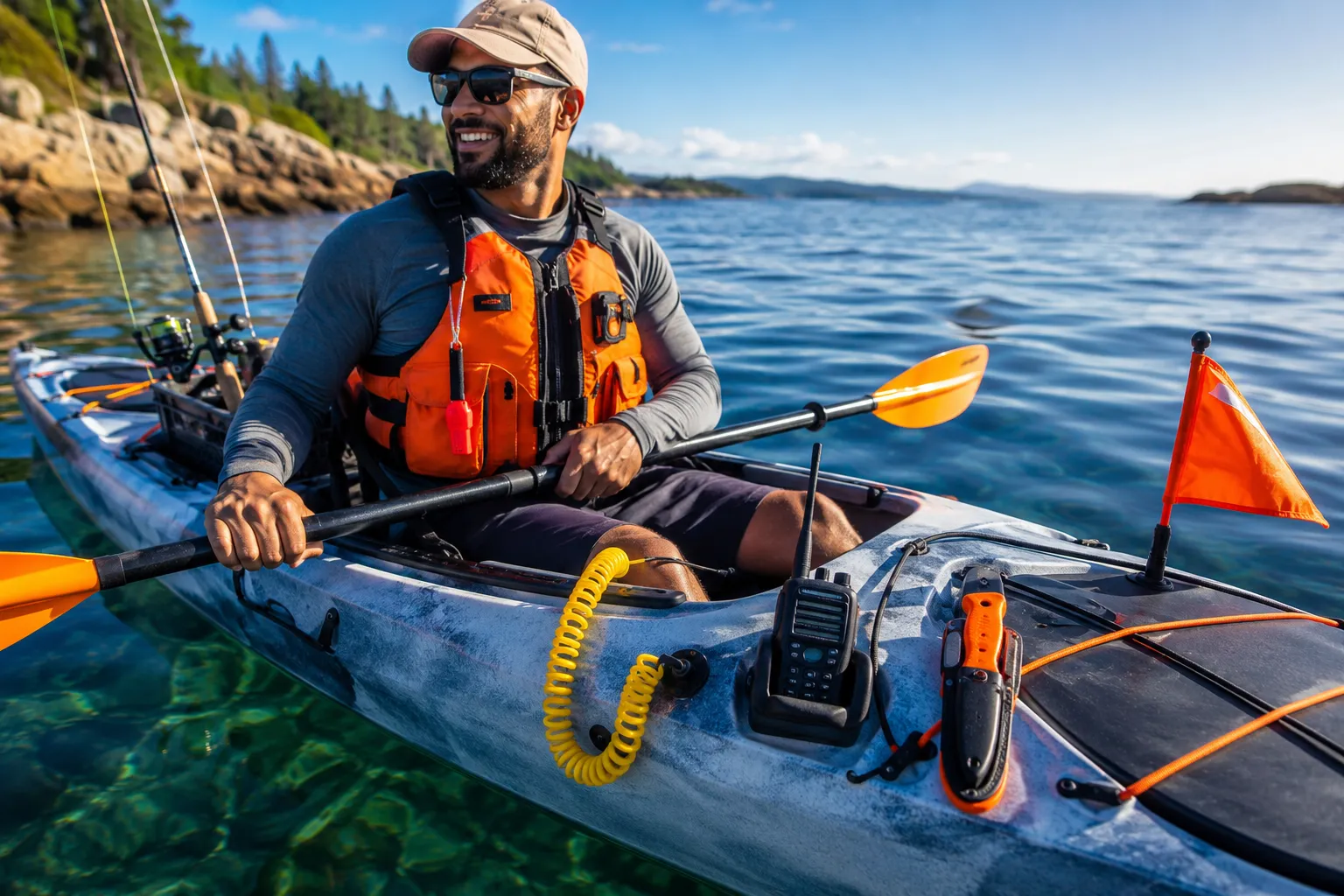
Quick Answer: Every kayak angler needs a USCG-approved personal flotation device (PFD), a sound-producing device like a whistle, a paddle leash, a cutting tool, and appropriate visual signals. Ocean and offshore anglers require additional equipment including VHF radios, flares, and enhanced flotation aids. These items aren’t just recommendations, many are legally required, and all can prevent a fishing trip from becoming a rescue situation.
Key Takeaways
- A USCG-approved PFD is legally required in all 50 states when kayak fishing, with specific Type requirements varying by location and distance from shore
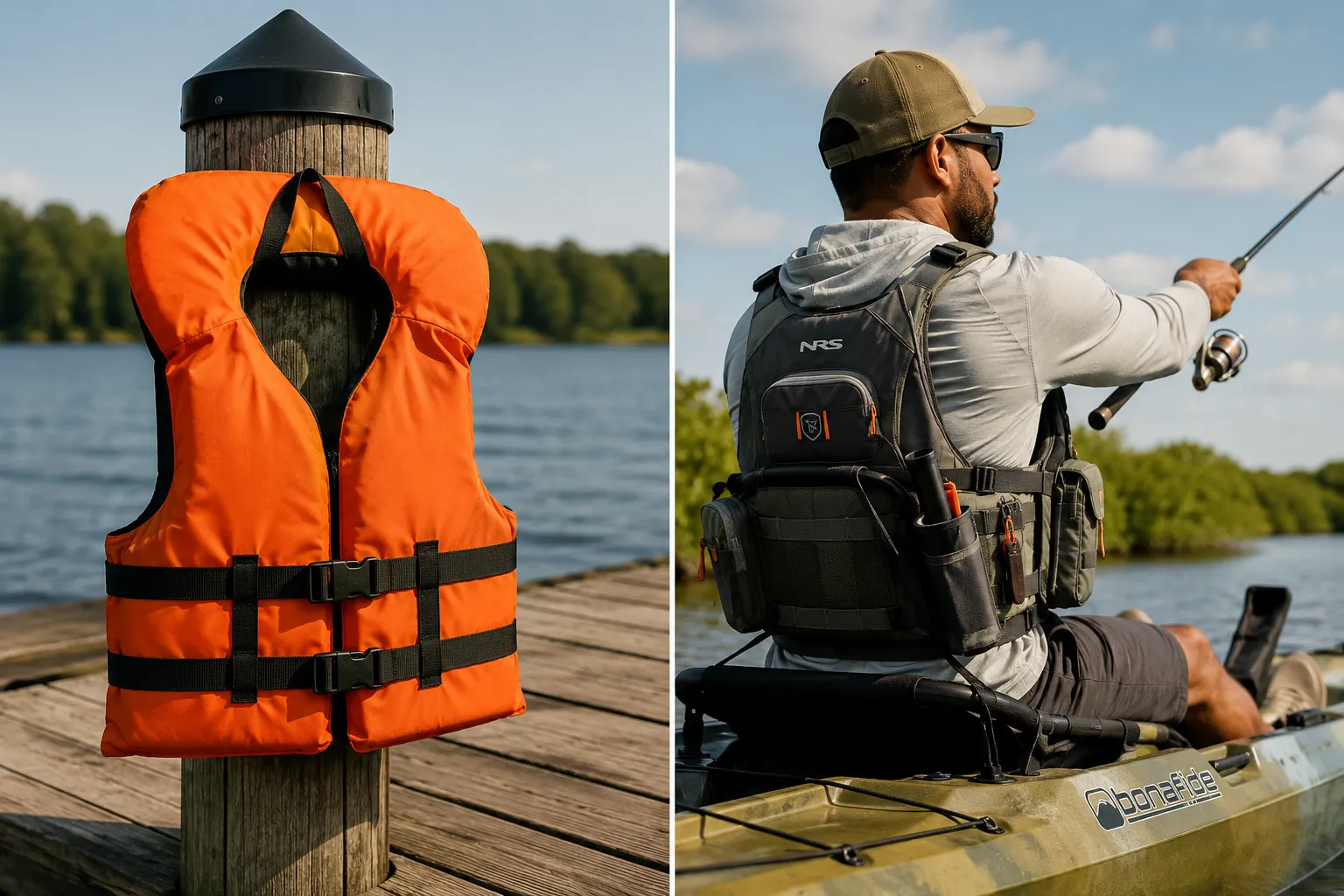
- Fishing-specific PFDs offer advantages over standard kayaking vests, including rod holders, tackle pockets, and designs that accommodate casting motions
- Basic safety gear costs $150-$300 for lake fishing, while ocean setups require $400-$600 in equipment
- Sound devices (whistle or horn) are mandatory in most states, and must be audible from specific distances depending on jurisdiction
- Paddle leashes prevent the most common kayak fishing emergency: losing your paddle while fighting a fish or taking photos
- Cutting tools are critical safety items, not just fishing tools, they can free you from anchor lines, fishing line entanglements, or vegetation in capsizing situations
- Ocean kayak fishing requires additional gear including VHF radios, visual distress signals, and often a bilge pump
- The biggest safety mistake kayak anglers make is treating safety equipment as optional once they feel comfortable on the water
Do I Need a Life Jacket for Kayak Fishing?
Yes, you need a life jacket (PFD) for kayak fishing, and it’s legally required in every U.S. state. Federal law mandates that all kayaks carry at least one USCG-approved personal flotation device for each person on board, and most states require you to wear it rather than just have it accessible.
The legal requirement exists because kayaks are classified as vessels under maritime law. Even if you’re an excellent swimmer, cold water, fishing gear entanglement, or an unexpected knock to the head during a capsize can make swimming impossible. A PFD keeps your head above water when you can’t.
State-specific requirements to know:
- Most states require children under 13 to wear a PFD at all times
- Many states require all kayakers to wear PFDs from November through April (cold-water months)
- Some states mandate PFD use when fishing alone or after dark
- Inflatable PFDs are legal for adults in most states but banned for children under 16
The fine for not having a proper PFD ranges from $25 to $500 depending on your state, but the real cost is the risk. According to U.S. Coast Guard data, 85% of drowning victims in recreational boating accidents were not wearing life jackets.
Choose a PFD that you’ll actually wear. If it’s uncomfortable or restricts your casting motion, you’ll be tempted to take it off once you’re on the water, defeating the entire purpose.
What Safety Gear Is Required by Law for Kayak Fishing?
Legal requirements for kayak fishing safety gear vary by state and water type, but federal baseline requirements apply everywhere. At minimum, you must have a USCG-approved PFD for each person, a sound-producing device, and navigation lights if paddling between sunset and sunrise.
Federal requirements (apply in all states):
- One USCG-approved Type I, II, III, or V PFD per person (must be appropriate size and in serviceable condition)
- One sound-producing device (whistle, horn, or bell) audible for at least half a mile
- Navigation lights (white light visible 360 degrees) when operating between sunset and sunrise or in restricted visibility
Common state additions:
- Visual distress signals for coastal waters beyond certain distances from shore (typically 2 miles)
- Throwable flotation device (Type IV) for kayaks over 16 feet
- Fire extinguisher for kayaks with enclosed fuel tanks (rare in fishing kayaks but applies to some motorized models)
- Registration numbers and decals displayed on the hull
Ocean and offshore requirements get stricter. If you’re fishing beyond the surf zone or more than 2 miles from shore, most coastal states require:
- VHF marine radio or other two-way communication device
- Visual distress signals (flares, signal mirror, or orange flag)
- Anchor and line appropriate for water depth
- Compass or GPS navigation device
Check your state’s boating regulations before your first trip. The National Association of State Boating Law Administrators maintains a database of state-specific requirements, and most state wildlife agencies publish kayak-specific guides.
A common mistake: Assuming that because kayaks don’t require registration in your state, safety equipment rules don’t apply. Registration and safety equipment are separate requirements, even unregistered kayaks must carry mandatory safety gear.
Best PFD for Kayak Fishing vs Regular Kayaking
Fishing-specific PFDs differ from standard kayaking life jackets in pocket configuration, range of motion, and compatibility with fishing gear. A fishing PFD typically features a higher back panel that won’t interfere with kayak seats, front-loading pockets for tackle, and rod holder attachments.
Key differences that matter:
| Feature | Fishing PFD | Standard Kayaking PFD |
|---|---|---|
| Shoulder cut | Wide, allows overhead casting | Snug, optimized for paddle strokes |
| Pocket placement | Front-loaded, tackle-accessible | Side or back, paddle-clearance focused |
| Back panel | High-cut, clears seat back | Full coverage, more flotation |
| Rod holder | Often included or attachable | Rarely available |
| Price range | $80-$200 | $50-$150 |
Choose a fishing PFD if:
- You frequently cast while seated (the shoulder cut makes a huge difference)
- You need quick access to pliers, line cutters, or other tools
- You use a high-back kayak seat (standard PFDs bunch up uncomfortably)
- You want to attach a rod holder for hands-free paddling
Stick with a standard kayaking PFD if:
- You paddle long distances between fishing spots (better ergonomics for sustained paddling)
- You fish primarily from an anchored position (less casting motion)
- You prefer minimalist gear without extra pockets and attachments
Inflatable PFDs are popular among kayak anglers because they’re less bulky and don’t restrict movement, but they come with tradeoffs. They require manual or automatic activation, need regular maintenance, and cost $150-$300. They’re excellent for experienced anglers in warm water but not ideal for beginners or cold-water fishing where immediate flotation is critical.
The best PFD is the one you’ll wear all day. Try before you buy if possible, and test casting motions in the store, what feels fine standing up may bind your shoulders when seated in a kayak.

Crafted with a premium ripstop polyester shell and replaceable EPE foam inside for superior buoyancy. Inside zipper opening for convenient to take out the floating foam to be a super thin and breathable vest.

US COAST GUARD APPROVED PFD: US Coast Guard Approved Type V Personal Flotation Device with Type III performance designed for stand-up paddlers, anglers, and boaters.

Breathable Fishing Life Jacket | Type III PFD built with better breathability for kayak fishing in the heat of the day.
How Much Does Kayak Fishing Safety Gear Cost?
A complete kayak fishing safety kit costs between $150 and $600 depending on where you fish and how much you already own. Lake and river anglers can meet legal requirements and stay safe for $150-$250, while ocean fishing demands $400-$600 in specialized equipment.
Budget breakdown for lake/river fishing:
- USCG-approved fishing PFD: $80-$120
- Whistle (Fox 40 or similar): $5-$10
- Paddle leash: $15-$25
- Rescue knife with line cutter: $20-$40
- Basic first aid kit: $15-$30
- Dry bag for phone/keys: $15-$25
- Total: $150-$250
Ocean/coastal fishing adds:
- VHF marine radio (handheld): $80-$150
- Visual distress signals (flares or flag): $30-$50
- Bilge pump or bailer: $15-$30
- Paddle float: $20-$35
- Signal mirror: $8-$15
- Upgraded PFD (often inflatable): $150-$250
- Additional cost: $250-$400
Ways to reduce costs without compromising safety:
- Buy last season’s PFD models (safety certifications don’t expire, but colors and styles change annually, retailers discount old stock by 30-50%)
- Make your own paddle leash using 1/4-inch bungee cord and carabiners ($5 in materials)
- Use a cut-down bleach bottle as a bailer instead of buying a bilge pump
- Start with required items only, then add nice-to-have gear as budget allows
Don’t cheap out on: Your PFD and cutting tool. These are the two items most likely to save your life, and quality matters. A $40 PFD that’s uncomfortable will end up in your hatch instead of on your body. A $10 knife that rusts shut won’t cut through anchor line in an emergency.
One-time costs vs ongoing: Most safety gear lasts years with basic care. PFDs should be replaced every 5-7 years or after significant sun exposure causes fabric deterioration. Flares expire (typically 42 months from manufacture), and VHF radio batteries need replacement, but most items are buy-once equipment.


Crafted with a premium ripstop polyester shell and replaceable EPE foam inside for superior buoyancy. Inside zipper opening for convenient to take out the floating foam to be a super thin and breathable vest.
What Whistle or Sound Device Do I Need on a Fishing Kayak?
You need a sound-producing device capable of producing a blast audible for at least half a mile, which federal law requires on all kayaks. A simple pealess whistle (like the Fox 40) meets this requirement, costs under $10, and should be attached to your PFD where you can reach it with one hand.
Why pealess whistles are standard: Traditional whistles with peas (the small ball inside) can freeze in cold weather or fail when wet. Pealess whistles work in any condition and produce 120+ decibels, loud enough to signal distress over wind and wave noise.
Attachment matters as much as the whistle itself. Use a coiled lanyard or retractable gear tether clipped to your PFD’s front D-ring. If the whistle is in your pocket or tackle bag, it’s useless in an emergency. You need one-handed access while potentially treading water.
Sound signal rules to know:
- One long blast: Warning signal (you’re approaching or being approached)
- Three short blasts: Distress signal (you need help)
- Five or more short blasts: Danger signal (collision risk)
Air horns are legal alternatives and produce louder signals (up to 150 decibels), but they’re bulkier and can fail if the canister gets wet or cold. They’re worth carrying for ocean fishing where you need to signal larger vessels, but keep a whistle as backup.
Common mistake: Relying on your voice to signal for help. Even a loud shout carries only 100-200 yards over water, and you’ll lose your voice quickly. A whistle can be blown repeatedly for hours without fatigue.

SUPER LOUD survival whistle: double tubes emergency whistle, high pitched powerful noise maker with dual sound chambers, can provide up to 120 decibel dB sound power, enough to be heard over a mile away. Cannot be overblown, works great as signal whistle.

WHISTLE WITH LANYARD FOR EASY CARRY – Lightweight with a slim, flat profile for comfortable wear. Soft lanyard allows hands-free carry on the trail, on the water, while walking alone, traveling, or during daily activities. Compact for backpacks or emergency kits — always within reach when needed.

WHISTLE WITH LANYARD FOR EASY CARRY – Lightweight with a slim, flat profile for comfortable wear. Soft lanyard allows hands-free carry on the trail, on the water, while walking alone, traveling, or during daily activities. Compact for backpacks, pockets, or emergency kits — always within reach when needed.
Do I Need a Leash for My Paddle When Kayak Fishing?
Yes, you need a paddle leash when kayak fishing, and it prevents the most common kayak fishing emergency: losing your paddle. When you’re fighting a fish, taking photos, or reaching for gear, your paddle can easily slip overboard and drift away faster than you can retrieve it, leaving you stranded.
A paddle leash is a coiled or straight tether that connects your paddle to your kayak, typically using carabiner clips on both ends. It costs $15-$25 and takes 30 seconds to install. The coiled design stays out of your way while paddling but extends when you set the paddle down.
Installation tips:
- Attach the kayak end to a deck rigging point near your seat (not the bow or stern, you want it within reach)
- Attach the paddle end to the shaft between your hands, not at the blade (better balance)
- Leave enough slack to paddle normally but not so much that the leash drags in the water
- Use stainless steel carabiners, not plastic clips (they corrode less and won’t break under load)
When to detach your paddle leash: In whitewater or surf conditions where a trapped paddle could flip your kayak or prevent you from swimming clear after a capsize. For calm lake and bay fishing, keep it attached. For ocean fishing beyond the surf zone, keep it attached. For launching through breaking waves, detach until you’re past the surf.
DIY option: Make a paddle leash using 6 feet of 1/4-inch bungee cord, two carabiners, and two cord locks. Thread the bungee through the cord locks to create adjustable loops at each end, attach carabiners, and you have a functional leash for under $5.
Paddle leashes also prevent theft. If you beach your kayak to fish from shore or use a restroom, a tethered paddle is much less likely to walk away than one lying on the ground.
Do I Need a Knife or Cutting Tool for Kayak Fishing Safety?
You absolutely need a cutting tool when kayak fishing, and it’s a safety device first and a fishing tool second. A rescue knife or line cutter can free you from anchor line entanglements, cut through fishing line wrapped around your paddle or rudder, or slice through vegetation in a capsizing situation.
Essential features for a kayak fishing knife:
- Serrated or partially serrated blade (cuts rope and line faster than straight edges)
- Blunt or rounded tip (prevents puncturing your kayak or PFD)
- Corrosion-resistant steel (stainless or titanium, freshwater rusts standard steel in weeks)
- Sheath with positive retention (friction fit or snap closure, you can’t have it falling out)
- Attachment point (lanyard hole for tethering to your PFD)
Where to carry it: On your PFD, not in your kayak. In an emergency, you may be separated from your kayak but you’ll be wearing your PFD. Mount the sheath on a chest strap or shoulder strap where you can reach it with either hand. Some fishing PFDs have dedicated knife pockets.
Specialized options worth considering:
- Line cutters (small notched blades designed specifically for fishing line, compact and effective)
- Trauma shears (EMT-style scissors that cut through rope, line, and clothing, safer than knives in some situations)
- Combination tools (knife with integrated line cutter, whistle, and sometimes a small marlin spike)
Real-world scenarios where you’ll need it:
- Your anchor line wraps around your leg during a capsize
- Fishing line tangles around your paddle shaft mid-stroke
- You hook yourself and need to cut the line to deal with the hook
- Vegetation wraps around your rudder or skeg in current
- You need to quickly cut away gear to reduce weight in a swamping situation
Price range: Decent kayak fishing knives cost $20-$60. Brands like NRS, Gerber, and Benchmade make models specifically for paddlers. Avoid cheap knives with carbon steel blades, they rust almost immediately in saltwater.
Maintenance: Rinse with fresh water after every saltwater trip, dry thoroughly, and apply a light coat of oil to the blade every few months. Check the sheath retention regularly, a knife that falls out during a capsize is worse than no knife at all.
Common Mistakes Kayak Anglers Make With Safety Equipment
The most common safety mistake kayak anglers make is treating safety gear as optional once they feel comfortable on the water. Experienced anglers often leave their PFD in the hatch, don’t attach their paddle leash, or skip the whistle because “nothing has ever happened before.” Statistically, most kayak fishing accidents happen to people with years of experience who got complacent.
Other frequent mistakes:
Buying a PFD but never wearing it. If your PFD is uncomfortable, too hot, or restricts your casting, you won’t wear it consistently. The solution isn’t to skip the PFD, it’s to buy a better one. Spend the extra $40 for a fishing-specific model that you’ll actually keep on all day.
Storing safety gear where you can’t reach it. Your whistle in a dry hatch, your knife in your tackle bag, and your paddle leash in your garage don’t help in an emergency. Safety equipment must be on your body (PFD, whistle, knife) or attached to your kayak (paddle leash, bilge pump) where you can access it in seconds.
Using expired or untested equipment. Flares expire, PFD foam degrades, and inflatable PFDs develop slow leaks. Test your gear at the start of each season. Inflate your inflatable PFD and leave it overnight to check for leaks. Make sure your whistle isn’t clogged. Verify your VHF radio holds a charge.
Assuming calm conditions will stay calm. Weather changes fast on the water, especially in coastal areas. Afternoon thunderstorms, sudden wind shifts, and fog banks can turn a pleasant morning into a dangerous situation in 20 minutes. Carry safety gear for the worst conditions you might encounter, not the conditions at launch.
Overloading the kayak and compromising stability. Adding too much fishing gear, a large cooler, and multiple rod holders can raise your center of gravity and reduce stability. If you capsize because your kayak is top-heavy, even the best safety gear can only mitigate the consequences, better to prevent the capsize by keeping weight low and centered.
Not practicing self-rescue. Owning a paddle float and bilge pump doesn’t help if you’ve never practiced using them. Spend 30 minutes in shallow, warm water practicing capsizing and re-entry. You’ll learn what works, what doesn’t, and what gear you actually need versus what sounded good in the store.
Fishing alone without telling anyone. Even with perfect safety gear, you need someone to know where you are and when to expect you back. Leave a float plan with a friend or family member: where you’re launching, where you plan to fish, and when you’ll be off the water. If you don’t check in, they know to call for help.
Ignoring the 120 rule in cold water. The 120 rule states that if the air temperature plus water temperature is less than 120°F, you’re at risk of cold water shock and hypothermia. In these conditions, a standard PFD isn’t enough, you need a wetsuit or drysuit. Many kayak fishing fatalities happen in spring and fall when anglers dress for the air temperature and end up in 50°F water.
Is a Bilge Pump Necessary for Kayak Fishing?
A bilge pump is necessary for ocean kayak fishing and highly recommended for any fishing beyond protected waters. Sit-on-top kayaks are self-bailing and rarely need pumps, but sit-inside kayaks can take on water from waves, rain, or splashing fish, and a swamped cockpit makes the kayak unstable and nearly impossible to paddle.
When you absolutely need a bilge pump:
- Sit-inside kayak fishing in any conditions
- Ocean or coastal fishing where waves can splash into the cockpit
- Fishing in cold water where a capsize and re-entry will flood the cockpit
- Multi-hour trips where rain or spray accumulation becomes a problem
Types of bilge pumps:
- Hand pumps ($15-$40): Manual pumps that move 5-10 gallons per minute, reliable, no batteries, require two hands to operate
- Electric pumps ($50-$150): Battery-powered, automatic or switch-activated, faster but can fail when wet or if batteries die
- Sponges and bailers ($5-$15): Low-tech backup, slow but effective for small amounts of water
For sit-on-top kayaks, a bilge pump is less critical because water drains through scupper holes. However, a large sponge or small bailer is still useful for clearing water from the footwell and seat area, which improves comfort and reduces weight.
Installation tip: Store your hand pump where you can reach it while seated, either under a bungee on the deck or in a cockpit-accessible hatch. If you have to dig through a rear hatch to find your pump while your cockpit is filling with water, it’s not going to help.
Practice using your pump before you need it. Hand pumps have a learning curve, you need to hold the intake underwater while pumping, which is awkward in a rocking kayak. Practice in calm conditions so you’re not figuring it out in rough water.
What Safety Gear Do I Need for Ocean Kayak Fishing vs Lakes?
Ocean kayak fishing requires significantly more safety equipment than lake fishing because of greater distances from shore, larger waves, stronger currents, and the presence of boat traffic. At minimum, ocean anglers need everything required for lake fishing plus a VHF radio, visual distress signals, a more robust PFD (often inflatable), and enhanced flotation/rescue gear.
Ocean-specific additions to your safety kit:
VHF marine radio (handheld, waterproof): Essential for calling the Coast Guard (Channel 16) or communicating with other boaters. Cell phones often don’t work beyond 1-2 miles from shore, and even when they do, you can’t broadcast a distress call to all nearby vessels. Cost: $80-$150.
Visual distress signals: Required by law in most states when fishing beyond 2 miles from shore. Options include:
- Three handheld flares or aerial flares (expire after 42 months)
- Orange distress flag (3×3 feet minimum)
- Signal mirror (effective in daylight up to 10 miles)
- Electronic distress light (LED strobe visible for miles at night)
Bilge pump or large bailer: Ocean waves will splash into your kayak. You need a way to remove water quickly, especially if you’re in a sit-inside kayak.
Paddle float: An inflatable sleeve that fits over your paddle blade, creating an outrigger to stabilize your kayak during re-entry after a capsize. Critical for deep-water self-rescue. Cost: $20-$35.
Anchor system with float: Ocean currents and wind can push you offshore quickly. A proper anchor (3-5 pounds) with 100+ feet of line and a float ball lets you hold position and, if necessary, release the anchor to escape a dangerous situation without losing your gear.
Compass or GPS: Fog, haze, and disorientation are real risks when you’re 3+ miles from shore with no landmarks. A deck-mounted compass ($20-$40) or handheld GPS ($100-$300) can guide you back.
Enhanced PFD: Many ocean kayak anglers use inflatable PFDs with 25+ pounds of flotation (more than standard Type III vests) and integrated harnesses for towing. Some include built-in hydration bladders for long trips.
Comparison table:
| Safety Item | Lake/River | Ocean/Coastal |
|---|---|---|
| USCG PFD | Required | Required (often upgraded) |
| Whistle | Required | Required |
| Paddle leash | Recommended | Essential |
| Cutting tool | Recommended | Essential |
| VHF radio | Optional | Essential |
| Visual signals | Not required | Required beyond 2 miles |
| Bilge pump | Sit-inside only | All kayaks |
| Paddle float | Optional | Recommended |
| GPS/compass | Optional | Recommended |
| First aid kit | Basic | Enhanced (hypothermia gear) |
Who should avoid ocean kayak fishing: Beginners, anyone uncomfortable with self-rescue techniques, anglers without proper safety gear, and anyone fishing alone without experience. Ocean conditions can deteriorate rapidly, and help is much farther away than on lakes.
Start inshore and work out. Don’t jump straight to offshore fishing. Build experience in protected bays and inside the surf zone before venturing into open ocean. Each mile from shore exponentially increases risk and required skill level.
How to Attach Safety Gear to a Kayak Without Losing Storage Space
Attaching safety gear to your kayak without sacrificing storage space requires strategic use of existing rigging points, PFD attachment systems, and vertical storage solutions. The goal is to keep safety equipment accessible while preserving hatch space and deck area for fishing gear.
PFD-mounted gear (keeps it on your body, not your kayak):
- Whistle on coiled lanyard clipped to chest D-ring
- Rescue knife in sheath on shoulder strap
- Small signal mirror in PFD pocket
- VHF radio in chest holster or waterproof pocket
- Line cutters on retractable tether
Deck rigging solutions:
- Paddle leash: Attach to a rigging point near your seat, not to deck bungees (which need to stay clear for other gear)
- Bilge pump: Slide under existing deck bungees parallel to the kayak’s centerline, or use a dedicated pump holder that mounts to deck rigging
- Paddle float: Deflated, it fits under deck bungees or in a mesh deck bag
- Throw bag: Compact rescue throw bags (25-50 feet of floating rope) fit in mesh deck bags or under bungees
Vertical storage (uses height, not deck space):
- Mount a VHF radio in a RAM mount or similar holder on your console or beside your seat
- Use a rod holder as a storage tube for flares (in a waterproof case)
- Attach a small dry bag to your seat back for first aid kit and emergency supplies
Hatch organization:
- Keep safety gear in a brightly colored dry bag so it’s instantly identifiable (red or orange)
- Store backup/seasonal safety gear (extra flares, cold-water gear) in hatches
- Never bury safety equipment under fishing gear, it should be the first thing you can grab
Gear that should NOT go in hatches:
- Your PFD (wear it)
- Whistle (on your PFD)
- Knife (on your PFD)
- Paddle leash (attached to kayak deck and paddle)
Gear that can go in hatches:
- Backup paddle (if you have one)
- Extra flares
- First aid kit (if you have a PFD-mounted mini kit)
- Paddle float (if you have deck space issues)
Multi-function gear saves space. A knife with an integrated whistle and line cutter replaces three separate items. A VHF radio with built-in GPS replaces two devices. A PFD with multiple pockets eliminates the need for a separate deck bag.
Test your setup before you need it. Can you reach your whistle with one hand while seated? Can you access your knife with either hand? Can you grab your bilge pump without removing other gear? If the answer to any of these is no, reorganize.
What Happens If I Capsize While Kayak Fishing Without Proper Gear?
Capsizing without proper safety gear can quickly escalate from an inconvenience to a life-threatening emergency. Without a PFD, you’re immediately fighting to stay afloat while dealing with shock, cold water, and potentially tangled fishing gear. Without a paddle leash, your paddle drifts away, leaving you unable to propel your kayak even if you manage to re-enter it.
Immediate consequences of capsizing without gear:
No PFD: You must tread water while trying to right and re-enter your kayak, which is exhausting even in calm conditions. In cold water (below 60°F), you have 10-15 minutes before losing dexterity in your hands, making re-entry nearly impossible. In rough water, you may not be able to keep your head above the surface while dealing with waves and gear.
No paddle leash: Your paddle floats away faster than you can swim while holding your kayak. Without a paddle, you can’t propel yourself to shore even if you successfully re-enter your kayak. You’re now drifting at the mercy of wind and current, potentially moving farther from shore.
No cutting tool: If your anchor line, fishing line, or rod leash tangles around your body or kayak during the capsize, you have no way to free yourself. Anglers have drowned because they couldn’t cut free from their own gear.
No whistle: You can’t effectively signal for help. Your voice carries only 100-200 yards over water, and you’ll exhaust yourself shouting. Nearby boaters or other kayakers may not see you, especially if you’re low in the water.
No communication device: If you’re out of sight of shore or other people, no one knows you’re in trouble. Without a VHF radio or waterproof phone, you can’t call for help. You’re relying entirely on someone noticing you’re overdue and initiating a search.
Cascading failures: Each missing piece of safety gear makes the situation worse. Without a PFD, you can’t rest while figuring out your next move. Without a paddle, you can’t reach shore even if you re-enter. Without a whistle, you can’t signal the boat that’s passing 200 yards away. Without a cutting tool, you can’t free yourself from the anchor line that’s pulling you under.
Cold water makes everything worse. Water conducts heat 25 times faster than air. In 50°F water, you have:
- 1-3 minutes before cold water shock (gasping, hyperventilation)
- 10-15 minutes of meaningful movement before losing dexterity
- 30-60 minutes before unconsciousness from hypothermia
Without a PFD, you’re using energy to stay afloat instead of conserving it to stay warm. Without proper gear, a capsize in cold water is often fatal.
Real-world outcome: According to U.S. Coast Guard statistics, the majority of kayak fishing fatalities involve experienced anglers who capsized without wearing a PFD. Many were found near their kayaks, suggesting they couldn’t re-enter or stay afloat long enough for rescue. In almost every case, a $100 PFD would have prevented the death.
The lesson: Proper safety gear doesn’t prevent capsizing, but it prevents capsizing from becoming fatal. Every piece of required safety equipment addresses a specific failure mode that can kill you.
Are Flares or Signal Devices Required for Kayak Fishing Offshore?
Flares and visual distress signals are required by federal law for kayak fishing in coastal waters beyond 2 nautical miles from shore, and many states extend this requirement to all ocean waters. The specific requirement is for three day/night signals or a combination of day signals (orange flag or smoke) and night signals (flares or electric light).
Legal requirements for visual distress signals:
Inland lakes and rivers: Not required (though a flashlight or headlamp is smart for low-light fishing)
Coastal waters within 2 miles of shore: Not required by federal law, but some states require them (check local regulations)
Coastal waters beyond 2 miles from shore: Required by federal law. You must carry either:
- Three handheld red flares (day/night signals)
- Three aerial red flares (day/night signals)
- One orange distress flag (3×3 feet minimum) plus three night signals
- One electric distress light (night signal) plus day signals
Types of visual distress signals:
Handheld flares ($30-$50 for a three-pack): Burn for 60 seconds, visible for 3-5 miles in daylight and up to 10 miles at night. Easy to use but have a limited burn time. Expire after 42 months and must be replaced.
Aerial flares ($40-$70 for a three-pack): Shoot 300+ feet into the air, visible for 10+ miles. More effective for attracting distant vessels but require careful aim and have recoil. Also expire after 42 months.
Orange distress flag ($15-$30): 3×3 feet minimum, orange with black square and circle. Doesn’t expire, reusable, but only visible in daylight and requires you to wave it (hard to do while managing a kayak in rough conditions).
Electric distress light ($40-$80): LED strobe visible for 3-5 miles at night. Doesn’t expire (though batteries need replacement), reusable, but ineffective in daylight.
Signal mirror ($8-$20): Reflects sunlight up to 10 miles in clear conditions. Doesn’t expire, weighs nothing, but requires sun and skill to aim effectively.
Practical recommendations:
For offshore kayak fishing, carry:
- Three aerial or handheld flares (meets legal requirement)
- Signal mirror (backup day signal, never expires)
- Electric distress light (backup night signal, reusable)
Store flares in a waterproof case (many come with one) in an accessible location, not buried in a hatch. In an emergency, you need to deploy signals quickly before you drift out of sight of potential rescuers.
When to use distress signals:
- You’re injured and can’t paddle back
- Your kayak is damaged and taking on water
- You’re caught in current or wind pushing you offshore
- Weather has deteriorated beyond your skill level
- You’re lost in fog or darkness
Don’t wait until it’s too late. If conditions are deteriorating and you’re not confident you can make it back safely, signal for help while you still have energy and daylight. False alarms are embarrassing; drowning is permanent.
Flare disposal: Expired flares are considered hazardous waste and can’t be thrown in regular trash. Many fire departments and Coast Guard stations accept expired flares for disposal. Don’t keep expired flares as “better than nothing”, they may not ignite when you need them.
Frequently Asked Questions
Can I use an inflatable PFD for kayak fishing?
Yes, inflatable PFDs are legal for adults in most states and popular among kayak anglers because they’re less bulky and don’t restrict casting motion. However, they require manual or automatic activation, need regular maintenance to check for leaks, and aren’t recommended for beginners, cold-water fishing, or whitewater conditions where immediate flotation is critical.
Do I need different safety gear for saltwater vs freshwater kayak fishing?
Saltwater requires more corrosion-resistant gear (stainless steel hardware, sealed electronics) and often additional equipment like VHF radios and visual distress signals if you’re fishing offshore. The basic safety items (PFD, whistle, paddle leash, knife) are the same, but saltwater versions need better corrosion protection and you should rinse everything with fresh water after each trip.
How often should I replace my kayak fishing safety gear?
PFDs should be replaced every 5-7 years or when the foam shows signs of deterioration (cracking, loss of buoyancy). Flares expire after 42 months. Whistles, knives, and paddle leashes last indefinitely with proper care but should be inspected regularly for damage. VHF radio batteries typically last 2-3 years with regular use.
Is a throwable flotation device required on a fishing kayak?
Federal law requires a throwable Type IV flotation device (cushion or ring) on boats over 16 feet, which exempts most fishing kayaks. However, some states have different requirements, so check your local regulations. Even if not required, a small throw bag (25-50 feet of floating rope with a bag) is useful for assisting other paddlers or self-rescue.
Can I keep my PFD in the kayak hatch instead of wearing it?
Legally, it depends on your state, some require you to wear it, others just require it to be accessible. Practically, a PFD in your hatch is useless in a capsize. You won’t have time to retrieve it, and you may be separated from your kayak. The U.S. Coast Guard reports that 85% of drowning victims in boating accidents had a PFD available but weren’t wearing it.
What’s the minimum safety gear for kayak fishing alone?
At minimum, wear a USCG-approved PFD with an attached whistle and knife, use a paddle leash, carry a waterproof communication device (phone in dry bag or VHF radio), and leave a float plan with someone on shore. Solo fishing increases risk significantly, if something goes wrong, no one is there to help, so your safety gear and skills must be better than if you’re fishing with a partner.
Do I need a first aid kit specifically for kayak fishing?
A basic waterproof first aid kit is essential for any kayak fishing trip. Include items for common fishing injuries (hook removal tools, antiseptic, bandages), sun protection (burn gel, lip balm), and any personal medications. For cold-water fishing, add emergency blanket and hand warmers. Store it in a waterproof case in an accessible location, and check expiration dates annually.
Are there different PFD requirements for children kayak fishing?
Yes, federal law and all state laws require children under 13 to wear a USCG-approved PFD at all times on the water (not just have it accessible). The PFD must be the appropriate size for the child’s weight, adult PFDs don’t work for children and aren’t legal. Many states extend the wearing requirement to age 16 or even 18.
How do I know if my PFD is still safe to use?
Inspect your PFD before each season: check for tears, worn straps, broken buckles, and compressed or cracked foam. Test buoyancy by wearing it in shallow water, it should float you easily without effort. Check that the USCG approval label is still legible (required for legal compliance). If the PFD is more than 7 years old or shows significant wear, replace it.
What safety gear do I need for kayak fishing at night?
Night fishing requires all standard safety gear plus a white 360-degree navigation light visible for 2 miles (required by law between sunset and sunrise), a headlamp or flashlight, and enhanced visual signals. Many anglers also carry glow sticks to mark their position. Wear your PFD, use a paddle leash, and be extra cautious, visibility is limited and other boaters may not see you.
Can I use my smartphone instead of a VHF radio for ocean kayak fishing?
Smartphones work for communication within 1-2 miles of shore where cell coverage exists, but they’re not a substitute for a VHF radio offshore. VHF radios broadcast on Channel 16 (monitored by Coast Guard and all vessels), work beyond cell range, and allow you to communicate with nearby boats. If you’re fishing beyond 2 miles from shore, carry both, a waterproof phone in a dry bag as backup and a VHF radio as primary.
What’s the most important piece of safety gear for kayak fishing?
Your PFD is the single most important piece of safety gear, it’s the only item that keeps you alive without any action on your part. Every other piece of safety equipment requires you to use it (whistle, knife, radio), but a properly fitted PFD keeps your head above water even if you’re unconscious. If you can only afford one piece of quality safety gear, invest in a comfortable, fishing-specific PFD that you’ll actually wear all day.
Conclusion
Essential safety gear every kayak angler needs isn’t optional equipment, it’s the difference between a memorable fishing trip and a tragedy. At minimum, every kayak angler must have a USCG-approved PFD (worn, not stored), a whistle attached to that PFD, a paddle leash, and a cutting tool. Ocean and offshore anglers need to add VHF radios, visual distress signals, and enhanced flotation gear to that baseline.
The total investment for lake fishing safety gear is $150-$250, while ocean fishing requires $400-$600. That’s less than most anglers spend on a single rod and reel, yet it’s infinitely more important. The best safety gear is equipment you’ll actually use, which means prioritizing comfort and accessibility over saving a few dollars.
Your action steps:
- Inventory your current safety gear against the requirements for where you fish (lake, river, coastal, or offshore)
- Buy and install missing items before your next trip, don’t wait for “someday”
- Practice using your safety equipment in controlled conditions (shallow, warm water) so you know how it works before you need it in an emergency
- Inspect your gear at the start of each season and replace worn or expired items
- Always leave a float plan with someone on shore: where you’re launching, where you’re fishing, and when you’ll be back
The kayak anglers who get in trouble aren’t usually beginners making obvious mistakes, they’re experienced fishermen who got comfortable and complacent. Don’t let familiarity breed carelessness. Wear your PFD every trip, attach your paddle leash every time, and carry the safety gear appropriate for the water you’re fishing.
Your safety gear will sit unused for 99% of your kayak fishing trips. That’s exactly what you want. But on the trip where conditions change, you capsize unexpectedly, or something goes wrong, that gear will save your life. The question isn’t whether you can afford proper safety equipment, it’s whether you can afford not to have it.