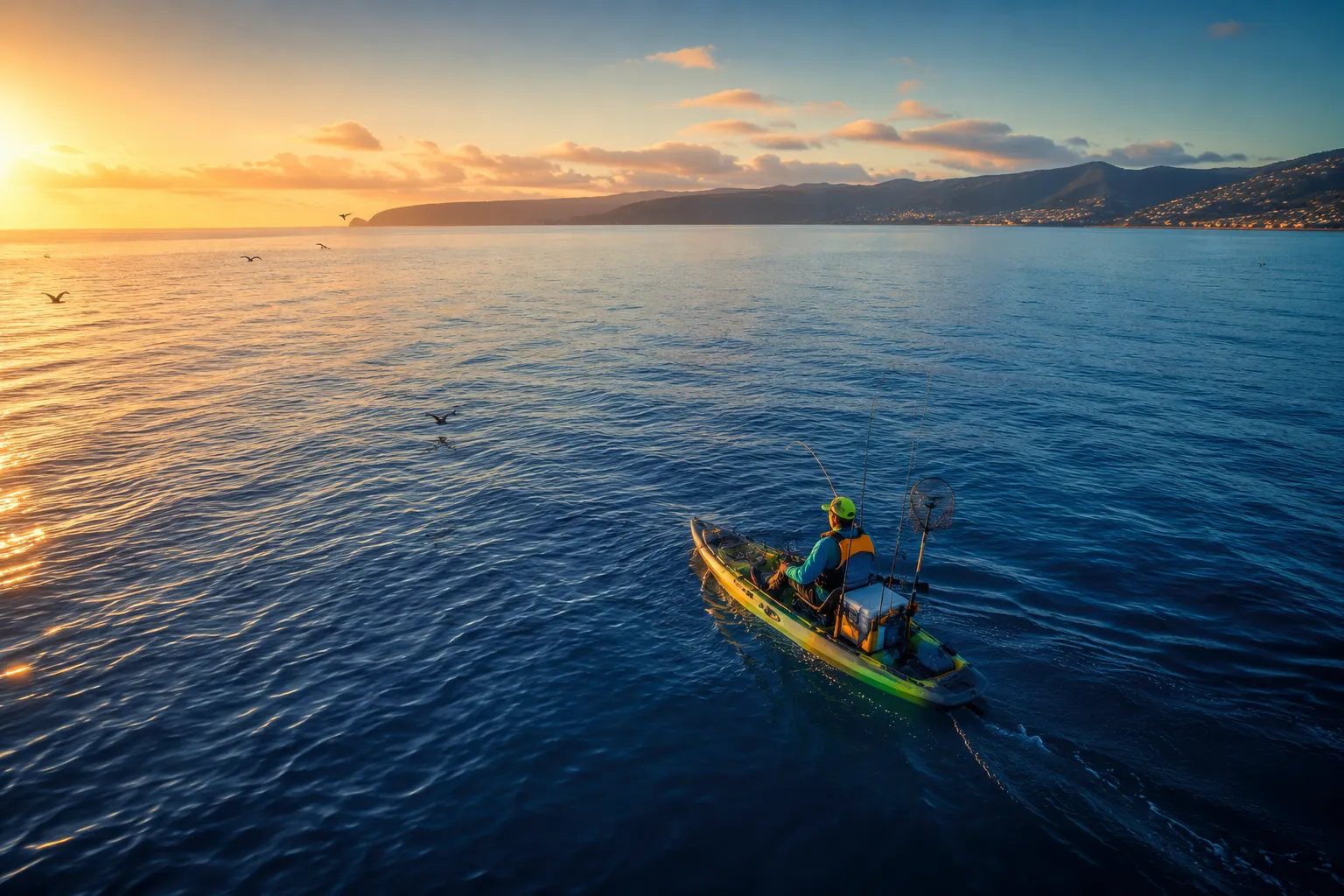
Most fishing kayaks can safely travel one to three miles offshore in calm conditions with proper safety gear, but the real answer depends on your kayak’s design, your skill level, weather conditions, and whether you have support. Experienced paddlers in stable, ocean-ready kayaks routinely fish five miles or more offshore, while beginners should stay within a half-mile of shore until they build skills and confidence.
Key Takeaways
- Distance capability varies widely: Sit-on-top fishing kayaks designed for ocean use can handle 3-5+ miles offshore, while recreational kayaks should stay within one mile of shore
- Conditions matter more than distance: Calm seas at three miles can be safer than rough conditions at half a mile; always check marine forecasts before launching
- Beginner limit: New kayak anglers should stay within a half-mile of shore and within sight of land until they master self-rescue and navigation skills
- Essential safety gear is non-negotiable: VHF radio, PFD, whistle, flares, and a float plan are minimum requirements for any offshore trip
- Wind is your biggest enemy: Offshore winds and afternoon sea breezes can make the return paddle exhausting or impossible; always launch with wind at your back when possible
- Kayak length and width affect offshore capability: Kayaks 12+ feet long with 33+ inch beam offer better tracking and stability for offshore conditions
- Self-rescue skills are mandatory: You must be able to flip your kayak upright and climb back on in deep water before venturing beyond swimming distance from shore
- No special fishing license needed: Most jurisdictions require the same fishing license regardless of distance, but check local regulations for offshore boundaries
What Is Considered Offshore for Kayak Fishing?
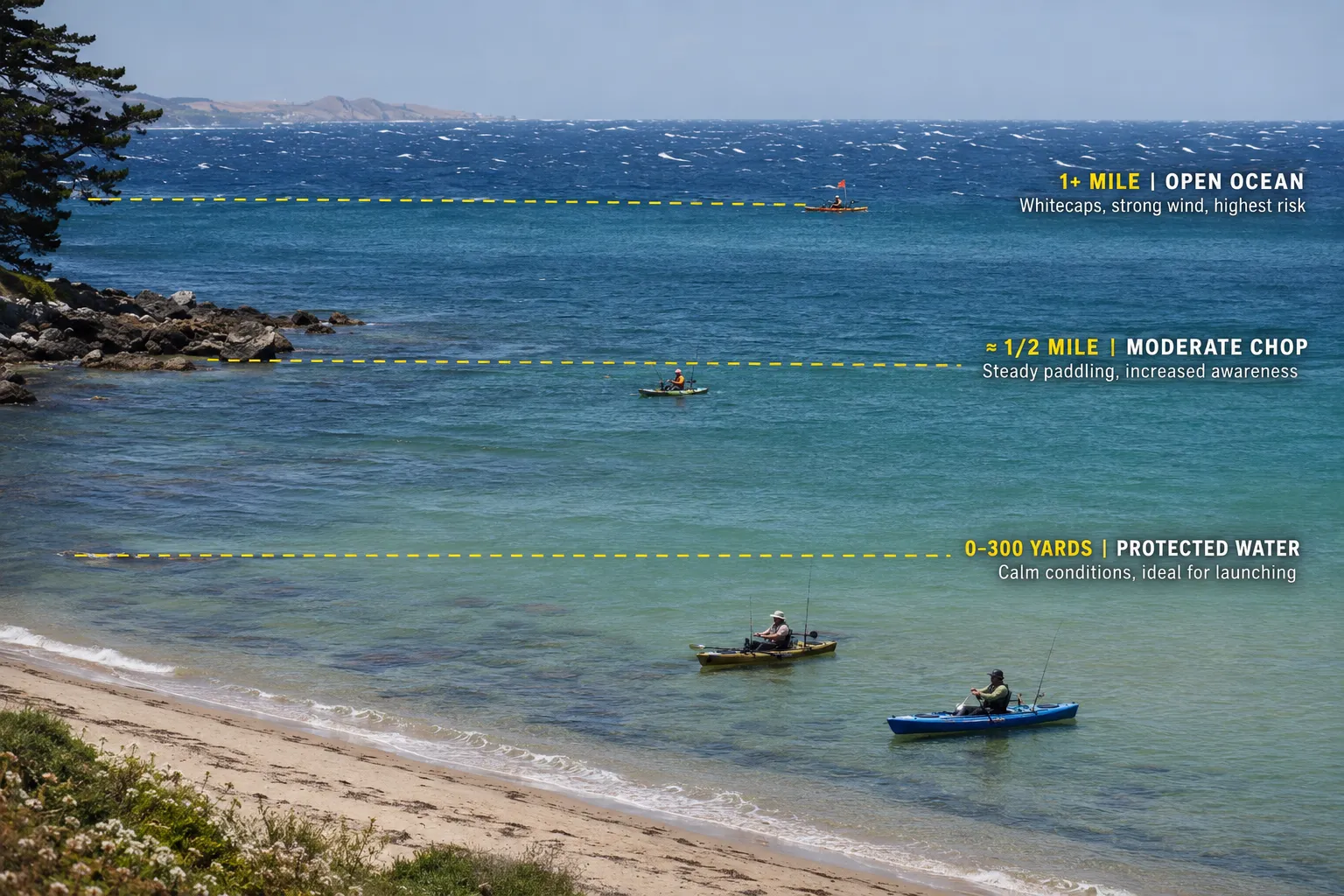
Offshore kayak fishing typically means paddling beyond one mile from shore into open ocean waters where you lose the protection of bays, inlets, and coastal structure. The exact definition varies by region and local paddling culture, but most kayak anglers consider anything beyond two miles as true offshore fishing.
The distinction matters because conditions change dramatically as you leave protected waters:
- Wave patterns become more pronounced without land to block swells
- Wind effects intensify with no barriers to slow gusts
- Water depth increases rapidly, often reaching 50-100+ feet
- Rescue becomes more difficult for both you and emergency services
- Navigation requires more attention as landmarks become less visible
Some coastal areas have specific regulatory definitions. For example, certain marine protected areas or fishing zones define offshore as beyond three nautical miles (3.45 statute miles), but this is a legal boundary, not a safety guideline for kayakers.
Choose your definition based on conditions, not just distance. A calm day at three miles can feel safer than a choppy half-mile paddle through a tidal inlet with strong current.
How Far Can a Beginner Safely Kayak in the Ocean?
Beginners should limit ocean kayaking to a half-mile from shore and stay within sight of land until they’ve practiced self-rescue, built paddling endurance, and learned to read ocean conditions. This conservative distance gives you a realistic chance of swimming to shore if something goes wrong and keeps you within range of beach-based help.
Before pushing beyond that half-mile comfort zone, master these skills:
- Self-rescue from a capsize in water over your head
- Paddle for 30+ minutes continuously without exhaustion
- Read basic weather patterns and recognize deteriorating conditions
- Navigate back to your launch point without relying solely on landmarks
- Handle boat wakes and moderate chop without panic
Common beginner mistake: Paddling out with the wind at your back, then discovering the return trip requires triple the effort. Always launch into the wind when possible, so your return is wind-assisted when you’re tired.
Start with protected bays and calm days. Build up gradually over multiple trips. The ocean will always be there, there’s no prize for rushing your progression.
Sit-On-Top vs Sit-Inside Kayaks for Offshore Fishing
Sit-on-top kayaks are overwhelmingly better for offshore fishing because they’re self-bailing, easier to re-enter after a capsize, and provide better access to gear and fish. Sit-inside kayaks can be used offshore but require advanced skills, a spray skirt, and strong roll technique, most fishing kayaks sold today are sit-on-top designs for good reason.
Here’s how they compare for offshore use:
| Feature | Sit-On-Top | Sit-Inside |
|---|---|---|
| Self-rescue difficulty | Easy, climb back on from the side | Hard, requires pump or assisted rescue |
| Water drainage | Automatic through scupper holes | Must be pumped or bailed out |
| Stability for fishing | Wider, more stable platforms | Narrower, less initial stability |
| Gear access | Open deck with rod holders, hatches | Limited to cockpit and small hatches |
| Capsize consequence | Wet but manageable | Kayak fills with water, very difficult |
Sit-on-top advantages offshore:
- Scupper holes drain water automatically, waves washing over the deck aren’t a crisis
- You can climb back on from deep water without assistance
- Wider beam (typically 32-36 inches) provides stability for casting and fighting fish
- No cockpit to fill with water if you flip
Sit-inside advantages (rare for fishing):
- Better protection from wind and spray in cold conditions
- Slightly faster and more efficient for long-distance paddling
- Lower center of gravity can feel more stable in rough water for experienced paddlers
Bottom line: Unless you’re an experienced sea kayaker who specifically wants the challenge of sit-inside fishing, choose a sit-on-top kayak for offshore work. The safety margin is significantly higher.

UV-Protected HDPE Construction for Durability: Built with high-density polyethylene (HDPE) plastic, this kayak is both lightweight and highly durable, offering long-lasting protection against UV rays for years of use in various conditions. Paddle included.

Powerful & Responsive Propeller Drive System: Take control with our smooth kayak propeller drive system, offering hands-free power, quiet acceleration, and easy reverse maneuvering. Perfect for tight spaces, docks, or mangrove fishing

Ergolounge seating system : Extra-thick cushioning and an extra high and wide padded backrest.
What Safety Gear Do You Need for Offshore Kayak Fishing?
Every offshore kayak trip requires a Coast Guard-approved PFD (worn, not stored), a whistle, a VHF marine radio, visual distress signals (flares or mirror), a bilge pump or bailer, a paddle leash, and a waterproof bag with your phone and emergency contacts. This is the bare minimum, most experienced offshore paddlers carry additional backup systems.
Non-negotiable safety items:
- PFD (Type III or V) with pockets for gear, must be worn at all times
- VHF marine radio (waterproof handheld, not just a phone)
- Whistle attached to your PFD
- Visual distress signals (three flares minimum or signal mirror)
- Knife (easily accessible, for cutting anchor line or fishing line in emergency)
- Bilge pump or large sponge for removing water from hull
- Paddle leash to prevent losing your paddle in a capsize
- Dry bag with phone, ID, emergency contacts, and first aid supplies
Highly recommended additions:
- Personal Locator Beacon (PLB) or GPS messenger device (SPOT, Garmin inReach)
- Compass and waterproof chart or GPS unit
- Anchor and anchor trolley to hold position in current
- Spare paddle (breakdown style that stores on deck)
- Sun protection (hat, sunglasses, sunscreen, long sleeves)
- Hydration system (2+ liters of water for a full day)
- Strobe light if there’s any chance you’ll be out near dusk
File a float plan with someone on shore. Tell them where you’re launching, where you plan to fish, what time you expect to return, and when to call for help if you don’t check in. This simple step has saved lives.
Common mistake: Carrying a phone in a waterproof case and thinking that’s enough communication. Cell coverage is unreliable offshore, and a phone won’t reach Coast Guard or other boaters. A VHF radio on channel 16 is your primary emergency lifeline.
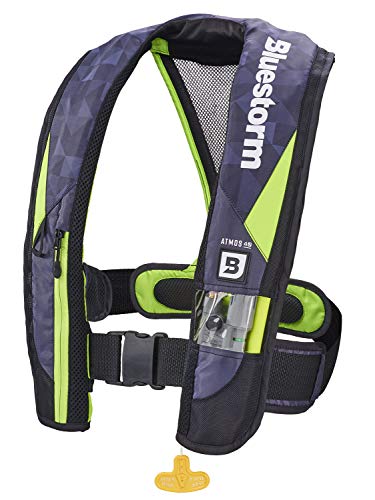
US COAST GUARD-APPROVED TYPE II PERSONAL FLOTATION DEVICE (PFD): This type 2 life jacket is designed to turn the wearer face-up in water. The life vest inflates automatically upon water immersion via a replaceable CO2 cylinder (includes 1 cylinder with purchase) or manually with a pull of the “jerk to inflate” cord or back-up oral inflation tube. Designed for commercial fisherman in mind this vest brings superior safety and performance to the recreational water enthusiast.

USCG APPROVED – this personal flotation device meets USCG requirements for a Type II (Infant) and III (Child) Life Jackets. Closed sides, buckle and zipper closures, additional crotch belt and rapid rescue handle for safety and peace of mind
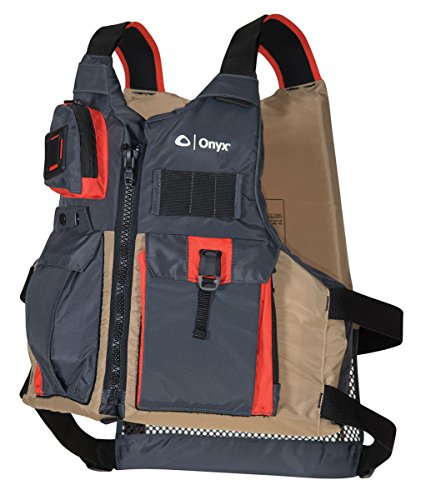
Designed for Anglers – Multiple pockets and tool holders keep fishing gear within easy reach
How to Know If Conditions Are Safe to Kayak Offshore
Conditions are generally safe for offshore kayaking when sustained winds are below 10 mph, wave height is under three feet, there’s no small craft advisory in effect, and the marine forecast shows stable or improving weather for your entire trip duration. Always check NOAA marine forecasts, not just general weather apps, before launching.
Pre-launch safety checklist:
- Check NOAA marine forecast for your specific coastal zone (marine.weather.gov)
- Look for small craft advisories,if one is posted, stay ashore
- Verify wind speed and direction,under 10 mph is comfortable, 10-15 mph is manageable for experienced paddlers, over 15 mph is risky
- Check wave height and period,waves under 3 feet with 8+ second period are manageable; short-period chop is exhausting
- Review tide tables,avoid paddling against strong tidal current
- Watch for afternoon wind patterns,many coastal areas see wind increase after noon
- Check visibility,fog offshore is dangerous; you need to see at least one mile
Red flags that mean stay ashore:
- Any small craft advisory or gale warning
- Sustained winds over 15 mph or gusts over 20 mph
- Wave height over 4 feet
- Thunderstorms in the forecast
- Fog or visibility under one mile
- Offshore wind direction (blowing from land toward sea)
- You feel uncertain or uncomfortable
The offshore wind trap: Wind blowing from shore toward the ocean feels calm at the beach but intensifies as you paddle out. It also makes the return paddle brutally difficult. If wind is forecast to blow offshore, either stay home or plan a very short trip.
Trust your gut. If conditions look sketchy at the launch, they’ll feel worse a mile offshore when you’re tired. There’s no shame in calling a trip, the fish will be there next week.
Can You Take a 10-Foot Kayak Into the Ocean?
A 10-foot kayak can be used in calm, protected ocean waters close to shore, but it’s not suitable for offshore fishing beyond a half-mile because shorter kayaks are slower, harder to paddle in a straight line, and more affected by wind and current. For offshore work, choose a kayak at least 12 feet long, with 13-14 feet being ideal for stability and tracking.
Why length matters offshore:
- Tracking: Longer kayaks hold a straight course better, reducing exhausting correction strokes
- Speed: Hull speed increases with length, a 10-foot kayak tops out around 3.5 mph, while a 14-foot kayak can reach 5+ mph
- Wave handling: Longer hulls bridge wave crests better and punch through chop more efficiently
- Storage: More length means more room for safety gear, fishing equipment, and catch
Length recommendations by experience and distance:
- 10-11 feet: Protected bays and nearshore only (under half-mile from shore)
- 12 feet: Capable of 1-2 miles offshore in good conditions
- 13-14 feet: Designed for 3-5+ miles offshore with proper conditions
- 14+ feet: Expedition-grade for serious offshore and multi-day trips
Width (beam) is equally important. A 10-foot kayak that’s 34 inches wide will be more stable than a 12-foot kayak that’s 28 inches wide. For offshore fishing, look for a beam of at least 32 inches, with 33-36 inches being the sweet spot for stability without sacrificing too much speed.
Common mistake: Buying a short, wide kayak thinking width alone equals offshore capability. You need both length for tracking and width for stability. A 10-foot kayak, no matter how wide, will exhaust you on a long offshore paddle.
What Happens If You Flip a Fishing Kayak Offshore?
If you flip a sit-on-top fishing kayak offshore, the kayak will float upside down or on its side, and you’ll need to flip it upright, climb back on from the water, and bail out any water in the hull before continuing. This is manageable with practice, but it’s exhausting, you’ll lose unsecured gear, and you’ll be wet and potentially cold, which is why self-rescue practice is mandatory before going offshore.
Step-by-step self-rescue for sit-on-top kayaks:
- Stay calm and assess,your PFD keeps you afloat; take a breath
- Secure your paddle,if you have a paddle leash, it’s still attached; if not, grab it immediately
- Flip the kayak upright,swim to the side, grab the far edge, and pull it toward you while pushing the near edge down
- Position yourself at the center,the widest, most stable part of the kayak
- Kick hard and pull yourself up,use a scissor kick and pull your chest onto the deck
- Swing your legs up,rotate your body and get both legs onto the kayak
- Sit up carefully,stay low until you’re balanced
- Bail water,use your bilge pump or sponge to remove water from the hull
What you’ll lose in a capsize:
- Any unsecured rods, tackle boxes, or gear (use rod leashes and tether everything)
- Fish in an open cooler or on a stringer
- Possibly your paddle if you don’t have a leash
- Body heat (even in warm water, you’ll get cold quickly)
Practice this in shallow water first. Flipping and re-entering a kayak is much harder than it looks, especially when you’re tired or in choppy water. Practice until you can do it smoothly without panic.
If you can’t get back on: Stay with your kayak (it’s a giant flotation device), activate your PLB or call for help on your VHF radio, and conserve energy. Don’t try to swim to shore if it’s more than a few hundred yards away, you’ll exhaust yourself.
Offshore vs Nearshore Kayak Fishing: Which Is Better?
Nearshore kayak fishing (within one mile of shore) is better for most anglers because it offers excellent fishing opportunities with significantly lower risk, easier access to structure and reefs, and a realistic swim-to-safety option if something goes wrong. Offshore fishing beyond two miles is rewarding for targeting pelagic species but requires advanced skills, specialized gear, and acceptance of higher risk.
Nearshore advantages:
- Safety margin: You can swim to shore or signal for help more easily
- Structure and variety: Reefs, wrecks, grass flats, and drop-offs are often within a mile of shore
- Less paddling fatigue: More energy for fishing, less for travel
- Better for learning: Build skills in a more forgiving environment
- Easier logistics: Shorter trips mean less gear and planning
Offshore advantages:
- Less fishing pressure: Fewer anglers means less spooked fish
- Bigger pelagic species: Tuna, mahi, wahoo, and billfish are offshore targets
- Cleaner water: Better visibility and often healthier ecosystems
- Adventure factor: The challenge and solitude appeal to some anglers
Choose nearshore if:
- You’re building skills or relatively new to kayak fishing
- You want consistent action without long paddles
- You fish alone frequently
- You prefer variety (multiple species and structure types)
Choose offshore if:
- You have solid self-rescue skills and offshore experience
- You’re targeting specific pelagic species
- You have proper safety gear and ideally fish with a buddy
- You’re comfortable with the increased risk and effort
Most productive approach: Master nearshore fishing first. The skills, confidence, and local knowledge you build close to shore will make you a better, safer offshore angler when you’re ready to push farther out.
How Far Offshore Is Too Far Without a Support Boat?
Most experienced kayak anglers consider three to five miles offshore as the practical limit for solo kayaking without a support boat, though some push farther in ideal conditions. Beyond five miles, the risk increases significantly because rescue becomes extremely difficult, weather can change faster than you can paddle back, and fatigue becomes a serious safety factor.
Factors that determine your safe distance:
- Your fitness level: Can you paddle hard for 60+ minutes straight if conditions deteriorate?
- Your kayak’s capability: Is it designed for offshore use with proper length, stability, and storage?
- Weather stability: Is the forecast rock-solid for the next 6+ hours?
- Water temperature: Cold water (under 60°F) dramatically reduces survival time in a capsize
- Your experience: Have you successfully handled rough conditions and self-rescue before?
Distance guidelines by experience:
- Beginner (under 10 offshore trips): Stay within one mile
- Intermediate (10-50 offshore trips): 1-3 miles in good conditions
- Advanced (50+ offshore trips): 3-5 miles with proper planning
- Expert with support: 5-10+ miles with buddy system or support boat
The buddy system changes everything. Paddling with a partner or small group dramatically increases safety. You can assist each other in rescues, share navigation duties, and provide moral support when conditions get tough. Many experienced offshore kayakers won’t go beyond three miles solo but will comfortably fish five to seven miles with a buddy.
Support boat benefits:
- Immediate rescue capability if you capsize or get injured
- Ability to carry extra gear, water, and safety equipment
- Psychological comfort knowing help is close
- Option to rest or get out of the water if exhausted
Common mistake: Thinking GPS and a PLB make any distance safe. These tools help rescuers find you, but rescue can take hours. You still need the skills and fitness to stay safe until help arrives.
Common Mistakes People Make Kayak Fishing Offshore
The most common offshore kayak fishing mistakes are underestimating wind and current, failing to secure gear properly, not practicing self-rescue before it’s needed, ignoring weather forecasts, and paddling out with the wind at your back without considering the return trip. These errors are preventable with planning and experience.
Top mistakes and how to avoid them:
1. Launching with offshore wind
- The mistake: Wind blowing from shore to sea feels calm at the beach but intensifies offshore and makes return paddling exhausting or impossible
- The fix: Check wind direction before launching; if it’s offshore, stay home or plan a very short trip
2. Not securing gear
- The mistake: Rods, tackle boxes, and tools slide off during a capsize or rough water
- The fix: Use rod leashes, bungee cords, and tethers for everything; if it’s not tied down, it will go overboard eventually
3. Skipping self-rescue practice
- The mistake: Assuming you’ll figure out how to get back on your kayak if you flip
- The fix: Practice capsizing and re-entering in shallow water until it’s second nature
4. Ignoring the marine forecast
- The mistake: Checking a general weather app instead of NOAA marine forecasts
- The fix: Always check marine.weather.gov for your specific coastal zone; look for small craft advisories
5. Overestimating fitness
- The mistake: Paddling farther than you can comfortably return from when tired
- The fix: Start conservative; your first trip offshore should be half the distance you think you can handle
6. Fishing without a float plan
- The mistake: Nobody knows where you are or when to expect you back
- The fix: Tell someone your launch point, destination, and return time; check in when you’re back
7. Inadequate hydration and sun protection
- The mistake: Focusing on fishing gear and forgetting water, sunscreen, and protective clothing
- The fix: Pack 2+ liters of water, wear sun-protective clothing, and reapply sunscreen every two hours
8. Anchoring without an anchor trolley
- The mistake: Anchoring from a fixed point on the kayak, which can flip you in current or wind
- The fix: Install an anchor trolley system that lets you adjust anchor position from bow to stern
9. Chasing fish too far offshore
- The mistake: Following a school of fish farther than planned, then realizing you’re exhausted and far from shore
- The fix: Set a hard distance limit before launching and stick to it, no matter how good the bite is
Do You Need a Special License to Fish Offshore in a Kayak?
In most U.S. states, you need the same recreational fishing license for offshore kayak fishing as you would for any other fishing method, with no special kayak or offshore endorsement required. However, some states have different license requirements for state waters (typically within three miles of shore) versus federal waters (beyond three miles), and certain species may require additional permits or stamps.
General licensing rules:
- State fishing license: Required in almost all states for residents and non-residents
- Saltwater fishing license: Some states have separate freshwater and saltwater licenses
- Federal waters: Fishing beyond three nautical miles may require federal registration (free in most cases)
- Species-specific permits: Highly migratory species (tuna, billfish, sharks) may require additional federal permits
Examples by region:
- Florida: Requires saltwater fishing license; no additional permit for offshore kayak fishing
- California: Requires fishing license; ocean enhancement validation for saltwater; no kayak-specific rules
- Texas: Requires saltwater fishing license; no additional offshore permit
- North Carolina: Requires coastal recreational fishing license; no kayak-specific requirements
Kayak registration vs fishing license:
Don’t confuse kayak registration (required in some states for vessel identification) with fishing licenses. Kayak registration is about the vessel; fishing licenses are about the activity. You may need both, but they’re separate requirements.
Check before you go: Regulations change frequently. Visit your state’s fish and wildlife website or call their licensing office to confirm current requirements. Getting caught fishing without proper licenses can result in significant fines.
Best Kayaks for Going More Than 2 Miles Offshore
The best kayaks for fishing more than two miles offshore are 13-14 feet long, 33-36 inches wide, have a weight capacity of 400+ pounds, feature a stable hull design (pontoon or tri-hull), include multiple sealed hatches for dry storage, and offer a comfortable seat for long paddles. Top models include the Hobie Pro Angler series, Native Watercraft Slayer Propel, and Old Town Predator PDL.
Key features for offshore capability:
Hull design:
- Length: 13-14 feet minimum for tracking and speed
- Width: 33-36 inches for stability without sacrificing too much speed
- Hull shape: Pontoon or tri-hull designs offer excellent stability; V-hulls are faster but less stable
Propulsion:
- Pedal drive: Hands-free fishing and more efficient for long distances (Hobie MirageDrive, Old Town PDL, Native Propel)
- Paddle: More affordable, lighter weight, no mechanical parts to fail
Storage and capacity:
- Weight capacity: 400+ pounds to handle you, gear, safety equipment, and catch
- Sealed hatches: Multiple dry storage compartments for electronics, safety gear, and valuables
- Deck space: Room for cooler, tackle, and fish
Fishing features:
- Rod holders: At least 4-6 for trolling and storage
- Anchor trolley: Essential for holding position in current
- Standing stability: Ability to stand and cast (if desired)
- Comfortable seat: Crucial for 4-6 hour trips
Top offshore kayak models (2026):
- Hobie Pro Angler 14: Industry standard, MirageDrive pedal system, 500 lb capacity, extremely stable
- Native Watercraft Slayer Propel 13: Pedal drive, reverse capability, 500 lb capacity, excellent stability
- Old Town Predator PDL: Pedal drive, 500 lb capacity, fast and stable, great for long paddles
- Jackson Kayak Kraken 13.5: Paddle-powered, 475 lb capacity, stable platform, more affordable
- Wilderness Systems Radar 135: Pedal drive, 550 lb capacity, modular design
Budget consideration: Offshore-capable kayaks typically cost $2,000-$4,000 for pedal models, $1,000-$2,000 for paddle models. This is a significant investment, but offshore safety demands a quality vessel.
How Do You Get Back If Wind Picks Up While Offshore Kayaking?
If wind picks up while you’re offshore, immediately start paddling back toward shore at a sustainable pace, angle your kayak 30-45 degrees into the wind rather than fighting it head-on, take breaks to conserve energy, stay hydrated, and if conditions become dangerous, call for help on your VHF radio before you’re too exhausted to paddle. Prevention through weather monitoring is far better than managing a wind emergency offshore.
Immediate actions when wind increases:
- Assess the situation: Is wind increasing gradually or rapidly? What direction is it blowing?
- Start back immediately: Don’t wait to see if it gets worse, begin your return as soon as you notice sustained wind increase
- Angle into the wind: Paddle at 30-45 degrees to the wind rather than straight into it; this reduces resistance and prevents being blown sideways
- Use a sustainable pace: You may be paddling for an hour or more; don’t sprint and exhaust yourself
- Take strategic breaks: In a sit-on-top kayak, you can rest briefly while drifting (you’ll lose some ground but gain energy)
- Stay hydrated: Drink water during breaks; dehydration accelerates fatigue
Advanced techniques:
- Quartering seas: Angle your kayak so waves hit at 30-45 degrees to your bow, not straight on
- Paddle with your core: Use torso rotation, not just arms, to generate power efficiently
- Shorter, quicker strokes: More effective in wind than long, slow strokes
- Stay low: Reduce your wind profile by staying seated and leaning slightly forward
When to call for help:
- Wind is increasing faster than you can paddle back
- You’re making no progress or losing ground despite hard paddling
- You’re becoming exhausted and can’t maintain pace
- Waves are breaking over your kayak repeatedly
- You feel unsafe or panicked
Call early, not late. Coast Guard and marine patrol would rather respond to a precautionary call than search for a missing kayaker after dark. There’s no shame in asking for help when conditions exceed your capability.
Prevention is everything: Check hourly wind forecasts before launching. Many coastal areas have predictable afternoon wind increases, plan to be back by noon if afternoon winds are forecast.
Is Offshore Kayak Fishing Worth the Risk?
Offshore kayak fishing is worth the risk for experienced paddlers who have proper safety gear, solid self-rescue skills, and realistic assessment of their abilities, because it offers access to less-pressured fish, bigger pelagic species, and a unique challenge that nearshore fishing can’t match. However, for beginners or anglers without proper preparation, the risk outweighs the reward, nearshore fishing offers excellent opportunities with far less danger.
Honest assessment of risks:
- Capsize in deep water: Manageable with practice, but exhausting and potentially dangerous in cold water
- Weather changes: Can happen faster than you can paddle back
- Fatigue: Long paddles are physically demanding; exhaustion impairs judgment
- Isolation: Help is farther away; rescue takes longer
- Equipment failure: A broken paddle or damaged kayak is more serious offshore
Rewards that draw anglers offshore:
- Less fishing pressure: Fewer anglers means less spooked fish and better action
- Bigger fish: Pelagic species like tuna, mahi, and wahoo are offshore targets
- Unique experience: The challenge and solitude appeal to adventurous anglers
- Personal growth: Successfully managing offshore trips builds confidence and skills
- Bragging rights: Landing a big fish from a kayak miles offshore is genuinely impressive
Who should fish offshore:
- Anglers with 20+ nearshore kayak fishing trips under their belt
- Paddlers who have practiced self-rescue until it’s automatic
- People with proper safety gear (VHF radio, PLB, PFD, etc.)
- Those who honestly assess conditions and turn back when needed
- Anglers who fish with a buddy or group when possible
Who should stick nearshore:
- Beginners with fewer than 10 kayak fishing trips
- Anyone uncomfortable with self-rescue or deep water
- Anglers without proper safety gear
- Those who fish alone and lack offshore experience
- People with medical conditions that could be dangerous offshore
The middle path: You don’t have to choose between nearshore and offshore forever. Build skills nearshore, gradually push your comfort zone, invest in proper gear, and transition to offshore when you’re ready. Many excellent kayak anglers fish nearshore 80% of the time and save offshore trips for perfect conditions and specific target species.
Bottom line: Offshore kayak fishing is worth the risk if you’re prepared, skilled, and honest with yourself about conditions and capabilities. It’s not worth the risk if you’re cutting corners on safety, pushing beyond your skill level, or ignoring warning signs.
Frequently Asked Questions
How far offshore can you take a fishing kayak safely?
Most fishing kayaks can safely go 1-3 miles offshore in calm conditions with proper safety gear and skills. Experienced paddlers in ocean-ready kayaks can fish 5+ miles offshore, while beginners should stay within a half-mile of shore until they build confidence and master self-rescue techniques.
What size kayak do you need for offshore fishing?
For offshore fishing, choose a kayak at least 12 feet long and 32 inches wide, with 13-14 feet and 33-36 inches being ideal. Longer kayaks track better and handle waves more efficiently, while wider beams provide stability for casting and fighting fish in open water.
Can you take a 10-foot kayak in the ocean?
A 10-foot kayak can be used in calm, protected ocean waters close to shore but is not suitable for offshore fishing beyond a half-mile. Shorter kayaks are slower, harder to paddle straight, and more affected by wind and current, making them exhausting and potentially dangerous for offshore use.
What happens if you flip your kayak offshore?
If you flip a sit-on-top kayak offshore, you’ll need to flip it upright, climb back on from the water, and bail out any water before continuing. This is manageable with practice but exhausting, and you’ll lose unsecured gear and get wet, which is why self-rescue practice is mandatory before going offshore.
Do you need a special license to fish offshore in a kayak?
Most states require only a standard recreational fishing license for offshore kayak fishing, with no special kayak or offshore endorsement. However, fishing beyond three miles (federal waters) may require free federal registration, and certain species may need additional permits or stamps.
Is offshore kayak fishing dangerous?
Offshore kayak fishing carries inherent risks including capsize in deep water, weather changes, fatigue, and isolation from help. However, with proper safety gear, self-rescue skills, weather monitoring, and realistic assessment of conditions, experienced paddlers can manage these risks effectively and fish offshore safely.
How do you know if it’s safe to kayak offshore?
Conditions are safe for offshore kayaking when sustained winds are below 10 mph, wave height is under 3 feet, there’s no small craft advisory, and the marine forecast shows stable weather. Always check NOAA marine forecasts, not general weather apps, and trust your gut if conditions look questionable.
What safety gear do you need for offshore kayak fishing?
Essential offshore safety gear includes a Coast Guard-approved PFD (worn), VHF marine radio, whistle, visual distress signals (flares), bilge pump, paddle leash, knife, and waterproof bag with phone and emergency contacts. A Personal Locator Beacon (PLB) or GPS messenger is highly recommended for trips beyond two miles.
How far is too far offshore without a support boat?
Most experienced kayak anglers consider 3-5 miles offshore as the practical limit for solo kayaking without a support boat. Beyond five miles, rescue becomes extremely difficult, weather can change faster than you can paddle back, and fatigue becomes a serious safety factor.
What’s better for offshore fishing: sit-on-top or sit-inside kayak?
Sit-on-top kayaks are overwhelmingly better for offshore fishing because they’re self-bailing, easier to re-enter after a capsize, and provide better access to gear and fish. Sit-inside kayaks require advanced skills and roll technique, making them impractical for most fishing applications.
Can beginners go offshore kayak fishing?
Beginners should not go offshore beyond a half-mile until they’ve mastered self-rescue, built paddling endurance, and learned to read ocean conditions. Start with protected nearshore waters, practice skills in safe environments, and gradually build experience over multiple trips before pushing farther offshore.
How do you get back if wind picks up offshore?
If wind picks up offshore, immediately start paddling back at a sustainable pace, angle your kayak 30-45 degrees into the wind rather than fighting it head-on, take breaks to conserve energy, and call for help on your VHF radio if conditions become dangerous before you’re too exhausted to paddle.
Conclusion
Understanding how far offshore you can take a fishing kayak comes down to honest assessment of your skills, your kayak’s capabilities, weather conditions, and safety preparation. While experienced anglers routinely fish three to five miles offshore in proper conditions, beginners should build confidence and skills within a half-mile of shore before pushing farther.
The distance number matters less than your preparation. A well-equipped, skilled paddler at three miles offshore in calm conditions is safer than an unprepared beginner at half a mile in deteriorating weather. Invest in proper safety gear, especially a VFD, VHF radio, and PLB. Practice self-rescue until it’s automatic. Check marine forecasts religiously. File float plans. Fish with a buddy when possible.
Your next steps:
- Assess your current skill level honestly,how many offshore trips have you completed successfully?
- Invest in essential safety gear if you don’t already have it (VHF radio, PLB, proper PFD)
- Practice self-rescue in shallow water until you can flip and re-enter smoothly
- Start conservative,your first offshore trip should be shorter than you think you can handle
- Build gradually,add a half-mile to your comfort zone every few trips as skills improve
- Never stop learning,take a sea kayaking safety course or join a local paddling club
The ocean will always be there, and the fish aren’t going anywhere. There’s no prize for rushing your progression or taking unnecessary risks. Build your skills methodically, respect the ocean’s power, and you’ll enjoy decades of safe, productive offshore kayak fishing.