Kayak fishing has grown 300% in participation since 2015, making it one of the fastest-growing outdoor activities in North America. This complete beginner’s guide to how to fish from a kayak covers everything from choosing your first boat to landing fish safely, with practical steps that get you on the water quickly and confidently.
Key Takeaways
- Sit-on-top kayaks are better for fishing beginners because they offer easier entry/exit, self-draining decks, and more stability than sit-inside models
- Budget $500-$1,200 for a quality beginner fishing kayak; avoid models under $400 as they lack essential fishing features and durability
- Choose 10-12 feet length for most fishing situations; shorter for small ponds, longer for open water and ocean use
- Width matters more than length for stability; aim for 32-36 inches wide if you plan to stand and fish
- You need a fishing license to fish from a kayak in all states, but kayak registration requirements vary by state and length
- Essential safety gear includes a properly fitted PFD (life jacket), whistle, paddle leash, and bilge pump as minimum requirements
- Anchor from the bow using an anchor trolley system; never anchor from the side as it can capsize your kayak in current or wind
- Start sitting down to cast and fight fish; only attempt standing after mastering seated techniques and balance
- Common beginner mistakes include overloading gear, poor weight distribution, anchoring incorrectly, and reaching too far over the side
- Practice capsizing recovery in shallow water before heading to deep or moving water
What Gear Do You Need to Start Kayak Fishing as a Beginner?
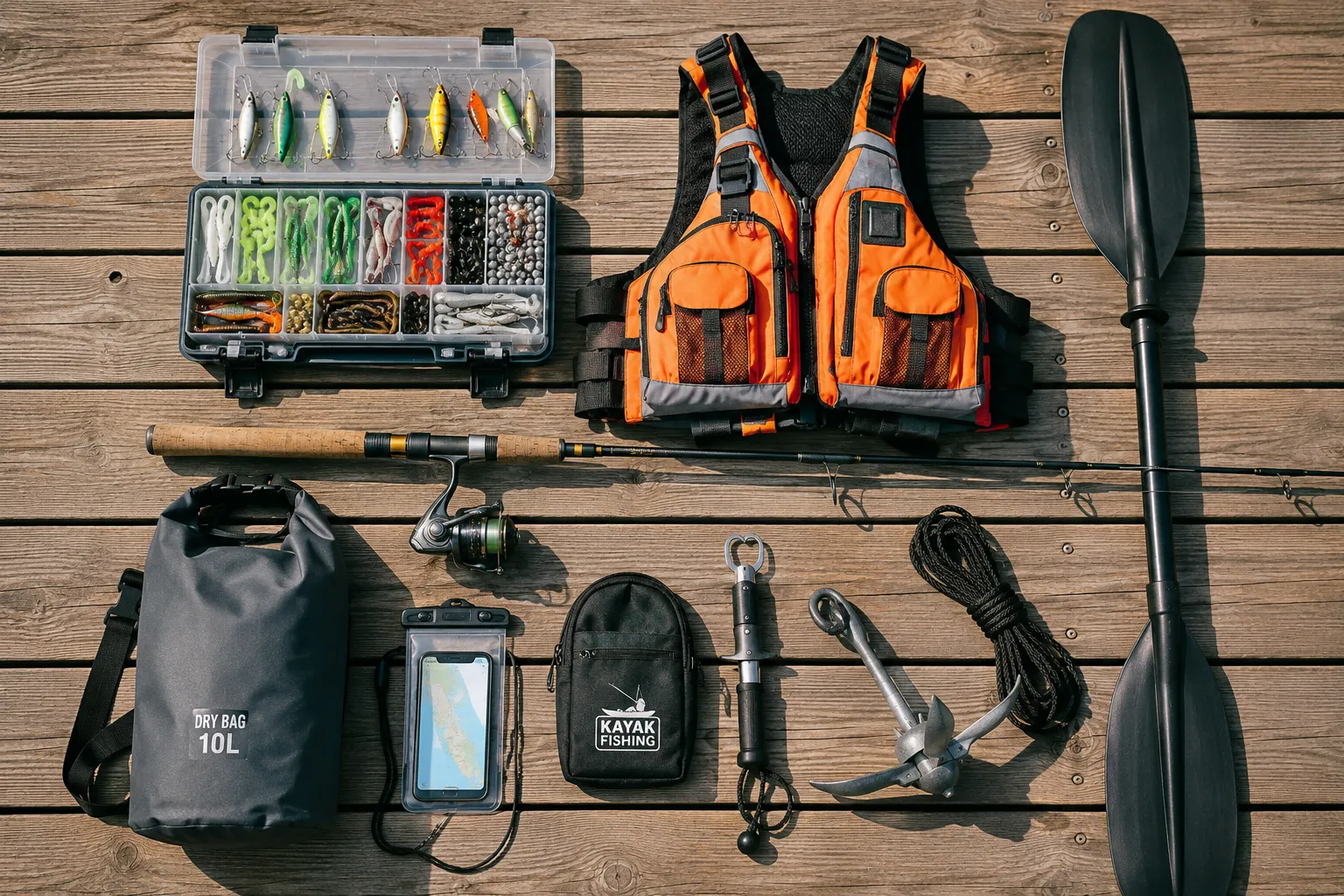
Starting kayak fishing requires less gear than you think. At minimum, you need a fishing kayak, paddle, personal flotation device (PFD), fishing rod and reel, basic tackle, and an anchor system.
Essential gear checklist:
- Fishing kayak with rod holders and storage
- Paddle (230-250cm length for most adults)
- PFD/life jacket (must be Coast Guard approved and properly fitted)
- Anchor and rope (3-5 lbs for lakes, 5-8 lbs for rivers)
- Fishing rod and reel (7-foot medium-action spinning combo works for most situations)
- Tackle box with basic lures, hooks, and terminal tackle
- Dry bag for phone, keys, and wallet
- Whistle (required safety item in most states)
- Bilge pump or sponge for removing water
- Paddle leash to prevent losing your paddle
Nice-to-have additions include a fish finder, anchor trolley, rod leashes, a small cooler or fish bag, and a kayak cart for transport. Don’t buy everything at once. Start with the essentials and add gear as you discover what your fishing style requires.
Common mistake: Beginners often overload their first kayak with too much gear, making it unstable and difficult to paddle. Start minimal and add items only after you’ve spent time on the water understanding weight distribution and storage needs.

UGLY STIK 7’ COMPLETE SALTWATER SPINNING COMBO: Includes 9 pieces of Saltwater tackle to catch multiple Saltwater Species: 20lb. mono double hook bottom rig (2), 3oz. pyramid sinker (2) and 3/0 circle hooks (5).

MODERATE ACTION: The Zebco Dock Demon spinning combo features a compact 30-inch 1-piece fishing rod that provides medium power and moderate action making it easier to catch light and medium species from panfish to trout, walleye, bass and more

WHAT'S INCLUDED IN PLUSINNO FISHING ROD KIT - The complete fishing starter kit for adults includes collapsible fishing rod X1, spinning reel X1, carrier bag X1 and 373PCS fishing tackle box with tackle included that allows anglers to access quickly, all fishing accessories clearly visible at a glance. It eliminates hassle of accessing lower compartments. Fishing rod and reel combo with lures offers a hassle-free, ready-to-go solution to start fishing anytime, anywhere.Perfect fishing gear.
Sit-On-Top vs Sit-Inside Kayak for Fishing: Which Is Better?
Sit-on-top kayaks are better for fishing in most situations, especially for beginners. They offer easier entry and exit, self-draining decks, more fishing space, and simpler recovery if you capsize.
Sit-on-top advantages:
- Self-bailing scupper holes drain water automatically
- Easy to get back on after falling off
- More room for gear and coolers
- Better for warm weather and summer fishing
- Simpler to stand and fish from
- No cockpit to fill with water if you flip
Sit-inside advantages:
- Better protection from wind and cold water splash
- Lower center of gravity (slightly more stable in rough water)
- Stays drier in rain and waves
- Warmer for cold-weather fishing
- Better for long-distance paddling
Choose sit-on-top if you fish in warm climates, want to stand while fishing, fish in calm to moderate water, or prioritize ease of use over weather protection. Choose sit-inside if you fish in cold weather, paddle long distances, need protection from wind and spray, or fish primarily from a seated position.
For beginners learning how to fish from a kayak, sit-on-top models remove the intimidation factor of feeling trapped and make the learning curve much gentler.

UV-Protected HDPE Construction for Durability: Built with high-density polyethylene (HDPE) plastic, this kayak is both lightweight and highly durable, offering long-lasting protection against UV rays for years of use in various conditions. Paddle included.

Powerful & Responsive Propeller Drive System: Take control with our smooth kayak propeller drive system, offering hands-free power, quiet acceleration, and easy reverse maneuvering. Perfect for tight spaces, docks, or mangrove fishing

Ergolounge seating system : Extra-thick cushioning and an extra high and wide padded backrest.
How Much Does a Fishing Kayak Cost for Beginners?
A quality beginner fishing kayak costs between $500 and $1,200. Budget models under $400 typically lack essential fishing features like rod holders, adequate storage, and durable construction, while premium models over $2,000 offer features most beginners don’t need yet.
Price breakdown by category:
- $300-$500: Basic recreational kayaks with minimal fishing features; acceptable for occasional use on calm water
- $500-$800: Entry-level fishing kayaks with rod holders, tank wells, and basic rigging; best value for beginners
- $800-$1,200: Mid-range fishing kayaks with better seats, more storage, improved stability, and quality construction
- $1,200-$2,000: Advanced features like standing platforms, premium seats, and specialized hull designs
- $2,000+: Pedal-drive systems, high-end materials, and professional-grade features
What affects the price:
- Hull material (polyethylene is cheapest, rotomolded is mid-range, thermoformed and composite are premium)
- Propulsion system (paddle is cheapest, pedal drives add $1,000-$2,500)
- Included accessories (seat quality, rod holders, storage hatches)
- Brand reputation and warranty coverage
- Weight capacity and size
Budget tip: Look for previous-year models in February through April when dealers clear inventory for new models. You can often save 20-30% on quality kayaks that are identical to current-year versions except for color.
Don’t forget to budget an additional $200-$400 for essential accessories like a paddle ($80-$150), PFD ($50-$100), anchor system ($30-$60), and basic safety gear.

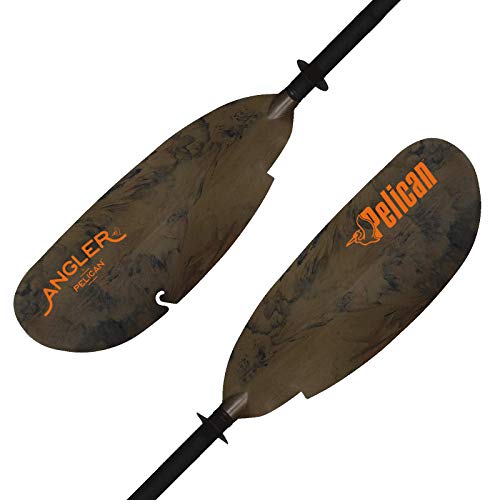
Longer reach:This high-quality paddle is extra long and sized to fit modern fishing kayaks over 34" wide.
How Do You Stay Stable and Not Tip Over While Fishing From a Kayak?
Staying stable in a fishing kayak comes down to choosing a wide, stable hull design, keeping your weight centered, and making smooth movements rather than sudden shifts. Most fishing kayaks are designed with stability in mind and are harder to tip than beginners expect.
Stability techniques:
- Keep your center of gravity low – Sit with your back against the seat and avoid leaning far to either side
- Distribute weight evenly – Place heavy gear like coolers and tackle boxes along the centerline, not on one side
- Use your hips, not your upper body – When reaching for something, rotate your hips rather than leaning your torso
- Brace with your knees – Press your knees against the sides of the kayak for added stability
- Move slowly and deliberately – Quick movements create instability; smooth transitions keep you balanced
Hull design matters: Wider kayaks (32-36 inches) offer more initial stability, making them feel more secure for beginners. Narrower kayaks (28-30 inches) are faster but require better balance. Pontoon-style hulls provide maximum stability for standing but sacrifice speed.
When fighting a fish: Keep the rod tip up and let the rod and reel do the work rather than pulling with your body. If a fish pulls hard to one side, turn the kayak to face the fish rather than fighting it from a side angle, which can create instability.
Practice drill: Before fishing, spend 30 minutes in shallow water practicing shifting your weight, reaching to both sides, and simulating casting motions. This builds muscle memory and confidence in your kayak’s stability limits.
What Length Kayak Is Best for Fishing?
The best fishing kayak length for most beginners is 10 to 12 feet. This range offers a good balance of stability, maneuverability, storage space, and ease of transport without being too difficult to paddle or too heavy to load on a vehicle.
Length guide by fishing environment:
- 8-10 feet: Small ponds, narrow creeks, and tight spaces; very maneuverable but limited storage and speed
- 10-12 feet: Lakes, rivers, and coastal bays; best all-around choice for beginners
- 12-14 feet: Large lakes, open bays, and ocean fishing; better tracking and speed but harder to turn
- 14+ feet: Offshore ocean fishing and long-distance trips; requires experience and strong paddling skills
Shorter kayaks (under 10 feet):
- Turn easily in tight spots
- Lighter and easier to transport
- Less storage space
- Slower on open water
- More affected by wind
Longer kayaks (over 12 feet):
- Track straighter and paddle faster
- More storage for gear and fish
- Better for covering distance
- Harder to maneuver in tight areas
- Heavier to carry and load
Choose based on where you’ll fish most often. If you fish small farm ponds and narrow rivers, a 10-foot kayak is ideal. If you fish large reservoirs or coastal areas, go with 11-12 feet. Most beginners learning how to fish from a kayak find 10.5 to 11.5 feet to be the sweet spot.
Transport consideration: Longer kayaks require longer vehicles or roof racks. Measure your vehicle’s roof length and ensure you can safely transport the kayak you choose.
How Wide Should a Fishing Kayak Be?
Fishing kayaks should be 30 to 36 inches wide for most anglers. Width directly affects stability, with wider kayaks offering more initial stability for standing and moving around, while narrower kayaks are faster and easier to paddle long distances.
Width categories:
- 28-30 inches: Performance-oriented; faster but requires good balance; best for experienced paddlers
- 30-33 inches: Balanced stability and speed; good for seated fishing with occasional standing
- 33-36 inches: High stability; excellent for standing and moving around; slower to paddle
- 36+ inches: Maximum stability; pontoon-style designs; very slow but nearly impossible to tip
Choose wider (33-36 inches) if you:
- Plan to stand while fishing
- Are new to kayaking
- Fish in windy or choppy conditions
- Carry lots of gear
- Prefer feeling secure over speed
Choose narrower (28-31 inches) if you:
- Paddle long distances
- Fish primarily while seated
- Want better speed and efficiency
- Have good balance and kayaking experience
- Fish protected, calm waters
The standing test: If you want to stand and fish, look for kayaks at least 33 inches wide with a flat standing platform. Anything narrower requires exceptional balance and experience.
Width also affects transport. Wider kayaks may not fit in some kayak carts or storage racks, and they catch more wind when car-topping, so secure them carefully.
How Do You Anchor a Kayak When Fishing?
Anchor your kayak from the bow (front) using an anchor trolley system that lets you adjust the anchor point from your seat. Never anchor from the side, as current or wind can push against the kayak’s broadside and flip it.
Basic anchoring steps:
- Choose the right anchor weight – 3-5 lbs for calm lakes, 5-8 lbs for rivers or wind, 8-10 lbs for ocean or strong current
- Use enough rope – At least 3 times the water depth (15 feet of rope for 5 feet of water)
- Deploy from the bow – Lower the anchor slowly from the front of the kayak
- Adjust with the trolley – Use your anchor trolley to slide the attachment point forward or back to control kayak position
- Set the anchor – Give a firm pull to dig the anchor into the bottom
- Retrieve slowly – Pull up hand-over-hand, coiling the rope as you go
Anchor trolley explained: This is a rope or cord system that runs from bow to stern along one side of your kayak, with a pulley that slides along it. You clip your anchor rope to the pulley, allowing you to adjust where the anchor pulls from without moving the anchor itself. This lets you position the kayak at different angles to wind or current.
Why never anchor from the side: If current or wind pushes against the side of an anchored kayak, it can roll the kayak over. The bow or stern naturally cuts through current and keeps the kayak stable.
Alternative to anchoring: Use a stake-out pole in shallow water (under 6 feet). Push the pole into the bottom and clip your kayak to it. This is quieter than dropping an anchor and works well in grass flats and shallow bays.
Common mistake: Using too short an anchor rope. If your rope is only as long as the water is deep, the anchor pulls at a steep angle and won’t hold. The 3:1 ratio (three feet of rope for every foot of depth) creates the proper angle for the anchor to dig in and hold.
Is Kayak Fishing Good for Kids or Older People?
Kayak fishing is excellent for both kids and older adults when you choose the right kayak and follow safety guidelines. The low-impact nature of kayak fishing makes it accessible across age groups, though each requires specific considerations.
For kids:
- Age 8 and up can typically handle their own kayak with supervision
- Under 8 should ride tandem with an adult
- Choose shorter, lighter kayaks (8-9 feet) that kids can paddle and control
- Always require a properly fitted PFD (life jacket)
- Start in calm, shallow water where they can touch bottom
- Keep trips short (1-2 hours) to match attention spans
- Use simple, kid-friendly tackle to avoid frustration
For older adults:
- Kayak fishing is easier on joints than wade fishing or boat fishing
- Choose kayaks with comfortable, high-backed seats with good lumbar support
- Look for easy entry/exit designs with lower sides
- Consider pedal-drive kayaks to reduce shoulder strain from paddling
- Sit-on-top models are easier to get in and out of than sit-inside
- Use a kayak cart to avoid carrying heavy loads
- Fish from easily accessible launch points with docks or gentle slopes
Safety considerations for both groups:
- Always wear a PFD, regardless of swimming ability
- Fish with a buddy or within sight of shore
- Carry a whistle and cell phone in a waterproof case
- Check weather before heading out
- Start in protected, calm water
- Take a basic kayaking safety course
Physical limitations: If you have limited mobility, balance issues, or recent surgery, consult your doctor before kayak fishing. Many people with physical limitations successfully kayak fish using stable platforms and adaptive equipment.
The key to making kayak fishing work for any age is matching the equipment and environment to the person’s abilities and building skills gradually.
What Are Common Mistakes Beginners Make When Kayak Fishing?
The most common mistakes beginners make when learning how to fish from a kayak include overloading gear, poor weight distribution, anchoring from the side, reaching too far over the edge, and fishing in conditions beyond their skill level.
Top 10 beginner mistakes:
Bringing too much gear – Overloading makes the kayak unstable and difficult to paddle. Start minimal and add only what you actually use.
Poor weight distribution – Placing all heavy gear on one side or too far forward/back affects stability and tracking. Keep weight centered and balanced.
Anchoring from the side – This can flip your kayak in current or wind. Always anchor from bow or stern using an anchor trolley.
Not wearing a PFD – Even strong swimmers can get into trouble. Wear your life jacket at all times, not just when conditions look rough.
Reaching too far over the side – Leaning far out to grab a fish, net, or dropped item is the #1 cause of capsizing. Use a net with a long handle and keep your weight centered.
Fishing in wind or current beyond skill level – Start in calm, protected water. Wind above 10-15 mph makes kayak control difficult for beginners.
Not securing gear – Dropped items sink fast. Use rod leashes, gear tethers, and keep small items in closed containers.
Standing too soon – Master seated fishing first. Standing requires excellent balance and a stable, wide kayak.
Ignoring weather forecasts – Conditions can change quickly on water. Check weather before every trip and have a plan to get off the water fast.
Not practicing self-rescue – Spend time in shallow water practicing getting back on your kayak after falling off. This skill can save your life.
The learning curve: Expect your first few trips to feel awkward. You’ll drop things, paddle in circles, and struggle with simple tasks. This is normal. Most anglers feel comfortable after 3-5 outings.
Start small: Your first trip should be 1-2 hours on calm water close to shore. Build distance and difficulty gradually as your skills and confidence grow.
How Do You Store Fishing Rods on a Kayak?
Store fishing rods on a kayak using built-in rod holders, flush-mount rod holders you install yourself, or horizontal rod storage in the tank well. Most fishing kayaks come with 2-4 molded rod holders, which is enough for beginners.
Rod holder types:
- Molded-in holders: Built into the kayak during manufacturing; usually located behind the seat; hold rods at an angle
- Flush-mount holders: Installed into the kayak deck; sit flush when not in use; adjustable angle
- Rocket launchers: Vertical tube holders that hold multiple rods upright; mounted behind the seat
- Horizontal storage: Rods laid flat in the tank well or along the sides, secured with bungee cords
Best practices:
- Use rod leashes – Attach a coiled leash from your rod to the kayak to prevent losing expensive rods overboard
- Store rods tip-first – Point rod tips toward the bow when not in use to avoid breaking them
- Secure reels – Make sure reels don’t bang against the kayak hull while paddling
- Keep one rod ready – Have your primary rod rigged and in an easy-to-reach holder
- Protect rod tips – Use rod tip protectors or position rods so tips don’t hit obstacles
How many rods to bring: Beginners should start with 1-2 rods. One rigged with your primary lure or bait, and one backup with a different setup. More rods create clutter and tangle risk in a small space.
DIY installation: If your kayak lacks enough rod holders, you can install flush-mount holders using a hole saw, marine sealant, and backing plates. This costs $10-15 per holder and takes about 30 minutes per installation.
While fighting a fish: Place your paddle across your lap or in paddle holders so both hands are free. Never drop your paddle in the water, even if it’s leashed, it creates drag and can get tangled.
Kayak Fishing vs Boat Fishing: Pros and Cons
Kayak fishing offers lower cost, better access to shallow water, quiet approach, and good exercise, while boat fishing provides more comfort, longer range, higher speed, and ability to fish in rough conditions. Each has distinct advantages depending on your fishing style and target waters.
Kayak fishing advantages:
- Much lower cost – $500-$1,200 vs $5,000-$50,000+ for boats
- No fuel costs – Paddle power is free
- Access shallow water – Fish spots boats can’t reach
- Quiet approach – Sneak up on spooky fish
- Easy storage – Fits in garage or apartment
- No trailer needed – Transport on roof racks or in truck bed
- Launch anywhere – No boat ramp required
- Great exercise – Burn calories while fishing
- Low maintenance – Rinse and store, no engine service
Kayak fishing disadvantages:
- Limited range – Typically 1-5 miles from launch
- Weather dependent – Can’t fish in wind, waves, or storms
- Physical effort required – Paddling can be tiring
- Less comfortable – Sitting in one position for hours
- Limited gear capacity – Can’t bring everything
- Slower travel – 2-3 mph paddling vs 20+ mph in a boat
- Solo activity – Most kayaks hold one person
Boat fishing advantages:
- Cover more water – Travel 20-50+ miles in a day
- Fish in rough conditions – Handle waves and wind
- More comfortable – Stand, move around, use bathroom
- Bring friends – Fish with 2-6 people
- Carry more gear – Multiple rods, large coolers, electronics
- Stay out longer – All-day trips with shade and amenities
Boat fishing disadvantages:
- High initial cost – Thousands to tens of thousands of dollars
- Ongoing expenses – Fuel, insurance, maintenance, storage
- Requires trailer and tow vehicle – Additional cost and complexity
- Need boat ramps – Limited launch locations
- Noisy – Engine scares fish in shallow water
- Can’t access skinny water – Miss prime fishing spots
Choose kayak fishing if you fish calm lakes and rivers, enjoy the physical activity, want low cost and maintenance, fish solo or with one partner, and target shallow-water species.
Choose boat fishing if you fish large lakes or ocean, want to cover lots of water, fish with family or groups, need weather protection, and have the budget for purchase and upkeep.
Many serious anglers own both and choose based on conditions and target species for each trip.
Do You Need a Special License to Fish From a Kayak?
You need a valid fishing license to fish from a kayak in all 50 states, just as you would fishing from shore or a boat. The kayak itself may require registration depending on your state’s regulations, but no special fishing license category exists for kayak fishing.
Fishing license requirements:
- All states require a fishing license for anglers 16 and older (age varies slightly by state)
- Same license as any other fishing – No separate “kayak fishing license” exists
- Purchase online or at retailers – Available through state wildlife agency websites and sporting goods stores
- Resident vs non-resident – Residents pay less; non-resident licenses cost 2-5 times more
- Annual or short-term options – Most states offer 1-day, 7-day, and annual licenses
Kayak registration requirements vary by state:
- Motorized kayaks (with trolling motors) require registration in most states
- Non-motorized kayaks may be exempt in some states, required in others
- Length matters – Some states exempt kayaks under 10 feet
- Check your state’s boating authority – Rules vary significantly
States that typically require kayak registration:
- California, Florida, Minnesota, Ohio, Pennsylvania, and many others require all kayaks to be registered
States that typically exempt non-motorized kayaks:
- Alaska, Arizona, Colorado, Idaho, Montana, Nevada, and several others exempt paddle-only kayaks
What registration involves:
- Pay a fee (usually $15-$50 for multiple years)
- Receive registration numbers to display on the kayak
- Carry registration card while on the water
- Renew periodically (every 1-3 years depending on state)
Check before you launch: Visit your state’s wildlife or boating agency website to confirm current requirements. Rules change, and penalties for fishing or boating without proper licenses can be steep ($100-$500+ fines).
Reciprocity: Some states honor fishing licenses from neighboring states, but most don’t. If you cross state lines to fish, you typically need a license for each state.
What Happens If You Hook a Big Fish From a Kayak?
When you hook a big fish from a kayak, stay calm, keep your rod tip up, let the fish run against your drag, and use the kayak’s mobility to your advantage by turning to face the fish. Most kayaks are stable enough to land surprisingly large fish if you fight them properly.
Step-by-step for fighting big fish:
- Set the hook firmly – Use a strong hookset but don’t jerk so hard you lose balance
- Keep rod tip high – This uses the rod’s flex to absorb runs and keeps line clear of the kayak
- Let the drag work – Don’t try to muscle the fish; let your drag tire it out
- Turn to face the fish – Use your paddle or feet to rotate the kayak toward the fish’s direction
- Stay centered – Keep your weight over the kayak’s centerline, not leaning to one side
- Let big fish run – Don’t try to stop a powerful run; let it take line and tire itself out
- Gain line when possible – Reel when the fish isn’t pulling; hold when it runs
- Net or lip carefully – When the fish is tired, bring it alongside (not over) the kayak to land it
The kayak advantage: Unlike fishing from shore, your kayak can move with the fish. If a big fish runs toward structure, paddle after it. If it dives under the kayak, rotate to keep the line clear. This mobility helps you land fish that would break off from shore.
What if the fish pulls you around? This is called the “Nantucket sleigh ride” and it’s part of the fun. Let the fish tow you while your drag wears it down. Stay calm, keep the rod tip up, and enjoy the ride. Most fish tire quickly when pulling a kayak.
Landing techniques:
- Lip grip – For bass and similar fish, grab the lower jaw when the fish is alongside
- Net – Use a large net with a long handle; scoop from head to tail, not tail to head
- Gaff – For large saltwater fish you plan to keep (not catch-and-release)
- Alongside release – For catch-and-release, unhook the fish while it’s in the water next to the kayak
Safety warning: Never wrap fishing line around your hand or tie it to the kayak. If a very large fish (like a big catfish, shark, or tarpon) takes off, you need to be able to let go. A fish strong enough to pull your kayak under is rare but possible.
When to break off: If a fish pulls you toward dangerous water (rapids, waterfall, heavy boat traffic), point the rod at the fish and break the line intentionally. No fish is worth risking your safety.
Best Budget Fishing Kayaks Under $500
Quality fishing kayaks under $500 are limited, but several models offer decent features for beginners willing to accept basic construction and minimal accessories. The Lifetime Tamarack Angler, Sun Dolphin Journey, and Pelican Catch series are the most reliable budget options in this price range.
What to expect under $500:
- Basic polyethylene construction (heavier, less durable than premium materials)
- 1-2 molded rod holders
- Simple paddle included (usually low quality)
- Basic seat (less comfortable for long trips)
- Limited storage options
- Shorter warranty (1-2 years vs 5+ years for premium brands)
- Heavier weight (60-80 lbs vs 40-60 lbs for premium kayaks)
Realistic budget options:
$400-$500 range:
- Lifetime Tamarack Angler 100 – 10 feet, stable, includes paddle and rod holders, widely available at big-box stores
- Sun Dolphin Journey 10 – Basic fishing features, lightweight for the price, good for calm water
- Pelican Catch 100 – Decent stability, tank well storage, acceptable for occasional use
$500-$700 range (better value):
- Perception Pescador 10 – More durable construction, comfortable seat, good stability
- Vibe Skipjack 90 – Well-designed for the price, good reviews, includes paddle
- BKC UH-RA220 – Feature-rich for the price, includes accessories
What you sacrifice at this price:
- Comfort on trips over 2-3 hours
- Durability (expect 3-5 years of use vs 10+ for premium kayaks)
- Resale value (budget kayaks depreciate quickly)
- Advanced features (no anchor trolley, basic rigging, minimal storage)
- Customer support and warranty coverage
Better strategy for tight budgets: Consider buying a used mid-range kayak ($800-$1,200 new) for $400-$600. You’ll get better quality, features, and durability than a new budget model. Check Facebook Marketplace, Craigslist, and local kayak shops for used inventory.
What to avoid: Kayaks under $300 from unknown brands sold at discount stores. These often use inferior materials, lack basic safety features, and can be dangerous. The $100-$200 you save isn’t worth the risk.
Upgrade path: If you start with a budget kayak and discover you love kayak fishing, plan to upgrade within 1-2 years. Budget kayaks work fine for learning but become limiting as your skills and ambitions grow.
Can You Stand Up and Fish in a Kayak Safely?
You can stand up and fish safely in a kayak designed for standing, typically 33+ inches wide with a flat standing platform. However, beginners should master seated fishing first and practice standing in shallow water before attempting it in deep or moving water.
Requirements for standing:
- Wide, stable kayak (33-36+ inches wide)
- Flat standing area with good traction
- Good balance and core strength
- Calm water conditions (wind under 10 mph, minimal waves)
- Practice and experience in the specific kayak
How to practice standing safely:
- Start in shallow water where you can touch bottom if you fall
- Wear your PFD – Non-negotiable for standing practice
- Begin on your knees – Kneel first to get a feel for stability
- Use a wide stance – Feet shoulder-width apart or wider
- Keep knees slightly bent – Rigid legs make balance harder
- Rise slowly – No sudden movements
- Use your hips for balance – Small hip adjustments keep you centered
- Practice sitting back down – This is often harder than standing up
When to stand:
- Sight fishing – Spot fish in clear water
- Casting distance – Get more distance and accuracy
- Navigating – See over vegetation or find channels
- Fighting fish – Better leverage on big fish (advanced technique)
When NOT to stand:
- Wind over 10-15 mph
- Waves or boat wakes
- While paddling or moving
- In current or moving water (until very experienced)
- When tired or off-balance
- In cold water (hypothermia risk if you fall)
Kayaks designed for standing:
- Jackson Big Rig series
- Bonafide SS127
- Vibe Sea Ghost 130
- Old Town Predator series
- Native Watercraft Slayer series
Most beginners don’t need to stand. You can catch plenty of fish while seated, and seated fishing is safer, less tiring, and works in more conditions. Standing is a skill to develop after you’re comfortable with all other aspects of kayak fishing.
If you fall while standing: Stay calm, hold onto your paddle and kayak, and use the re-entry technique you practiced. This is why you practice in shallow water first.
Conclusion
Learning how to fish from a kayak opens up fishing opportunities that boats and shore fishing can’t match. Start with a stable sit-on-top kayak in the 10-12 foot range, invest in essential safety gear, and practice basic skills in calm, shallow water before venturing into challenging conditions.
Your action plan:
- Choose your first kayak based on where you’ll fish most often (10-12 feet, 32-36 inches wide, sit-on-top design)
- Get proper safety gear including a fitted PFD, whistle, paddle leash, and bilge pump
- Practice in shallow water before fishing – work on balance, paddling, and basic maneuvers
- Start simple with one rod, minimal tackle, and short trips close to shore
- Learn anchoring and weight distribution before fishing in current or wind
- Master seated fishing before attempting to stand
- Build gradually – add distance, conditions, and techniques as your skills grow
The beauty of kayak fishing is its accessibility. You don’t need thousands of dollars in equipment or years of experience to catch fish. With a basic setup and a willingness to learn, you can be successfully fishing from a kayak within weeks of starting.
Focus on safety first, comfort second, and catching fish third. The fish will come once you’re comfortable and confident in your kayak. Take your time, practice the fundamentals, and enjoy the unique perspective kayak fishing provides.
Next steps: Visit local kayak shops to sit in different models, join a kayak fishing group or online forum to learn from experienced anglers, and check your state’s requirements for licenses and registration. Then get on the water and start building the skills that will serve you for years of kayak fishing adventures.