Quick Answer
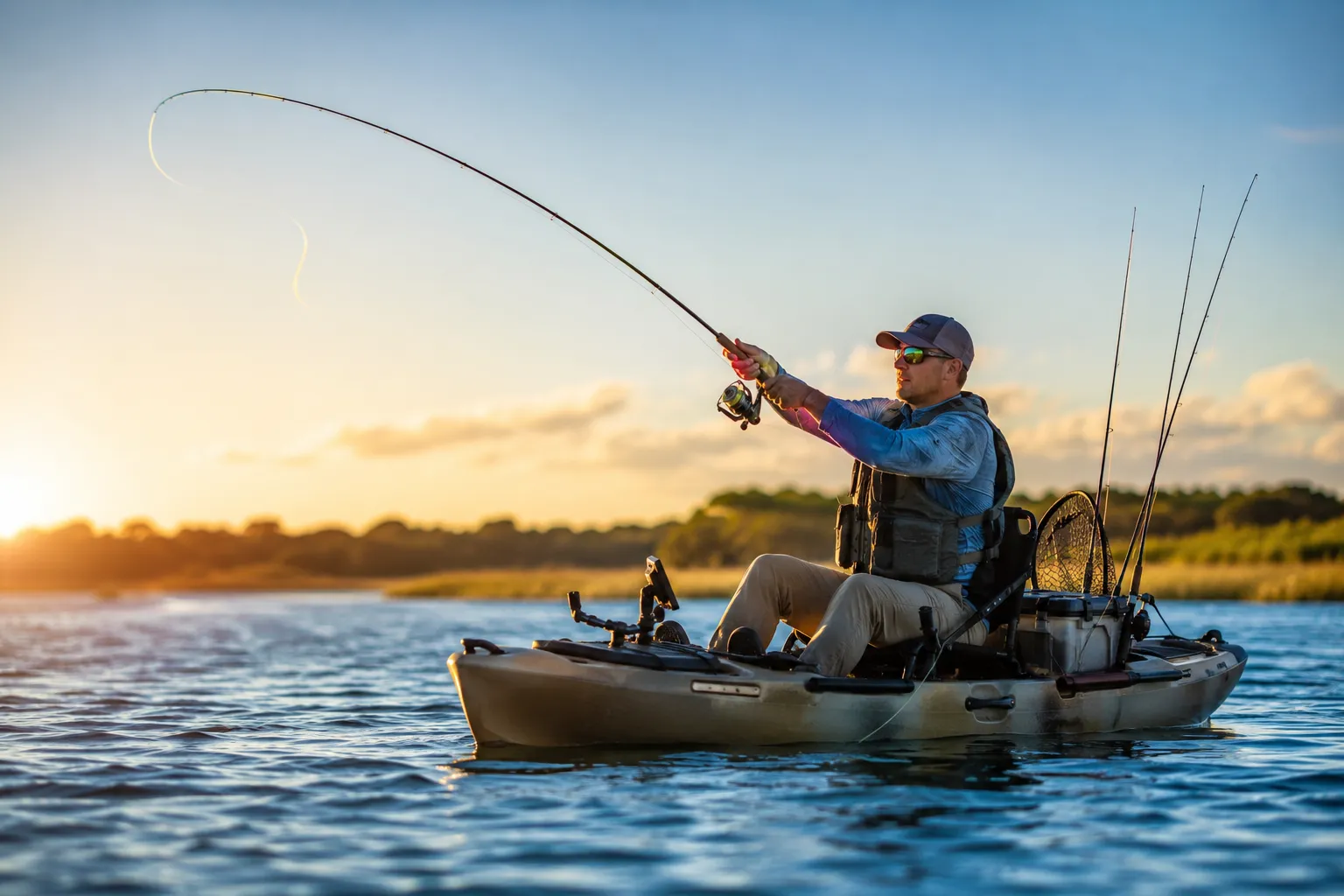
Casting from a sitting position requires adjusting your technique to work within a lower profile and limited range of motion. The key is rotating your upper body during the cast, keeping your rod tip high to clear obstacles, and using a smooth acceleration rather than relying on the power that comes from standing leverage. Most anglers can achieve 70-80% of their standing cast distance while seated with proper form, and accuracy often improves due to a more stable base.
Key Takeaways
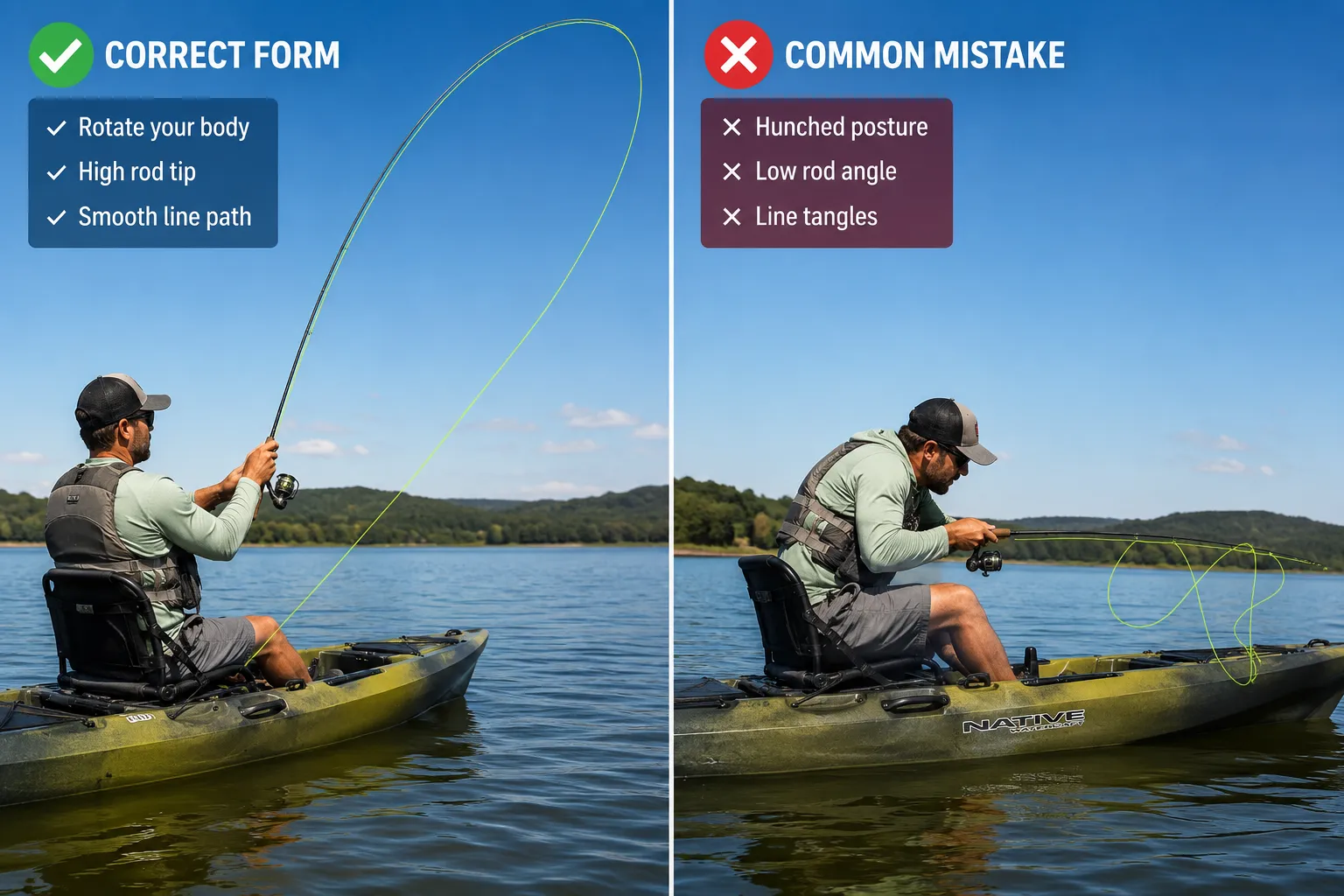
- Body rotation is essential, turn your shoulders and torso during the cast since you can’t use leg drive or full-body weight transfer
- Rod length matters, rods between 6’6″ and 7′ work best for seated casting, offering control without excessive tip height
- Keep your rod tip high, this prevents the line from hitting your lap, the kayak, or wheelchair armrests during the forward cast
- Sidearm and three-quarter casts are more effective than overhead casts when sitting, especially in confined spaces
- Line management prevents tangles, keep loose line organized and check for obstructions before each cast
- Practice builds muscle memory, seated casting uses different muscles than standing, so specific practice improves both distance and accuracy
- Adaptive techniques exist for wheelchair anglers, float tube users, and those with limited mobility
What Is the Proper Technique for Casting While Sitting Down
The proper seated casting technique centers on upper body rotation and controlled rod acceleration. Unlike standing casts where you can use your legs and full body weight, seated casts rely on shoulder rotation, core engagement, and precise timing.
Start by positioning your body at a 45-degree angle to your target rather than facing it directly. This setup allows maximum rotation during the cast. Grip the rod with your dominant hand on the reel and your other hand on the rod blank for two-handed control on longer rods, or use a one-handed grip for shorter rods under 7 feet.
The casting motion breaks down into four phases:
- Load phase, Bring the rod back smoothly while rotating your shoulders away from the target, keeping your elbow at roughly shoulder height
- Pause, Allow the rod to load fully; you should feel the weight of the lure bending the rod
- Acceleration, Rotate your shoulders toward the target while accelerating the rod tip forward in a smooth arc
- Release and follow-through, Release line at the rod’s maximum forward speed (roughly 10-11 o’clock position) and let the rod tip follow through toward the water
Common adjustment: Keep your casting elbow slightly away from your body rather than tucked in. This creates clearance and prevents the rod butt from catching on your torso or the seat.
The biggest mistake beginners make is trying to muscle the cast with just their arm. Power comes from rotation and rod loading, not arm strength alone.
Sitting vs Standing Casting: Which Is Better for Beginners
Sitting casts are often easier for beginners to learn because the stable, seated position eliminates balance concerns and reduces the number of moving parts in the casting motion. New anglers can focus entirely on rod control and timing without worrying about footwork or weight transfer.
Standing casts generate more power and distance through full-body mechanics, but they require better balance and coordination. For beginners fishing from kayaks, small boats, or shore chairs, starting seated builds confidence and develops the fundamental timing that applies to all casting styles.
Choose seated casting if you:
- Fish primarily from kayaks, canoes, or small boats where standing is unstable
- Have mobility limitations or balance concerns
- Are learning to cast and want to master timing before adding complexity
- Fish in tight spaces with overhead obstructions like tree canopies
Choose standing casting if you:
- Need maximum distance for surf fishing or large open-water situations
- Fish from stable platforms like large boats or solid docks
- Need to see over tall grass, reeds, or structure
- Have already mastered basic casting mechanics while seated
Many experienced anglers use both techniques depending on the situation. Learning seated casting first builds a solid foundation that translates well when you eventually stand.
Best Fishing Rod Length for Casting From a Seated Position
Rods between 6 feet 6 inches and 7 feet offer the best balance of casting distance, accuracy, and maneuverability when casting from a seated position. This length range provides enough leverage for good distance without creating excessive tip height that makes control difficult or causes the rod to hit obstacles.
Rod length considerations for seated casting:
- 6’6″ to 7′ (medium), Ideal for kayaks, small boats, and wheelchair fishing; easy to control, clears most seated obstructions
- 7′ to 7’6″ (medium-long), Works for taller anglers or when fishing open water with no overhead obstacles; provides extra distance
- Under 6’6″ (short), Best for ultra-tight spaces like float tubes or heavily wooded banks; sacrifices some distance for maximum control
- Over 7’6″ (long), Generally too unwieldy for seated casting; tip control becomes difficult and the rod is more likely to hit the kayak, chair, or other obstacles
Action matters as much as length. A medium or medium-fast action rod loads more easily with less effort, which is important when you can’t generate power from your legs. Fast-action rods require more aggressive loading and work better for experienced casters.
For kayak fishing specifically, 7-foot rods are the most popular choice because they handle both casting and fighting fish without being too long to store or maneuver in the cockpit.
If you fish from a wheelchair or specialized adaptive chair, test the rod while seated in your actual fishing position. Armrests, wheels, and seat height all affect which length works best for your setup.

DURABLE MATERIAL-The kayak paddle lanyard is made up of nylon fabric, which features with nice anti-corrosion performance and longer service life, and the fixed elongation will not overstretch and lose its elasticity.

Amazing Quality Graphite Blank: All CR7B 1-piece rods are constructed with 40-ton graphite blanks with carbon-wrapped veils. It's light weight yet providing great power, strength, durability, and sensitivity

Beauty & Performance Rod:The contrast between the black finish and the custom shark graphics skin decorative wrap and silver features that perfectly into the blue camouflage handles.Designed with an ergonomic camouflage handle that provides a comfortable grip, reducing fatigue during long fishing sessions
How to Get More Distance When Casting From a Kayak or Chair
Maximizing casting distance while seated comes down to three factors: proper rod loading, efficient energy transfer, and reducing friction in your setup. Most seated anglers can reach 60-80 feet with practice, which covers the vast majority of fishing situations.
Distance-boosting techniques:
Use a longer casting motion. Bring the rod farther back during your backcast to increase the loading phase. The rod should reach roughly 1 o’clock behind you (not straight back, which reduces control).
Accelerate smoothly, not abruptly. A smooth acceleration from slow to fast loads the rod progressively and releases energy efficiently. Jerky, sudden movements waste energy and reduce distance.
Time your release precisely. Release the line when the rod reaches maximum forward speed, typically when the tip is at 10 or 11 o’clock. Releasing too early sends the lure high; too late sends it into the water short.
Rotate your entire upper body. Your shoulders should rotate at least 90 degrees from backcast to follow-through. This rotation adds significant power that arm strength alone can’t provide.
Use the right lure weight. Your rod has an optimal lure weight range (printed near the handle). Lures at the heavier end of that range load the rod better and cast farther than ultra-light lures.
Check your line. Old, memory-coiled line creates friction in the guides and reduces distance by 10-20%. Fresh line with low memory (like braided line or quality monofilament) flows more freely.
Upgrade your guides. Larger guides with ceramic or titanium inserts reduce friction. If your rod has small, corroded guides, distance suffers.
Practice the double-haul (for experienced casters). This advanced technique involves pulling line with your non-rod hand during the cast to increase line speed and distance.
Distance isn’t everything. Accuracy matters more in most fishing situations, and seated casting often provides better accuracy due to the stable platform.

8 Fibers (Featuring one GORE Performance Fiber and 7 Dyneema Fibers)

CAST FURTHER & LASTS LONGER- Beyond Braid has a smooth fluoropolymer coating that allows for more efficient casts and longer distances every time. A thinner diameter slices through your guides and allows you to pack more line onto your reel.

CONTROLLED STRETCH: Nylon gives under load, which cushions a hookset and keeps treble hooks pinned when a fish surges boatside or a light drag takes a sudden headshake
Why Does My Line Tangle When I Cast Sitting Down
Line tangles during seated casts typically result from the line hitting an obstruction (your body, the seat, the kayak) during the forward cast or from poor line management before casting. The lower casting angle when seated increases the chance of these contact points.
Primary causes and solutions:
Low rod tip during the cast, If your rod tip drops below horizontal during the forward motion, the line can hit your lap, legs, or the front of your kayak. Solution: Keep the rod tip high throughout the entire casting motion, finishing with the tip pointed at your target.
Loose line in the cockpit, Excess line lying in your lap or around your feet can catch on gear, clothing, or the seat. Solution: Strip line directly into a line management system (stripping basket, small bucket, or designated area) rather than letting it fall randomly.
Wind from behind, Wind blowing from behind you can blow slack line forward, creating loops that tangle during the cast. Solution: Use a sidearm cast that keeps the line lower and less affected by wind, or position your kayak differently relative to the wind.
Reel bail not fully closed, A partially open bail allows line to come off the spool unevenly. Solution: After closing the bail, give the reel handle a full turn while holding tension on the line to ensure it’s fully engaged.
Rod guides misaligned, If guides are bent or twisted, line doesn’t flow smoothly through them. Solution: Inspect each guide before fishing and carefully straighten any that are bent.
Overfilled spool, Line filled too high on the spool (closer than 1/8 inch from the rim) can spring off in loops. Solution: Remove some line or use backing to achieve proper fill level.
Casting too hard, Overpowering the cast, especially with light lures, causes the line to spring off the spool in uncontrolled loops. Solution: Match your casting power to the lure weight and use smooth acceleration rather than a violent snap.
Before each cast, look down at your line path from reel to first guide. This quick check catches 90% of potential tangles before they happen.
Can You Cast Accurately While Sitting in a Boat
Yes, seated casting often produces better accuracy than standing because the stable, low center of gravity eliminates body sway and provides a consistent platform. Many tournament kayak anglers prefer seated casting for precision work around structure.
Accuracy while seated depends on three factors: a stable seating position, consistent casting mechanics, and practice with your specific setup. The reduced variables in seated casting (no leg movement, no balance adjustments) mean your casts become more repeatable once you develop proper form.
Accuracy advantages of seated casting:
- Stable base, No rocking or swaying means the rod moves through the same path every cast
- Lower profile, Less affected by wind, especially in kayaks where you sit close to the water
- Better sight lines, In a kayak, your eyes are closer to the water, making it easier to judge distance to targets
- Repeatable mechanics, Fewer body parts involved means more consistent motion
To maximize accuracy while seated:
Pick a specific target (a stump, a patch of lily pads, a rock) rather than casting to a general area. Your brain needs a precise focal point to guide the cast.
Use the same casting motion every time. Accuracy comes from repetition, so develop one reliable casting style and practice it until it becomes automatic.
Adjust your body position, not just your arm. Rotate your entire torso to aim at different targets rather than trying to steer the cast with just your arm and wrist.
Practice at various distances. Most anglers are accurate at one distance (usually their comfortable range) but struggle when they need to cast shorter or longer. Practice 20-foot, 40-foot, and 60-foot casts to build versatility.
Common accuracy mistake: Trying to steer the lure mid-cast by moving the rod tip left or right. This creates inconsistent results. Instead, aim your body and rod at the target before starting the cast, then execute the same smooth motion every time.
What Type of Cast Works Best When Fishing From a Wheelchair
Sidearm and three-quarter angle casts work best for wheelchair fishing because they keep the rod tip and line path clear of armrests, wheels, and the chair back while providing good distance and accuracy. Overhead casts often cause the rod butt to hit the chair or the line to catch on equipment.
Wheelchair-specific casting techniques:
Sidearm cast, The rod moves horizontally, parallel to the water. This keeps the entire casting motion in front of the chair and away from armrests. Best for: short to medium distances (20-50 feet), tight spaces, and situations where you need to keep the lure low.
Three-quarter cast, The rod moves at a 45-degree angle between sidearm and overhead. This provides more distance than a pure sidearm cast while still clearing most wheelchair components. Best for: medium to long distances (40-70 feet) and open-water fishing.
Roll cast (for fly fishing), The line rolls forward without a backcast, eliminating the need to bring the rod behind you. Best for: fly fishing from wheelchairs, situations with obstacles behind you.
Positioning tips for wheelchair anglers:
Angle your chair 30-45 degrees to your target rather than facing it directly. This allows your casting arm to move freely without the chair back blocking your backcast.
If your chair has removable armrests, consider removing the one on your casting side for maximum range of motion.
Use a rod holder mounted to the chair for hands-free rod storage between casts. This prevents the rod from falling and keeps it secure while you handle fish or adjust tackle.
Rod selection for wheelchair fishing: Choose rods in the 6’6″ to 7′ range with medium action. Shorter rods (under 6’6″) work well if you have limited upper body mobility. Longer rods become difficult to control and are more likely to hit the chair during casting.
Many adaptive fishing programs offer specialized instruction for wheelchair casting techniques. Organizations like Disabled Sports USA and local adaptive recreation programs provide hands-on coaching tailored to individual mobility levels.

2026 UPGRADED Clamp on Bike Rod Holder - Simply tighten the knob by hand for quick installation and removal of the clamp on rod holder from the bike pole. Align the circular grooves on the bike fishing rod holders with the clamp base and secure with the provided screw. Find fishing pole holder for bike right frame position like handles or folks and clamp it by rotating the knob.

Secure Your Rods and Reels: Store your fishing pole anywhere with this versatile bike fishing rod holder. It's a reliable rod holders for fishing boat, wheelchairs, bicycles, golf carts motorcycles, ATVs, kayaks, scooter, e bike, canoes, beach wagons. Perfect for fishing enthusiasts always on the go.

【Full Auto】Shackcom auto spring rod holder sensitively detects the fish bites lures, in the meanwhile, the fishing rod holder automatically pull up the fishing pole immediately. You just only wait on chair, relax in nature, free your hands, enjoy the time!【NOTICE: The bank fishing rod holder is required to be tested with fishing pole】
What Mistakes Do People Make When Casting From a Sitting Position
The most common mistake in seated casting is trying to use the same technique as standing casts without adjusting for the different body mechanics. This leads to poor distance, accuracy problems, and frustration.
Top seated casting mistakes and corrections:
Mistake: Not rotating the upper body
Anglers try to cast with just their arm, which severely limits power and distance. Correction: Rotate your shoulders at least 90 degrees from backcast to follow-through, engaging your core muscles.
Mistake: Dropping the rod tip too low
The rod tip drops below horizontal during the forward cast, causing the line to hit the angler’s lap or the kayak. Correction: Keep the rod tip high throughout the cast, finishing with it pointed at the target.
Mistake: Using too much arm strength
Trying to muscle the cast with arm power alone rather than letting the rod do the work. Correction: Focus on smooth acceleration and proper rod loading; the rod’s flex provides the power.
Mistake: Poor timing on the release
Releasing the line too early (lure goes high and short) or too late (lure hits the water immediately). Correction: Release when the rod reaches maximum forward speed, typically at 10-11 o’clock.
Mistake: Choosing the wrong rod length
Using a rod that’s too long (over 7’6″) makes control difficult and increases the chance of hitting obstacles. Correction: Stick with 6’6″ to 7′ rods for most seated fishing situations.
Mistake: Ignoring line management
Letting loose line fall randomly around the seat, creating tangles. Correction: Use a stripping basket or designate a specific area for line management.
Mistake: Facing the target directly
Sitting square to the target limits rotation and range of motion. Correction: Angle your body 45 degrees to the target to allow full shoulder rotation.
Mistake: Not practicing seated casting specifically
Assuming that standing casting skills automatically transfer to seated positions. Correction: Practice seated casting separately to build the specific muscle memory and timing it requires.
Mistake: Casting too hard with light lures
Overpowering light lures causes control problems and tangles. Correction: Match your casting power to the lure weight; lighter lures need gentler, more controlled casts.
The fastest way to identify your specific mistakes is to video yourself casting from the side angle. Watch the video and compare your motion to proper technique demonstrations.
Is Sitting or Standing Better for Fly Fishing From a Float Tube
Sitting is the only practical option for fly fishing from a float tube, but the technique differs significantly from standard seated fly casting. Float tubes position you low in the water with limited mobility, requiring specialized casting approaches.
Float tube fly casting adaptations:
Roll casts become your primary technique. The standard fly fishing backcast is nearly impossible in a float tube because you can’t rotate far enough and the tube itself blocks your backcast. Roll casts keep the line in front of you and work well in the confined space.
Use shorter rods. Fly rods in the 8′ to 8’6″ range work better than standard 9′ rods in float tubes. The shorter length provides better control in the limited space.
Master the water haul. This technique uses the water’s surface tension to load the rod instead of a traditional backcast. Let your fly line settle on the water, then lift and accelerate the rod forward, using the water’s resistance to load the rod.
Position matters more than casting distance. Since you can’t cast as far from a float tube, use your fins to position yourself closer to targets. Effective float tube anglers prioritize stealth and positioning over long casts.
Keep your rod tip high. The low position in a float tube means your rod tip is closer to the water than in any other fishing situation. Keep the tip elevated during the cast to maintain line control.
Wind creates major challenges. Float tubes sit low and catch wind easily, making them drift. Fish with the wind at your back when possible, and use heavier flies that cast more easily in wind.
Standing in a float tube is not recommended. Unlike fishing kayaks with standing platforms, float tubes don’t provide the stability or structure for standing. Attempting to stand creates a serious safety risk.
For anglers who want the option to stand while fly fishing, a standup paddleboard (SUP) or a fishing kayak with a standing platform offers better versatility than a float tube.
How to Avoid Hitting Yourself When Casting While Seated
Avoiding self-strikes while casting seated requires keeping the rod tip high, using proper casting angles, and maintaining awareness of the lure’s path throughout the cast. Most self-strikes happen during the backcast when anglers can’t see the lure.
Safety techniques to prevent self-strikes:
Use a sidearm or three-quarter cast instead of overhead. These angles keep the lure’s path away from your head and body throughout the entire casting motion.
Watch your backcast. Turn your head to track the lure during the backcast, especially when learning. Once you develop muscle memory, you’ll feel the proper timing without looking.
Wait for the rod to fully load. Rushing the forward cast before the rod loads completely causes the lure to swing forward unpredictably, sometimes toward your body.
Keep your casting elbow away from your body. An elbow tucked tight to your torso brings the rod path closer to your head and increases strike risk.
Shorten your backcast in tight spaces. You don’t need a full backcast for short-distance casts. A compact motion reduces the chance of hitting yourself or obstacles.
Use a casting plug for practice. Practice plugs (weighted rubber lures with no hooks) let you develop proper technique without injury risk.
Check for obstacles behind you. Tree branches, dock posts, or other anglers can catch your lure on the backcast, causing it to snap forward toward you.
Wear protective eyewear. Polarized sunglasses protect your eyes from errant casts and are essential safety gear for all fishing situations.
Be extra careful with treble hooks. Lures with multiple treble hooks (crankbaits, topwater plugs) are more likely to catch you if something goes wrong. Single hooks are safer for beginners.
If you do hook yourself, don’t panic. For hooks embedded past the barb, the proper removal technique is to push the hook through until the barb exits, cut off the barb with pliers, then back the hook out. For serious hook injuries, seek medical attention rather than attempting self-removal.
Do I Need a Different Reel for Sitting Casts
No, you don’t need a different reel specifically for seated casting. The same spinning reels, baitcasting reels, and fly reels that work for standing fishing work equally well when seated. However, certain reel features become more important in seated fishing situations.
Reel features that matter more when seated:
Smooth drag system, When fighting fish from a seated position (especially in a kayak), you have less ability to move with the fish. A smooth, reliable drag prevents break-offs when you can’t chase a running fish.
Adequate line capacity, Seated anglers often can’t reposition as quickly as shore anglers, so having enough line to handle long runs is important.
Comfortable handle, You’ll likely fight fish longer from a seated position since you can’t walk them in. A comfortable handle reduces hand fatigue.
Good gear ratio, For kayak fishing, a moderate gear ratio (around 6:1 for spinning reels) balances retrieval speed with cranking power, which matters when you can’t use body position to help fight fish.
Sealed or water-resistant construction, Kayak and boat anglers are closer to the water, increasing splash and spray exposure. Sealed reels last longer in these conditions.
Reel types and seated casting:
Spinning reels work well for seated casting because they’re easy to use, cast smoothly, and handle light lures effectively. They’re the most popular choice for kayak fishing.
Baitcasting reels provide more power and control but require more skill to prevent backlashes. They work fine for seated casting once you master the thumb control technique.
Fly reels function the same whether you’re sitting or standing. Choose based on the line weight you’re casting, not your body position.
The biggest reel consideration for seated fishing isn’t the reel itself but how you store it between casts. Use a rod holder to keep your rod secure rather than laying it across your lap where it can fall or get tangled.
How to Practice Casting From a Seated Position at Home
Practicing seated casting at home builds muscle memory and improves technique without the distractions of actual fishing. Set up a safe practice area in your yard or a local park where you can cast repeatedly without obstacles.
Home practice setup:
Create a practice station. Use a folding lawn chair, kayak seat, or even a bucket to simulate your actual fishing position. Practice from the same height and seating style you’ll use on the water.
Use practice plugs. Weighted rubber casting plugs (available at tackle shops) have the weight of real lures without hooks. They’re safe for practice and won’t damage your yard.
Set up targets. Place hula hoops, buckets, or towels at various distances (20, 40, and 60 feet) to practice accuracy. Start close and gradually increase distance as your accuracy improves.
Practice on grass, not pavement. Grass is softer on practice plugs and your line. Pavement can damage both and creates a safety hazard if the plug bounces.
Record yourself. Use your phone to video your casting motion from the side. Compare your technique to instructional videos to identify areas for improvement.
Practice specific scenarios. If you fish from a kayak, practice with a paddle across your lap. If you use a wheelchair, practice from your actual chair. Realistic practice transfers better to real fishing.
Effective practice drills:
Distance ladder, Cast to a 20-foot target five times, then 30 feet five times, then 40 feet, gradually increasing distance. This builds control across multiple ranges.
Accuracy challenge, Place a hula hoop at 40 feet and try to land 10 consecutive casts inside it. Track your success rate and try to improve each session.
Rapid casting, Practice making 20 casts as quickly as possible while maintaining good form. This builds the muscle memory for repetitive casting during actual fishing.
Obstacle course, Set up chairs or other obstacles to simulate fishing around structure. Practice casting under, around, and between obstacles.
One-handed casting, Practice casting with just your dominant hand (no support hand on the rod). This improves control and is useful when you need one hand free for paddle control or other tasks.
Wind practice, Practice on windy days to learn how wind affects your casts and develop compensation techniques.
Practice frequency matters more than duration. Three 15-minute practice sessions per week build better muscle memory than one 90-minute marathon session. Consistent, focused practice produces the fastest improvement.
Is Casting From a Kayak Harder Than From Shore
Casting from a kayak is different rather than inherently harder, with unique challenges and advantages compared to shore fishing. The main differences involve stability, positioning, and the mechanics of casting from a seated position.
Kayak casting challenges:
Limited mobility, You can’t walk to different positions as easily as shore anglers. Repositioning requires paddling, which takes more time and effort.
Lower casting angle, Sitting in a kayak puts you closer to the water, which can make it harder to cast over obstacles like grass beds or lily pads.
Stability concerns, Casting creates body movement that can rock the kayak, especially in narrower models. This affects both casting and fish-fighting.
Gear management, Everything must be secured or it will slide around or fall overboard. Loose line, tackle, and tools require more organization than shore fishing.
Wind and current, Kayaks drift constantly, requiring frequent repositioning. Shore anglers have a stable platform that doesn’t move.
Kayak casting advantages:
Access to unreachable spots, Kayaks reach areas that shore anglers can’t access, including offshore structure, islands, and the far side of lakes.
Stealth approach, Kayaks are quiet and create minimal disturbance, letting you get closer to fish than wading or boat motors allow.
360-degree casting, You can cast in any direction without obstacles behind you (trees, banks, other anglers).
Stable seated platform, Once you’re positioned, a kayak provides a stable base for accurate casting without the fatigue of standing all day.
Better angles on structure, You can position directly over or beside structure for vertical presentations that shore anglers can’t achieve.
Learning curve: Most anglers need 3-5 kayak fishing trips to feel comfortable with the casting mechanics and boat control. After that initial adjustment period, kayak casting becomes second nature.
The key to successful kayak casting is accepting that it’s a different skill set. Don’t try to replicate shore fishing techniques exactly. Instead, develop kayak-specific techniques that work with the platform’s strengths.
Frequently Asked Questions
What angle should I hold the rod when casting from a sitting position?
Hold the rod at a 45-degree angle (three-quarter cast) or horizontal (sidearm cast) rather than vertical. These angles keep the line clear of your body and the seat while providing good distance and control.
Can I cast as far sitting down as I can standing up?
Most anglers achieve 70-80% of their standing cast distance while seated with proper technique. The reduced distance rarely matters in practical fishing situations, and the improved accuracy often compensates.
Why do I keep hitting the kayak with my lure when casting?
You’re likely dropping your rod tip too low during the forward cast or not rotating your body enough. Keep the rod tip high and rotate your shoulders fully toward the target to keep the lure’s path clear of the kayak.
Should I use braided line or monofilament for seated casting?
Both work well, but braided line has less memory and flows through guides more smoothly, which can add 5-10 feet of distance. Monofilament is more forgiving for beginners and has better shock absorption.
How do I cast in wind while sitting in a kayak?
Use sidearm casts that keep the line low and less affected by wind. Cast with the wind at your back when possible, and use slightly heavier lures that cut through wind better than ultra-light baits.
Is a longer or shorter rod better for kayak fishing?
A 7-foot rod is the most versatile length for kayak fishing, offering good distance and control without being too long to store or maneuver. Shorter rods (6’6″) work better in very tight spaces.
Can I practice casting while sitting on my couch?
Yes, but use a practice plug with no hooks and make sure you have enough ceiling height. A better option is practicing outside in a chair where you can actually cast and see where the plug lands.
Do I need special casting lessons for wheelchair fishing?
While not required, adaptive fishing programs offer valuable instruction tailored to wheelchair anglers. Many techniques differ from standard seated casting, so specialized coaching can accelerate your learning.
How do I keep my line from tangling around my legs when casting?
Keep your rod tip high throughout the cast, and use a stripping basket or designated line management area rather than letting line fall randomly in your lap.
What’s the best way to learn seated casting quickly?
Practice at home with a casting plug and targets at various distances. Record yourself to identify technique issues, and focus on smooth acceleration and proper body rotation rather than trying to cast hard.
Should I cast with one hand or two hands while sitting?
Use two hands for rods over 7 feet to maintain better control. Shorter rods can be cast effectively one-handed, which is useful when you need your other hand for paddle control or balance.
How close should I get to my target when casting from a kayak?
Position yourself 30-50 feet from your target for most situations. This distance is easy to cast accurately while seated and keeps you far enough away to avoid spooking fish in clear water.
Conclusion
Mastering how to cast from a sitting position opens up new fishing opportunities whether you’re in a kayak, fishing from a wheelchair, or simply prefer the stability and comfort of seated fishing. The key differences from standing casts, upper body rotation, high rod tip position, and smooth acceleration, become second nature with focused practice.
Start by choosing the right rod length (6’6″ to 7′ for most situations), practice your technique at home with casting plugs and targets, and focus on body rotation rather than arm strength. Remember that seated casting often provides better accuracy than standing due to the stable platform, even if you sacrifice some distance.
Your next steps:
- Assess your current rod length and consider whether it’s optimal for seated casting
- Set up a practice area at home with targets at 20, 40, and 60 feet
- Video yourself casting to identify technique issues
- Practice for 15 minutes three times per week to build muscle memory
- Apply your improved technique on the water, starting with short casts and gradually increasing distance
Whether you’re kayak fishing, using adaptive equipment, or simply exploring new fishing methods, seated casting is a valuable skill that expands where and how you can fish effectively. The initial adjustment period is brief, and the benefits, access to new water, improved accuracy, and all-day comfort, make it well worth the effort to develop proper technique.