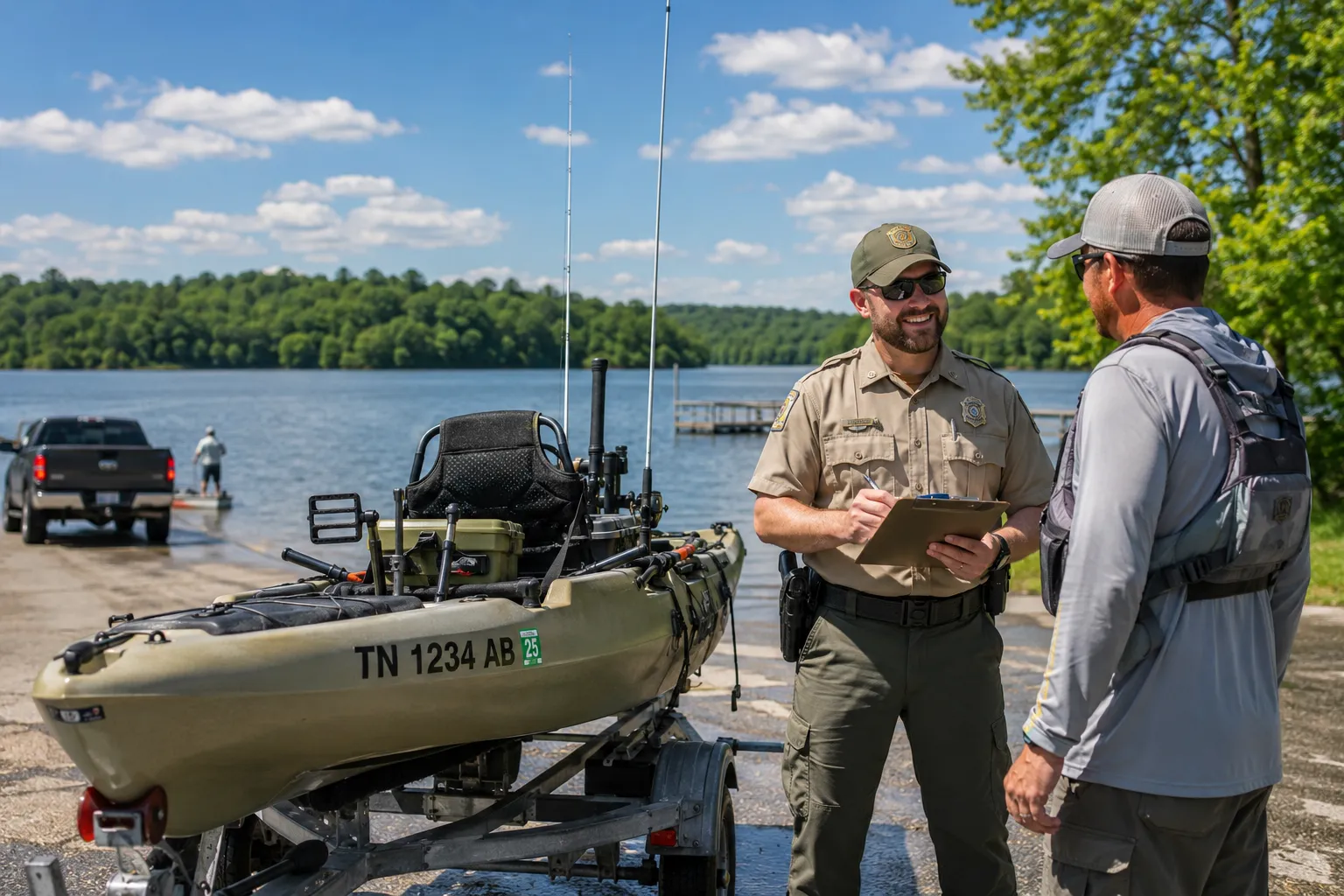
More than 13 million Americans paddled a kayak in 2025, and a growing number of them are fishing from their boats. But before you launch that new fishing kayak, you might be breaking the law without even knowing it. Whether you need to register a fishing kayak depends on your state, the type of propulsion system you use, and where you plan to fish.
Key Takeaways
- Most states require registration only for motorized kayaks, including those with electric trolling motors or pedal drives in some jurisdictions
- Registration costs typically range from $10 to $50 for a multi-year period, varying by state
- Paddle-only fishing kayaks are exempt from registration in most states, but a few require all watercraft to be registered regardless of propulsion
- Fines for operating an unregistered kayak can reach $100 to $500 depending on your state’s enforcement policies
- Inflatable fishing kayaks follow the same registration rules as hard-shell kayaks based on propulsion type
- Interstate kayak fishing requires understanding multiple states’ rules, as registration from your home state may not be recognized elsewhere
- Private pond use typically doesn’t require registration, but rules vary if the pond connects to public waterways
- Common registration mistakes include failing to display numbers properly and not renewing on time
Do All Kayaks Need to Be Registered or Just Motorized Ones?
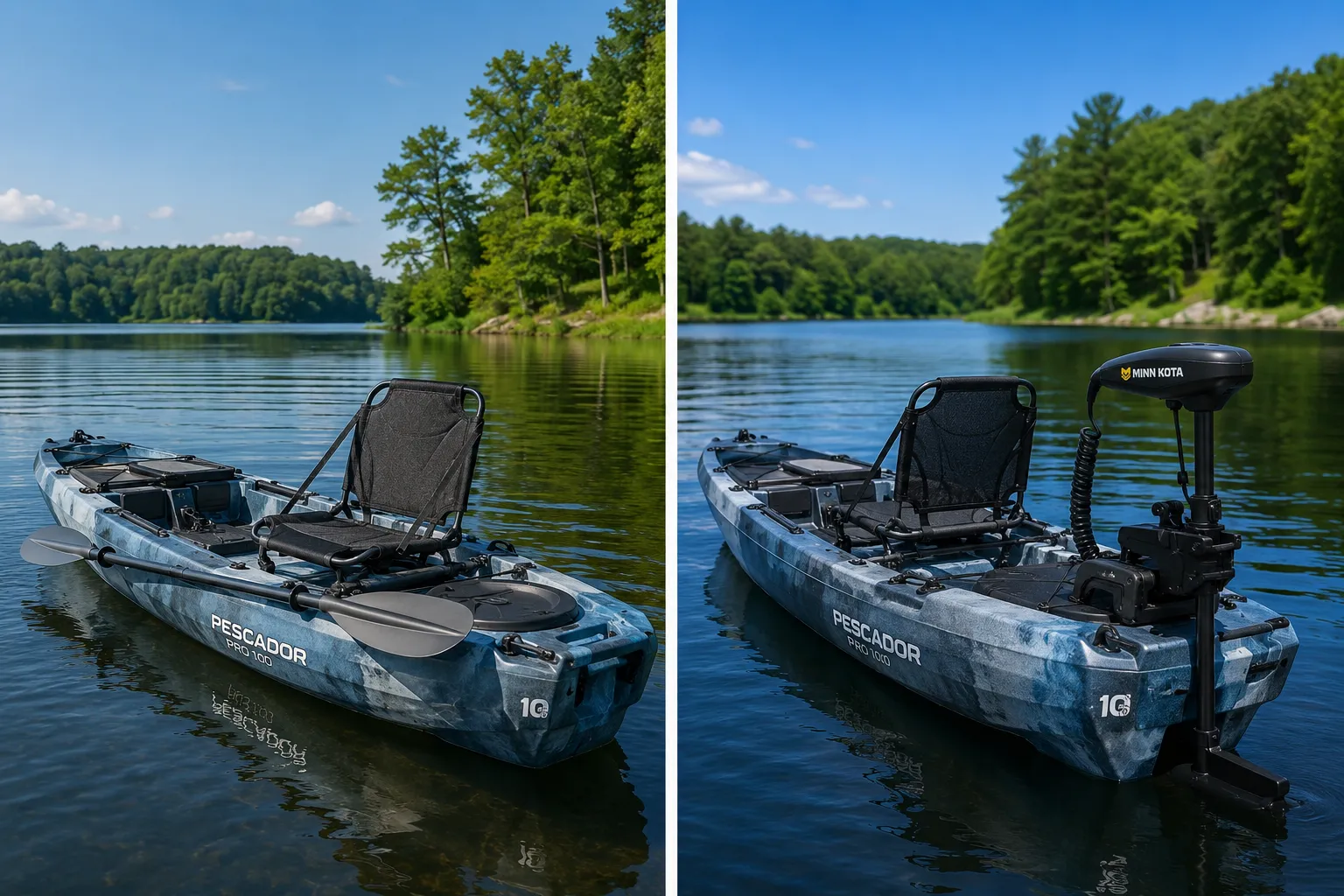
In most states, only motorized kayaks require registration. A paddle-only fishing kayak can be launched on public waters without any registration, title, or license plate in the majority of U.S. jurisdictions.
The key distinction is propulsion type. If you paddle your fishing kayak using only a double-bladed paddle, most states classify it as a non-motorized vessel exempt from registration requirements. However, the moment you attach any motor, even a small electric trolling motor, the rules change.
States that require registration for motorized kayaks include:
- Alabama
- Arizona
- California
- Colorado
- Florida
- Georgia
- Michigan
- Minnesota
- New York
- Texas
- Washington
- Wisconsin
Exceptions to watch for:
- Ohio requires registration for all watercraft over 10 feet, regardless of propulsion
- Pennsylvania requires registration for all boats used on Pennsylvania waters, including non-motorized kayaks
- Alaska requires registration for motorized vessels only, but defines “motorized” broadly
Choose paddle-only if: You want to avoid registration fees and paperwork entirely, and you don’t mind the physical effort of paddling all day.
Choose motorized if: You’re willing to register your kayak in exchange for covering more water with less effort, especially on large lakes or when fighting wind and current.

【Partner For Paddles】 Designed to prevent losing your paddle on water, paddle leash is an essential kayak accessory for every paddler. A leash at a nice price but could keep your paddle always secure. Find the perfect partner for your paddles!
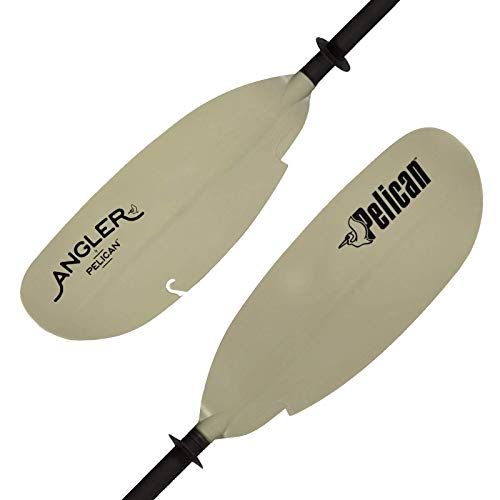
The Poseidon Angler Kayak Paddle is ideal for angler paddlers taller than 5'5". Measuring 98.5” (250cm) long, this paddle is the perfect match for wider fishing kayaks

✿【DURABLE MATERIAL】The kayak paddle lanyard is made up of nylon fabric, which features with nice anti-corrosion performance and longer service life, and the fixed elongation will not overstretch and lose its elasticity.
What States Require Fishing Kayak Registration?
State registration requirements for fishing kayaks vary dramatically across the country. Some states require all kayaks to be registered, others only motorized kayaks, and a few have no kayak registration requirements at all.
States requiring ALL kayaks to be registered (motorized and non-motorized):
- Ohio (vessels over 10 feet)
- Pennsylvania (all boats on state waters)
States requiring ONLY motorized kayaks to be registered:
- Alabama, Arizona, Arkansas, California, Colorado, Connecticut, Delaware, Florida, Georgia, Idaho, Illinois, Indiana, Iowa, Kansas, Kentucky, Louisiana, Maine, Maryland, Massachusetts, Michigan, Minnesota, Mississippi, Missouri, Montana, Nebraska, Nevada, New Hampshire, New Jersey, New Mexico, New York, North Carolina, North Dakota, Oklahoma, Oregon, Rhode Island, South Carolina, South Dakota, Tennessee, Texas, Utah, Vermont, Virginia, Washington, West Virginia, Wisconsin, Wyoming
States with NO kayak registration requirements:
- Alaska (for non-motorized only)
- Hawaii (for non-motorized only)
Important state-specific nuances:
- California: Requires registration for kayaks with motors, but offers a special “CF” numbering system for small vessels
- Florida: Requires registration for any vessel with a motor, including electric trolling motors, but exempts paddle-only kayaks
- New York: Requires registration for motorized kayaks but offers a simplified process for small electric motors under certain horsepower
- Texas: Requires registration and a title for motorized kayaks; paddle kayaks are exempt
Common mistake: Assuming that because you registered your kayak in your home state, you’re legal everywhere. Always check the specific requirements of any state where you plan to fish.
How Much Does It Cost to Register a Kayak?
Kayak registration fees are generally affordable, ranging from $10 to $50 for a multi-year registration period. The exact cost depends on your state, the length of your kayak, and whether it’s motorized.
Typical registration fee ranges by state:
- Low-cost states ($10-$20 for 2-3 years): Alabama, Arkansas, Idaho, Montana, South Dakota, Wyoming
- Mid-range states ($20-$35 for 2-3 years): Colorado, Florida, Georgia, Michigan, Minnesota, North Carolina, Texas, Wisconsin
- Higher-cost states ($35-$50+ for 2-3 years): California, Massachusetts, New York, Washington
Additional costs to consider:
- Title fees: Some states require a title for motorized kayaks, adding $5-$15 to your initial registration
- Processing fees: Online registration may include a $2-$5 convenience fee
- Decal replacement: If you lose your registration stickers, replacement costs $5-$10
- Late renewal penalties: Renewing after expiration can add $10-$25 in late fees
Example cost breakdown (Florida):
- Initial registration for kayak under 16 feet: $27.50 (2-year period)
- Title fee (one-time): $5.25
- Processing fee: $2.00
- Total first-time cost: $34.75
Money-saving tip: Many states offer longer registration periods (3-5 years) at a discounted rate compared to annual renewal. If you plan to keep your kayak long-term, opt for the longest period available.
Choose to register even if exempt if: You plan to add a motor later, fish in multiple states, or want official proof of ownership for insurance purposes.

COMPLETE 146-PIECE VESSEL KIT: Includes 4 full sets of letters (A-Z) and 4 full sets of numbers (0-9). This single kit provides more than enough characters to mark both the Port and Starboard sides of your boat or PWC, with extras for tender vessels or mistakes.

US COAST GUARD COMPLIANT: Meets all US Coast Guard (USCG) and state requirements for boat registration visibility. The 3-inch block-style font ensures your vessel numbers are legible for law enforcement and marina officials on all waterways.

All styles of the boat registration hull numbers letters decals measure in at 3 inches in height
Difference Between Registering a Kayak and a Boat
Registering a fishing kayak is generally simpler and cheaper than registering a traditional boat, but the core requirements are similar. Both processes establish legal ownership and ensure the vessel meets state safety standards.
Key differences:
| Aspect | Kayak Registration | Boat Registration |
|---|---|---|
| Cost | $10-$50 (multi-year) | $30-$200+ (annual or biennial) |
| Title requirement | Only if motorized (most states) | Required in most states |
| Safety inspections | Rarely required | Often required for larger vessels |
| Insurance | Not typically required | May be required for financed boats |
| Documentation | State registration only | May require federal documentation for vessels over 26 feet |
| Renewal frequency | 2-5 years typical | 1-3 years typical |
Similarities between kayak and boat registration:
- Both require displaying registration numbers on the hull
- Both require carrying proof of registration while on the water
- Both require renewal before expiration
- Both establish legal ownership
- Both may require reporting if the vessel is sold or transferred
Important distinction: Federal documentation (through the U.S. Coast Guard) is not required for kayaks. Even large fishing kayaks fall well below the 26-foot threshold that triggers federal documentation requirements.
Common mistake: Treating kayak registration as optional because “it’s not really a boat.” In states that require registration, a kayak is legally a vessel subject to the same enforcement as any other watercraft.
Can I Get Fined for Not Registering My Fishing Kayak?
Yes, you can be fined for operating an unregistered fishing kayak if your state requires registration. Penalties range from $50 to $500 depending on the jurisdiction and whether it’s a first or repeat offense.
Typical fine structures:
- First offense: $50-$150 fine plus court costs
- Second offense: $100-$300 fine plus potential impoundment
- Third offense: $250-$500 fine, possible criminal charges, vessel impoundment
Real enforcement scenarios:
Law enforcement officers, including game wardens, DNR officers, and marine patrol, actively check for proper registration at boat launches, on the water, and during fishing license checks. Kayak anglers are not exempt from these checks.
States with aggressive enforcement:
- Florida: Marine patrol regularly checks kayak registration at popular fishing spots
- California: Department of Fish and Wildlife officers check registration during fishing license inspections
- Texas: Game wardens have authority to check registration and can impound unregistered vessels
- Michigan: DNR officers conduct regular watercraft checks at launch sites
Additional consequences beyond fines:
- Vessel impoundment: Your kayak can be confiscated until you provide proof of registration
- Court appearance: Some jurisdictions require appearing before a judge
- Criminal record: Repeat offenses may result in misdemeanor charges
- Insurance issues: Operating an unregistered vessel may void any watercraft insurance coverage
Risk assessment: The likelihood of getting caught depends on where you fish. High-traffic public lakes and rivers with active law enforcement presence carry higher risk than remote backcountry waters.
Choose to register if: You fish on public waters in a state that requires it, regardless of how remote the location seems. The one-time cost of registration is far less than a single fine.
Do I Need to Register a Kayak With a Trolling Motor?
Yes, in nearly all states that require watercraft registration, adding a trolling motor to your fishing kayak triggers the registration requirement. This applies even to small electric trolling motors that draw minimal power.
Why trolling motors trigger registration:
State laws typically define a “motorized vessel” as any watercraft equipped with a motor capable of propulsion, regardless of size or power source. A 30-pound-thrust electric trolling motor meets this definition just as much as a 250-horsepower outboard.
States with specific trolling motor rules:
- Florida: Any motor, including electric trolling motors, requires registration
- California: Electric motors require registration; no minimum horsepower threshold
- Texas: All motors require registration and a title
- Minnesota: Electric trolling motors trigger registration requirements
- Wisconsin: Any motor, regardless of power source, requires registration
Exceptions and gray areas:
- Alaska: Allows small electric motors under certain conditions without registration on some waters
- Montana: Has specific exemptions for electric motors under 10 horsepower on certain lakes
Installation timing matters:
If you buy a kayak without a motor and register it as non-motorized (in states requiring all kayaks to register), you must update your registration when you add a trolling motor. Failing to update can result in fines.
Common mistake: Assuming that because the motor is removable, you can claim the kayak is “non-motorized” when convenient. If the motor is present on the kayak while on the water, the vessel is motorized for registration purposes.
Choose a trolling motor if: You’re willing to handle the registration requirement in exchange for hands-free propulsion, better boat control in wind and current, and the ability to cover more water while keeping your hands free for fishing.
How to Register a Fishing Kayak in My State
The kayak registration process is straightforward in most states and can often be completed online in 15-30 minutes. You’ll need proof of ownership, personal identification, and payment for the registration fee.
Step-by-step registration process:
Gather required documents:
- Bill of sale or manufacturer’s certificate of origin
- Driver’s license or state ID
- Proof of residency (utility bill or lease agreement)
- Hull identification number (HIN) from your kayak
Determine your state’s registration authority:
- Department of Natural Resources (DNR)
- Department of Motor Vehicles (DMV)
- Parks and Wildlife Department
- Fish and Game Department
Choose registration method:
- Online: Fastest option, available in most states, results in 3-7 days
- In-person: Visit local office, walk out with temporary registration
- Mail: Complete paper forms, mail with payment, wait 2-4 weeks
Complete the application:
- Provide kayak details (make, model, year, length, HIN)
- Declare propulsion type (paddle-only or motorized)
- Choose registration period (if options available)
- Pay registration fee
Receive registration materials:
- Registration certificate (carry on kayak)
- Registration decals/numbers (affix to hull)
- Renewal notice (note expiration date)
State-specific online registration portals:
- Florida: flhsmv.gov/dmv/boats
- California: dmv.ca.gov/boats
- Texas: tpwd.texas.gov/fishboat/boat/boat_registration
- Michigan: michigan.gov/dnr
- Minnesota: dnr.state.mn.us/licenses/watercraft
How to display registration numbers properly:
Registration numbers must be displayed on both sides of the bow (front) of your kayak. The numbers should be:
- At least 3 inches tall
- Block letters and numbers
- Contrasting color to the hull
- Read from left to right
- Separated from any other numbers by a space or hyphen
Example proper format: FL 1234 AB
Common registration mistakes:
- Registering in the wrong state (must register in your state of primary residence)
- Failing to transfer registration when buying a used kayak
- Not updating registration when moving to a new state
- Letting registration expire without renewing
- Displaying numbers incorrectly or in the wrong location

US COAST GUARD COMPLIANT: Meets all US Coast Guard and state specific requirements for boat registration visibility. Features the required 3-inch block font design to ensure your vessel is legal on public waterways. The solid white color provides high contrast on dark hulls, ensuring readability by marine patrol.

US COAST GUARD COMPLIANT: Meets all US Coast Guard and state specific guidelines for registration visibility. Each character stands a full 3 inches tall, ensuring your vessel is legally marked and easily identifiable on the water.

COMPLETE REGISTRATION KIT: Includes everything you need to mark both the port and starboard sides of your vessel. The 146-piece set contains 4 sets of letters (A-Z) and 4 sets of numbers (0-9), ensuring you have plenty of characters for any state registration code.
Do Inflatable Fishing Kayaks Need Registration?
Inflatable fishing kayaks follow the same registration rules as hard-shell kayaks. If your state requires registration for motorized kayaks and you add a motor to your inflatable, you must register it. Paddle-only inflatable kayaks are exempt in states that only require motorized vessels to be registered.
Why inflatable status doesn’t matter:
State watercraft laws classify vessels by propulsion type and use, not by construction material. An inflatable kayak used for fishing is legally identical to a hard-shell kayak for registration purposes.
Practical considerations for inflatable kayak registration:
- Number placement: Registration numbers must still be displayed on both sides of the bow, which can be challenging on inflatable surfaces
- Decal adhesion: Standard registration decals may not stick well to PVC or Hypalon; use marine-grade adhesive or vinyl numbers
- Deflation and storage: Numbers must remain visible and legible even after repeated inflation and deflation cycles
- Temporary vs. permanent numbers: Some kayakers use removable vinyl numbers on inflatables to avoid permanent marking
Best practices for marking inflatable kayaks:
- Use marine-grade vinyl letter and number sets designed for inflatable boats
- Apply numbers to the flattest, most rigid section of the bow tubes
- Clean and dry the surface thoroughly before application
- Consider using a contrasting color patch as a background for better visibility
- Test adhesion before launching to ensure numbers won’t peel off in water
States with specific inflatable vessel guidance:
- Florida: Provides specific instructions for marking inflatable vessels in registration materials
- California: Allows temporary registration numbers for inflatable kayaks that are frequently deflated
- Texas: Requires permanent marking even on inflatable vessels
Common mistake: Assuming inflatable kayaks are “toys” exempt from registration. If you’re using an inflatable fishing kayak on public waters with a motor, it’s a registered vessel in most states.
What Happens If I Use My Kayak in a Different State?
Using your fishing kayak in a different state requires understanding reciprocity agreements and temporary use provisions. Most states honor valid out-of-state kayak registrations for short-term visitors, but rules vary significantly.
General reciprocity rules:
- Short-term visits (under 60-90 days): Most states honor your home state registration
- Extended stays or relocation: You must register in the new state within 60-90 days
- Seasonal residents: Rules vary; some states require registration if you’re present more than 6 months
- Border waters: Special rules often apply to rivers and lakes that form state boundaries
States with strict non-resident rules:
- California: Requires non-resident kayaks with motors to obtain a California registration if used more than 60 consecutive days
- Florida: Honors out-of-state registration for up to 90 days; after that, Florida registration required
- Texas: Requires Texas registration for any vessel “regularly used” in Texas waters, regardless of owner’s residence
States with generous reciprocity:
- Michigan: Honors all valid out-of-state registrations for non-residents
- Wisconsin: Accepts out-of-state registration for temporary visits
- Minnesota: Honors valid registrations from other states for visitors
Special cases:
- Unregistered home state, registered destination state: If your home state doesn’t require kayak registration but you’re visiting a state that does, you may need to obtain a temporary registration or non-resident permit
- Border fishing: When fishing on boundary waters (like the Mississippi River between states), you’re typically legal if registered in either state, but check specific agreements
Multi-state fishing trip strategy:
- Register your kayak in your home state (if required)
- Research registration requirements for destination states
- Carry your registration certificate on every trip
- Keep a copy of reciprocity rules from destination state websites
- If staying longer than 60 days, register in the destination state
Common mistake: Assuming that because you’re “just visiting,” registration rules don’t apply. Law enforcement officers in popular fishing destinations actively check kayak registration, especially during peak seasons.
Do I Need Registration for a Sit-On-Top Fishing Kayak?
Sit-on-top fishing kayaks are subject to the same registration requirements as sit-inside kayaks. The hull design and seating configuration don’t affect registration rules; only propulsion type and state law matter.
Why sit-on-top vs. sit-inside doesn’t matter for registration:
State watercraft laws define vessels by their propulsion method and intended use, not by their design features. A sit-on-top kayak is legally a kayak, subject to the same rules as any other kayak design.
Registration requirements for sit-on-top kayaks:
- Paddle-only sit-on-top: Exempt from registration in most states (except Ohio, Pennsylvania)
- Sit-on-top with trolling motor: Requires registration in all states that require motorized vessel registration
- Sit-on-top with pedal drive: See pedal drive section below for specific rules
Practical considerations for sit-on-top registration:
Sit-on-top kayaks actually make registration number display easier than sit-inside designs. The wide, flat bow area provides an ideal surface for affixing registration numbers that remain visible and legible.
Best placement for registration numbers on sit-on-top kayaks:
- Position numbers on the upper surface of the bow, 3-6 inches back from the nose
- Use the flattest section of the hull for best adhesion
- Ensure numbers are visible from both sides when viewed from the front
- Avoid placing numbers on curved or textured sections where they may peel
Common mistake: Believing that because sit-on-top kayaks are often marketed as “recreational” rather than “boats,” they’re exempt from registration. Marketing categories have no legal bearing on registration requirements.
Common Mistakes When Registering a Kayak for the First Time
First-time kayak registration can be confusing, and several common errors can delay your registration or result in fines. Understanding these pitfalls helps ensure a smooth registration process.
Top registration mistakes and how to avoid them:
1. Registering in the wrong state
- Mistake: Registering in a state where you frequently fish rather than your state of residence
- Fix: Always register in your state of primary residence, regardless of where you fish most often
2. Incorrect number display
- Mistake: Using numbers that are too small, wrong color, or improperly formatted
- Fix: Follow your state’s specific requirements for size (usually 3 inches), color contrast, and format
3. Missing the hull identification number (HIN)
- Mistake: Leaving the HIN field blank or entering it incorrectly
- Fix: Locate the HIN on the stern (rear) of your kayak, usually on the upper right side; it’s a 12-character code
4. Not updating registration after modifications
- Mistake: Adding a motor to a registered non-motorized kayak without updating the registration
- Fix: File an amendment with your state’s registration authority whenever you add or remove a motor
5. Losing registration documents
- Mistake: Not keeping a waterproof copy of registration on the kayak
- Fix: Store registration certificate in a waterproof bag attached to your kayak; keep a photo backup on your phone
6. Missing renewal deadlines
- Mistake: Forgetting to renew registration before expiration
- Fix: Set a calendar reminder 30 days before expiration; many states send renewal notices but don’t rely on them
7. Incorrect ownership documentation
- Mistake: Trying to register a used kayak without proper transfer paperwork from the previous owner
- Fix: Obtain a signed bill of sale with the seller’s information, purchase price, date, and kayak details (HIN, make, model)
8. Paying the wrong fee
- Mistake: Underpaying because you selected the wrong vessel type or length category
- Fix: Measure your kayak accurately and select the correct propulsion type on the application
9. Not researching multi-state requirements
- Mistake: Assuming home state registration covers you everywhere
- Fix: Check registration reciprocity rules for any state where you plan to fish
10. Registering too late
- Mistake: Waiting until after you’ve already been stopped by law enforcement
- Fix: Register before your first launch on public waters; processing can take 1-4 weeks
First-time registration checklist:
- Verify your state requires registration for your kayak type
- Gather bill of sale or manufacturer’s certificate
- Locate and record your kayak’s HIN
- Measure kayak length accurately
- Determine correct propulsion type (paddle, electric motor, etc.)
- Calculate correct registration fee
- Complete application accurately
- Choose appropriate registration period
- Order or prepare registration numbers in correct size and color
- Set renewal reminder for expiration date
Is Kayak Registration Required for Private Ponds?
Kayak registration is typically not required for use on private ponds that have no connection to public waterways. However, state laws vary, and some jurisdictions require registration for all motorized vessels regardless of where they’re used.
General rule for private water:
Most states exempt vessels used exclusively on private property from registration requirements. If you own the pond or have permission from the landowner, and the pond has no outlet to public waters, registration is usually not required.
Exceptions and special cases:
States that may still require registration on private water:
- Pennsylvania: Requires registration for all boats, even those used exclusively on private property
- Ohio: Requires registration for vessels over 10 feet, regardless of where used
- Some counties and municipalities: May have local ordinances requiring registration even on private property
When private pond use requires registration:
- The pond connects to a public waterway (stream, river, or lake)
- You transport the kayak across public roads to reach the pond
- The pond is accessible to the public (even if privately owned)
- Local zoning or HOA rules require registration
- You plan to use the kayak on public waters at any point
Practical considerations:
Even if registration isn’t legally required for private pond use, consider registering anyway if:
- You might occasionally fish public waters
- You want proof of ownership for insurance purposes
- You’re transporting the kayak on public roads (some states require registration for trailered vessels)
- The pond has any connection to public waterways, even seasonal
Common mistake: Assuming that because you only fish private ponds, you never need registration. If you transport your kayak across public roads or occasionally launch on public waters, registration may be required.
Choose to register even for private use if: You want the flexibility to fish anywhere without worrying about compliance, or if your state requires registration regardless of where the vessel is used.
Pedal Drive Kayak Registration Requirements vs. Paddle Kayaks
Pedal drive kayaks occupy a gray area in registration law. Some states classify them as motorized vessels requiring registration, while others treat them as non-motorized because they’re human-powered.
The pedal drive classification debate:
Pedal drive systems (like Hobie MirageDrive, Old Town PDL, or Native Propel) use human power transmitted through a mechanical drive system. They have no motor, engine, or battery, but they do have a propulsion mechanism beyond a simple paddle.
States that require registration for pedal drive kayaks:
- Florida: Classifies pedal drives as “mechanical propulsion” requiring registration
- California: Requires registration for any “mechanically propelled” vessel, including pedal drives
- Texas: Requires registration for pedal drive kayaks
- New York: Treats pedal drives as motorized for registration purposes
States that exempt pedal drive kayaks from registration:
- Michigan: Considers pedal drives human-powered and exempt
- Wisconsin: Does not require registration for pedal-powered kayaks
- Minnesota: Exempts human-powered vessels regardless of drive mechanism
- North Carolina: Treats pedal drives as non-motorized
States with unclear or evolving rules:
Several states have not explicitly addressed pedal drive systems in their watercraft laws. In these jurisdictions, enforcement may vary by officer or region. When in doubt, contact your state’s watercraft registration authority for clarification.
Why the distinction matters:
The difference between registering and not registering can mean:
- $20-$50 in fees
- Displaying registration numbers on your kayak hull
- Carrying registration documents
- Renewing every 2-3 years
- Potential fines if you guess wrong
Comparison: Pedal drive vs. electric motor vs. paddle
| Feature | Paddle Only | Pedal Drive | Electric Motor |
|---|---|---|---|
| Power source | Human arms | Human legs | Battery |
| Registration (most states) | Not required | Varies by state | Required |
| Typical cost | $0 | $0-$50 | $20-$50 |
| Number display | No | Depends on state | Yes |
| Renewal required | No | Depends on state | Yes |
How to determine if your pedal drive kayak needs registration:
- Check your state’s watercraft registration website for specific language about “mechanical propulsion” or “pedal-powered vessels”
- Call your state’s DNR or watercraft registration office directly
- Ask for written clarification if the rules are unclear
- When in doubt, register, it’s cheaper than a fine
Common mistake: Assuming pedal drives are always exempt because they’re human-powered. Several states explicitly require registration for any mechanical propulsion system, regardless of power source.
Choose pedal drive if: You want hands-free propulsion and better speed than paddling, and you’re willing to navigate the registration requirements in your state.
Frequently Asked Questions
Do I need a title for my fishing kayak?
Most states only require a title for motorized kayaks, and some don’t require titles for kayaks at all. Check your state’s specific requirements; typically, only registration (not a title) is needed for kayaks under 16 feet.
Can I register my kayak online?
Yes, most states offer online kayak registration through their DNR or DMV websites. Online registration is usually faster than mail or in-person, with processing times of 3-7 business days.
How long does kayak registration last?
Registration periods vary by state but typically last 1-3 years. Some states offer longer periods (up to 5 years) at discounted rates. Check your registration certificate for the expiration date.
What if I buy a used kayak that’s already registered?
You must transfer the registration to your name within 15-30 days of purchase (timeframe varies by state). You’ll need a bill of sale from the previous owner and may need to pay a transfer fee of $5-$15.
Do I need insurance for my fishing kayak?
Kayak insurance is not legally required in any state, but it’s recommended for expensive fishing kayaks. Some homeowners or renters insurance policies cover kayaks; check with your insurance provider.
Can I use permanent marker for registration numbers?
No, permanent marker typically doesn’t meet state requirements for visibility and durability. Use vinyl registration numbers or marine-grade paint that contrasts with your hull color and meets the minimum 3-inch height requirement.
What happens if my registration decals fall off?
You can order replacement decals from your state’s registration authority for a small fee ($5-$10). You must display valid registration numbers at all times while on the water, so replace them promptly.
Do I need to register a kayak I only use in saltwater?
Yes, if your state requires registration for your kayak type. Saltwater vs. freshwater use doesn’t affect registration requirements; the same rules apply regardless of where you fish.
Can I get a temporary kayak registration?
Some states offer temporary registrations (usually 30-90 days) for non-residents or while waiting for permanent registration to process. Check with your state’s watercraft registration office for temporary permit options.
Do kayak registration fees go toward conservation?
Yes, in most states, watercraft registration fees fund boating safety programs, boat ramp maintenance, aquatic invasive species prevention, and fisheries management. Your registration directly supports the waters you fish.
What if I move to a new state with my kayak?
You must register your kayak in your new state of residence within 60-90 days of moving (timeframe varies by state). Your old registration becomes invalid once you establish residency elsewhere.
Do I need separate registration for multiple kayaks?
Yes, each kayak requires its own registration. If you own multiple fishing kayaks, you must register each one individually and display unique registration numbers on each vessel.
Conclusion
Understanding whether you need to register a fishing kayak comes down to three factors: your state’s laws, your kayak’s propulsion system, and where you plan to fish. Most paddle-only fishing kayaks don’t require registration, but adding any motor, even a small electric trolling motor, triggers registration requirements in nearly all states.
The cost and effort of registering a fishing kayak are minimal compared to the potential fines and hassle of operating an unregistered vessel. Registration fees typically range from $10 to $50 for a multi-year period, and the process can often be completed online in less than 30 minutes.
Take these action steps today:
- Check your state’s specific requirements by visiting your DNR or DMV website
- Determine your kayak’s propulsion type (paddle-only, electric motor, or pedal drive)
- Register if required before your first launch on public waters
- Display registration numbers properly on both sides of your kayak’s bow
- Set a renewal reminder so you don’t let your registration expire
- Research reciprocity rules if you plan to fish in other states
Don’t let registration confusion keep you off the water. Take 30 minutes to verify your state’s requirements and register if needed. The peace of mind of fishing legally is worth far more than the small registration fee, and you’ll be supporting the conservation of the waters you love to fish.